MCQ 511 Mark
If $p$ is a prime number, find the number of factors of a number $p^3.$
AnswerThe answer must be true for any value of $p,$ so plug in an easy (prime) number for $p,$ such as $2.$
The factors of $2^3 = 8$ are $1, 2, 4,$ and $8,$ so answer $D$ is correct. In general, since $p$ is prime, the only numbers
that go into $p^3$ without a remainder are $1, p, p^21, $ and $p^3.$
View full question & answer→MCQ 521 Mark
The smallest fraction which should be subtracted from the sum of $1\frac{3}{4},2\frac{1}{2},5\frac{7}{12},3\frac{1}{3}$ and $2\frac{1}{4}$ to make the result a whole number, is _______.
- ✓
$\frac{5}{12}$
- B
$\frac{7}{12}$
- C
$\frac{1}{2}$
- D
$7$
AnswerCorrect option: A. $\frac{5}{12}$
$\Rightarrow1\frac{3}{4},2\frac{1}{2},5\frac{7}{12},3\frac{1}{3}+2\frac{1}{4}$
$=\frac{7}{4}+\frac{5}{2}+\frac{67}{12}+\frac{10}{3}+\frac{9}{4}$
$=\frac{21+30+67+40+27}{12}$
$=\frac{185}{12}$
$=15\frac{5}{12}$
$\therefore$ The smallest fraction which should be subtracted from the sum of $1\frac{3}{4},2\frac{1}{2},5\frac{7}{12},3\frac{1}{3}$ and $2\frac{1}{4}$ to make the result a whole number is $\frac{5}{12}$.
View full question & answer→MCQ 531 Mark
A number $n$ is said to be perfect if the sum of all its divisors (excluding n itself) is equal to $n.$
An example of a perfect number is:
View full question & answer→MCQ 541 Mark
Bhushan counted to $60$ using multiples of $6.$
Which statement is true about multiples of $6?$
- A
They are all odd numbers.
- B
They all have $66$ in the ones place.
- ✓
They can all be divided evenly by $3.$
- D
They can all be divided evenly by $12.$
AnswerCorrect option: C. They can all be divided evenly by $3.$
Multiple of $6$ like $6, 12, 18,24, 30$ and they can all be divided evenly by $3.$
So option $C$ is correct.
View full question & answer→MCQ 551 Mark
The factors of $a^4 -$ $4a^2$ are
- ✓
$a^2$ $(a - 2) (a + 2)$
- B
$a (a - 2) (a + 2)$
- C
$a (a + 2) (a + 2)$
- D
$a^2$ $(a - 2)^2$
AnswerCorrect option: A. $a^2$ $(a - 2) (a + 2)$
$a^4 - 4a^2 = a^2 (a^2 - 4)$
$= a^2$ $(a + 2) (a - 2)$ So correct answer will be option $A$
View full question & answer→MCQ 561 Mark
Mark the correct alternative in the following:
The number of factors of $1080$ is:
Answer$1080$ $= 2 \times 2 \times 2 \times 3 \times 3 \times 3 \times 5$ $= 2^3 \times 3^3 \times 5^1$
Thus, the total number of factors ig given by
$(3 + 1)(3 + 1)(1 + 1) = 32$
Hence, the correct answer is option $(a).$
View full question & answer→MCQ 571 Mark
$x$ is twice the difference between the $6th$ and $10th$ multiple of $7.$
Find the value of $x.$
Answer$6th$ multiple of $7 = 42$
$10th$ multiple of $7 = 70$
Now, $x = 2 × (70 − 42) = 2 × 28 = 56$
View full question & answer→MCQ 581 Mark
Choose the most appropriate option. The number of three digit numbers which are multiples of $9$ are$?$
AnswerSmallest $2$ digit number which is divisible of $9$ is $108$ and highest $3$ digit number which is divisible of $9$ is $999.$
$108,117,126,..... 999.$
Now, it becomes $A. P.$ where we can easily find nn
$T_{n = a + (n - 1)d}$
Where, $T_{n = n^{th}}$ term of $A.P.$
$a =$ First term
$d =$ Common difference.
$\therefore999=108+(\text{n}-1)9$
$\Rightarrow\text{n}-1=\frac{999-108}{9}$
$\Rightarrow\text{n}-1=\frac{891}{9}$
$\Rightarrow\text{n}-1=99$
$\therefore\text{n}=100$
View full question & answer→MCQ 591 Mark
Mark $(\checkmark)$ against the correct answer in the following: Which of the following is a composite number?
Answer$a.\ 23$ is not a composite number as it cannot be broken into factors.
$b.\ 29$ is not a composite number as it cannot be broken into factors.
$c.\ 32$ is a composite number as it can be broken into factors, which are $2 \times 2 \times 2 \times 2 \times 2.$
View full question & answer→MCQ 601 Mark
Mark the correct alternative in the following:
The $HCF$ of first $100$ natural numbers is:
AnswerThe $HCF$ of first $100$ natural numbers is $1$ because there are some prime numbers like $2, 3, 5$ and so on which can't have common factor other than $1.$
Hence, the correct answer is option $(c).$
View full question & answer→MCQ 611 Mark
Mark the correct alternative in the following:
The least number exactly divisible by $36$ and $24$ is:
Answer$36 = 2 \times 2 \times 3 \times 3 = 2^2 \times 3^2$
$24 = 2 \times 2 \times 2 \times 3 = 2^3 \times 3^1$
$LCM$ of $36$ and $24 = 2^3 \times 3^2 = 72$
Hence, the correct answer is option $(b).$
View full question & answer→MCQ 621 Mark
What is the reciprocal of $-3?$
- A
$-3$
- ✓
$-\frac{1}{3}$
- C
$\frac{1}{3}$
- D
$3$
AnswerCorrect option: B. $-\frac{1}{3}$
Reciprocal of $-3=\frac{1}{-3} $ or $\frac{-1}{3}$
View full question & answer→MCQ 631 Mark
In a unit fraction, the numerator is ________
AnswerA unit fraction is a rational number written as a fraction in which numerator is $1$ and denominator is a positive integer.
Example- $\frac{1}{2},\frac{1}{3},\frac{1}{5}$ etc.
View full question & answer→MCQ 641 Mark
Find a possible value of $v,$ if the least common multiple of $9,10,12$ nand $v$ is $540.$
Answer$LCM$ of $9,10,129 = 3 \times 310 = 2 \times 512 = 2 = 2 \times 2 \times 3$
$LCM (9,10,12) = 2 \times 2 \times 3 \times 3 \times 5 = 180$
$180$ is also multiply of $18,36,45.$
If $v$ is $18,36$ and $45$ than $LCM$ of all the number would be $180$ but its $540$
View full question & answer→MCQ 651 Mark
Which of the following is greatest?
- A
$4th$ multiple of $52$
- B
$8th$ multiple of $37$
- ✓
$5th$ multiple of $25$
- D
$7th$ multiple of $50$
AnswerCorrect option: C. $5th$ multiple of $25$
$(a) 4th$ multiple of $52 = 52 \times 4 = 208$
$(b) 8th$ multiple of $37=37 \times 8 = 296$
$(c) 5th$ multiple of $25=25 \times 5 = 125$
$(d) 7th$ multiple of $50 = 50 \times 7 = 350$
So, $350$ is the greatest value amongst all.
View full question & answer→MCQ 661 Mark
$LCM$ of the numbers $12, 24$ and $36$ is:
AnswerTaking out the factors of the given numbers, $12 = 2 \times 2 \times 3$
$24 = 2 \times 2 \times 2 \times 3$
$36 = 2 \times 2 \times 3 \times 3$
$\therefore LCM$ of $12, 24$ and $36 = 2 \times 2 \times 2 \times 3 \times 3 = 72$
View full question & answer→MCQ 671 Mark
If $p$ and $n$ are integers such that $p > n > 0$ and $p^2− n^2= 12,$ which of the following can be the value of pn? $i.\ 1$ $ii.\ 2$ $iii.\ 4$
- A
$I$ only
- B
$II$ only
- C
$I$ and $II$ only
- ✓
AnswerSince $p$ are integers so $p + n$ and $p - n$ will also be integers.
$p^2 − n^2 = (p + n) (p - n) = 4 \times 3$ On comparing wee get $p + n = 4$ and $p - n = 3$
On solving these two equation we get $p = 3.5$ and $n = 0.5pn = 3.5 \times 0.5 = 1.75$
View full question & answer→MCQ 681 Mark
Mark the correct alternatiue in the following:
If the $HCF$ of two number is $16$ and their product is $3072$, then their $LCM$ is:
Answer We know:
$HCF \times LCM =$ Product of two numbers
$\because 16 \times LCM = 3,072$
$\therefore LCM = 3,07216=192$
View full question & answer→MCQ 691 Mark
Decimal expansion of a rational number cannot be ..........
- ✓
Non-terminating and non-recrring
- B
Non-terminating and recurring
- C
- D
AnswerCorrect option: A. Non-terminating and non-recrring
The decimal expansion of a rational number always either terminates after a finite number of digits or begins to repeat the same finite sequence of digits over and over.
Moreover, any repeating or terminating decimal represents a rational number.
So,Decimal expansion of a rational number cannot be
Answer $(A)$ Non-terminating and non-recrring
View full question & answer→MCQ 701 Mark
Find a number which has a multiple of all the numbers from $1$ to $10?$
- ✓
$5040$
- B
$1260$
- C
$720$
- D
$1440$
AnswerCorrect option: A. $5040$
Number which has a multiple of all the numbers from $1$ to $10$ will be multiple of their $LCM.$
$LCM (1, 2, 3, 4, 5, 6, 7, 8, 9, 10) = 2520$
The only multiple of $2520$ from the options is $5040$ which is option $A$ so correct answer will be option $A$
View full question & answer→MCQ 711 Mark
$LCM$ of the numbers $4$ and $9$ is:
AnswerFactors of the given numbers are, $4 = 2 \times 2$
$9 = 3 \times 3$
$\therefore LCM$ of $4$ and $9 = 2 \times 2 \times 3 \times 3 = 36$
View full question & answer→MCQ 721 Mark
Mark $(\checkmark)$ against the correct answer in the following: Which of the following are co$-$primes?
- A
$39, 91$
- ✓
$161, 192$
- C
$385, 462$
- D
AnswerCorrect option: B. $161, 192$
$a.\ 39$ and $91$ are not co$-$primes as $39$ and $91$ have a common factor, i.e. $13.$
$b.\ 161$ and $192$ are co$-$primes as $161$ and $192$ have no common factor other than $1.$
$c.\ 385$ and $462$ are not co$-$primes as $385$ and $462$ have common factors $7 $ and $11.$
View full question & answer→MCQ 731 Mark
Mark the correct alternative in the following:
From the numbers $2, 3, 4, 5, 6, 7, 8, 9$ how many pairs of co-primes can be formed$?$
AnswerWe can form $19$ pairs of co primes from the $2, 3, 4, 5, 6, 7, 8, 9$ which are given below,
$(2, 3), (2, 5), (2, 7), (2, 9), (3, 4),(3, 5), (3, 7), (3, 8), (4, 5), (4, 7), (4, 9), (5, 6), (5, 7), (5, 8), (5, 9), (6, 7), (7, 8), (7, 9)$ and $(8, 9)$
Hence, the correct answer is option $(a).$
View full question & answer→MCQ 741 Mark
Factorise $(3 − 4y − 7y^2)^2− (4y + 1)^2$
- A
$(7y^2− 4) (7y^2− 8y − 2)$
- ✓
$(4 − 7y^2) (2 − 8y − 7y^2)$
- C
$(7y^2− 4) (2 − 8y − 7y^2)$
- D
$(4 − 7y^2) (7y^2+ 8y − 2)$
AnswerCorrect option: B. $(4 − 7y^2) (2 − 8y − 7y^2)$
We have, $(3 − 4y − 7y^2) 2 − (4y + 1)^2$
We know that $a^2− b^2= (a + b) (a − b)$
$\therefore \Rightarrow (3 − 4y − 7y^2+ 4y + 1) (3 − 4y − 7y^2− 4y − 1)$
$\Rightarrow (4 − 7y^2) (2 − 8y − 7y^2)$
Hence, this is the answer.
View full question & answer→MCQ 751 Mark
When $31513$ ad $34369$ are divided by a certain three digit number, the remainders are equal, then the remainder is ______.
AnswerLet the divisor be $a$ and remainder be $r$
Let $31513 = am + r$ and $34369 = an + r$
Then, $a (n - m) = 2856 = 24 \times 119 = 12 \times 238 = 8 \times 357 = 6 \times 476 = 4 \times 714$
All three digit numbers give same remainder $= 97$
View full question & answer→MCQ 761 Mark
How many factors does the number $2424$ has $?$
- A
$2$ factors
- B
$4$ factors
- C
$6$ factors
- ✓
$8$ factors
AnswerCorrect option: D. $8$ factors
Factors of $24$ are $1, 2, 3, 4, 6, 8, 12, 24$
View full question & answer→MCQ 771 Mark
Mark the correct alternatiue in the following:
The smallest number which when diminished by $3$ is divisible by $11,28,36$ and $45$ is:
AnswerRequired smallest number $= LCM$ of $(11, 28, 36, 45) + 3 = 13,860 + 3 = 13,863$
View full question & answer→MCQ 781 Mark
The number of even prime factor(s) in $1955$ is/are
AnswerFactor of $1955 = 5 × 17 × 23$
$1, 5, 17, 23$ are not even, so there are no even factors.
View full question & answer→MCQ 791 Mark
$5$ thousandths is:
- A
$0.05$
- ✓
$0.005$
- C
$5.000$
- D
$0.056$
AnswerCorrect option: B. $0.005$
A decimal is a fractional number and is indicated by digits after a period which is called a decimal point.
Tenths have one digit after the decimal point. The decimal $0.8$ is pronounced as eight tenths.
Hundredths have two digits after the decimal point.
The decimal $0.06$ is pronounced as six hundredths.
Thousandths follow a similar pattern.
They have three digits after the decimal point.
The decimal $0.005$ is pronounced as five thousandths.
Hence, five thousandths is $0.005.$
View full question & answer→MCQ 801 Mark
Convert $75\%$ into regular fraction.
- A
$\frac{1}{4}$
- B
$\frac{2}{4}$
- ✓
$\frac{3}{4}$
- D
$\frac{4}{5}$
AnswerCorrect option: C. $\frac{3}{4}$
$75\%$ can be written in regular fraction as $75\%=\frac{75}{100}$
On reducing the fraction, we get
$\frac{75}{100}=\frac{3}{4}$
View full question & answer→MCQ 811 Mark
Factors of $(a+b)^3 - (a-b)^3$ are:
- A
$2ab(3a^2+b^2)$
- B
$ab(3a^2+b^2)$
- ✓
$2b(3a^2+b^2)$
- D
$3a^2+b^2$
AnswerCorrect option: C. $2b(3a^2+b^2)$
$(a + b)^3 - (a - b)^3$
$\Rightarrow a^3 + 3a^2b + 3ab^2 + b^3 - (a^3 - 3a^2b + 3ab^2 - b^3)$
$\Rightarrow a^3 + 3a^2b + 3ab^2 + b^3 - a^3 - 3a^2b + 3ab^2 - b^3$
$\Rightarrow 6a^2b + 2b^3$
$\Rightarrow 2b (3a^2 + b^2)$
View full question & answer→MCQ 821 Mark
Which of the following fraction has denominator $4?$
- A
$\frac{42}{7}$
- B
$\frac{7}{24}$
- ✓
$\frac{9}{4}$
- D
$\frac{4}{9}$
AnswerCorrect option: C. $\frac{9}{4}$
Denominator is the number at the bottomOut of the given options, only $\frac{9}{4}$ has denominator as $4.$
Hence, the answer is $\frac{9}{4}.$
View full question & answer→MCQ 831 Mark
The prime number that comes just after $43$ is .............
AnswerA prime number is a whole number greater than $1$ whose only factors are $1$ and itself.
A factor is a whole numbers that can be divided evenly into another number.
The first few prime numbers are $2, 3, 5, 7, 11, 13, 17, 19, 23$ and $29.$
The next prime number after $43$ is $47,$So option C is the correct answer.
View full question & answer→MCQ 841 Mark
The number of divisors of $2^6.3^5.5^3.7^4.11$ is equal to:
- A
$11^2 - 1$
- B
$21^2 - 1$
- C
$31^2 - 1$
- ✓
$41^2 - 1$
AnswerCorrect option: D. $41^2 - 1$
Consider the factor $2^6$
$2^0, 2^1, 2^2, 2^3, 2^4, 2^5, 2^6.$
Any of the seven could be divisors. Arguing as above for the other factors we can say that the number of divisors are
$7 \times 6 \times 4 \times 5 \times 2 = 42 \times 40=1680=1600+80$
$=40^2 + 2\times40 +1- 1 = (40+1)^2 -1 = 41^2 -1$
View full question & answer→MCQ 851 Mark
Mark $(\checkmark)$ against the correct answer in the following: Which of the following numbers is divisible by $11?$
- A
$3333333$
- B
$1111111$
- ✓
$22222222$
- D
AnswerCorrect option: C. $22222222$
A number is divisible by $11,$ if the difference of the sum of its digits in odd places and the sum of the digits in even places $($starting from ones place$)$ is either $0$ or a multiple of $11.$
$a.\ 3333333$
Consider the number $3333333.$
Sum of its digits in odd places $(3 + 3 + 3 + 3) = 12$
Sum of its digits in even places $(3 + 3 + 3) = 9$
Difference of the two sums $= 12 - 9 = 3$
Since this number $(3)$ is not divisible by $11, 3333333$ is not divisible by $11.$
$b.\ 1111111$
Consider the number $1111111.$
Sum of its digits in odd places $(1 + 1 + 1 + 1) = 4$
Sum of its digits in even places $(1 + 1 + 1) = 3$
Difference of the two sums $= 4 - 3 = 1$
Since this number $(1) $ is not divisible by $11, 1111111$ is also not divisible by $11.$
$c.\ 22222222$
Consider the number $22222222.$
Sum of its digits in odd places $(2 + 2 + 2 + 2)= 8$
Sum of its digits in even places $(2 + 2 + 2 + 2) = 8$
Difference of the two sums $= 8 - 8 = 0$
Since this number $(0)$ is divisible by $11, 22222222$ is also divisible by $11.$
View full question & answer→MCQ 861 Mark
Mark $(\checkmark)$ against the correct answer in the following: The number which is neither prime nor composite is:
Answer$1$ is neither prime nor composite.
Is not correct because composite numbers are defined for positive numbers, but $0$ is neither a positive number nor a negative number.
Is not correct because $2$ is a prime number.
Is not correct because $3$ is a prime number.
View full question & answer→MCQ 871 Mark
Convert the following into fraction. $56\%$
- A
$\frac{50}{100}$
- ✓
$\frac{14}{25}$
- C
$56\times100$
- D
$\frac{23}{50}$
AnswerCorrect option: B. $\frac{14}{25}$
One percent is equal to one hundredth part:
$1\%\frac{1}{100}$
So in order to convert percent to fraction, divide the percent by $100\%$ and reduce the fraction.
For example $56\%$ is equal to $\frac{56}{100}$ with gcd $= 4$ is equal to $\frac{14}{25}:$
$56\%\frac{56}{100}=\frac{14}{25}$
View full question & answer→MCQ 881 Mark
The value of $\Bigg[\bigg(-2\frac{3}{4}\bigg)-\bigg(-1\frac{3}{4}\bigg)\Bigg]+\Bigg[\bigg(-2\frac{3}{4}\bigg)-\bigg(-1\frac{3}{4}\bigg)\Bigg]+ ....$ upto $30$ times is:
Answer Consider the given expression.
$\Bigg[\bigg(-2\frac{3}{4}\bigg)-\bigg(-1\frac{3}{4}\bigg)\Bigg]+\Bigg[\bigg(-2\frac{3}{4}\bigg)-\bigg(-1\frac{3}{4}\bigg)\Bigg]+ ....$ upto $30$ times
Sum $=\Bigg[\bigg(\frac{-11}{4}\bigg)-\bigg(\frac{-7}{4}\bigg)\Bigg]+\Bigg[\bigg(\frac{-11}{4}\bigg)-\bigg(\frac{-7}{4}\bigg)\Bigg]+ ....$ upto $30$ times
$=\big[-1\big]+\big[-1\big]+....$ upto $30$ times
$=-30$
Hence, the value of the expression is $-30.$
View full question & answer→MCQ 891 Mark
The number of prime factors in $1955$ are
Answer Factors of $1955 = 5 \times 17 \times 23$
Number of factors are $3.$
View full question & answer→MCQ 901 Mark
Mark the correct alternative in the following:
If $1*548$ is divisible by $3, $which of the following digits can replace $*?$
AnswerSum of the given digits $= 1 + 5 + 4 + 8 = 18$
Since $18$ is a multiple of $3,$ the required digit is $0.$
View full question & answer→MCQ 911 Mark
Place value and face value are always equal for
Answer The place value of every one-digit number is the same as and equal to its face value.
$(i)$ Place value and face value of $1, 2, 3, 4, 5, 6, 7, 8$ and $9$ are $1, 2, 3, 4, 5, 6, 7, 8$ and $9$ respectively.
$(ii)$ The place value of zero $(0)$ is always $0.$ As, in $105, 350, 42017, 90218$ the place value of $0$ in each number is $0.$
So option $A$ is the correct answer.
View full question & answer→MCQ 921 Mark
Example for an improper fraction is:
- A
$\frac{25}{26}$
- B
$\frac{12}{13}$
- ✓
$\frac{15}{14}$
- D
$\frac{19}{20}$
AnswerCorrect option: C. $\frac{15}{14}$
Improper fraction is a fraction in which the numerator is greater than the denominator, such as $\frac{3}{2}$
Hence, $\frac{15}{14}$ is an improper fraction.
View full question & answer→MCQ 931 Mark
Evaluate the following: $0.8\times\frac{\frac{7}{12}}{\frac{5}{24}}$
- ✓
$2\frac{6}{25}$
- B
$3\frac{6}{25}$
- C
$\frac{6}{25}$
- D
$\frac{26}{25}$
AnswerCorrect option: A. $2\frac{6}{25}$
Given, $0.8\times\frac{\frac{7}{12}}{\frac{5}{24}}=0.8\times\frac{7}{12}\times\frac{24}{5}=0.8\times\frac{14}{5}$
$=\frac{8}{10}\times\frac{14}{5}$
$=\frac{56}{25}$
$=2\frac{6}{25}$
View full question & answer→MCQ 941 Mark
Which of the following integers has most number of divisors?
Answer The answer must be true for any value of $p,$ so plug in an easy (prime) number for $p,$ such as $2.$
The factors of $2^3$ $= 8$ are $1, 2, 4,$ and $8,$ so answer $D$ is correct. In general, since $p$ is prime, the only numbers
that go into $p^3$ without a remainder are $1, p, p^21,$ and $p^3.$
View full question & answer→MCQ 951 Mark
How many two-digit prime numbers are there having the digit $3$ in their units place$?$
Answer$ 2$ digit prime nos. having $3$ in their units place are-
$13, 23, 43, 53, 73$
$\therefore $ There are $55$ such nos.
View full question & answer→MCQ 961 Mark
Mark $(\checkmark)$ against the correct answer in the following:
If $a$ and $b$ are co-primes, then their $LCM$ is:
AnswerCorrect option: B. $\frac{\text{a}}{\text{b}}$
If $a$ and $b$ are co-primes then their $LCM$ will be $ab.$
For example, $4$ and $9$ are co-primes.
$LCM$ of $4$ and $9$ is $4 \times 9.$
View full question & answer→MCQ 971 Mark
Mark the correct alternative in the following:
If $1*548$ is divisible by $3,$ then $*$ can take the value:
AnswerSum of the given digits $= 1 + 5 + 4 + 8 = 18$
Since $18$ is a multiple of $3,$ the required digit is $0.$
View full question & answer→MCQ 981 Mark
Numerator in the fraction $\frac{5}{6}$ is ___
- ✓
$5$
- B
$6$
- C
$\frac{1}{5}$
- D
$\frac{1}{6}$
AnswerNumerator of a fraction is the upper number.
So, the numerator of the fraction $\frac{5}{6}$ is $5.$
Hence, the answer is $5.$
View full question & answer→MCQ 991 Mark
$LCM$ of the numbers $12, 24$ and $36$ is
AnswerTaking out the factors of the given numbers,$12 = 2 \times 2 \times 3$
$24 = 2 \times 2 \times 2 \times 3$
$36 = 2 \times 2 \times 3 \times 3$
$\therefore LCM$ of 12, 24 and $36 = 2 \times 2 \times 2 \times 3 \times 3 = 72$
View full question & answer→MCQ 1001 Mark
Mark the correct alternatiue in the following:
The least number divisible by $15,20,24,32$ and $36$ is:
AnswerCorrect option: A. $1440$
The least number divisible by $15, 20, 24, 32,$ and $36$ can be found by taking their $LCM$ as:
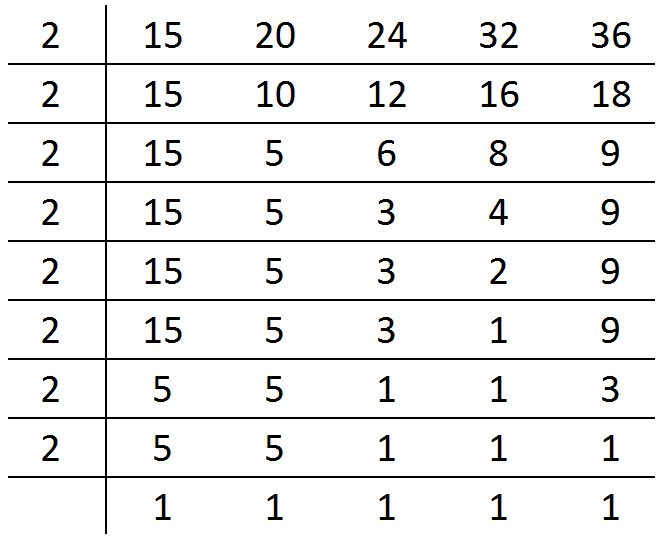
$\therefore LCM$ of $15, 20, 24, 32$ and $36 = 2 \times 2 \times 2 \times 2 \times 2 \times 3 \times 3 \times 5 = 1,440$
Hence, $1,440$ is the least number that is divisible by $15, 20, 24, 32$ and $36.$
View full question & answer→