MCQ 1011 Mark
The $HCF$ of two co-primes is:
AnswerA set of numbers which do not have any other common factor other than $1$ are called co-prime.
View full question & answer→MCQ 1021 Mark
$8 - [28 ÷ \{34 - (36 - 18 ÷ 9 \times 8)\}] = ?$
AnswerGiven expression:
$= 8 - [28 ÷ \{34 - (36 - 18 ÷ 9 × 8)\}] [$Performing division$]$
$= 8 - [28 ÷\{34 - (36 - 2 × 8)\}] [$Performing multiplication$]$
$= 8 - [28 ÷ \{34 - (36 - 16)\}]$
$= 8 - [28 ÷ \{34 - 20\}] [$Removing parentheses$]$
$= 8 - [28 ÷ 14] [$Removing braces$]$
$= 8 - 2$
$= 6 [$Removing square brackets$]$
View full question & answer→MCQ 1031 Mark
Additive identity element of $24$ is:
View full question & answer→MCQ 1041 Mark
The product of a whole number (other than zero) and its successor is:
- ✓
- B
- C
Divisible by $4$
- D
Divisible by $3$
AnswerWe have:
Whole number $= 1$
Successor of $1 = 1 + 1 = 2$
Their product $= 1 \times 2 = 2$
Thus, $2$ is an even number.
View full question & answer→MCQ 1051 Mark
$7589 - ? = 3434$
AnswerCorrect option: C. $4155$
Let $7589 - x = 3434$
Then, $x = 7589 - 3434 = 4155$
View full question & answer→MCQ 1061 Mark
$100 \times 10 - 100 + 2000 ÷ 100 = ?$
AnswerGiven expression:
$= 100 \times 10 - 100 + 2000 ÷ 100$
$= 100 \times 10 - 100 + 20 [$performing division$]$
$= 1000 - 100 + 20 [$performing multiplication$]$
$= 1020 - 100 [$performing addition$]$
$= 920 [$performing subtraction$]$
View full question & answer→MCQ 1071 Mark
Whole numbers are not closed under __________ operation.
AnswerWhen any whole number is divided by another whole number, the result is not always a whole number.
Eg. $2\div 3 = \dfrac {2}{3}=0.666.$ Thus, whole numbers are not closed under division operation.
View full question & answer→MCQ 1081 Mark
The $HCF$ of two co-primes is:
AnswerThe smallest prime number is $2.$
Thus, when we multiply any natural number we will always get an even number.
View full question & answer→MCQ 1091 Mark
The property represented by $a + b = b + a$ is:
AnswerCommutative property of addition: Changing the order of addends does not change the sum.
For example, $a + b = b + a$
View full question & answer→MCQ 1101 Mark
Closure property is applicable to ........ operation of whole numbers.
MCQ 1111 Mark
On dividing a number by $53$ we get $8$ as quotient and $5$ as remainder. The number is:
AnswerDivisor $= 53,$ Quotient $= 8,$ Remainder $= 5$ and Dividend $= ?$
Now, Dividend $=$ Quotient $\times $ Divisor $+$ Remainder
$= 8 \times 53 + 5$
$= 429$
View full question & answer→MCQ 1121 Mark
How many whole numbers are between $437$ and $487?$
AnswerThe whole numbers between $437$ and $487$ are $438, 439, 440, 441, … , 484, 485$ and $486.$ To find the required number of whole numbers,
We need to subtract $437$ from $487$ and then subtract again $1$ from the result.
Thus, there are $(487 - 437) - 1$ whole numbers between $437$ and $487.$
Now, $(487 - 437) - 1$
$= 50 - 1 = 49$
Hence, the correct option is $(b).$
View full question & answer→MCQ 1131 Mark
The predecessor of $1$ in whole numbers is:
AnswerPredecessor of $1 = 1 - 1 = 0$
View full question & answer→MCQ 1141 Mark
The product of the predecessor and successor of an odd natural number is always divisible by:
AnswerThe predecessor of an odd number is an even number.
The successor of an odd number is also an even number.
These two even numbers are two consecutive even numbers, and the product of two consecutive even numbers is always divisible by $8.$
View full question & answer→MCQ 1151 Mark
The additive identity of any rational number is _____.
AnswerThe additive identity property says that if you add a real number to zero or add zero to a real number, then you get the same real number back.
The number zero is known as the identity element.
Then zero $(0)$ is the additive identity of a real number and all rational numbers are real.
Hence, $0$ is the additive identity of rational numbers.
View full question & answer→MCQ 1161 Mark
Every counting number has an infinite number of:
AnswerMultiples are what we get after multiplying the number by any number.
Thus, every counting number has an infinite number of multiples
View full question & answer→MCQ 1171 Mark
The product of the successor and predecessor of $99$ is:
- ✓
$9800$
- B
$9900$
- C
$1099$
- D
$9700$
AnswerCorrect option: A. $9800$
We have:
Successor of $99 = 99 + 1 = 100$
Predecessor of $99 = 99 - 1 = 98$
Their product $= 100 \times 98 = 9800$
View full question & answer→MCQ 1181 Mark
If $a$ is a whole number such that $a + a = a,$ then $a = ?$
AnswerGiven: a is a whole number such that $a + a = a$ If $a = 1,$
then $1+1=2\ne1$
If $a = 2,$ then $2+2=4\ne1$
If $a = 3,$ then $3+3=6\ne1$
View full question & answer→MCQ 1191 Mark
The identity element for addition of whole numbers is ........
Answer The sum of any whole number and $0$ is the number itself.
Therefore, the identity element for addition of whole numbers is $0.$
View full question & answer→MCQ 1201 Mark
$1568 \times 185 - 1568 \times 85 = ?$
- A
$7840$
- B
$15680$
- ✓
$156800$
- D
AnswerCorrect option: C. $156800$
By using the distributive property, we have;
$1568 \times 185 - 1568 \times 85$
$= 1568 \times (185 - 85)$
$= 1568 \times 100$
$= 156800$
View full question & answer→MCQ 1211 Mark
Which of the following does not satisfy closure property for whole numbers$?$
- A
$6 \times 5 = 30$
- B
$4 \times 4 = 16$
- ✓
$5 - 8 = -3$
- D
AnswerCorrect option: C. $5 - 8 = -3$
$ 5$ and $8$ are whole numbers but $-3$ is not a whole number.
View full question & answer→MCQ 1221 Mark
Example of distributive property specific to whole numbers is:
- A
$-2 \times (1 + 10) = (-2 \times 1) + (-2 \times 10)$
- ✓
$(9 + 0) \times 5 = (9 \times 5) + (0 \times 5)$
- C
$12 \times (-2 −8) = (12 \times -2) − (12 \times 8)$
- D
AnswerCorrect option: B. $(9 + 0) \times 5 = (9 \times 5) + (0 \times 5)$
Apart from $B,$ the other options contain a negative sign.
Negative numbers do not belong to whole numbers.
View full question & answer→MCQ 1231 Mark
The whole number which has no predecessor is:
AnswerThe whole number which has no predecessor is $0.$
i.e., $0 - 1 = -1,$ which is not a whole number.
View full question & answer→MCQ 1241 Mark
The difference between successor and predecessor of any number is:
AnswerLet the number is $n$
Then the successor of the number $= n + 1$
and the predecessor of the number $= n − 1$
Difference $= n+1−(n−1)$
$= n + 1 − n + 1$
$= 2$
View full question & answer→MCQ 1251 Mark
What least number should be subtracted from $10004$ to get a number exactly divisible by $12?$
AnswerHere we have to tell what least number should be subtracted from $10004$ to get a number exactly divisible by $12.$
So, we will first divide $10004$ by $12.$
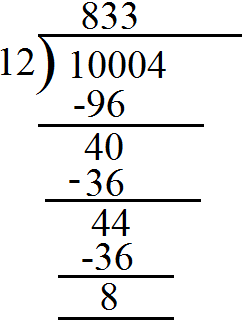
Remainder $= 8$
So, $8$ should be subtracted from $10004$ to get the number exactly divisible by $12.$
i.e., $10004 - 8 = 9996$
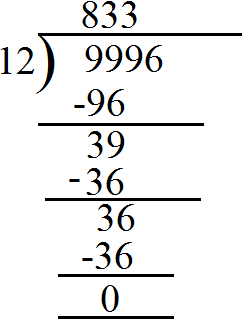
Hence, $9996$ is exactly divisible by $12.$
View full question & answer→MCQ 1261 Mark
Which is equal to $(4 \times 8) + (4 \times 60)?$
- ✓
$4 \times (60 + 8)$
- B
$8 \times (60 + 4)$
- C
$12 \times (60 + 4)$
- D
$16 \times (60 + 8)$
AnswerCorrect option: A. $4 \times (60 + 8)$
The distributive property of multiplication states that a number is multiplied by the sum of two numbers, when the first number can be distributed to both of those numbers and multiplied by each of them separately, then adding the two products together for the same result as multiplying the first number by the sum.
So $(4 \times 8) + (4 \times 60) = 4 \times (8 + 60)$
View full question & answer→MCQ 1271 Mark
The number of whole numbers between the smallest whole number and the greatest $2 -$ digit number is:
AnswerThe smallest whole number is $0$ and the two - digit greatest whole number is $99.$
So the numbers between $0$ and $99$ are $1, 2, ...., 98$
i.e. there are $98$ whole numbers between $0$ and $99.$
View full question & answer→MCQ 1281 Mark
Commutative property for ........... operation holds true in case of whole numbers.
AnswerCommutative property for addition holds true in the case of whole numbers.
For example:
$7 + 4 = 11$
$4 + 7 = 11$
$\Rightarrow 7 + 4 = 4 + 7$
View full question & answer→MCQ 1291 Mark
Simplify using associative property: $(18 + 59) + 1$
Answer$(18 + 59) + 1 = 18 + (59 + 1) ($associative property$)$
$= 18 + 60$
$= 78$
$($Here, to find the result, we avoided $18 + 59,$ which could be time consuming$).$
View full question & answer→MCQ 1301 Mark
Which of the following statements is incorrect?
- A
Whole numbers are closed under addition
- B
Whole numbers are closed under multiplication
- ✓
Whole numbers are closed under subraction
- D
Whole numbers are not closed under subtraction
AnswerCorrect option: C. Whole numbers are closed under subraction
The difference of two whole numbers is not necessarily a whole number. The statement whole numbers are closed under subtraction is an incorrect statement.
View full question & answer→MCQ 1311 Mark
Smallest whole and natural number are respectively ________.
- A
$1, 2$
- ✓
$0, 1$
- C
$2, 1$
- D
$10, 9$
AnswerCorrect option: B. $0, 1$
Smallest whole number is $0$ and natural number is $1$
View full question & answer→MCQ 1321 Mark
The number of whole numbers between $-6$ and $6$ is:
AnswerNumber $-5, -4, -3, -2, -1, 0, 1, 2, 3, 4, 5$ lies between $-6$ and $6.$
Among them $0, 1, 2, 3, 4, 5$ are whole numbers.
$\therefore 6$ whole numbers lies between $-6$ and $6$
View full question & answer→MCQ 1331 Mark
Multiplicative identity of whole number is given by
- ✓
$1$
- B
$0$
- C
Both $0$ and $1$
- D
AnswerThe multiplicative identity property states that any time you multiply a number by $1,$ the result, or product, is that original number.
So it is clear that multiplicative property is given by
View full question & answer→MCQ 1341 Mark
For any two whole numbers, $x$ and $y, x + y = ..........$
AnswerCorrect option: A. $y + x$
Addition of whole numbers is commutative.
So, for any two whole numbers, $x$ and $y, x + y = y + x$
View full question & answer→MCQ 1351 Mark
$133 + 28 \div 7 - 8 \times 2 = ?$
AnswerGiven expression:
$= 133 + 28 \div 7 - 8 \times 2$
$= 133 + 4 - 8 \times 2 [$performing division$]$
$= 133 + 4 - 16 [$performing multiplication$]$
$= 137 - 16 [$performing addition$]$
$= 121 [$performing subtraction$]$
View full question & answer→MCQ 1361 Mark
The product of the predecessor and successor of an even natural number is:
- A
Divisible by $2$
- B
Divisible by $3$
- C
Divisible by $4$
- ✓
AnswerEven natural number $= 2$
Predecessor of $2 = 2 - 1 = 1$
Successor of $2 = 2 + 1 = 3$
Their product $= 1 \times 3 = 3$
Thus, the product is an odd number.
View full question & answer→MCQ 1371 Mark
Find the missing values: $571 + (...... + 394) = (..... + 429) + 394$
- A
$571, 394$
- ✓
$429, 571$
- C
$571, 429$
- D
AnswerCorrect option: B. $429, 571$
Addition is associative for whole numbers
i.e. $a + (b + c) = (a + b) + c$
$\therefore 571 + (429 + 394) = (571 + 429) + 394$
$\therefore$ The missing terms are $429, 571.$
View full question & answer→MCQ 1381 Mark
$\frac{-4}{7} □\frac{0}{9}=\frac{-4}{7}$ then the answer is:
AnswerCorrect option: C. $+$ or $-$
$\frac{-4}{7}+\frac{0}{9}=\frac{-4}{7}$
$\frac{-4}{7}-\frac{0}{9}=\frac{-4}{7}$
Therefore we use both $+$ or $-$
View full question & answer→MCQ 1391 Mark
The smallest whole number is:
AnswerThe smallest whole number is $0.$
View full question & answer→MCQ 1401 Mark
Number of whole numbers between $38$ and $68$ is:
AnswerOption $C$ is rightWhole number starts from $0$ and increase by $1$ each
They are $0, 1, 2, 3...$.
Whole numbers between $39$ and $68$ are
$39, 40, 41... 66, 67$
Hence $29$ whole numbers between $38$ and $68$
View full question & answer→MCQ 1411 Mark
The given below input rearranges step-by-step in particular order according to a set of rules. In this case the last step of arranged input is Step $V.$
Input : $85\ 16\ 36\ 04\ 19\ 97\ 63\ 09$
Step $I$ : $97\ 85\ 16\ 36\ 04\ 19\ 63\ 09$
Step $II$ : $97\ 85\ 63\ 16\ 36\ 04\ 19\ 09$
Step $III$ : $97\ 85\ 63\ 36\ 16\ 04\ 19\ 09$
Step $IV$ : $97\ 85\ 63\ 36\ 19\ 16\ 04\ 09$
Step $V$ : $97\ 85\ 63\ 36\ 19\ 16\ 09 \ 04$
Study the above arrangement carefully and then answer the following question.
Which of the following will be step III for their input below?
Input : $09\ 25\ 16\ 30\ 32\ 18\ 17\ 06$
- ✓
$\text{32 30 25 09 16 18 17 06.}$
- B
$\text{32 30 09 25 16 18 17 06.}$
- C
$\text{32 09 25 16 30 18 17 06.}$
- D
$\text{32 30 09 25 16 19 17 08.}$
AnswerCorrect option: A. $\text{32 30 25 09 16 18 17 06.}$
In every step, the series progresses towards getting its elements arranged in a descending order.
So, in every step, the largest elements of the input come to the front.
Input : $\text{09 25 16 30 32 18 17 06}$
Step $I$ : $\text{32 09 25 16 30 18 17 06}$
Step $II$ : $\text{32 30 09 25 16 18 17 06}$
Step $III$ : $\text{32 30 25 09 16 18 17 06}$
View full question & answer→MCQ 1421 Mark
The successor of $-18$ is:
AnswerSince in succession we move from left to the right on the number line.
And , $-17$ lies on right side of $-18$
Hence, $-17$ is the successor of $-18$
View full question & answer→MCQ 1431 Mark
Mark the correct alternative in the following:
The number of whole numbers between the smallest whole number and between the greatest three digit number is:
Answer The smallest whole number is $0.$
Greatest three digit number $= 999$
The number of whole numbers from $0$ to $999$ is $1000.$
So, the number of whole numbers between $0$ and $999 ($excluding $0$ and $999)$ is $1000 - 2 = 998.$
Hence, the correct option is $(c).$
View full question & answer→MCQ 1441 Mark
The predecessor of $1$ in natural numbers is:
View full question & answer→MCQ 1451 Mark
$(888 + 777 + 555) = (111 \times ?)$
Answer$ (888 + 777 + 555) = (111 \times ?)$
$\Rightarrow (888 + 777 + 555) = 111 \times (8 + 7 + 5) [$by taking $111$ common$]$
$= 111 \times 20 = 2220$
View full question & answer→MCQ 1461 Mark
The number which when divided by $53$ gives $8$ as quotient and $5$ as remainder is:
AnswerHere, Divisor $= 53,$ Quotient $= 8$ and Remainder $= 5.$
Now, using the relation Dividend $=$ Divisor $\times $ Quotient $+$ Remainder
We get Dividend,
$= 53 \times 8 + 5$
$= 424 + 5$
$= 429$
Thus, the required number is $429.$
Hence, the correct option is $(c).$
View full question & answer→MCQ 1471 Mark
........... are not associative for whole numbers.
- A
Addition and multiplication
- B
- C
Multiplication and division
- ✓
AnswerSubtraction and division are not associative for whole numbers, because by changing the order while performing these operations, the result would also change (mostly).
View full question & answer→MCQ 1481 Mark
The smallest natural number is:
MCQ 1491 Mark
Multiplicative identity of whole numbers is ..........
- ✓
$1$
- B
$0$
- C
$2$
- D
Both $A$ and $B$
AnswerMultiplicative identity is a number with which when multiplied should give the result as the same number.
View full question & answer→MCQ 1501 Mark
$\frac{11}{4}$ is a number between:
- A
$1$ and $2$
- ✓
$2$ and $3$
- C
$3$ and $4$
- D
AnswerCorrect option: B. $2$ and $3$
$\frac{11}{4}=2\frac{3}{4}$
So $\frac{11}{4}$ lies between $2$ and $3.$
View full question & answer→