MCQ 1511 Mark
Find the missing values: $52 + (53 + 55) = (..... + ......) + 55$
- A
$55, 52$
- B
$55, 53$
- ✓
$52, 53$
- D
AnswerCorrect option: C. $52, 53$
Addition is associative for whole numbers. i.e. $a + (b + c) = (a + b) + c$
$\therefore 52 + (53 + 55) = (52 + 53) + 55$
$\therefore$ The missing terms are $52, 53.$
View full question & answer→MCQ 1521 Mark
If $a$ and $b$ are any two whole numbers, then the result of ......... is always a whole number:
- A
$a + b$ and $a - b$
- ✓
$a + b$ and $a \times b$
- C
$a \times b$ and $a ÷ b$
- D
AnswerCorrect option: B. $a + b$ and $a \times b$
Whole numbers are closed under addition and multiplication because when any two whole numbers are added or multiplied the result is also a whole number.
View full question & answer→MCQ 1531 Mark
Natural numbers are also known as ...........
Answer$ 1, 2, 3, 4, 5, .....$ are called "natural numbers" and are also known as counting numbers.
View full question & answer→MCQ 1541 Mark
The value of $4 \times 378 \times 25$ is:
- ✓
$37800$
- B
$3780$
- C
$9450$
- D
$30078$
AnswerCorrect option: A. $37800$
By regrouping, we get
$4 \times 378 \times 25 = 4 \times 25 \times 378$
$= 100 \times 378$
$= 37800$
Hence, the correct option is $(a).$
View full question & answer→MCQ 1551 Mark
If two numbers are equal, then:
- ✓
Their $LCM$ is equal to their $HCF.$
- B
Their $LCM$ is less than their $HCF.$
- C
Their $LCM$ is equal to two times their $HCF.$
- D
AnswerCorrect option: A. Their $LCM$ is equal to their $HCF.$
If two numbers are equal, then their $LCM$ is equal to their $HCF.$
View full question & answer→MCQ 1561 Mark
The product of the successor $999$ and predecessor of $1001$ is:
Answer Successor of $999 = 999 + 1 = 1000$
Predecessor of $1001 = 1001 - 1 = 1000$
Now,
Product$ = ($Successor of $999) × ($Predecessor of $1001)$
$= 1000 × 1000$
$= 1000000$
$=$ One million
Hence, the correct option is $ (c).$
View full question & answer→MCQ 1571 Mark
For any two whole numbers a and b which of the following statements is incorrect$?$
AnswerCorrect option: C. $a + b = a \times b$
The sum of any two whole numbers and the product of the same are not necessarily equal.
Eg. $2 + 2 = 4 = 2 \times 2,$ but $3 + 3 = 6$ and $3 \times 3 = 9$ which are not equal.
Rest all options depicts commutative property which whole numbers satisfy.
View full question & answer→MCQ 1581 Mark
Which of the following numbers is a prime number$?$
AnswerSince, factors of,
$91 = 1 \times 7 \times 13$
$81 = 1 \times 3 \times 3 \times 3 \times 3$
$87 = 1 \times 3 \times 29$
$97 = 1 \times 97$
Thus, $81, 87$ and $91$ all are not prime numbers.
View full question & answer→MCQ 1591 Mark
The product of two numbers is $1530$ and their $HCF$ is $15.$ The $LCM$ of these numbers is:
AnswerProduct of two numbers $= HCF$ of two numbers $\times \ LCM$ of two numbers.
$\Rightarrow 1530 = 15 \times LCM$ of two numbers
$\Rightarrow LCM$ of two numbers $= 153015 = 102$
$\Rightarrow 1530 = 15 \times LCM$ of two numbers
$\Rightarrow LCM$ of two numbers $= 153015 = 102$
View full question & answer→MCQ 1601 Mark
The whole number which does not have a predecessor is:
AnswerStep $1$: Check which of these numbers has a predecessor.
Whole numbers are $0, 1, 2, 3...$ and so on.
Predecessor of a number is the number that comes before it.
But since there is no whole number before $0,$ the whole number which does not have a predecessor is $0.$
View full question & answer→MCQ 1611 Mark
The whole number n satisfying $n + 35 = 101$ is:
AnswerHere, $n + 35 = 101.$
Adding $-\ 35$ on both sides, we get
$n + 35 + (-35) = 101 + (-35)$
$n + 0 = 66$
$n = 66$
Hence, the correct option is $(d).$
View full question & answer→MCQ 1621 Mark
Where does the natural numbers ends$?$
AnswerNatural numbers start at $1$ and as we add $1$ to a natural number, we get the next natural number.
So if we keep adding $1,$ we keep getting next natural numbers, so the natural numbers never ends.
View full question & answer→MCQ 1631 Mark
The successor of $1001$ is:
AnswerCorrect option: B. $1002$
Successor of $1001 = 1001 + 1 = 1002$
View full question & answer→MCQ 1641 Mark
$3640 - 14 ÷ 7 \times 2 = ?$
AnswerCorrect option: A. $3636$
Given expression:
$= 3640 - 14 ÷ 7 \times 2$
$= 3640 - 2 \times 2 [$performing division$]$
$= 3640 - 4 [$performing multiplication$]$
$= 3636 [$performing subtraction$]$
View full question & answer→MCQ 1651 Mark
$15 + 5 ÷ 5 \times 2 = ?$
AnswerWe have:
$15 + 5 ÷ 5 \times 2$
$= 15 + 1 \times 2 ($Performing division$)$
$= 15 + 2 ($Performing multiplication$)$
$= 17$
View full question & answer→MCQ 1661 Mark
Identify the number which when multiplied to the number $82,$ gives the same number.
- A
$82$
- B
$0$
- C
$\frac {1}{82}$
- ✓
Answer$1$ is the only number which when multiplied to any number $82,$ gives the same number.
View full question & answer→MCQ 1671 Mark
Which of the following depicts associative property under addition$?$
AnswerCorrect option: C. $a + (b + c) = (a + b) + c$
Associative property for addition states that for any three numbers,
it does not matter which two are added first and then their sum is added to the third integer the final result will be same$\therefore a + (b + c) = (a + b) + c$
View full question & answer→MCQ 1681 Mark
What least number should be added to $10056$ to get a number exactly divisible by $23?$
AnswerHere, we have to tell that what least number must be added to $10056$ to get a number exactly divisible by $23.$
So, first we will divide $10056$ by $23.$
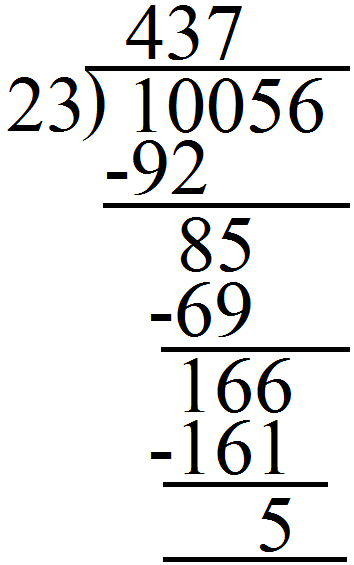
Remainder $= 5$
Required number $= 23 - 5 = 18$
So, $18$ must be added to $10056$ to get a number exactly divisible by $23.$
i.e., $10056 + 18 = 10074$
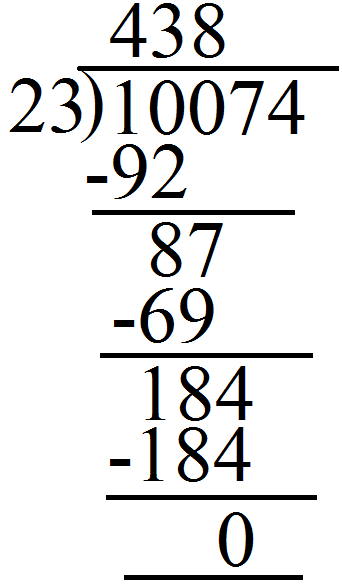
Hence, $10074$ is exactly divisible by $23.$
View full question & answer→MCQ 1691 Mark
Which of the following options defines associative property for whole numbers$?$
- ✓
$0 + (8 + 5) = (0 + 8) + 5$
- B
$0 \times (8 + 5) = (0 + 8) \times 5$
- C
$0 - (8 ÷ 5) = (0 - 8) ÷ 5$
- D
$0 ÷ (8 ÷ 5) = (0 ÷ 8) ÷ 5$
AnswerCorrect option: A. $0 + (8 + 5) = (0 + 8) + 5$
$LHS = 0 + (8 + 5) = 0+ 13 = 13$
$RHS = (0 + 8) + 5 = (0 + 8) + 5 = 13$
$LHS = RHS$
View full question & answer→MCQ 1701 Mark
Which of the following depicts associative law for multiplication$?$
AnswerCorrect option: D. $(a \times b) \times c = a \times (b \times c)$
Associative property for multiplication states that the product of any three or more numbers remains the same irrespective of the order in which the multiplication is carried out.
$\therefore (a \times b) \times c = a \times (b \times c).$
View full question & answer→MCQ 1711 Mark
Select the correct order for defining the following terms:
$i.$ Natural number
$ii.$ imaginary number
$iii.$ rational number
$iv.$ integer
- ✓
$I, IV, III, II$
- B
$I, II, III, IV$
- C
$I, III, II, IV$
- D
$IV, I, III, II$
AnswerCorrect option: A. $I, IV, III, II$
Here natural numbers are subset of integers , integers are subset of rational numbers and
rational numbers are subset of imaginary numbers
Therefore the correct order of defining them is shown in option $A$
View full question & answer→MCQ 1721 Mark
Which of the following numbers cannot be arranged as a rectangle?
MCQ 1731 Mark
Which of the following numbers is not a triangular number$?$
View full question & answer→MCQ 1741 Mark
Which of the following numbers cannot be shown by two rectangles$?$
View full question & answer→MCQ 1751 Mark
First triangular number is
MCQ 1761 Mark
Which of the following numbers can be shown as square?
MCQ 1771 Mark
The number $10$ cannot be shown as a
View full question & answer→MCQ 1781 Mark
The number $6$ cannot be shown as a
View full question & answer→MCQ 1791 Mark
The number $5$ can be arranged as a
View full question & answer→MCQ 1801 Mark
Which of the following is true?
- ✓
The number $2$ can be arranged as a line.
- B
The number $2$ can be arranged as a square.
- C
The number $2$ can be arranged as a triangle.
- D
The number $2$ can be arranged as a rectangle
AnswerCorrect option: A. The number $2$ can be arranged as a line.
The number $2$ can be arranged as a line.
View full question & answer→MCQ 1811 Mark
I purchased $10$ litres of milk in the morning and 5 litres of milk in the evening. If the milk costs $₹ 30$ per litre, how much money will I have to pay to the milkman?
View full question & answer→MCQ 1821 Mark
$‘2 \times (3 + 4) = (2 \times 3) + (2 \times 4)’$ The above is known as
- ✓
distributivity of multiplication over addition
- B
associativity of addition
- C
associativity of multiplication
- D
AnswerCorrect option: A. distributivity of multiplication over addition
distributivity of multiplication over addition
View full question & answer→MCQ 1831 Mark
$‘(2 \times 3) \times 4 = 2 \times (3 \times 4)’ $ The above is known as
- A
commutativity of addition
- B
associativity of addition
- C
commutativity of multiplication
- ✓
associativity of multiplication
AnswerCorrect option: D. associativity of multiplication
commutativity of addition
View full question & answer→MCQ 1841 Mark
$‘(1 + 2) + 3 = 1 + (2 + 3)’$ The above is known as
- A
commutativity of addition
- ✓
associativity of addition
- C
commutativity of multiplication
- D
associativity of multiplication
AnswerCorrect option: B. associativity of addition
associativity of addition
View full question & answer→MCQ 1851 Mark
$‘3 + 5 = 5 + 3’$ The above is known as
- A
$50600, 8500, 7235, 4000$
- ✓
$50600, 8500, 4000, 7200$
- C
$50600, 7235, 8500, 4000$
- D
$50600, 7235, 4000, 8500$
AnswerCorrect option: B. $50600, 8500, 4000, 7200$
$50600, 8500, 4000, 7200$
View full question & answer→MCQ 1861 Mark
Whole numbers are closed under addition and multiplication.’ This property is known as
- ✓
$7500, 2000, 525, 132$
- B
$132, 525, 2000, 7500$
- C
$132, 525, 7500, 2000$
- D
$7500, 2000, 132, 525$
AnswerCorrect option: A. $7500, 2000, 525, 132$
$7500, 2000, 525, 132$
View full question & answer→MCQ 1871 Mark
$1 ÷ 0 =$
View full question & answer→MCQ 1881 Mark
Which of the following will not represent zero?
- ✓
$0 + 1$
- B
$0 × 0$
- C
$0/2$
- D
$(2-2)/2$
AnswerCorrect option: A. $0 + 1$
$0 + 1$
View full question & answer→MCQ 1891 Mark
Find $(24 ÷ 4) – 2.$
View full question & answer→MCQ 1901 Mark
Find $27 ÷ (9 ÷ 3).$
View full question & answer→MCQ 1911 Mark
How many natural numbers are there between $1$ and $10?$
View full question & answer→MCQ 1921 Mark
Which of the following statement is true$?$
AnswerCorrect option: A. The whole number $0$ has no predecessor.
The whole number $0$ has no predecessor.
View full question & answer→MCQ 1931 Mark
Which of the following statement is true$?$
- ✓
$1$ is the smallest natural number.
- B
$50$ is the predecessor of $49.$
- C
$1$ is the smallest whole number.
- D
$599$ is the successor of $600$
AnswerCorrect option: A. $1$ is the smallest natural number.
$1$ is the smallest natural number.
View full question & answer→MCQ 1941 Mark
Which of the following is true$?$
- ✓
$210 > 201$
- B
$210 < 201$
- C
$210 = 201$
- D
AnswerCorrect option: A. $210 > 201$
$210 > 201$
View full question & answer→MCQ 1951 Mark
Which of the following statement is true$?$
AnswerCorrect option: A. All natural numbers are also whole numbers.
All natural numbers are also whole numbers.
View full question & answer→MCQ 1961 Mark
The smallest whole number is
MCQ 1971 Mark
To find the successor of a number, we have to add the number itself.
MCQ 1981 Mark
To find the predecessor of a number, we have to subtract from the number itself.
MCQ 1991 Mark
The difference between the successor and the predecessor of a number is
MCQ 2001 Mark
The difference between the predecessor of a number and the number it self is