Questions

[3 Marks Each] QUE-ANS

🎯

Test yourself on this topic

13 questions · timed · auto-graded

Question 13 Marks
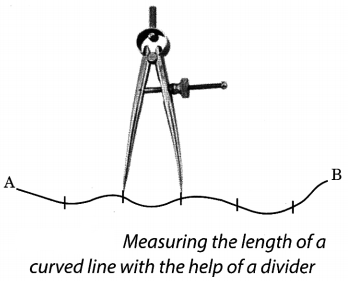
How will you measure the length of any curved line?
Answer
To measure the length of curved lines we have to use divider. Let there be a curved line $AB$. Open the legs of the divider to cover some convenient distance, say $5$ mm. Place one leg of the divider at one end of the curved line. Put the other leg on the line. Now count the number of times the divider has to be taken along the line to cover the entire length of line $AB$. At the end, some portion of line may be left out, being less than the distance between the two legs. Measure it separately by adjusting the divider. Multiply the number of complete steps by the distance between the two legs. Add the length of the remaining distance to this length. You will get the total length of curved line.
View full question & answer
Question 23 Marks
What are different types of motion? Explain with example.
Answer
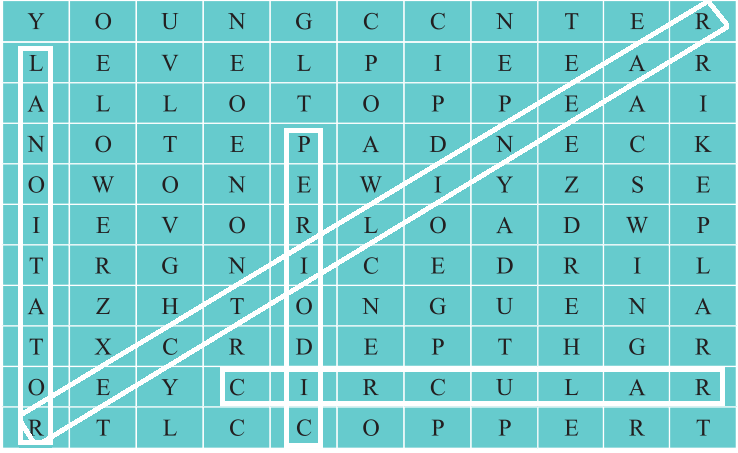
When objects move along a straight line such motion is called rectilinear motion. A sprinter in $100m$ race move along a straight track. This is an example of rectilinear motion. When an object moves in a circular path, such motion is called circular motion.
For example: Motion of a point marked on the blade of an electric fan is a circular motion. An object repeats its motion after some time this, type of motion is called periodic motion.
For example: Motion of a pendulum is a periodic motion.
View full question & answer
Question 33 Marks
Match the events related to motion in Column $I$ with the types of motions given in Column $II$.
S.No.
COLUMN $I$
S.No.
COLUMN $II$
$A.$
A moving wheel of a $(i)$ Sewing machine.
$i.$
Circular motion.
$B.$
Movement of tip of the minute hand of a clock in one hour.
$ii.$
Rotational motion.
$C.$
A moving swing.
$iii.$
Periodic motion.
Answer
S.No.
COLUMN $I$
S.No.
COLUMN $II$
$A.$
A moving wheel of a (i) Sewing machine.
$ii.$
Rotational motion.
$B.$
Movement of tip of the minute hand of a clock in one hour.
$i.$
Circular motion.
$C.$
A moving swing.
$iii.$
Periodic motion.
  1. Rotational motion is a motion in a circular path about a fixed axis.
  2. Circular motion is a motion of an object or a part of it around a fixed point.
  3. Periodic motion is the motion that repeats itself after some period of time.
View full question & answer
Question 43 Marks
Identify the different types of motion in the following word diagram given as Fig.
Answer
The different types of motion in the following word diagram is as given:
View full question & answer
Question 53 Marks
How are the motions of a wheel of a moving bicycle and a mark on the blade of a moving electric fan different? Explain.
Answer
Differences between wheel of moving bicycle and mark on the blade of electric fan are as given:
S.NO.
Wheel of moving bicycle
Mark on the blade of electric fan
$1.$
It executes rectilinear as well as circular motion because the wheel as a whole will move forward and its point or particles around the rim will execute circular motion.
It executes circular motion because the mark on the blade of a fan will move such that its distance from the centre of the fan will remain same.
$2.$
It changes position while executing circular motion.
It cannot change its position.
$3.$
It can cover some distances in any time interval.
It cannot cover any distance.
$4.$
Wheel around its axle executes rotational motion.
It cannot execute rotational motion.
View full question & answer
Question 63 Marks
Three students measured the length of a corridor and reported their measurements. The values of their measurements were different. What could be the reason for difference in their measurements? (Mention any three)
Answer
The reasons may be as follows:
  1. Their scales of measurement may not be standard or they may be using different scales of measurement.
  2. The length of the scale may not be proper, i.e. the length of scale may be shorter than the length they want to measure.
  3. There may be some errors in the scale which they are using or they may not be using the correct method of observing the scale.
View full question & answer
Question 73 Marks
While travelling in a train, it appears that the trees near the track are moving whereas co-passengers appear to be stationary. Explain the reason.
Answer
While travelling, trees near the track seem to be moving back (i.e. opposite to the direction of motion of a train) because there is a relative motion between the outside trees and the moving train.
While in case of co-passengers, the relative motion between us and co-passengers, is zero, so they appear to be stationary.
View full question & answer
Question 83 Marks
Give two examples of periodic motion.
Answer
Examples of periodic motion:
  1. Motion of a pendulum: The bob of a pendulum repeats itself at a certain time period. This motion is called periodic motion.
  2. Motion of a boy sitting on a swing: The motion of a swing repeats itself at a certain time period. Hence, a boy sitting on a swing has periodic motion.
View full question & answer
Question 93 Marks
Four children measure the length of a table which was about $2m$. Each of them used different ways to measure it.
  1. Sam measured it with a half metre long thread.
  2. Gurmeet measured it with a $15 \ cm$ scale from her geometry box.
  3. Reena measured it using her hand span.
  4. Salim measured it using a $5 m$ long measuring tape.
Which one of them would get the most accurate length? Give reason for your answer.
Answer
  1. Salim will measure it most accurately because of the following reasons:
  1. Length $2 m$ which he wants to measure can be measured using this scale only in a single attempt.
  2. This scale is standard scale and will give the correct measurement.
    Other scales given are either non-standard or having the length less than the length we want to measure.
View full question & answer
Question 103 Marks
Describe the method you would use to find the thickness of a sheet of paper of your science book.
Answer
It is not easy to measure the thickness of a single sheet of paper by using metre scale. The method used to find the thickness of a single sheet is as follows:
Take $100$ sheets of paper together. Find their combined thickness by using a centimetre scale. Divide the total thickness by the number of sheets. It is the thickness of a single sheet.
For example: If the thickness of $100$ sheets $= 1.5 \ cm.$
Thickness of a single sheet
$=\frac{\text{Total thickness}}{\text{No. of sheet}}$
$=\frac{1.5}{100}$
$=0.005\text{cm}$
View full question & answer
Question 113 Marks
The height of a person is $1.65m$. Express this in $cm$ and $mm.$
Answer
Height of the person $= 1.65m$
$1m = 100\ cm$
$1.65m = 100 \times 1.65 = 165\ cm$
Hence, the height of the person is $165\ cm.$
Again, $1m = 100\ cm = 1000mm$
Therefore, $1.65m = 1.65 \times 10 = 1650mm$
Hence, the height of the person is $1650mm.$
View full question & answer
Question 123 Marks
Why would you not like to use a measuring tape made of an elastic material like rubber to measure distance? What would be some of the problems you would meet in telling someone about a distance you measured with such a tape?
Answer
An elastic measuring tape is stretchable. It cannot be used to measure distances because the length of the tape may change on stretching. As a result, the measured length would not be correct.
If you measure the length of an object twice using an elastic tape, then you may get different values of the same length each time. This is because elastic tapes are stretchable.
View full question & answer
Question 133 Marks
Write the similarities and differences between the motion of a bicycle and a ceiling fan that has been switched on.
Answer
Similarities between the motion of a bicycle and a ceiling fan:
  1. The blades of a fan and the wheels of a bicycle are fixed at a point.
  2. Both have circular motion about their respective fixed points.
Differences between the motion of a bicycle and a ceiling fan:
  1. A bicycle has linear motion, whereas the blades of a ceiling fan do not have linear motion.
  2. The motion of the blades of a fan is periodic, whereas the motion of a bicycle is rectilinear motion.
View full question & answer