Questions · Page 1 of 4

[1 Marks Each] M.C.Q.

🎯

Test yourself on this topic

50 questions · timed · auto-graded

MCQ 11 Mark
Clouds are:
  • A
    Water vapours as such.
  • B
    Water vapours condensed to tiny droplets of water.
  • Tiny droplets of water and dust particles.
  • D
    All of the above.
Answer
Correct option: C.
Tiny droplets of water and dust particles.
View full question & answer
MCQ 21 Mark
DIRECTIONS: Read the passage (s) given below and answer the questions that/ allow Passage - Apart from drinking, there are so many activities for which we use water. Most of the water is in oceans and seas. We draw drinking water from taps which is further drawn from a well or a lake etc. We need water for which of the following?
  • A
    Baking.
  • B
    Brushing.
  • C
    Cooking.
  • All of these.
Answer
Correct option: D.
All of these.
All of these.
View full question & answer
MCQ 31 Mark
When you see clouds forming in the sky, the water above you is forming droplets in what stage of the water cycle?
  • A
    Collection
  • B
    Evaporation
  • Condensation
  • D
    Precipitation
Answer
Correct option: C.
Condensation
Clouds are formed because of condensation.
View full question & answer
MCQ 41 Mark
We cannot use seawater because:
  • Sea water is salty.
  • B
    Sea water is polluted.
  • C
    Of high cost.
  • D
    Sea water cannot be transported.
Answer
Correct option: A.
Sea water is salty.
Sea water is salty.
View full question & answer
MCQ 51 Mark
A cloud is unable to hold droplets of water because:
  • They become heavier.
  • B
    They become lighter.
  • C
    They undergo condensation slowly.
  • D
    They undergo sublimation.
Answer
Correct option: A.
They become heavier.
In a cloud, the size of the droplets of water increases. They become heavier and fall as rain.
View full question & answer
MCQ 61 Mark
The basic idea behind rain water harvesting is:
  • A
    To harvest water.
  • B
    To harvest crops.
  • To catch water where it falls.
  • D
    All of the above.
Answer
Correct option: C.
To catch water where it falls.
View full question & answer
MCQ 71 Mark
Why is mineral water better than distilled water for drinking?
  • A
    Mineral water is cheap.
  • B
    Mineral water is easily available.
  • Mineral water contains dissolved salts.
  • D
    Mineral water is colorful.
Answer
Correct option: C.
Mineral water contains dissolved salts.
Mineral water contains dissolved salts and it is preferred over distilled water for drinking.
View full question & answer
MCQ 81 Mark
Rain water harvesting refers to:
  • A
    A method of collecting rain water for our immediate daily use.
  • B
    A method of conservation of rains.
  • Collecting rain water for later use.
  • D
    All of the above.
Answer
Correct option: C.
Collecting rain water for later use.
View full question & answer
MCQ 91 Mark
What do we see on the surface of glass containing ice-chilled water?
  • A
    Dust
  • Water droplets
  • C
    Water vapour
  • D
    Ice
Answer
Correct option: B.
Water droplets
Water droplets collect on the outer surface of glass containing ice - chilled water due condensation of water vapour present in the atmosphere.
View full question & answer
MCQ 101 Mark
DIRECTIONS: Read the passage (s) given below and answer the questions that/ allow Passage - Apart from drinking, there are so many activities for which we use water. Most of the water is in oceans and seas. We draw drinking water from taps which is further drawn from a well or a lake etc. Choose the correct option?
  • A
    All of us i'. e., Indians) get drinking water from taps.
  • The water that we get from taps is also drawn from a lake, or a river or a well.
  • C
    Both the above.
  • D
    None of these.
Answer
Correct option: B.
The water that we get from taps is also drawn from a lake, or a river or a well.
View full question & answer
MCQ 111 Mark
Evaporation of sea water:
  • A
    Takes place during day time.
  • B
    Takes place during night time.
  • Takes place throughout day and night.
  • D
    Takes place only during noon.
Answer
Correct option: C.
Takes place throughout day and night.
View full question & answer
MCQ 121 Mark
Why is water useful to life on the earth?
  1. It maintains ecological balance.
  2. It sustains life.
  3. It is necessary for respiration in aquatic organisms.
  • A
    Only $(i)$ and $(ii).$
  • B
    Only $(ii)$ and $(iii)$.
  • C
    Only $(i)$ and $(iii).$
  • $(i), (ii)$ and $(iii).$
Answer
Correct option: D.
$(i), (ii)$ and $(iii).$

Water is useful to life on the earth. To maintain ecological balance, for sustaining life and it is also necessary for respiration in aquatic organisms.

View full question & answer
MCQ 131 Mark
Which of the following combines with water vapour or rain water to form acid rain?
  • A
    Dust.
  • B
    Carbon particles.
  • C
    Oxygen.
  • Sulphur dioxide.
Answer
Correct option: D.
Sulphur dioxide.
Sulphur dioxide in the air combines with water vapour in the atmosphere or rain water to form acid rain i.e., sulphurous acid or sulphuric acid respectively.
View full question & answer
MCQ 141 Mark
Rain water harvesting is a method employed to:
  • A
    Stop soil erosion in a place.
  • Raise the water table of a place.
  • C
    Decrease drought at a place.
  • D
    Decrease floods at a place.
Answer
Correct option: B.
Raise the water table of a place.
Rain water is collected in a special type of arrangement. This water is used which in turn helps to raise the water table of a place.
View full question & answer
MCQ 151 Mark
Purest form of natural water is _________.
  • A
    Seawater.
  • B
    Groundwater.
  • Rainwater.
  • D
    Surface water.
Answer
Correct option: C.
Rainwater.
Rainwater.
View full question & answer
MCQ 161 Mark
The actual source of tap water, supplied by municipal corporation is:
  • A
    River.
  • B
    Lake.
  • C
    Well.
  • All of these.
Answer
Correct option: D.
All of these.
The actual source of tap water is also a river, lake or well.
View full question & answer
MCQ 171 Mark
There are.......... stage of water cycle.
  • A
    $2$
  • B
    $3$
  • $4$
  • D
    $6$
Answer
Correct option: C.
$4$

The stages are evaporation, condensation precipitation and collection.

View full question & answer
MCQ 181 Mark
DIRECTIONS: Read the passage (s) given below and answer the questions that/ allow Passage - If we put some water in a plate and allow the plate to lie in open in sunlight we find that the water from the plate disappears. Moreover even if we keep the plate in shade the water still disappears. The process by which the water disappears from the plate is
  • Evaporation.
  • B
    Condensation.
  • C
    Transpiration.
  • D
    Precipitation.
Answer
Correct option: A.
Evaporation.
Evaporation.
View full question & answer
MCQ 191 Mark
The water cycle is the Earth's way of:
  • A
    Getting rid of water.
  • Recycling water.
  • C
    Using up all of our water.
  • D
    Cleaning our water.
Answer
Correct option: B.
Recycling water.
Water cycle is the cyclic movement of water from the atmosphere to the earth and back to the atmosphere through various processes.
View full question & answer
MCQ 201 Mark
DIRECTIONS: Match Column$-I$ with Column$-II$ and select the correct answer using the codes given below the columns.
S.No.
Column-$I$
S.No.
Column-$II$
$A$
Water cycle.
$(p)$
Solid state of water.
$B$
Hail, snow.
$(q)$
Condensation.
$C$
Water vapour changes to liquid water.
$(r)$
Circulation of water between ocean and land.
$D$
Water enters air.
$(s)$
Transpiration.
  • A
    $A\rightarrow (p); B\rightarrow (q); C\rightarrow (r); D\rightarrow (s).$
  • B
    $A\rightarrow (q); B\rightarrow (r); C\rightarrow (s); D\rightarrow (p).$
  • $A\rightarrow (r); B\rightarrow (p); C\rightarrow (q); D\rightarrow (s).$
  • D
    $A\rightarrow (s); B\rightarrow (q); C\rightarrow (p); D\rightarrow (r).$
Answer
Correct option: C.
$A\rightarrow (r); B\rightarrow (p); C\rightarrow (q); D\rightarrow (s).$
View full question & answer
MCQ 211 Mark
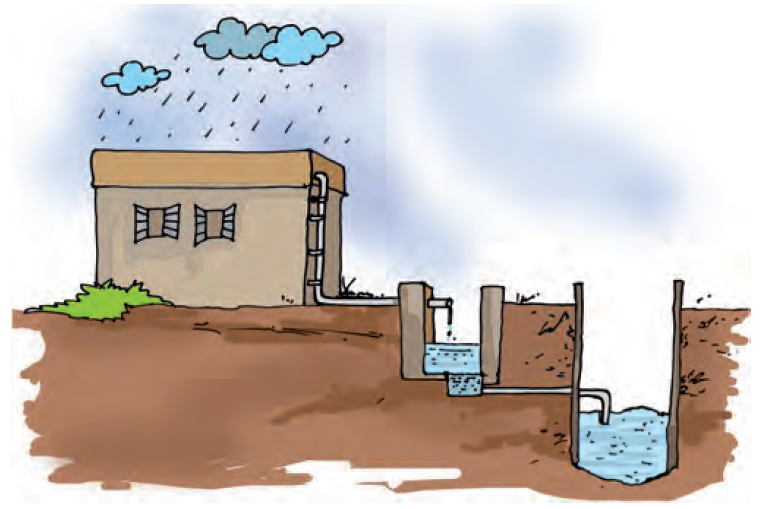
Observe the figure given below and identify the process.
  • A
    Water cycle.
  • B
    Water purification.
  • C
    Water condensation.
  • Rain water harvesting.
Answer
Correct option: D.
Rain water harvesting.
Rain water harvesting is a process of collection of rainwater in cemented pits. The rainwater so collected can be stored under the ground and used for various purposes in future.
View full question & answer
MCQ 221 Mark
Aquatic animals and plants:
  • A
    Have special organs that store oxygen.
  • B
    Have to come out of water to breathe.
  • Use the oxygen dissolved in water for respiration.
  • D
    Use oxygen present in the air.
Answer
Correct option: C.
Use the oxygen dissolved in water for respiration.
Aquatic animals and plants use the oxygen dissolved in water for respiration.
View full question & answer
MCQ 231 Mark
Why is the presence of water vapours in air important?
  • A
    It is important for air to be moist.
  • It is important for water cycle in nature.
  • C
    It is important as plant get their water from this source.
  • D
    None of these.
Answer
Correct option: B.
It is important for water cycle in nature.
View full question & answer
MCQ 241 Mark
Which type of rainfall would be most helpful to farmers?
  • Rainfall that evaporates quickly
  • B
    Rainfall that runs off the land quickly
  • C
    Rainfall that soaks into the soil slowly
  • D
    Very little rainfall
Answer
Correct option: A.
Rainfall that evaporates quickly
Rainfall that soaks into the soil slowly is most helpful to fanners.
View full question & answer
MCQ 251 Mark
A girl saw a water puddle while going to school. In the evening, while returning home, she observed that the puddle disappeared. This was because:
  • A
    The water evaporated.
  • B
    The water seeped into the ground.
  • C
    The water condensed.
  • Both $(a)$ and $(b).$
Answer
Correct option: D.
Both $(a)$ and $(b).$

 The puddle disappeared by evening, because of evaporation and the seepage of water into the ground.

View full question & answer
MCQ 261 Mark
Water vapours enter the air (or atmosphere) by which of the following processes?
  • A
    Evaporation of ocean water.
  • B
    Transpiration occurring in plants.
  • C
    By evaporation of sweat of animals.
  • All of the above.
Answer
Correct option: D.
All of the above.
All of the above.
View full question & answer
MCQ 271 Mark
Which of the following are changed when water boils?
  1. Temperature.
  2. State.
  3. Colour.
  • Only $(i)$ and $(ii).$
  • B
    Only $(ii)$ and $(iii).$
  • C
    Only $(i)$ and $(iii).$
  • D
    $(i), (ii)$ and $(iii)$.
Answer
Correct option: A.
Only $(i)$ and $(ii).$

When water boils, there will be a change in its temperature and state.

View full question & answer
MCQ 281 Mark
DIRECTIONS: Read the passage (s) given below and answer the questions that/ allow Passage - Only a small fraction of water available on the earth is fit for use of plants, animals and humans. The total amount of water on earth remains the same, but the water available for use is very limited and is decreasing with over usage. How is it that total amount of water on earth remains same though it is consumed by us forvario us activities on a large scale?
  • Because of water cycle.
  • B
    Because of transpiration.
  • C
    Because of condensation.
  • D
    Because of water harvesting.
Answer
Correct option: A.
Because of water cycle.
View full question & answer
MCQ 291 Mark
Cloud seeding is a technique that induces rain. What does the process involve?
  • A
    Adopting an agricultural practice that depends on clouds.
  • Introducing particles in clouds to facilitate condensation.
  • C
    Making clouds and placing them in the sky.
  • D
    Scattering clouds to form seed like structures.
Answer
Correct option: B.
Introducing particles in clouds to facilitate condensation.
Cloud seeding is an artificial method of introducing particles in clouds to cause rains by initiating condensation of water vapour present in the clouds.
View full question & answer
MCQ 311 Mark
In a small town, the number of water pumps, concrete houses and roads increased. What happens to the water table of that place?
  • It becomes lower.
  • B
    It becomes higher.
  • C
    It remains unaffected.
  • D
    It first becomes lower and then higher.
Answer
Correct option: A.
It becomes lower.
It becomes lower.
View full question & answer
MCQ 321 Mark
Where does condensation occur in the water cycle?
  • When cloud is forming.
  • B
    When ocean water changes into water vapour.
  • C
    When water flowing down a river.
  • D
    When underground water soaking into rocks and soil.
Answer
Correct option: A.
When cloud is forming.
Clouds are the condensed form of water vapour,
View full question & answer
MCQ 331 Mark
Water is available on the surface of earth in the form of oceans, seas, rivers, ponds, etc. Approximately how much of the earth is covered with water?
  • A
    $\frac13$ part.
  • $\frac23$ part.
  • C
    $\frac12$ part.
  • D
    $\frac14$ part.
Answer
Correct option: B.
$\frac23$ part.

Abut $\frac23$ part of earth is covered with water.

View full question & answer
MCQ 341 Mark
Temporary hardness of water is due to the presence of:
  • Calcium bicarbonate.
  • B
    Sodium carbonate.
  • C
    Potassium carbonate.
  • D
    Magnesium hydride.
Answer
Correct option: A.
Calcium bicarbonate.
The temporary hardness of water is due to the presence of bicarbonates of calcium and magnesium dissolved in it.
View full question & answer
MCQ 351 Mark
In which of the following activities will you use minimum amount of water?
  • A
    Bathing.
  • Brushing teeth.
  • C
    Washing clothes.
  • D
    Mopping a room.
Answer
Correct option: B.
Brushing teeth.
In brushing teeth we use minimum amount of water.
View full question & answer
MCQ 361 Mark
Water in our tap comes from a:
  • A
    River.
  • B
    Lake.
  • C
    Well.
  • River, lake or well.
Answer
Correct option: D.
River, lake or well.
Water in our tap comes from river, lake or well.
View full question & answer
MCQ 371 Mark
DIRECTIONS: Match Column$-I$ with Column$-II$ and select the correct answer using the codes given below the columns.
S.No.
Column-$I$
S.No.
Column-$II$
$A$
Ground water
$(p)$
Excess rains.
$B$
Ocean
$(q)$
Aquifers.
$C$
Clouds
$(r)$
Water containing dissolved salts.
$D$
Floods
$(s)$
Water vapour and dirt.
  • A
    $A \rightarrow (p); B \rightarrow (q); C \rightarrow (r); D \rightarrow (s).$
  • $A \rightarrow (q); B \rightarrow (r); C \rightarrow (s); D \rightarrow (p).$
  • C
    $A \rightarrow (r); B \rightarrow (s); C \rightarrow (p); D \rightarrow (q).$
  • D
    $A \rightarrow (s); B \rightarrow (p); C \rightarrow (q); D \rightarrow (r).$
Answer
Correct option: B.
$A \rightarrow (q); B \rightarrow (r); C \rightarrow (s); D \rightarrow (p).$
View full question & answer
MCQ 381 Mark
In water cycle we studied that water enters in air by some processes. If we say that water vapours that enter the air by process $'A?$ and by $'B',$ gets converted into water droplets which of the following correctly identifies $'A$ and $'B?$
  • A
    $A =$ evaporation $B =$ process of change of water vapours into liquid.
  • B
    $A =$ The process involved in the disappearance of water from plate kept in sunlight, $B =$ The process by which a wheat plant loses water to the atmosphere.
  • C
    $A =$ The process by which forest plants lose water to the atmosphere $B =$ The process involved in the conversion of water vapours to liquid water.
  • $(a)$ and $(c)$ are correct.
Answer
Correct option: D.
$(a)$ and $(c)$ are correct.

$A =$ Evaporation or transpiration, $B =$ Condensation.

View full question & answer
MCQ 391 Mark
Ocean water is highly salt is hand unfit for drinking purposes.
  • A
    Oceans play no role in supply of usable water.
  • Role of oceans in supply of usable water is quite important.
  • C
    Both the above.
  • D
    None of these.
Answer
Correct option: B.
Role of oceans in supply of usable water is quite important.
View full question & answer
MCQ 401 Mark
Why does the water table of a place become lower?
  • A
    When trees are planted.
  • When there is a drought.
  • C
    When there is a cyclone and flood.
  • D
    All of the above.
Answer
Correct option: B.
When there is a drought.
The water table of a place where droughts prolong for a long period of time becomes lower because of lesser water seeping into the ground.
View full question & answer
MCQ 411 Mark
Which of the following is potable water?
  • A glass of water fit for drinking.
  • B
    Water in a pot.
  • C
    Sea water.
  • D
    Water with bacteria and chemicals.
Answer
Correct option: A.
A glass of water fit for drinking.
Water which is fit for drinking is called potable water.
View full question & answer
MCQ 421 Mark
Plants release large amount of water vapour into the atmosphere by the process called:
  • A
    Evaporation
  • B
    Condensation
  • C
    Precipitation
  • Transpiration
Answer
Correct option: D.
Transpiration
Plants release large amount of water vapour into the atmosphere by the process called transpiration.
View full question & answer
MCQ 431 Mark
The process of collecting rain water in huge, cemented pits is called:
  • A
    Storing of water.
  • B
    Filtration of water.
  • C
    Transportation of water.
  • Rain water harvesting.
Answer
Correct option: D.
Rain water harvesting.
The process of collecting rain water in huge cemented pits is called rain water harvesting.
View full question & answer
MCQ 441 Mark
Which natural disaster causes famine?
  • A
    Flood.
  • B
    Earthquake.
  • Drought.
  • D
    All of these.
Answer
Correct option: C.
Drought.
Drought.
View full question & answer
MCQ 451 Mark
Which of the following substances contain water?
  1. Milk.
  2. Blood.
  3. Oil.
  4. Fruits.
  • Only $(i), (ii)$ and $(iv).$
  • B
    Only $(i),(ii)$ and $(iii).$
  • C
    Only $(ii), (iii)$ and $(iv).$
  • D
    Only $(i), (iii)$ and $(iv).$
Answer
Correct option: A.
Only $(i), (ii)$ and $(iv).$

Water is present in a large amount in natural substances like milk, blood and fruits.

View full question & answer
MCQ 461 Mark
Which of the following will be an advantage of inter-linking rivers in India?
  • A
    Lot of people will gain employment.
  • B
    Floods will take place uniformly throughout the country.
  • Water will be distributed uniformly.
  • D
    India will become a technically advanced country.
Answer
Correct option: C.
Water will be distributed uniformly.
The advantage of inter-linking all the rivers in India is to facilitate uniform distribution of water.
View full question & answer
MCQ 471 Mark
Which of the following processes help in transfer of water to air?
  • A
    Evaporation.
  • B
    Condensation.
  • C
    Transpiration.
  • Both $(a)$ and $(c).$
Answer
Correct option: D.
Both $(a)$ and $(c).$
View full question & answer
MCQ 481 Mark
Which one is the purest form of water?
  • A
    River water
  • B
    Groundwater
  • Rainwater
  • D
    Ocean water
Answer
Correct option: C.
Rainwater
Rainwater
View full question & answer
MCQ 491 Mark
Water is:
  • A
    An element.
  • A compound.
  • C
    A mixture.
  • D
    Both $(a)$ and $(c).$
Answer
Correct option: B.
A compound.

Water is a compound because it is made up of a single type of molecules which have two different types of atoms hydrogen and oxygen.

View full question & answer
MCQ 501 Mark
What percentage of water is readily available to us?
  • $3\%.$
  • B
    $97\%.$
  • C
    $60\%.$
  • D
    $40\%.$
Answer
Correct option: A.
$3\%.$
$3\%.$
View full question & answer