Questions · Page 3 of 5

M.C.Q. [I MARKS]

MCQ 1011 Mark
Ordinarily, kerosene oil bums in air with a yellow flame. However, in stoves, it bums with a blue flame. Which of the following statements explains the above observation?
  • Complete combustion of kerosene takes place in stoves.
  • B
    The ignition temperature of kerosene is attained easily in stoves.
  • C
    Stoves are made of iron and kerosene bums with a blue flame in the presence of iron.
Answer
Correct option: A.
Complete combustion of kerosene takes place in stoves.

Ordinarily, kerosene oil burns in air with a yellow flame producing a lot of smoke. However, the stoves are made in such a manner that combustion of kerosene takes place in presence of large amount of oxygen. Thus, complete combustion of kerosene takes place and blue flame is obtained as a result.
View full question & answer
MCQ 1021 Mark
Explosion takes place because of:
  • Release of large amount of gas under pressure due to sudden reaction.
  • B
    Release of large amount of heat.
  • C
    Release of large amount of light.
  • D
    None of the above.
Answer
Correct option: A.
Release of large amount of gas under pressure due to sudden reaction.
View full question & answer
MCQ 1031 Mark
Water cannot be used as fire extinguisher to put out.
  • A
    Burning charcoal.
  • B
    Burning cloth.
  • C
    Burning wood.
  • Burning oil.
Answer
Correct option: D.
Burning oil.
As water is heavier than oil, therefore, it slips down permitting the oil to rise to the surface and continue to burn.
View full question & answer
MCQ 1041 Mark
Liquids and gaseous fuels have more advantages over solid fuels. Some of the advantages are:
$i.$ Calorific value of liquid and gaseous fuels is higher than the solid fuels.
$ii.$ Liquids and gaseous fuels have higher ignition temperatures than the solid fuels.
$iii.$ Liquids and gaseous fuels are easier to store since solid fuels occupy lot of space.
$iv.$ Liquids and gaseous fuels burn completely, leaving no residue.
The correct advantages are:
  • A
    $(i), (ii)$ and $(iii)$
  • $(i), (iii)$ and $(iv)$
  • C
    $(ii), (iii)$ and $(iv)$
  • D
    $(i), (ii)$ and $(iv)$
Answer
Correct option: B.
$(i), (iii)$ and $(iv)$
View full question & answer
MCQ 1051 Mark
Which of the following is not a combustible substance?
  • A
    Camphor
  • Glass
  • C
    Straw
  • D
    Alcohol
Answer
Correct option: B.
Glass

Those substances which do not burn are called non-combustible substance. Some of the non-combustible substances are stone, glass, cement, soil and iron nails etc.

View full question & answer
MCQ 1061 Mark
In combustion:
  • Both heat and light is produced.
  • B
    Only heat is produced.
  • C
    Only light is produced.
  • D
    All are correct.
Answer
Correct option: A.
Both heat and light is produced.
View full question & answer
MCQ 1071 Mark
Like fuel the sun also provides heat and light. The process taking place in the sun is called.
  • A
    Combustion
  • Nuclear process.
  • C
    Burning
  • D
    All of these.
Answer
Correct option: B.
Nuclear process.
Nuclear process.
View full question & answer
MCQ 1081 Mark
If a person’s clothes catch fire the best way to extinguish the fire is to:
  • A
    Throw water on the clothes.
  • B
    Use fire extinguisher.
  • Cover the person with a woolen blanket.
  • D
    Cover the person with a polythene sheet.
Answer
Correct option: C.
Cover the person with a woolen blanket.

Cover the person with a woollen blanket so that the supply of air to the burning clothes is cutoff and hence, the burning of fire stops.

View full question & answer
MCQ 1091 Mark
Why is $L.P.G$, used as domestic fuel, mixed with a strong smelling volatile liquid like mercaptan?
  • A
    For better combustion.
  • B
    For good smell/fragrance.
  • For detection of gas leakage.
  • D
    For higher calorific value.
Answer
Correct option: C.
For detection of gas leakage.

Butane is an odourless gas, so it is mixed with mercaptan such that if the gas leaks in air, it can be easily detected due to its peculiar choking smell and prevents it from explosion.

View full question & answer
MCQ 1101 Mark
If a person’s clothes catches fire, the best way to extinguish the fire is to:
  • A
    Throw water on the clothes.
  • B
    Use fire extinguisher.
  • Cover the person with a woolen blanket.
  • D
    Cover the person with a polythene sheet.
Answer
Correct option: C.
Cover the person with a woolen blanket.
Cover the person with a woollen blanket so that the supply of air to the burning clothes is cut off and hence, the burning (or fire) stops.
View full question & answer
MCQ 1111 Mark
Saumya is writing about “ideal fuel” as ideal fuel is cheap easy to transfer and readily available in the market. Choose in correct sentences written by saumya:
  • A
    It does not produce harmful gases or do not leave any residue after burning.
  • B
    It has a proper ignition temperature.
  • C
    It can burn easily in air at a moderate rate.
  • It has a low calorific value for proper burning.
Answer
Correct option: D.
It has a low calorific value for proper burning.

It has a high calorific value. Hence, it produces a large amount of heat.

View full question & answer
MCQ 1121 Mark
What are the essential requirements for a fire to start and continue?
$i.$ Fuel
$ii.$ Air $($oxygen$)$
$iii.$ Heat
  • A
    Only $(i)$ and $(ii)$
  • B
    Only $(ii)$ and $(iii)$
  • C
    Only $(i)$ and $(iii)$
  • $(i), (ii)$ and $(iii)$
Answer
Correct option: D.
$(i), (ii)$ and $(iii)$
A fire needs fuel, air $($oxygen which supports combustion$)$, and heat to raise the temperature of the fuel beyond ignition temperature.
View full question & answer
MCQ 1131 Mark
The ignition temperature of four substances $I, II, III,$ and $IV$ is $25^\circ C$, $35^\circ C$, $40^\circ C$, and $60^\circ C$ respectively. The substances that will catch fire at $36^\circ C$ are _____$i$_____ and ______$ii$______. The remaining substances can be called _____$iii$_____ at this temperature. The information in which alternative completes the given statements?
  • $i$
    $ii$
    $iii$
    $i$
    $II$
    Non-flammable
  • B
    $i$
    $ii$
    $iii$
    $II$
    $III$
    Non-flammable
  • C
    $i$
    $ii$
    $iii$
    $III$
    $IV$
    Non-flammable
  • D
    $i$
    $ii$
    $iii$
    $IV$
    $I$
    Non-flammable
Answer
Correct option: A.
$i$
$ii$
$iii$
$i$
$II$
Non-flammable
The ignition temperature of a substance is the minimum temperature at which it starts burning. A substance remains non-flammable below its ignition temperature. When substances $I, II, III,$ and $IV$ are heated to $36^\circ C$,only substances $I$ and $II$ will catch fire as their ignition temperatures are below the temperature provided to them. Substances $III$ and $IV$ with a higher ignition temperature will remain non-flammable at this temperature.
View full question & answer
MCQ 1141 Mark
In villages, people use wood as fuel because:
  • A
    It is considered to be an ideal fuel.
  • Of its easy availability and low cost.
  • C
    It is environment friendly.
  • D
    It catches fire easily.
Answer
Correct option: B.
Of its easy availability and low cost.
In villages, people use wood as fuel because of its easy availability and low cost.
View full question & answer
MCQ 1151 Mark
Choose the incorrect statement from the following.
A good fuel is one which:
  • A
    Is readily available.
  • B
    Produces a large amount of heat.
  • Leaves behind many undesirable substances.
  • D
    Burns easily in air at a moderate rate.
Answer
Correct option: C.
Leaves behind many undesirable substances.

A good fuel does not produce any harmful gases or leaves any residue after burning. So, incorrect statement is option $(c)$.

View full question & answer
MCQ 1161 Mark
Sujit was performing an experiment in the laboratory. He collected four substances $I, II, III,$ and $IV$ and kept all of them in contact with air at room temperature. He observed that substance $III$ suddenly bursts into flames. Then, he heated $I, II,$ and $IV$ and found out that while $I$ and $II$ catch fire, substance $IV$ does not. However, substance $IV$ catches fire on prolonged heating. Which substance undergoes spontaneous combustion in Sujit's experiment?
  • A
    $I$
  • B
    $II$
  • $III$
  • D
    $IV$
Answer
Correct option: C.
$III$
Spontaneous combustion is the one in which a substance starts burning without any heat provided to it. In the given experiment, substance $III$ suddenly bursts into flames when kept in contact with air at room temperature. Hence, it represents spontaneous combustion.
View full question & answer
MCQ 1171 Mark
An electric spark is struck between two electrodes placed near each other, inside a closed tank full of petrol. What will happen?
  • A
    Spontaneous combustion of petrol.
  • B
    Explosion.
  • C
    Slow combustion of petrol.
  • Nothing will happen.
Answer
Correct option: D.
Nothing will happen.

A tank filled with petrol implies there is no air/oxygen inside the tank. As there is no supporter of combustion, burning of petrol does not takes place though spark is brought nearer to it.

View full question & answer
MCQ 1181 Mark
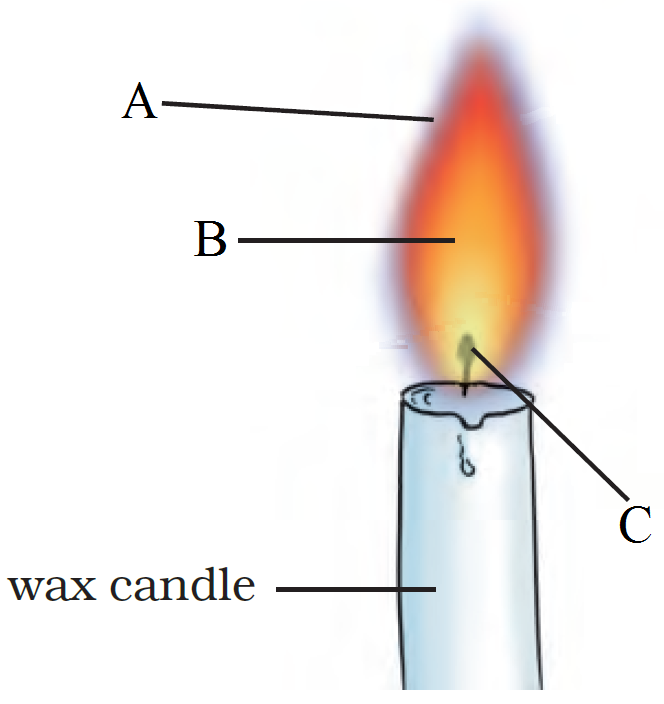
The different zones of a candle flame are marked by the letters $A, B$ and $C$.

Which of the following is correct?
  • A
    $A$ is moderately hot.
  • B
    $C$ is moderately hot.
  • $A$ is the hottest part of the flame.
  • D
    $B$ is the hottest part of the flame.
Answer
Correct option: C.
$A$ is the hottest part of the flame.

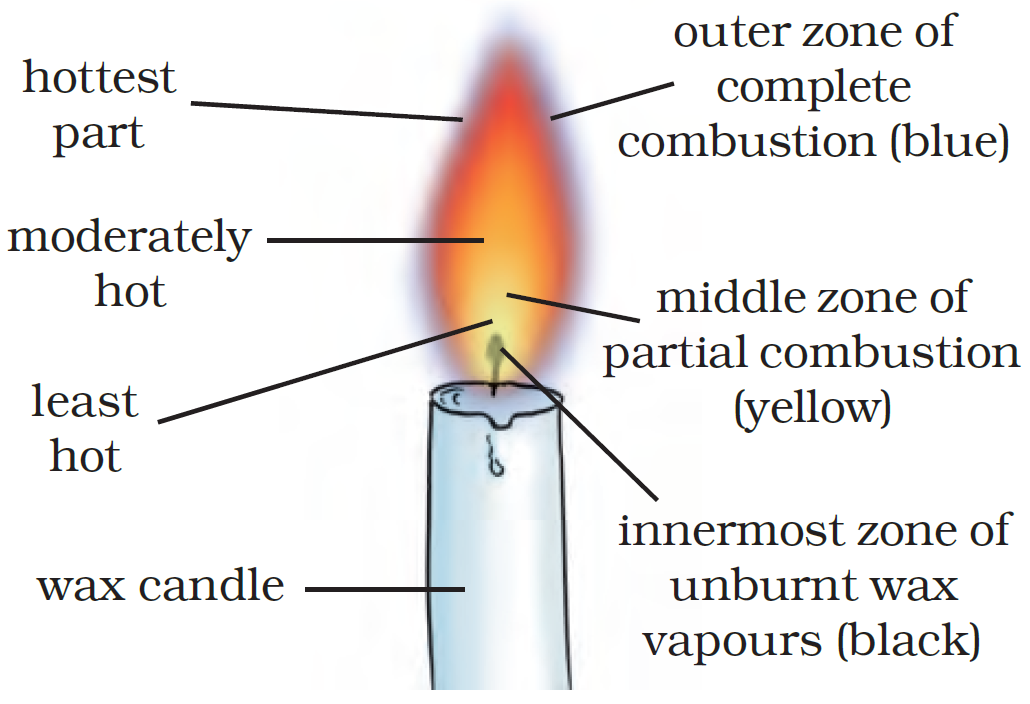
$A$ is the hottest part of the flame since the zone undergoes complete combustion. $B$ undergoes partial combustion and is moderately hot. $C$ is the innermost zone with unburnt wax vapours.

View full question & answer
MCQ 1191 Mark
What are the two main hydrocarbons present in $L.P.G.$?
  • Butane + propane.
  • B
    Butane + isobutene.
  • C
    Propane + ethane.
  • D
    Methane + ethane.
Answer
Correct option: A.
Butane + propane.
$L.P.G.$ is a mixture of hydrocarbons. It consists of butane, propane and ethane but butane and propane are the two major constituents of $L.P.G.$
View full question & answer
MCQ 1201 Mark
Choose the correct statement about inflammable substance from the following:
  • A
    Low ignition temperature and cannot catch fire easily.
  • B
    High condition temperature and can catch fire easily.
  • Low ignition temperature and can catch fire easily.
  • D
    High ignition temperature and cannot catch fire easily.
Answer
Correct option: C.
Low ignition temperature and can catch fire easily.
Inflammable substances have low ignition temperature and can and catch fire easily.
View full question & answer
MCQ 1211 Mark
Global warming leads to a rise in the sea level causing floods in the coastal areas. One of the main reasons of global warming is:
  • A
    Combustion of fuels releases sulphur dioxide which increases the temperature.
  • B
    Combustion of fuels releases carbon monoxide which decreases the temperature.
  • C
    Combustion of fuels releases unburnt carbon particles which causes decrease in temperature.
  • Combustion of fuels releases carbon dioxide which causes increase in temperature.
Answer
Correct option: D.
Combustion of fuels releases carbon dioxide which causes increase in temperature.
Global warming is the increase of earth's average temperature due to significant increase in the level of $CO_2,$ from combustion of fuels.
View full question & answer
MCQ 1221 Mark
The middle zone of a candle flame is also called the zone of ______ combustion.
  • A
    Spontaneous
  • B
    Rapid
  • Partial
  • D
    Complete
Answer
Correct option: C.
Partial

In the middle zone of candle flame, incomplete combustion takes place.

View full question & answer
MCQ 1231 Mark
What is the lowest temperature at which a substance starts burning called?
  • A
    Minimum temperature.
  • Maximum temperature.
  • C
    Boiling temperature.
  • D
    Ignition temperature.
Answer
Correct option: B.
Maximum temperature.

The temperature at which a substance starts burning on heating is called ignition temperature. Highly inflammable substances have a low ignition temperature. Hence, they catch fire easily.

View full question & answer
MCQ 1241 Mark
$CNG$ and $LPG$ are the examples of.
  • A
    Solid fuels.
  • B
    Liquid fuels.
  • Gaseous fuels.
  • D
    They are not fuels.
Answer
Correct option: C.
Gaseous fuels.
Gaseous fuels.
View full question & answer
MCQ 1251 Mark
What does the blue zone in an $L.P.G.$ flame indicate?
  • Unburnt vapours.
  • B
    Partial decomposition.
  • C
    Moderately hot.
  • D
    Hottest zone of complete combustion.
Answer
Correct option: A.
Unburnt vapours.

The blue zone in $L.P.G.$ flame indicates the hottest zone where complete combustion takes place.

View full question & answer
MCQ 1261 Mark
Which of the following has the characteristics of a good fuel?
  • A
    Coke
  • Butane
  • C
    Coal
  • D
    Kerosene
Answer
Correct option: B.
Butane
All the given substances can act as fuels but butane is considered as a good fuel because of the following characteristics:
$i.$ Exists in gaseous state.
$ii.$ Has high calorific value.
$iii.$ Does not form poisonous products during combustion.
View full question & answer
MCQ 1271 Mark
What is the main chemical component present in striking surface of a matchbox?
  • A
    Potassium chlorate
  • Phosphorus
  • C
    Potassium
  • D
    Graphite
Answer
Correct option: B.
Phosphorus

When a matchstick strikes on striking surface of a matchbox, the heat of the friction causes a reaction between the potassium chlorate in the match head and phosphorus in the striking surface.

View full question & answer
MCQ 1281 Mark
Which substance give heat and light after combustion.
  • A
    Flame
  • Fuel
  • C
    Combustion
  • D
    None of these.
Answer
Correct option: B.
Fuel
Fuel
View full question & answer
MCQ 1291 Mark
Global warming is a result of ____$i$_____ percentage of ____$ii$_____ in air. The information in which alternative completes the given statement?
  • $i$-An increased, $ii$-Carbon dioxide.
  • B
    $i$-A decreased, $ii$-Carbon dioxide.
  • C
    $i$-An increased, $ii$-nitrogen.
  • D
    $i$-A decreased, $ii$-nitrogen.
Answer
Correct option: A.
$i$-An increased, $ii$-Carbon dioxide.
  Fuels, on combustion, release carbon dioxide $(CO_2)$ in the environment. As a large amount of fuel is burnt daily to meet our energy needs, the concentration of carbon dioxide in the atmosphere is increasing everyday. This increase in the concentration of carbon dioxide in the atmosphere causes a rise in the temperature of the Earth. This phenomenon is called global warming.
View full question & answer
MCQ 1301 Mark
An ideal fuel is cheap, readily available, easily combustible and easy to transport. It has high calorific value. It does not produce gases or residues that pollute the environment. Based on the above statements which of the following is closest to being an ideal fuel?
  • A
    Kerosene
  • B
    Petrol
  • C
    Coal
  • Compressed Natural Gas $(CNG).$
Answer
Correct option: D.
Compressed Natural Gas $(CNG).$
There is probably no fuel that could be considered as an ideal fuel. We should look for a fuel which fulfils most of the requirements for a particular use. Compressed Natural Gas $(CNG)$ contains methane which doesn't produce a large amount of toxic gases or residue that pollute the environment. It is also easily combustible. Of the given options it is closest to being an ideal fuel.
View full question & answer
MCQ 1311 Mark
Name the chemical process in which a substance reacts with oxygen to give out heat.
  • A
    Reaction
  • B
    Junction
  • Combustion
  • D
    All of these
Answer
Correct option: C.
Combustion
Combustion
View full question & answer
MCQ 1321 Mark
Which of the following substances is non- combustible?
  • A
    Wood
  • B
    Biogas
  • C
    Kerosene oil
  • A piece of stone
Answer
Correct option: D.
A piece of stone
A piece of stone is non-combustible. A substance is defined as non-combustible if it does not react with oxygen to produce heat. A piece of stone does not react with oxygen.
View full question & answer
MCQ 1331 Mark
Which one of the following has the highest calorific value?
  • A
    Kerosene.
  • B
    Biogas.
  • $LPG.$
  • D
    Petrol.
Answer
Correct option: C.
$LPG.$
$LPG$ has the highest calorific value, i.e. $55000 kJ/kg.$
It means that if $1kg$ of $LPG$ is burnt completely, then it will produce $55000$ kilojoules of heat energy.
Note:
Calorific value
$45000 kJ/kg$ $35000$ to $40000 kJ/kg$ $45000 kJ/kg$
View full question & answer
MCQ 1341 Mark
Which of the following does not involve a combustion reaction?
  • A
    Production of heat and light from kerosene in a lantern.
  • B
    Production of heat and light from hydrogen in a rocket.
  • Production of heat and light from hydrogen in the sun.
  • D
    Production of heat and light from wood in a bonfire.
Answer
Correct option: C.
Production of heat and light from hydrogen in the sun.

Production of heat and light from hydrogen in the sun is a nuclear reaction.

View full question & answer
MCQ 1351 Mark
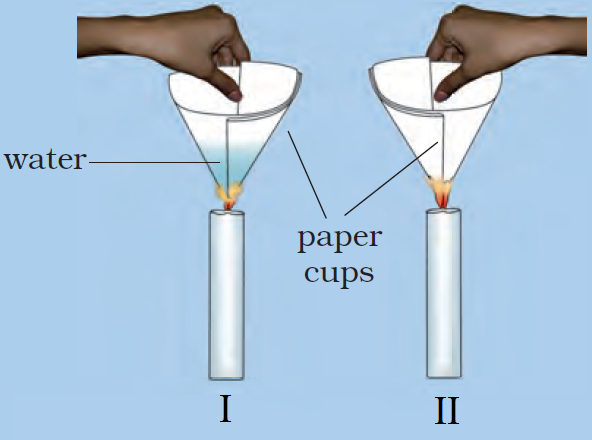
Rajesh made two paper cups $I$ and $II$ by folding a sheet of paper. He pours $50mL$ water in cup $II$, and heats both cups separately with the help of a candle (as shown in the figure). Rajesh observes that while one paper cup burns readily, the other does not burn. He observed that paper cup ____$i$____ does not burn since its ignition temperature was ______$ii$______ while heating.

The information in which alternative completes the given statement?
  • A
    $i-I$, $ii$-reached.
  • B
    $i-II, ii$-reached.
  • C
    $i-I, ii$-not reached.
  • $i-I, ii$-not reached.
Answer
Correct option: D.
$i-I, ii$-not reached.
The ignition temperature of a substance is the minimum temperature at which it starts burning. A substance does not catch fire as long as its temperature is lower than its ignition temperature. In the presence of water, the ignition temperature of paper cup $II$ is not reached. This is because water absorbs all heat and gets converted into water vapours. As a result, paper cup $II$ does not burn.
View full question & answer
MCQ 1361 Mark
If the clothes of a person working in the kitchen catch fire, then to extinguish the fire:
  • A
    Sand should be thrown over the burning clothes.
  • B
    Water should be thrown over the burning clothes.
  • C
    Polyester blanket should be used to cover the burning clothes.
  • Woollen blanket should be used to cover the burning clothes.
Answer
Correct option: D.
Woollen blanket should be used to cover the burning clothes.

If the clothes of a person working in the kitchen catch fire, the person is immediately covered with a blanket. When the burning clothes of a person are covered with a blanket, the supply of air to the burning clothes is cut off and hence the burning stops.

View full question & answer
MCQ 1371 Mark
Which of the following is the best extinguisher for inflammable materials?
  • A
    Water
  • B
    Sulphur dioxide
  • Carbon dioxide
  • D
    Carbon monoxide
Answer
Correct option: C.
Carbon dioxide

Carbon dioxide is the best extinguisher for inflammable materials like petrol, because it is heavier than oxygen, it covers fire like a blanket. Since, the contact between the fuel and oxygen is cut off, the fire is controlled. Secondly, it does not harm the electrical equipment. It can also be used to put out fires involving electrical equipment.

View full question & answer
MCQ 1381 Mark
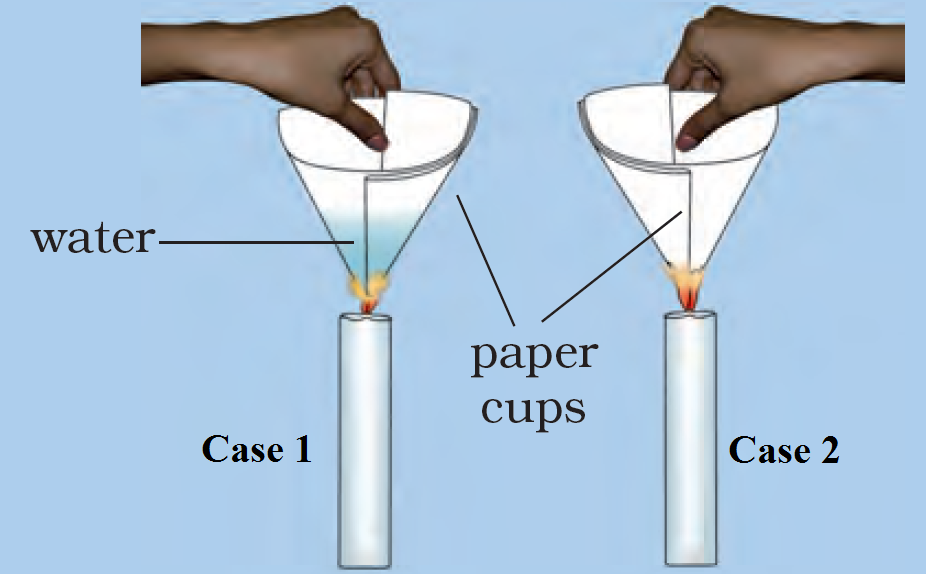
The picture below shows two cases in which a person is trying to burn the paper cup. In case $1$, the cup has water in it and in case $2$, it is empty and dry. Identify in which of the cases the paper will burn.
  • A
    Case $1$
  • B
    Both case $1$ and case $2$
  • C
    The paper doesn't burn in both the cases.
  • Case $2$
Answer
Correct option: D.
Case $2$
In case $2$, the empty paper cup reaches its ignition temperature and catches fire. In case $1$, the heat supplied to the paper cup is transferred to water in it. So, in the presence of water, the ignition temperature of the paper is not reached. So, the paper would not burn in case $1$.
View full question & answer
MCQ 1391 Mark
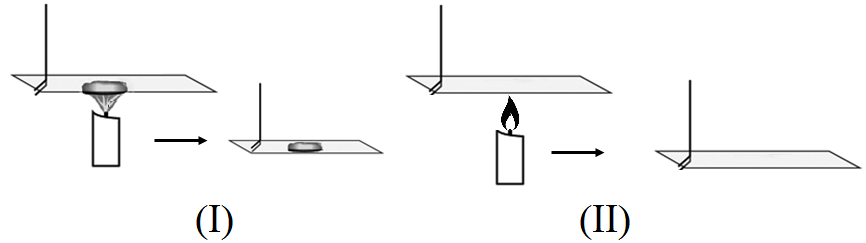
Swati took two glass plates $I$ and $II$. She introduced them to the-different zones of a flame (as shown in the figure). She held them there with a pair of tongs for about $10$ seconds. She observes that a circular-blackish ring has developed on plate I, while no such blackish ring is observed on plate $II$. From Swati's experiment, it can be concluded that ______$i$______ zone is the zone containing unburnt particles, and the ___$ii$___ zone is the zone of complete combustion.

The information in which alternative completes the given statement?
  • A
    $i$-outermost, $ii$-Innermost.
  • $i$-Innermost, $ii$-Outermost.
  • C
    $i$-Innermost, $ii$-Middle.
  • D
    $i$-Middle, $ii$-Innermost.
Answer
Correct option: B.
$i$-Innermost, $ii$-Outermost.
A circular-blackish ring has developed on plate $I$ when it is held near the innermost zone. This indicates that the innermost zone contains unburnt carbon particles. On the other hand, no such ring is observed on plate $II$ when it is held near the outermost zone. This indicates that the outermost zone contains no unburnt particles. Hence, the outermost zone is the zone of complete combustion.
View full question & answer
MCQ 1401 Mark
The given table lists some of the fuels along with their calorific values and ignition temperatures.
Fuel
Calorific value (KJ/ g)
Ignition temperature$({}^\circ c)$
$P$
$100$
$5$
$Q$
$80$
$50$
$R$
$30$
$60$
$S$
$20$
$70$
Which of the following faels is an ideal fuel?
  • A
    $P$
  • $Q$
  • C
    $R$
  • D
    $S$
Answer
Correct option: B.
$Q$
There are several factors which are considered while choosing a fuel.
A good fuel should have high calorific value and a low ignition temperature.
However, the ignition temperature must not be lower than room temperature (so that it does not catch fire at room temperature).
Fuel $Q$ is adequate because it has high calorific value and low ignition temperature.
View full question & answer
MCQ 1411 Mark
Incomplete combustion of fossil fuels releases a gas $'X$?. This gas is poisonous in nature and it bums with a blue flame. Which gas does $X$ represent?
  • A
    Ozone
  • B
    Chlorine
  • C
    Carbon dioxide
  • Carbon monoxide
Answer
Correct option: D.
Carbon monoxide
Incomplete combustion of fossil fuels leads to the formation of carbon monoxide. Carbon monoxide can be poisonous if inhaled in large quantities. It burns with a blue flame.
View full question & answer
MCQ 1421 Mark
One of the following is not a combustible susbtance. This one is:
  • A
    Alcohol
  • B
    Hydrogen
  • Asbestos
  • D
    Chaff
Answer
Correct option: C.
Asbestos
Asbestos is a noncombustible substance and cannot catch fire on its own.
View full question & answer
MCQ 1431 Mark
A person caught fire on clothes is wrapped with blanket because:
  • A
    The person suddenly feels cold.
  • B
    To hide the burnt body parts.
  • C
    The person’s clothes gets burnt.
  • To reduce air supply and put fire off.
Answer
Correct option: D.
To reduce air supply and put fire off.
View full question & answer
MCQ 1441 Mark
Consider the given statements and choose the incorrect one:
  • A
    The immediate burning of cooking gas store is an example of rapid combustion.
  • B
    The burning of white phosphorus is an example of spontaneous combustion.
  • C
    Bursting of crackers is an example of explosive combustion.
  • The spontaneous combustion which take place in nature are less dangerous.
Answer
Correct option: D.
The spontaneous combustion which take place in nature are less dangerous.
The spontaneous combustion which take place in nature are very dangerous.
View full question & answer
MCQ 1451 Mark
The outermost zone of a candle flame is the:
  • A
    Least hot part
  • B
    Coldest part
  • Hottest part
  • D
    Moderately hot part
Answer
Correct option: C.
Hottest part
In the outer zone complete combustion of the fuel takes place and the colour of the flame is blue and is the hottest part of the flame.
View full question & answer
MCQ 1461 Mark
Which of the following statements are true?
$i.$ Yellow flames are ideal for heating.
$ii.$ The substances which vaporise during burning give flames.
$iii.$ Luminous zone contains unburnt carbon particles.
$iv.$ The non$-$luminous zone has highest temperature.
  • A
    $I, II$ and $III$
  • B
    $I, II$ and $IV$
  • $II, III$ and $IV$
  • D
    $I, III$ and $IV$
Answer
Correct option: C.
$II, III$ and $IV$
$II, III$ and $IV$
View full question & answer
MCQ 1471 Mark
A certain gas is used by living organisms for respiration, and this is used in the process of combustion. In the process of combustion, the gas reacts with combustible substances to produce heat. The mentioned gas is:
  • Oxygen
  • B
    Nitrogen
  • C
    Carbon dioxide
  • D
    Carbon monoxide
Answer
Correct option: A.
Oxygen
Oxygen gas is used by human beings and other living organisms for respiration. Combustion is a chemical process in which a combustible substance reacts with oxygen. Heat and sometimes light energy is released during combustion. Hence, the gas mentioned is oxygen.
View full question & answer
MCQ 1481 Mark
$LPG$ means:
  • Liquefied Petroleum Gas
  • B
    Liquefied Petrol Gas
  • C
    Liquid Petrol Godown
  • D
    Liquid Petroleum Gas
Answer
Correct option: A.
Liquefied Petroleum Gas
View full question & answer
MCQ 1491 Mark
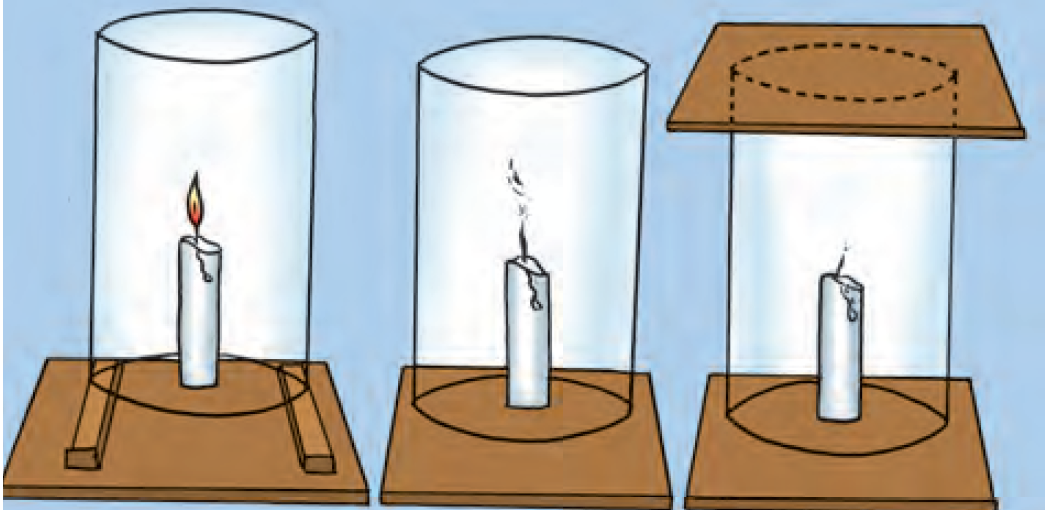
Three candles $X, Y,$ and $Z$ are fixed on a table. A glass chimney is placed over candle $X$, and is rested on wooden blocks in a manner which allows the entrance of oxygen. To candle $Y$, a glass chimney is placed in such a way that it is simply rested on the table. For candle $Z$, a similar arrangement is made along with the placement of a glass plate over the chimney. Candle _____$i$____ bums freely. The flame of candle _____$ii$_____ will flicker off giving smoke, and that of candle _____$iii$_____ will simply go off.

The information in which alternative completes the given statements?
  • $i-X, ii-Y, iii-Z$
  • B
    $i-Z, ii-Y, iii-X$
  • C
    $i-Y, ii-X, iii-Z$
  • D
    $i-Z, ii-X, iii-Y$
Answer
Correct option: A.
$i-X, ii-Y, iii-Z$
CandleXburns freely as air can enter the chimney from below. However, the chimney is placed over candle $Y$ in such a way that it is rested on the table. This means that air does not enter the chimney from below. Thus, the flame of candle $Y$ flickers and produces smoke. On the other hard, the flame of candle $Z$ goes off as air is not available for burning.
View full question & answer
MCQ 1501 Mark
Which one among the following is considered as the cleanest fuel?
  • A
    Cow dung cake.
  • B
    Petrol.
  • C
    Kerosene.
  • Hydrogen gas.
Answer
Correct option: D.
Hydrogen gas.

Hydrogen gas is considered as cleanest fuel. Unlike carbon-based fuels, hydrogen produces no harmful by-products on combustion. Only energy and clean water are produced.

View full question & answer