Questions · Page 4 of 5

M.C.Q. [I MARKS]

MCQ 1511 Mark
Choose the incorrect statement from the following.
Forest fires are usually due to:
  • A
    Carelessness of humans.
  • B
    Cutting of trees.
  • Heat of sun.
  • D
    Lightning strike.
Answer
Correct option: C.
Heat of sun.
Forest fires are not due to cutting of trees,
View full question & answer
MCQ 1521 Mark
The efficiency of a fuel is expressed in terms of its ________.
  • A
    Density
  • B
    Volume
  • Calorific value
  • D
    Purity
Answer
Correct option: C.
Calorific value
Fuel efficiency is expressed in terms of calorific value and its unit is kilojoule per kg. It is the amount of heat produced on complete combustion of $1kg$ of a fuel.
View full question & answer
MCQ 1531 Mark
Which of the following should be done to control fire?
  • Reduce the heat supply.
  • B
    Increase the oxygen supply.
  • C
    Increase fuel supply.
  • D
    Reduce the nitrogen supply.
Answer
Correct option: A.
Reduce the heat supply.

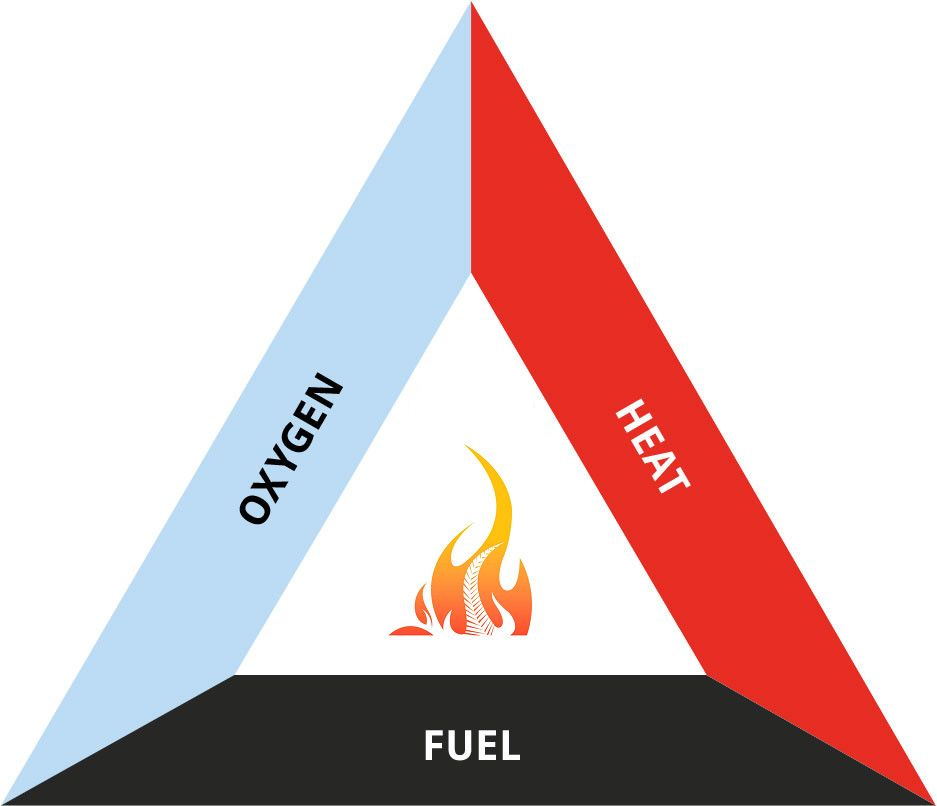
The diagram given represents what is called the fire triangle which shows that oxygen, heat and fuel in the proper proportions are necessary to create a fire. Reducing or eliminating any or all of these properly can help in containing or stopping the fire. So in order to stop a fire,
$i.$ Heat should be reduced $-$ this decreases the temperature of fuel below ignition temperature thus stopping the fire.
$ii.$ Oxygen should be cut off $-$ lack of Oxygen will stop the combustion.
$iii.$ Fuel should be limited $-$ Decreasing the quantity of fuel available for combustion can help contain it.
View full question & answer
MCQ 1541 Mark
The gas that is used in fire extinguishers is
  • A
    Nitrogen
  • B
    Hydrogen
  • C
    Sulphur dioxide
  • Carbon dioxide
Answer
Correct option: D.
Carbon dioxide
Carbon dioxide is an excellent fire extinguisher. It is a non-combustible gas and heavier than air. Hence, carbon dioxide is used in fire extinguishers.
View full question & answer
MCQ 1551 Mark
Which of the following has the highest calorific value?
  • A
    Kerosene
  • B
    Biogas
  • Lpg
  • D
    Petrol
Answer
Correct option: C.
Lpg

Lpg has the highest calorific value $i.e. 55,000kj/ kg$. It means that if $1kg$ of $lpg$ is burnt completely, then it will produce $55,000$ kilojoules of heat energy. Note: fuel calorific value kerosene $45000kj/ kg$ biogas $35000 – 40000kj/ kg$ petrol $45000kj/ kg$.

View full question & answer
MCQ 1561 Mark
Which of the following is not a characteristic of a good fuel?
  • A
    It should be cheap and readily available.
  • B
    It should have a high calorific value.
  • C
    It should be environment friendly.
  • It should bum at a slow rate in air.
Answer
Correct option: D.
It should bum at a slow rate in air.

A good fuel is the one that neither burns at a very fast rate nor burns at a very slow rate. It should burn at a moderate rate in air.

View full question & answer
MCQ 1571 Mark
Which of the following has the highest calorific value?
  • A
    Petrol
  • B
    Coke
  • Natural gas
  • D
    Kerosene
Answer
Correct option: C.
Natural gas
Natural gas has the highest calorific value of $50000kJ/ kg$ Petrol has $45000kJ/ kg$ Kerosene has $4500 kJ/ kg$ and Coke has 28000kJ/ kg.
View full question & answer
MCQ 1581 Mark
Which of the following undergoes spontaneous combustion?
  • A
    Yellow sulphur
  • B
    Red phosphorus
  • White phosphorus
  • D
    Brown sulphur
Answer
Correct option: C.
White phosphorus
White phosphorus undergoes spontaneous combustion. It catches fire on its own at room temperature.
View full question & answer
MCQ 1591 Mark
A substance which reacts with oxygen giving heat is called a combustible substance. Which one of the following is a combustible substance?
  • A
    Iron nail
  • B
    Glass
  • C
    Stone
  • Wood
Answer
Correct option: D.
Wood

Wood is a combustible substance. It is a solid fuel and produces smoke during combustion.

View full question & answer
MCQ 1601 Mark
Which of the following burns without producing a flame?
  • A
    Camphor
  • Coke
  • C
    Cooking gas
  • D
    Kerosene
Answer
Correct option: B.
Coke
Coke does not vapourise during burning and hence do not produce flame.
View full question & answer
MCQ 1611 Mark
Hydrogen is not considered a good fuel because it:
  • A
    Can be liquefied.
  • B
    Is limited in nature.
  • Has very high calorific value.
  • D
    Has very high ignition temperature.
Answer
Correct option: C.
Has very high calorific value.
Hydrogen has the highest calorific value among all the substances found on earth $(150kJ/ g)$. Moreover, it has low ignition temperature. Therefore, when it is ignited, it reacts explosively with oxygen. Thus, it is very unsafe to use and is not considered as a good fuel.
View full question & answer
MCQ 1621 Mark
Read the given statements and select the correct options.
Statement 1: Kerosene oil and wood do not catch fire on their own at room temperature.
Statement 2: A combustible material cannot catch fire as long as its temperature is lower than its ignition temperature.
  • Both statements $1$ and $2$ are true and statement $2$ is the correct explanation of statement $1$.
  • B
    Both statements $1$ and $2$ are true but statement $2$ is not the correct explanation of statement $1$.
  • C
    Statement $1$ is true and statement $2$ is false.
  • D
    Both statements $1$ and $2$ are false.
Answer
Correct option: A.
Both statements $1$ and $2$ are true and statement $2$ is the correct explanation of statement $1$.

Ignition temperature is the lowest temperature at which a combustible substance catches fire.

View full question & answer
MCQ 1631 Mark
A family consumes $12kg$ of $L.P.G.$ in $30$ days. Calculate the average energy consumed per day, if the calorific value of $L.P.G.$ is $50kJ/ kg\ 1$.
  • A
    $10,000J$ per day.
  • B
    $15,000J$ per day.
  • $20,000J$ per day.
  • D
    $25,000J$ per day.
Answer
Correct option: C.
$20,000J$ per day.
Energy released by $12kg$ of $L.P.G.$ in $30$ days = No. of $kg$ of gas utilized by a family in $30$ days calorific value of gas.
$=\frac{12}{30}\times50=20\text{kJ}\text{/ day}.$
Therefore, energy consumed per day: $= 20,000$ joules/ day.
View full question & answer
MCQ 1641 Mark
What is burning of a substance in the presence of air with the evolution of heat called?
  • A
    Distillation
  • B
    Carbonization
  • Combustion
  • D
    Refining
Answer
Correct option: C.
Combustion
The process of a substance burning in the presence of air with evolution of heat is called combustion.
View full question & answer
MCQ 1651 Mark
On a cold winter night, the persons sleeping in a room with closed door and windows with a coal fire burning inside may die due to the excessive accumulation of:
  • A
    Nitrogen monoxide
  • B
    Nitrogen dioxide
  • C
    Carbon dioxide
  • Carbon monoxide
Answer
Correct option: D.
Carbon monoxide
Due to the burning of coal, the available oxygen gets depleted and it leads to incomplete burning of coal. Incomplete combustion of coal gives carbon monoxide gas. It is a very poisonous gas. It is dangerous to burn coal in a closed room. The carbon monoxide gas produced can kill persons sleeping in that closed room.
View full question & answer
MCQ 1661 Mark
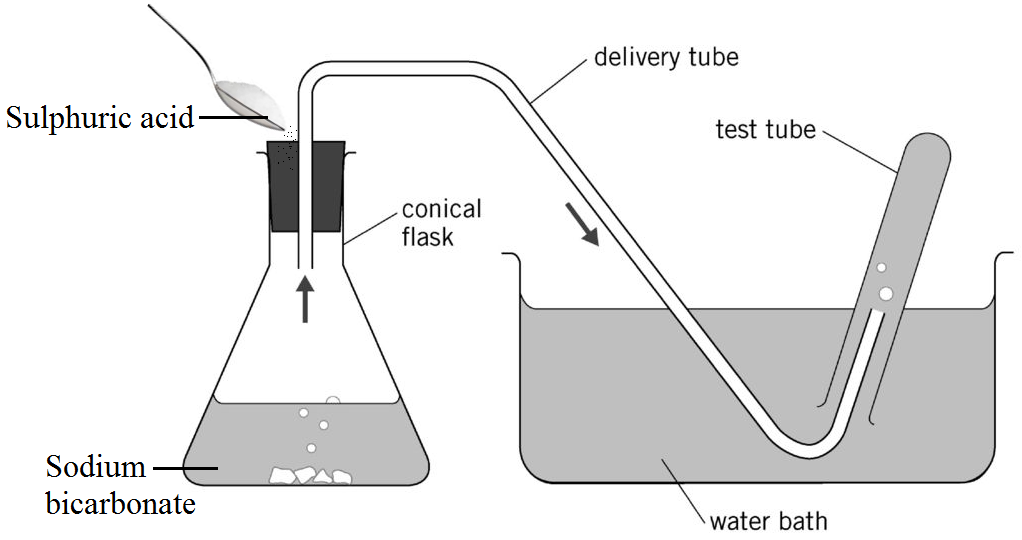
Radhika took some sodium bicarbonate in a conical flask and set up the apparatus as shown in the given diagram. She added cone. Sulphuric acid into the conical flask using a funnel.

Which of the flowing statements is correct for the given experiment?
  • A
    The gas coming out of the delivery tube is heavier than air and will make the candle glow brightly.
  • B
    The gas coming out of the delivery tube is lighter than air and will extinguish the candle.
  • The gas coming out of the delivery tube is heavier than air and will extinguish the candle.
  • D
    The gas coming out of the delivery tube is lighter than air and will make the candle glow brightly.
Answer
Correct option: C.
The gas coming out of the delivery tube is heavier than air and will extinguish the candle.
Carbon dioxide gas is formed when sodium bicarbonate reacts with conc.
Sulphuric acid to produce carbon dioxide $2NaHCO_3+H_2SO_4→Na_2SO_4+2H_2O+2CO_2$ Since carbon dioxide is heavier than air, it starts filling the beaker and slowly reaches the level of the flame. As the gas does not support combustion, the flame is extinguished.
View full question & answer
MCQ 1671 Mark
Read the given statements and select the correct option.
Statement 1: Phosphorus burns in air at room temperature.
Statement 2: It is an example of spontaneous combustion.
  • A
    Both statements $1$ and $2$ are true and statement $2$ is the correct explanation of statement $1$.
  • Both statements $1$ and $2$ are true but statement $2$ is not the correct explanation of statement $1$.
  • C
    Statement $1$ is true and statement $2$ is false.
  • D
    Both statements $1$ and $2$ are false.
Answer
Correct option: B.
Both statements $1$ and $2$ are true but statement $2$ is not the correct explanation of statement $1$.
Phosphorous has a very low ignition temperature (lower than the room temperature) so, it burns rapidly in air at room temperature producing heat and light.
View full question & answer
MCQ 1681 Mark
Natural resources are classified as:
$P.$ Exhaustible.
$Q.$ Inexhaustible.
Some natural resources are:
$I.$ Petrol, diesel.
$II.$ Coal, petroleum.
$III.$ Air, water.
$IV.$ Cow dung cakes, sunlight.
$V.$ Forests, minerals.
Which of the following represents the correct match?
  • A
    $P-(iii), (iv);$
    $Q-(i), (ii), (v)$
  • $P-(i), (ii), (v);$
    $Q-(iii), (iv)$
  • C
    $P-(ii), (v);$
    $Q-(i), (iii), (iv)$
  • D
    None of these is a correct match.
Answer
Correct option: B.
$P-(i), (ii), (v);$
$Q-(iii), (iv)$
 
$P-(i), (ii), (v);$
$Q-(iii), (iv)$
View full question & answer
MCQ 1691 Mark
Ignition temperature is:
  • Lowest temperature at catch fire.
  • B
    Higher temperature at catch fire.
  • C
    Any temperature.
  • D
    None of these.
Answer
Correct option: A.
Lowest temperature at catch fire.
View full question & answer
MCQ 1701 Mark
$CO_2$ extinguishers help extinguish fires by.
  • A
    Cutting supply of nitrogen.
  • B
    Limiting the supply of fuel.
  • Cutting the supply of oxygen.
  • D
    Reducing the heat of surroundings.
Answer
Correct option: C.
Cutting the supply of oxygen.
Carbon dioxide is a non-conductive and non-corrosive gas used to reduce the amount of oxygen available to the fire. It is heavier than air, hence when $CO_2$ extinguishers are used $CO_2$ replaces the air from the surface of fire and thus cuts the supply of oxygen. In this way, it helps in extinguishing the fire.
View full question & answer
MCQ 1711 Mark
For a spontaneous combustion to take place, which condition given below is necessary?
  • A
    Flame.
  • Low ignition temperature.
  • C
    Rise in temperature.
  • D
    Temperature below $30^\circ C$.
Answer
Correct option: B.
Low ignition temperature.

For spontaneous combustion to take place, a substance should have low ignition temperature: e.g., The ignition temperature of phosphorus is $35^\circ\ C$.

View full question & answer
MCQ 1721 Mark
Which one of the following gases is used in combustion?
  • A
    Hydrogen
  • Oxygen
  • C
    Nitrogen
  • D
    Carbon dioxide
Answer
Correct option: B.
Oxygen
Oxygen
View full question & answer
MCQ 1731 Mark
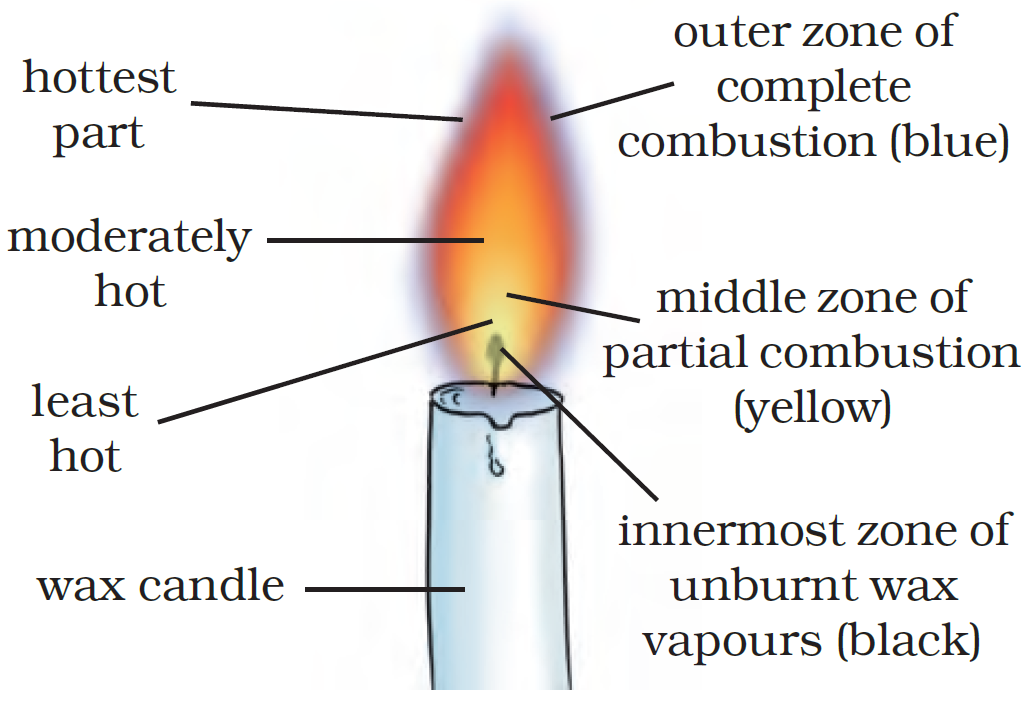
The colour of outer zone of candle flame is _________.
  • A
    Orange
  • B
    Red
  • Blue
  • D
    Yellow
Answer
Correct option: C.
Blue
The outer zone of candle flame is blue in colour. It is where the complete combustion takes place.
View full question & answer
MCQ 1741 Mark
Combustible substances are also known as:
  • Inflammable
  • B
    Flaming
  • C
    Illuminous
  • D
    Non-flammable
Answer
Correct option: A.
Inflammable
Inflammable
View full question & answer
MCQ 1751 Mark
When methane burns in air, what are the products formed?
  • A
    $\text{CO}_2+2\text{H}_2\text{O}+\text{heat}$
  • B
    $\text{CO}_2+\text{H}_2$
  • $\text{CO}+\text{O}_2$
  • D
    $\text{CO}_2+\text{O}_2+\text{heat}$
Answer
Correct option: C.
$\text{CO}+\text{O}_2$
Fuels and hydrocarbons burn in oxygen and form $CO_2+2O_2→CO_2+2H_2O+$heat and give out heat. $CH_4+2O_2→CO_2+2H_2O+$heat
View full question & answer
MCQ 1761 Mark

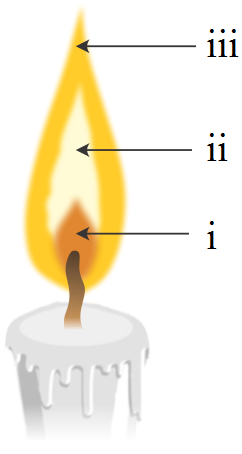
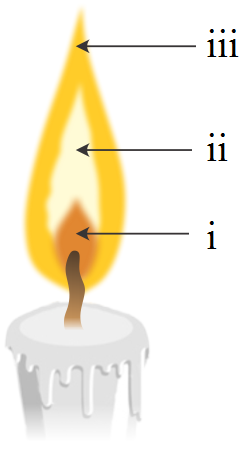
The given figure represents the various zones of a candle flame.

The information in which alternative correctly labels the given figure?
  • A
    $i$
    $Ii$
    $iii$
    Hottest
    Least hot
    Moderately hot
  • $i$
    $ii$
    $iii$
    Hottest
    Moderately hot
    Least hot
  • C
    $i$
    $ii$
    $iii$
    Least hot
    Moderately hot
    Hottest
  • D
    $i$
    $ii$
    $iii$
    Least hot
    Hottest
    Moderately hot
     
Answer
Correct option: B.
$i$
$ii$
$iii$
Hottest
Moderately hot
Least hot
 
A candle flame consists of three zones: the outermost zone, the middle zone, and the innermost zone. The outermost zone of a candle flame is the zone of complete combustion. Therefore, it is the hottest. The middle zone is moderately hot, and the innermost zone only has unburnt wax. Thus, the innermost zone is least hot zone.
View full question & answer
MCQ 1771 Mark
Fires in underground coal mines usually occur due to the:
  • A
    Explosive combustion
  • B
    Deliberate combustion
  • Spontaneous combustion
  • D
    Rapid combustion
Answer
Correct option: C.
Spontaneous combustion

Fires in underground coalmines occur due to spontaneous combustion of coal dust.

View full question & answer
MCQ 1781 Mark
What kind of reaction is combustion?
  • A
    Reduction
  • B
    Redox
  • C
    Substitution
  • Oxidation
Answer
Correct option: D.
Oxidation

Combustion is an oxidation reaction accompanied by heat and light.

View full question & answer
MCQ 1791 Mark
Which of the following statement is or are incorrect?
  • A
    A small fire can be extinguished by throwing sand or soil over it.
  • B
    If the clothes of person working in the kitchen catch fire, the person is immediately covered with a blanket.
  • C
    The combustion reaction in which a large amount of heat and light produced in a short time is called rapid combustion.
  • Any fire needs heat and combustible materials to occur.
Answer
Correct option: D.
Any fire needs heat and combustible materials to occur.
Any fire needs three things to represent will, combustible substance, air (or oxygen) and heat. If any one of these three things is removed, then the burning will stop and fire will be extinguished.
View full question & answer
MCQ 1801 Mark
Ravi collected four different types of fuels $I, II,$ in, and $IV$. He wants to find out which fuel is the most efficient among the fuels he has collected. He bums $1.2kg$ of $I, 4kg$ of $II, 3.2kg$ of $III$, and $2.4kg$ of $IV$ completely. He found out that the heat produced by complete burning of $I, II, III,$ and $IV$ is $7200kJ, 32000kJ, 12800kJ,$ and $16800kJ$ respectively. From this experiment, he concluded that _$i$_ is the most efficient fuel and its calorific value is _$ii$_. The information in which alternative completes the given statement?
  • A
    $i-I, ii-5000kJ/ kg$
  • $i-II, ii-8000kJ/ kg$
  • C
    $i-II, ii-6000kJ/ kg$
  • D
    $i-IV, ii-8000kJ/ kg$
Answer
Correct option: B.
$i-II, ii-8000kJ/ kg$
The calorific value of fuel is the amount of heat energy produced by complete combustion of $1kg$ of fuel.
For fuel I: $1.2kg$ of I produces $7200kJ$ of heat on complete combustion. $1kg$ of I will produce $\frac{7200}{1.2}\text{kJ}$ of heat.
$= 6000kJ$ of heat
Hence, the calorific value of $I$ is $6000kJ/ kg$.
For fuel II: $4kg$ of $II$ produces $32000kJ$ of heat on complete combustion. $1kg$ of $II$ will produce $\frac{32000}{4.0}\text{kJ}$ of heat.
$= 8000kJ$ of heat
Hence, the calorific value of $II$ is $8000kJ/ kg$.
For fuel III: $3.2kg$ of III produces $12800kJ$ of heat on complete combustion. $1kg$ of III will produce $\frac{32000}{4.0}\text{kJ}$ of heat.
$= 4000kJ$ of heat
Hence, the calorific value of $II$ is $4000kJ/ kg$.
For fuel IV: $2.4kg$ of $IV$ produces $16800kJ$ of heat on complete combustion. $1kg$ of $IV$ will produce $\frac{16800}{2.4}\text{kJ}$ of heat.
$= 7000kJ$ of heat
Hence, the calorific value of III is $7000kJ/ kg$.
The higher the calorific value of fuel, the more will be its efficiency.
Here, the calorific value of fuel II is the highest $(8000kJ/ kg)$.
Therefore, amongst the fuels that Ravi collected, II is the most efficient fuel.
View full question & answer
MCQ 1811 Mark
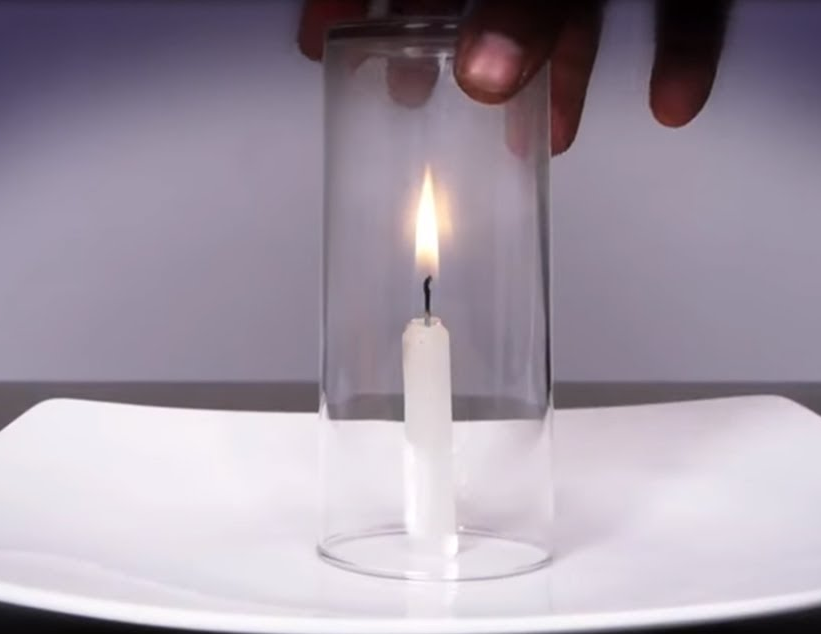
Neha took a burning candle and covered it with an empty glass by putting it upside down. She observed that the candle burns for some time before it finally goes off. What is the reason for this?
  • The candle keeps burning for some time as long as the air present in the glass is available to it and then it goes off.
  • B
    The ignition temperature of the candle becomes low due to glass cover hence it goes off.
  • C
    The candle keeps burning as long as the complete wax melts away and then goes off.
  • D
    Oxygen is produced when the candle burns. This oxygen keeps the candle burning for some time and then it goes off.
Answer
Correct option: A.
The candle keeps burning for some time as long as the air present in the glass is available to it and then it goes off.
For combustion, air is necessary. The flame finally goes off because the air is not available.
View full question & answer
MCQ 1821 Mark
Which of the following is the most environment friendly fuel to be used in automobiles?
  • A
    Petrol
  • B
    Diesel
  • Natural gas
  • D
    Petroleum gas
Answer
Correct option: C.
Natural gas

The use of petrol and diesel as fuels in automobiles is being replaced by $CNG$ because it produces very small amount of harmful gases.

View full question & answer
MCQ 1831 Mark
The unit of calorific value of a fuel is:
  • A
    ${}^\circ C$
  • B
    $L$
  • C
    $m/s$
  • $kJ/kg$
Answer
Correct option: D.
$kJ/kg$
Calorific value is the heat energy produced by the complete combustion of one kg of fuel. Its unit is $kJ/ kg.$
View full question & answer
MCQ 1851 Mark
Mohan is writing some statements, choose the correct statements and help him:
  • A
    When water is thrown on a burning substance it gets cooled below its ignition temperature and stops burning.
  • B
    The fire produced by burning oil (frying pan) and petrol (petrol pumps, oil tanks etc.) Cannot be extinguished by using water.
  • C
    The fire caused by electrical short circuit in an electrical appliance or in electrical wiring should not be extinguished by throwing water.
  • All the above.
Answer
Correct option: D.
All the above.
All the above.
View full question & answer
MCQ 1861 Mark
What is combustion?
  • An exothermic reaction.
  • B
    An endothermic reaction.
  • C
    A displacement reaction.
  • D
    A reduction reaction.
Answer
Correct option: A.
An exothermic reaction.
Combustion is burning of a substance in the presence of oxygen. During this process heat energy is released, it is therefore an oxidation and exothermic reaction.
View full question & answer
MCQ 1871 Mark
When we heat water in a paper bowl over a candle, the paper does not catch fire because:
  • A
    Paper is not inflamable
  • B
    Paper gets wet
  • Due to water the ignition temperature of paper is not reached
  • D
    This is not possible
Answer
Correct option: C.
Due to water the ignition temperature of paper is not reached
View full question & answer
MCQ 1881 Mark
What ignition temperature does an inflammable substance have?
  • A
    More than $100^\circ C$
  • Less than $100^\circ C$
  • C
    More than $200^\circ C$
  • D
    Between $200^\circ C$ to 3$50^\circ C$
Answer
Correct option: B.
Less than $100^\circ C$
Inflammable substances have very low ignition temperatures, so they catch fire easily. e.g., alcohol, ether, carbon disulphide, benzene, synthetic fibres etc.
View full question & answer
MCQ 1891 Mark
Arrange the following fuels in the increasing order of their calorific value.
$i.$  Petrol
$ii.$ Wood
$iii.$ Coal
$iv.$ Natural gas
  • A
    $(i), (ii), (iii), (iv)$
  • B
    $(ii), (iii), (iv)$ and $(i)$
  • C
    $(ii), (i), (iii)$ and $(iv)$
  • $(ii), (iii), (i)$ and $(iv)$
Answer
Correct option: D.
$(ii), (iii), (i)$ and $(iv)$

$i.$ Wood? $17000$ to $22000\ kJ/ \ kg.$
$ii.$ Coal? $25000$ to $33000\ kJ/ \ kg.$
$iii.$ Petrol? $45000\ kJ/ \ kg$.
$iv.$ Natural gas? $50000\ kJ/ \ kg$.
View full question & answer
MCQ 1901 Mark
Which of the following does not represent characteristic of a good fuel?
  • A
    It should have a high calorific value.
  • B
    Its ignition temperature should be low but well above the room temperature.
  • It should have a high rate of combustion.
  • D
    It should be fairly cheap and safe to handle and transport.
Answer
Correct option: C.
It should have a high rate of combustion.
A good fuel should have a moderate rate of combustion and should release heat in a controlled manner.
View full question & answer
MCQ 1911 Mark
Long, long ago, which of the following trees was used to produce matchsticks?
  • A
    Mango
  • B
    Deodar
  • C
    Banyan
  • Pine
Answer
Correct option: D.
Pine
Pine
View full question & answer
MCQ 1921 Mark
Which of the following represents the correct increasing order of calorific value of the given fuels?
  • A
    Hydrogen < $LPG$ < Biogas < Cow dung cake < coal.
  • B
    Cow dung cake < Biogas < $LPG$ < Coal < Hydrogen.
  • Cow dung cake < Coal < Biogas < $LPG$ < Hydrogen.
  • D
    Hydrogen < Cow dung cake < $LPG$ < Biogas < Coal.
Answer
Correct option: C.
Cow dung cake < Coal < Biogas < $LPG$ < Hydrogen.
 
Fuel
Calorific value (kJ/ kg)
Cow dung cake
$6,000 - 8,000$
Coal
$25,000 - 33,000$
Biogas
$35,000 - 40,000$
$LPG$
$55,000$
Hydrogen
$1,50,000$
View full question & answer
MCQ 1931 Mark
Boojho is writing some statements but he confused to know whether the statements are correct or not? Would you help him?
  • A
    Rapid combustion is that type of combustion in which a large amount of heat and light are produced in a short time.
  • B
    Spontaneous is that type of combustion in which reaction occurs on its own without helping of heat.
  • C
    Explosive combustion is that type of combustion in which a large amount of heat, light and sound are produced in very fast way.
  • All the above.
Answer
Correct option: D.
All the above.
All the above.
View full question & answer
MCQ 1941 Mark
What is the heat produced by burning 1 g of fuel completely known as?
  • A
    Heat capacity
  • Calorific value
  • C
    Vapour density
  • D
    Boiling point
Answer
Correct option: B.
Calorific value
Calorific value of a substance is the amount of heat released during the combustion of a specified amount of fuel or food. The calorific value is the characteristic of a substance.
View full question & answer
MCQ 1951 Mark
The head of a matchstick contains a mixture of antimony trisulphide, potassium chlorate, starch, and some glue. For combustion, it is struck against a rough surface made of powdered glass and red phosphorus. Which of the following substances will be the first to get ignited when the match is struck against a rough surface?
  • A
    Antimony trisulphide
  • B
    Potassium chlorate
  • Red phosphorus
  • D
    Powdered glass
Answer
Correct option: C.
Red phosphorus
When a match is struck against a rough surface, red phosphorus attains its ignition temperature through the heat of friction and gets converted into white phosphorous, which immediately reacts with potassium chlorate and antimony trisulphide to start combustion.
View full question & answer
MCQ 1961 Mark
Which of the following gas does not contribute to the formation of acid rain?
  • A
    Nitrogen monoxide.
  • Carbon monoxide.
  • C
    Sulphur dioxide.
  • D
    Nitrogen dioxide.
Answer
Correct option: B.
Carbon monoxide.

Carbon monoxide does not contribute to the formation of an acid rain.

View full question & answer
MCQ 1971 Mark

The following figure represents the different zones of a flame.

The information in which alternative correctly represents the different zones of the flame?
  • A
    $i$
    $ii$
    $iii$
    Zone of complete combustion
    Zone of partial combustion
    Zone of unburnt wax vapours
  • B
    $i$
    $ii$
    $iii$
    Zone of partial combustion
    Zone of unburnt wax vapours
    Zone of complete combustion
  • $i$
    $ii$
    $iii$
    Zone of unburnt Wax vapours
    Zone of partial combustion
    Zone of complete combustion
  • D
    $i$
    $ii$
    $iii$
    Zone of complete combustion
    Zone of partial combustion
    Zone of unburnt Wax vapours
Answer
Correct option: C.
$i$
$ii$
$iii$
Zone of unburnt Wax vapours
Zone of partial combustion
Zone of complete combustion
The candle flame consists of outermost zone, middle zone, and innermost zone. The outermost zone is the zone of complete combustion. It is blue in colour and is the hottest part of the flame. In the middle zone, partial combustion takes place. It appears yellow in colour. This zone is moderately hot. The innermost zone is the zone of unburnt wax. This zone appears black in colour. It is the least hot region of the flame.
View full question & answer
MCQ 1981 Mark
The ignition temperatures of four substances,$ P, Q, R,$ and $S,$ are $125^\circ C$,$270^\circ C$, $155^\circ C$, and $310^\circ C$ respectively. Which of the following pairs of substances catches fire at $250^\circ C$?
  • A
    $Q$ and $S$
  • $P$ and $R$
  • C
    $R$ and $S$
  • D
    $P$ and $Q$
Answer
Correct option: B.
$P$ and $R$
The lowest temperature at which a substance catches fire is called its ignition temperature. A substance burns only when the temperature of the substance is higher than its ignition temperature. The ignition temperatures of $P$ and $R$ are lower than $250^\circ C$. Therefore, $P$ and $R$ will catch fire at $250^\circ C.$
View full question & answer
MCQ 1991 Mark
Which chemical is used in the rubbing surface provided for matchsticks?
  • A
    Sulphur
  • B
    Gold
  • Red phosphorus
  • D
    White phosphorus
Answer
Correct option: C.
Red phosphorus
Red phosphorus
View full question & answer
MCQ 2001 Mark
The following table lists some substances as combustible and non-combustible.
Combustible
Non-combustible
Wood
Glass
Magnesium
Charcoal
Kerosene
Stone
Which of the following substances is listed incorrectly in the table?
  • A
    Glass
  • Charcoal
  • C
    Kerosene
  • D
    Magnesium
Answer
Correct option: B.
Charcoal
Combustion is a chemical process in which a substance reacts with oxygen with the emission of heat. The substances that undergo combustion are called combustible substances and those that do not undergo combustion are called non-combustible substances. Charcoal is a combustible substance. Hence, it is listed incorrectly in the table.
View full question & answer