Questions · Page 1 of 5

M.C.Q. [I MARKS]

🎯

Test yourself on this topic

50 questions · timed · auto-graded

MCQ 11 Mark
Tick the correct answer. The process of conversion of sugar into alcohol is called:
  • A
    Nitrogen fixation.
  • B
    Moulding.
  • Fermentation.
  • D
    Infection.
Answer
Correct option: C.
Fermentation.
Fermentation.
View full question & answer
MCQ 21 Mark
Tick the correct answer. The bread or idli dough rises because of:
  • A
    Heat.
  • B
    Grinding.
  • Growth of yeast cells.
  • D
    Kneading.
Answer
Correct option: C.
Growth of yeast cells.
View full question & answer
MCQ 31 Mark
Tick the correct answer. The most common carrier of communicable diseases is:
  • A
    Ant.
  • Housefly.
  • C
    Dragonfly.
  • D
    Spider.
Answer
Correct option: B.
Housefly.
Housefly.
View full question & answer
MCQ 41 Mark
Tick the correct answer. Carrier of malaria$-$causing protozoan is:
  • Female Anopheles mosquito.
  • B
    Cockroach.
  • C
    Housefly.
  • D
    Butterfly.
Answer
Correct option: A.
Female Anopheles mosquito.
View full question & answer
MCQ 51 Mark
Tick the correct answer. The following is an antibiotic:
  • A
    Sodium bicarbonate.
  • Streptomycin.
  • C
    Alcohol.
  • D
    Yeast.
Answer
Correct option: B.
Streptomycin.
Streptomycin.
View full question & answer
MCQ 61 Mark
Tick the correct answer. Yeast is used in the production of:
  • A
    Sugar.
  • Alcohol.
  • C
    Hydrochloric acid.
  • D
    Oxygen.
Answer
Correct option: B.
Alcohol.
Alcohol.
View full question & answer
MCQ 71 Mark
Boojho wants to know the incorrect sentences about bacteria?
  • A
    Bacteria found in air soil and water.
  • B
    Bacteria are found inside our bodies.
  • C
    Bacteria are larger than viruses.
  • Bacteria cannot feed and respire.
Answer
Correct option: D.
Bacteria cannot feed and respire.
Bacteria can feed and respire. But viruses are the intermediate of living and non-living things. Viruses reproduced when it enters any host body.
View full question & answer
MCQ 81 Mark
Which of the following is the smallest microorganism?
  • A
    Algae
  • B
    Bacterium
  • C
    Protozoan
  • Virus
Answer
Correct option: D.
Virus
Virus is the smallest microorganism.
View full question & answer
MCQ 91 Mark
What does our body produce to fight the invader when a disease-carrying microbe enters our body?
  • A
    Antigens
  • Antibodies
  • C
    Pathogens
  • D
    Antibiotics
Answer
Correct option: B.
Antibodies
(b).
When a disease-carrying microbe enters the human body, the body's immune
cells (white blood cells) produce antibodies to fight the invader.
View full question & answer
MCQ 101 Mark
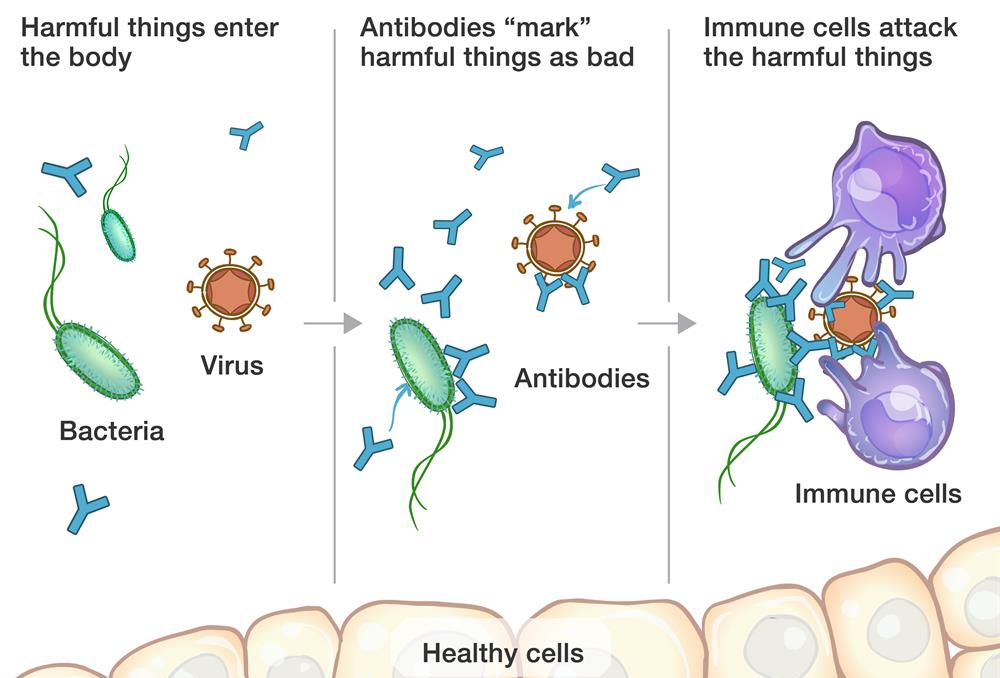
Refer to the given figure showing different steps regarding antibodies fighting against a disease.

Arrange them in a correct sequence.
  • $(ii) → (i) → (iii)$
  • B
    $(i) → (ii) → (iii)$
  • C
    $(i) → (iii) → (ii)$
  • D
    $(iii) → (i) → (ii)$
Answer
Correct option: A.
$(ii) → (i) → (iii)$

 When a disease causing microbe (such as virus) enters body, some white blood cells produce chemicals called antic odies that surround the invader microbe. Once the virus has been surrounded by antibodies the white blood cell eats it.

View full question & answer
MCQ 111 Mark
What process takes place when yeast is added to grape juice and left for a week?
  • A
    Decomposition
  • Fermentation
  • C
    Distillation
  • D
    Oxidation
Answer
Correct option: B.
Fermentation
Fermentation takes place when yeast is added to grape juice and left for a week.
View full question & answer
MCQ 131 Mark
Paheli and boojho discussed a topic of microorganisms. Choose which of the following statements is or are incorrect?
  • A dilute solution of acetic acid is called vinegar.
  • B
    Acetobacter bacteria convert alcohol into acetic acid.
  • C
    Yeast is capable of converting sugar into alcohol.
  • D
    None of the above.
Answer
Correct option: A.
A dilute solution of acetic acid is called vinegar.
all these statements are correct.
View full question & answer
MCQ 141 Mark
Which of the following reproduces only inside a host cell?
  • A
    Bacteria.
  • Virus.
  • C
    Amoeba.
  • D
    Fungus.
Answer
Correct option: B.
Virus.
Virus is a micro organism, which is in an inactive or deal form outside the body of a host.
It reproduces or replicates only when it enters a host and reaches its cells.
View full question & answer
MCQ 151 Mark
A microorganism $X$ is used in the making of bread. It is also used in making which of the following substances?
  • A
    Cheese
  • B
    Vinegar
  • Wine
  • D
    Yoghurt
Answer
Correct option: C.
Wine

$X$ represents yeast cells are useful in preparing wine.

View full question & answer
MCQ 161 Mark
Match column I with column II and select the correct option from the codes given below.
 
Column I
 
Column II
$(a)$
Apple scab
$(i)$
Blue green algae
$(b)$
Flagellum
$(ii)$
Xanthomonas campestris
$(c)$
Nostoc
$(iii)$
Spirogyra
$(d)$
Tooth Paste
$(iv)$
Fungus
$(e)$
Multicellular
$(v)$
Euglena
  • A
    $(a)-(v), (b)-(iv), (c)-(ii), (d)-(i), (e)-(iii)$
  • B
    $(a)-(ii), (b)-(v), (c)-(i), (d)-(iii), (e)-(iv)$
  • $(a)-(iv), (b)-(v), (c)-(i), (d)-(ii), (e)-(iii)$
  • D
    $(a)-(i), (b)-(ii), (c)-(iii), (d)-(iv), (e)-(v)$
Answer
Correct option: C.
$(a)-(iv), (b)-(v), (c)-(i), (d)-(ii), (e)-(iii)$
View full question & answer
MCQ 171 Mark
$..............$ are the agents that act as carriers of a pathogen and spread diseases.
  • A
    Microbes
  • Vectors
  • C
    $\text{DNA}$
  • D
    Parasites
Answer
Correct option: B.
Vectors
Animals or insects carry infecting agents from a sick person to another potential host. These animals are thus the intermediaries and are termed as vectors. The most common vectors are mosquitoes.
View full question & answer
MCQ 181 Mark
Match different organisms in column I with their related characteristics in column II and select the correct option from the codes given below.
 
Column I
 
Column II
$(a)$
Entamoeba histolytica
$(i)$
A brown alga which is a rich source of iodine.
$(b)$
Bacteriophage
$(ii)$
A protozoan that causes disease in human beings by living in the large intestine of humans.
$(c)$
Penicillium
$(iii)$
A virus which infects a bacterial cell.
$(d)$
Fucus
$(iv)$
A fungus used to obtain anti.
  • $(a) - (ii), (b) - (iii), (c) - (iv), (d) - (i)$
  • B
    $(a) - (iii), (b) - (ii), (c) - (iv), (d) - (i)$
  • C
    $(a) - (ii), (b) - (i), (c) - (iii), (d) - (iv)$
  • D
    $(a) - (iv), (b) - (ii), (c) - (i), (d) - (iii)$
Answer
Correct option: A.
$(a) - (ii), (b) - (iii), (c) - (iv), (d) - (i)$
View full question & answer
MCQ 191 Mark
A bacteria undergoes binary fission in every minute. This bacterium can fill up a cup in $1$ hour. In how much time will the cup be half filled?
  • $30$ minutes
  • B
    $59$ minutes
  • C
    $20$ minutes
  • D
    $40$ minutes
Answer
Correct option: A.
$30$ minutes
$59$ minutes
View full question & answer
MCQ 201 Mark
Which one of the following is called pond silk?
  • Spirogyra
  • B
    Volvox
  • C
    Chlamydomonas
  • D
    Euglena
Answer
Correct option: A.
Spirogyra
Spirogyra is called pond silk.
View full question & answer
MCQ 211 Mark
Study the given correlation.
Heat treatment : Sterilisation : : Vaccination : $X$
Here, $X$ refers to
  • A
    Pasteurisation
  • Immunisation
  • C
    Fertilisation
  • D
    Inoculation.
Answer
Correct option: B.
Immunisation

As sterilisation is obtained through heat treatment, similarly immunisation is obtained through vaccination.

View full question & answer
MCQ 221 Mark
The status of algae in the aquatic food chain is:
  • A
    Consumers
  • Producers
  • C
    Host
  • D
    Small in size
Answer
Correct option: B.
Producers
Producers
View full question & answer
MCQ 231 Mark
The gas released during the preparation of bread is:
  • A
    Oxygen.
  • Carbon dioxide.
  • C
    Nitrogen.
  • D
    Sulphur dioxide.
Answer
Correct option: B.
Carbon dioxide.
B.  Carbon dioxide.
Explanation:
Carbon dioxide $(CO_2)$ is released during the preparation of bread. This is the process of fermentation in which yeast cells rapidly produces $CO2,$ which causes resining of the dough used in preparation of bread.
View full question & answer
MCQ 241 Mark
Robert koch discovered the bacillus anthracis in $1876$ which cause anthrax $($a dangerous human and cattle$)$ disease caused by:
  • A
    Virus
  • B
    Fungi
  • Bacteria
  • D
    Protozoa
Answer
Correct option: C.
Bacteria
Bacillus anthracis is an aerobic spore$-$forming bacterium that causes disease in humans and animals. The bacteria is found in two forms: cutaneous anthrax and inhalation anthrax. Cutaneous anthrax is an infection of the skin caused by direct contact with the bacterium.
View full question & answer
MCQ 251 Mark
Consider the following sentences and choose the correct statements.
  • A
    Edward jenner is known for his role in identification of the causing agent of anthrax.
  • B
    Robert koch discovered the vaccine for smallpox in $1798.$
  • Louis pasteur discovered fermentation in $1857$ by demonstrating the microbes cause souring of milk.
  • D
    All the above.
Answer
Correct option: C.
Louis pasteur discovered fermentation in $1857$ by demonstrating the microbes cause souring of milk.

 Robert coach is known for his role in identification of the causing agent of anthrax. Edward jenner is known as father of immunology. He discovered the vaccine for smallpox in $1798.$ Louis pasteur discovered fermentation in $1857$ by demonstrating the microbes cause souring of milk.

View full question & answer
MCQ 261 Mark
Which microorganism causes $\text{AIDS}?$
  • A
    A protozoa
  • B
    A bacteria
  • A virus
  • D
    An algae
Answer
Correct option: C.
A virus
A virus
View full question & answer
MCQ 271 Mark
How many among the following are fungal diseases in plants$?$
F curl of cotton, Rust of wheat, Tobacco mosaic disease, Loose smut of wheat, Leaf curl of tomatoCitrus canker, Late blight of potato, Mosaic disease of mustard, Downy mildew of grapes, Lea.
  • A
    $6$
  • B
    $7$
  • $4$
  • D
    $5$
Answer
Correct option: C.
$4$

 Late blight of potato, downy mildew of grapes, rust of wheat and loose smut of wheat are fungal diseases.


View full question & answer
MCQ 281 Mark
Microorganism is used for the production of medicines and vaccines. Thus, they are the source of antibiotics. The first ever antibiotics was made by Alexander Fleming in $1929$. Which one of the following antibiotics was first made by him?
  • A
    Streptomycin
  • B
    Tetracycline
  • Penicillin
  • D
    Erythromycin
Answer
Correct option: C.
Penicillin
Penicillin
View full question & answer
MCQ 291 Mark
Scientist who discovered fermentation is:
  • A
    Alexander Fleming
  • Louis Pasteur
  • C
    John Mendal
  • D
    Edward Jenner
Answer
Correct option: B.
Louis Pasteur
Louis Pasteur
View full question & answer
MCQ 301 Mark
It is the first ever plant cell that developed close associations with the fungi. It is also the first plant, which have the genetic fusion of two. Identify the figure given below:
  • A
    Lichens
  • Moss
  • C
    Ordovician
  • D
    Silurian
Answer
Correct option: B.
Moss
View full question & answer
MCQ 311 Mark
Fungus can be seen with a:
  • A
    Microscope
  • B
    Telescope
  • C
    Magnifying glass
  • Both $(a)$ and $(c)$
Answer
Correct option: D.
Both $(a)$ and $(c)$
View full question & answer
MCQ 321 Mark
Which among the following pathogen causes cholera?
  • A
    Fungus
  • B
    Protozoan
  • C
    Virus
  • Bacteria
Answer
Correct option: D.
Bacteria
Cholera is caused by a bacteria. It spreads through contaminated food and water. It can be prevented by consuming properly cooked food and drinking boiled water.
View full question & answer
MCQ 331 Mark
Identify the given microorganism and select the incorrect statement regarding it.
  • A
    It is a saprophyte commonly called as black bread mould.
  • B
    It reproduces by means of spores.
  • C
    It results in the spoilage of food materials.
  • It is a parasitic fungus that causes various diseases in plants, animals and humans.
Answer
Correct option: D.
It is a parasitic fungus that causes various diseases in plants, animals and humans.
View full question & answer
MCQ 341 Mark
Alcohol is produced with the help of:
  • A
    Sodium chloride.
  • Yeast
  • C
    Nitrogen
  • D
    Carbon dioxide.
Answer
Correct option: B.
Yeast
Yeast
View full question & answer
MCQ 351 Mark
Which one of the following is not a method of food preservation$?$
  • A
    Pickling
  • B
    Salting
  • C
    Drying
  • Boiling
Answer
Correct option: D.
Boiling
 Boiling food in water cannot completely destroy all microorganisms. Only the cells of bacteria, yeasts and moulds can be destroyed at temperatures of $100^\circ C$ or above. Moreover, it doesn't preserve the food. The most commonly used food preservation methods are salting, drying, freezing and pickling.
$i.$ Salting is the preservation of food with dry edible salt.
$ii.$ Drying or dehydrating food is a method of food preservation that removes enough moisture from the food so that bacteria, yeast and moulds cannot grow.
$iii.$ Freezing, in food processing, is a method of preserving food by lowering the temperature to inhibit microorganism growth.
$iv.$ Pickling is the process of preparing food by soaking and storing it in a salt solution, vinegar or both.
View full question & answer
MCQ 361 Mark
A plant disease called citrus canker is caused by a:
  • A
    Fungi
  • B
    Protozoa
  • C
    Virus
  • Bacteria
Answer
Correct option: D.
Bacteria
Citrus canker is a plant disease caused by a bacteria. It's mode of transmission is through air.
View full question & answer
MCQ 371 Mark
Substance used to produce immunity against diseases in the living body is called:
  • A
    Immune
  • Vaccine
  • C
    Antibody
  • D
    Antigen
Answer
Correct option: B.
Vaccine
Vaccine
View full question & answer
MCQ 381 Mark
Poliomyelitis is responsible virus for polio. Who discovered polio vaccine$?$
  • A
    Louis pasteur
  • Jonas salk
  • C
    Robert koch
  • D
    None of the above
Answer
Correct option: B.
Jonas salk

 An inactivated (killed) polio vaccine (ipv) developed by dr. Jonas salk and first used in $1955,$ and. A live attenuated (weakened) oral polio vaccine (opv) developed by dr. Albert sabin and first used in $1961.$

View full question & answer
MCQ 391 Mark
What causes the dough to rise when yeast is added to it?
  • A
    An increase in temperature.
  • B
    An increase in the amount of substance.
  • C
    An increase in the amount of released water by yeast cells.
  • The release of carbon dioxide gas.
Answer
Correct option: D.
The release of carbon dioxide gas.
The release of carbon dioxide gas causes dough to rise when yeast is added to it. $($Fermentation$)$
View full question & answer
MCQ 401 Mark
While baking cakes, yeast reproduces rapidly and produces $............$ gas.
  • Carbon dioxide
  • B
    Nitrogen
  • C
    Oxygen
  • D
    Hydrogen
Answer
Correct option: A.
Carbon dioxide
While baking cakes, yeast reproduces rapidly and produces carbon dioxide gas. This gas is responsible for the spongy texture of cake.
View full question & answer
MCQ 411 Mark
Identify the disease that is caused by protozoa.
  • A
    Cholera
  • Malaria
  • C
    Jaundice
  • D
    Hepatitis $B$
Answer
Correct option: B.
Malaria

 The disease is malaria.

View full question & answer
MCQ 441 Mark
The disease caused by protozoa is:
  • A
    Tuberculosis
  • B
    Polio
  • C
    Typhoid
  • Malaria
Answer
Correct option: D.
Malaria
Malaria
View full question & answer
MCQ 451 Mark
Bacteria are organisms.
  • A
    Multicellular
  • Unicellular
  • C
    Bicellular
  • D
    Tricellular
Answer
Correct option: B.
Unicellular
Unicellular
View full question & answer
MCQ 461 Mark
Which of the following diseases is caused by a bacteria?
  • A
    Dengue
  • B
    Chicken pox
  • C
    Polio
  • Tuberculosis
Answer
Correct option: D.
Tuberculosis
$i.$ Tuberculosis is an air$-$borne disease caused by the bacterial species Mycobacterium tuberculosis.
$ii.$ Polio, dengue and chicken pox are viral diseases caused by Picornavirus, Flavivirus and chicken pox virus respectively.
View full question & answer
MCQ 471 Mark
Which of the following statements is true for viruses?
  • Viruses multiply only in living host.
  • B
    Their crystals have a definite shape.
  • C
    Viruses grow and multiply by themselves outside the host.
  • D
    Viruses may be crystallized.
Answer
Correct option: A.
Viruses multiply only in living host.
Viruses multiply only in living host suggests that viruses are living.
View full question & answer
MCQ 481 Mark
Tiny organisms which cannot be seen with the naked eyes are called:
  • Microorganisms
  • B
    Animals
  • C
    Fungi
  • D
    Bacteria
Answer
Correct option: A.
Microorganisms
Microorganisms
View full question & answer
MCQ 491 Mark
The process by which amount of nitrogen remains the same in the atmosphere is known as:
  • A
    Fermentation
  • B
    Carbon cycle
  • Nitrogen cycle
  • D
    Photosynthesis
Answer
Correct option: C.
Nitrogen cycle
Nitrogen cycle
View full question & answer
MCQ 501 Mark
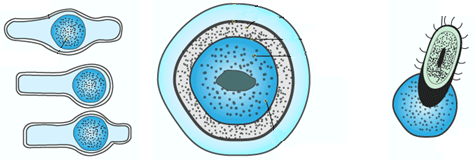
Different microorganisms reproduces by different methods. Identify the methods of reproduction in the microorganism given below in the figure:
  • Endospore in bacteria.
  • B
    Fission is amoeba.
  • C
    Spore formation in fungus.
  • D
    Cell division in virus.
Answer
Correct option: A.
Endospore in bacteria.
View full question & answer