Questions

questions in details [4 marks ]

🎯

Test yourself on this topic

24 questions · timed · auto-graded

Question 14 Marks
Differentiate between internal fertilisation and external fertilisation.
Answer
The differences between internal and external fertilization are:
Internal Fertilization External Fertilization
In this type of fertilization, the fusion of male and female gametes takes place inside the body. In this type of fertilization, the fusion of male and female gametes takes place outside the body.
In this type of fertilization, there are high chances of survival of offspring. In this type of fertilization, there are low chances of survival of offspring.
In this type of fertilization, less numbers of eggs are produced. In this type of fertilization, large numbers of eggs are produced.
Example: Cows, Hens, Human beings, etc. Example: Fish, Frog, etc.
View full question & answer
Question 24 Marks
Define asexual reproduction. Describe two methods of asexual reproduction in animals.
Answer
Asexual reproduction is a mode of reproduction in which only one parent is involved to reproduce offspring. In this type of reproduction, the offspring’s produced are exact copies of their parents. Asexual reproduction is generally observed in very small sized organisms. Examples of asexual reproduction are Binary fission, Budding, Fragmentation etc.
Budding: In this mode of asexual reproduction, a part of the organism starts bulging out and slowly it grows and develops into a separate individual.
Example: Hydra, yeast, etc.
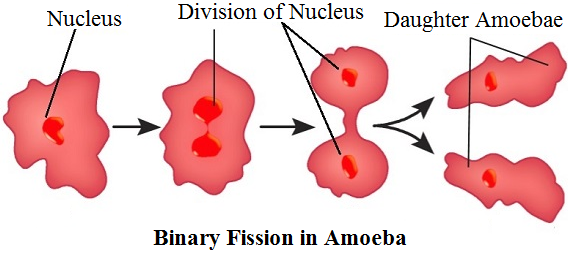
Binary Fission: In this mode of asexual reproduction, a single cell divides into two halves.
Example: Bacteria, amoeba, etc.
View full question & answer
Question 34 Marks
Describe the process of fertilisation in human beings.
Answer
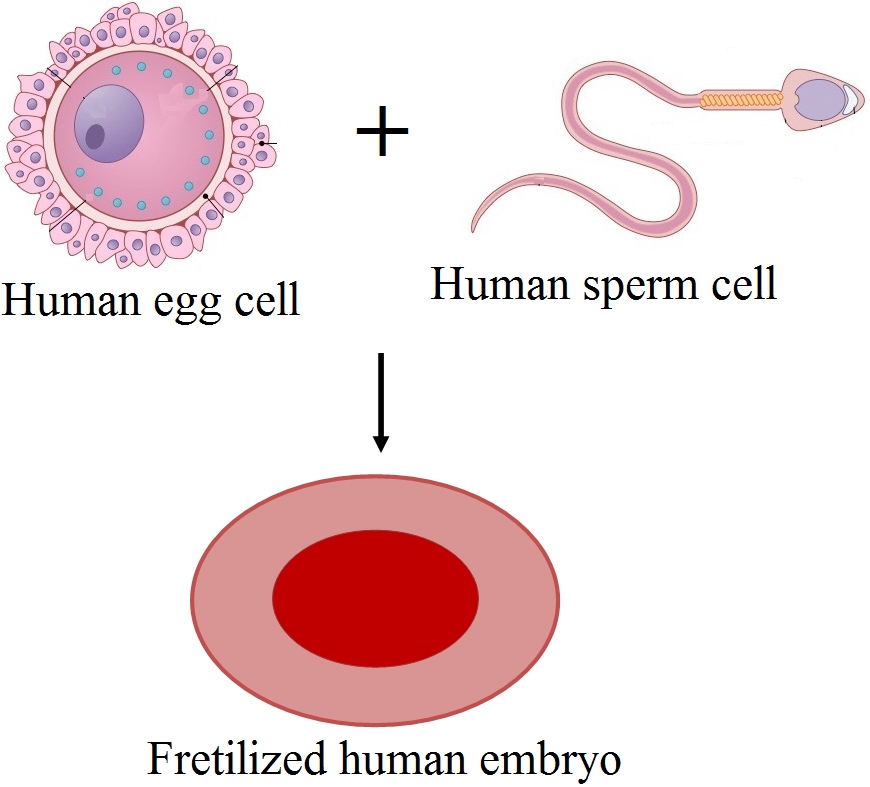
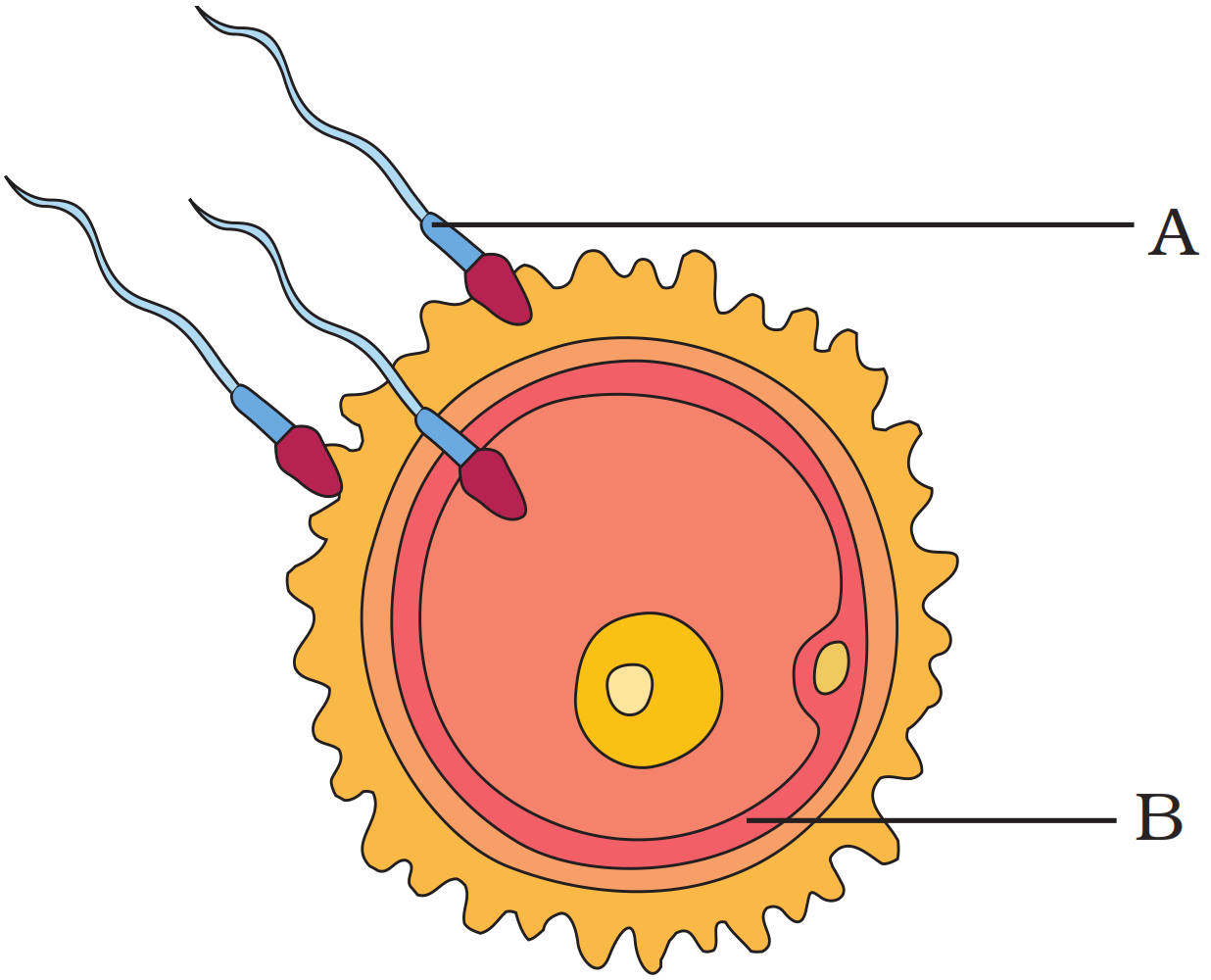
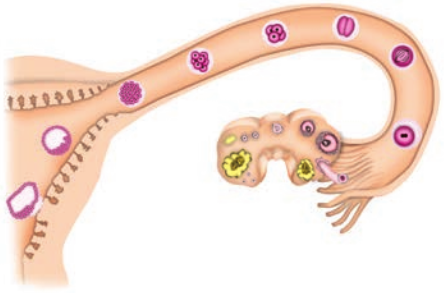
Fertilization involves the fusion of the male and the female gamete. The male and the female gametes are released from the male and the female reproductive organs. Sperms or male gametes are released from the male reproductive organ i.e., the penis. These sperms then enter the female body through the vagina. Then, they travel through the fallopian tubes where they meet the eggs. Hence, the process of fertilization takes place in the fallopian tubes.

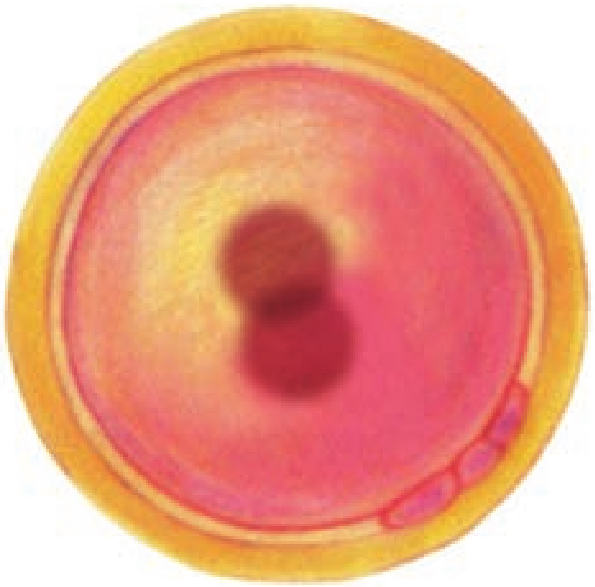
During fertilization, the haploid nucleus of the sperm and that of the ovum fuse with each other to form the zygote. This zygote divides to form an embryo which in turn develops into a foetus.
View full question & answer
Question 44 Marks
Differentiate between internal fertilization and external fertilization. What type of fertilization takes place in?
$1.$ Frog, and
$2.$ Fox?
Answer
Differences between internal fertilization and external fertilization:
Internal fertilization External fertilization
It takes place inside the female body. It takes place outside the female body.
Example: Human being. Example: Human being.
$1.$ In frog, external fertilization takes place.
$2.$ In fox, internal fertilization takes place.
View full question & answer
Question 54 Marks
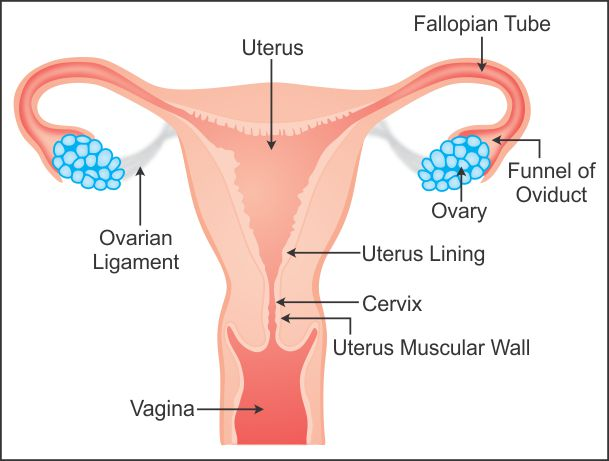
Draw a labeled diagram of the human female reproductive system.
$1.$ Where in the human body does an egg $($or ovum$)$ get fertilized?
$2.$ Where does a fertilized egg $($or zygote$)$ develop into a baby in the human body?
Answer
The diagram of the human female reproductive system is shown below:

$1.$ In the human body, an egg $($or ovum$)$ gets fertilized in the fallopian tubes.
$2.$ The fertilized egg $($or zygote$)$ develops into a baby in the uterus of the human body.
View full question & answer
Question 74 Marks
Describe the various steps involved in the sexual reproduction in animals.
Answer
Following steps are involved in the process of sexual reproduction in an animal:
$1.$ In the animal, male parent produces male gametes called sperms. Millions of sperms are produced by testes.
$2.$ The female parent produces female gamete called ova $($eggs$)$. Like a sperm, an egg is also a single cell.
$3.$ The next step is fertilization. In this step, sperm enters the ovum and fuses with it to form a new cell called zygote. The zygote is the beginning of a new individual.
$4.$ In this step, zygote begins to develop into an embryo. The zygote divides repeatedly to form a large number of cells and ultimately the zygote grows and develops to form a baby.
View full question & answer
Question 84 Marks
Mother gives birth to a baby but the baby has characters of both parents. How is this possible?
Answer
Although, mother gives birth to a baby but the baby is formed from the fertilisation of male and female gamete that comes from the father and mother, respectively. The nuclei of both the parent gametes fuse to form a zygote with new character combinations from both parents. Hence, the zygote formed from fertilisation have characters of both the parents. This zygote develops inside the female body (uterus) and finally takes birth as baby.
View full question & answer
Question 94 Marks
$X$ and $Y$ are the two types of animals. The animals like $X$ undergo external fertilization whereas animals like $Y$ undergo internal fertilization. The animals like $X$ lay eggs from which baby animals are hatched. On the other hand, in animals like $Y$, the young one develops inside the uterus of mother which then gives birth to the baby.
$1.$ What is the general name of animals like $X$?
$2.$ Give two examples of animals like $X$?
$3.$ What is the general name of animals like $Y$?
$4.$ Write the names if two animals like $Y$.
Answer
$1.$ General Name of Animals Like $X$ is Oviparous. Oviparous animals are those which reproduce by laying eggs. The young ones develop inside the eggs.
$2.$ Examples of Animals like $X$ are Frog, Fish and Star Fish etc.
$3.$ General Name of Animals Like $Y$ is Viviparous. Viviparous animals are those animals in which the young ones develop inside the uterus of the mother.
$4.$ Examples of Animals like $Y$ are Human beings, cattle, etc.
View full question & answer
Question 104 Marks
The term metamorphosis is not used while describing human development. Why?
Answer
The term ‘metamorphosis’ is not used while describing human development because in human beings, body parts of an adult are present from the time of birth itself, i.e. while beginning of life as a baby and until you are an adult, the basic plan of body does not change. On the contrary, in metamorphosis, the parts of the adult are different from those at the time of birth.
View full question & answer
Question 114 Marks
Explain how, chicks are born. How much time does the embryo present in hen’s egg take to develop into a chick (when provided sufficient warmth)?
Answer
In hens, internal fertilization take place but they do not give birth to chicks like human beings. After fertilization, the zygote divides repeatedly to form embryo which travels down the oviduct. As it travels down, many protective layer are formed around it.
The outermost protective layer is hard shell which we can see in a hen’s egg. After the hard shell is formed around the developing embryo, the hen finally lays the egg. The hen, then sits on the egg to provide sufficient warmth to the eggs for the development of the embryo into the chicks. The embryo takes about $3$ weeks to develop into a complete chick.
View full question & answer
Question 124 Marks
Give five example each of animals which develop:
$1.$ Inside the mother.
$2.$ Inside eggs which the mother lays.
Answer
$1.$ The animals which give birth to young one are called viviparous animals. In such animals, the baby develops inside the body of the mother.
Examples of Viviparous animals: Human beings, cat, dog, cow, tiger.
$2.$ The animals that reproduce by laying eggs are called oviparous animals. In such animals, the baby develops inside eggs that the mother lays.
Examples of Oviparous animals: Frog, sparrow, lizard, hen, fish, butterfly.
View full question & answer
Question 134 Marks
The animal A which is classified as an amphibian lays eggs in pond water. The hatching of its eggs produces a tailed$-$form $B$ which looks very different from the animal $A.$ The form $B$ then undergoes a change $C$ and gets converted into animal $A.$
$1.$ Name $(i)$ animal $A$ and $(ii)$ form $B.$
$2.$ What is the change $C$ known as?
$3.$ Name the breathing organs of $A.$
$4.$ What are the breathing organs of $B?$
Answer
$1.$ Animal $A$ is Frog and form is Tadpole.
$2.$ The change from Tadpole to Frog is called as Metamorphosis.
$3.$ Since, $A$ is Frog, hence the breathing organ of Frog is Lungs.
$4.$ Since, $B$ is Tadpole. The breating organ of Tadpole is gills.
View full question & answer
Question 144 Marks
What is meant by the terms ‘internal fertilization and ‘external fertilization’? Explain with example.
Answer
Internal fertilization: Fertilization which takes place inside the female body is called internal fertilization. Internal fertilization occurs in many animals including humans, cows, dogs and hens. External fertilization: This type of fertilization in which the fusion of a male and a female gamete takes place outside the body of the female is called external fertilization. It is very common in aquatic animals such as fish, starfish, etc.
View full question & answer
Question 154 Marks
Fill up the blanks with the terms given below: Amoeba is a ___________ celled organism. It reproduces by ___________ reproduction. The process of reproduction begins by the division of its ___________ into two. This is followed by the division of its ___________ into two. This type of reproduction is called ___________ fission.
Answer
Amoeba is a Single celled organism. It reproduces by asexual reproduction. The process of reproduction begins by the division of its nucleus into two. This is followed by the division of its body into two. This type of reproduction is called binary fission.
View full question & answer
Question 164 Marks
Two very small organisms $X$ and $Y$ both reproduce by the method of budding. Organism $X$ is industrially very important because it is used in making alcohol from sugar. It is also used in making bread. Organisms $Y$ is a tiny animal having tentacles which live in water.
$1.$ What is organisms $X$?
$2.$ Name the process in which $X$ converts sugar into alcohol.
$3.$ To which class of organism does $X$ belong?
$4.$ What are organisms $Y$?
$5.$ Out of $X$ and $Y$, which organism is multicellular and which one is unicellular?
Answer
$1. X$ is $Y$east.
Explanation:
$Y$easts are unicellular fungi which convert glucose into alcohol through the process of fermentation.
$2.$ The process in which $X$ converts sugar into alcohol is called Fermentation.
Explanation:
The following chemical reaction takes place:
$\ce{Y east + Glucose \rightarrow Alcohol (l) + CO_2 (g).}$
$3.$ The organism $X$ i.e. $Y$east belongs to the fungi of living organisms.
Explanation:
$Y$east is a single$-$cellular organism which divides by mitosis and shows budding. Fungi have the following characteristics:
$I.$ They have a cell wall.
$II.$ They have a nucleus.
$III.$ They have no chloroplasts.
$4.$ Organism $Y$ is Hydra.
Explanation:
Hydra is a genus of small fresh$-$water animals.
$5. Y$east ($X$) is a unicellular and Hydra $(Y)$ is a Multicellular.
Explanation:
$Y$easts are unicellular organisms because they are single$-$celled organisms.
Hydra are multicellular organisms with complex bodies.
View full question & answer
Question 174 Marks

After observing Fig. answer the following.
$a.$ Read the following statements and label them in the figure:
$i.$ The part which produces female gametes.
$ii.$ The part where development of the baby takes place.
$iii.$ The part through which the developing embryo passes to reach the uterus.
$b.$ Explain the future development of the embryo that would take place after it gets embedded in the uterus.
Answer
$a.$ The parts in the figure are labelled below:
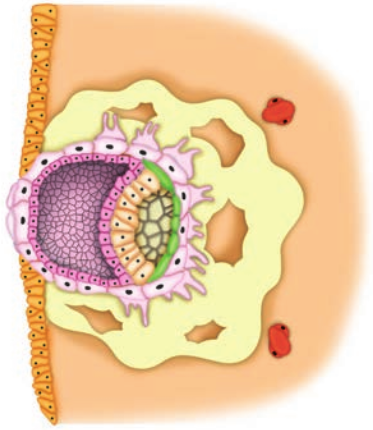
$b.$ The embryo continues to grow and develop after it gets embedded in the uterus. It divides and differentiates into three germ layers which give rise to different body parts such as hands, legs, head, eyes, ears, etc. This stage where all the body parts are distinct and easily identified in developing embryo is called foetus.
A human embryo becomes a foetus after about $8$ weeks of pregnancy. After completion of development of foetus $($i.e. after about $38$ weeks or $9$ months$)$, mother gives birth to baby.
View full question & answer
Question 184 Marks
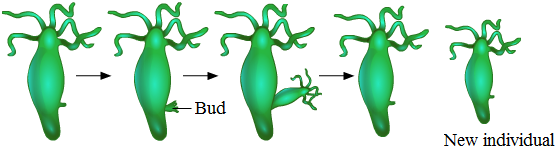
How does a Hydra reproduce? Explain with the help of labeled diagrams.
Answer

Hydra reproduces by budding. In hydra, there may be one or more bulges. These bulges are the developing new individual and they are called buds. This bud then grows gradually to form a small hydra by developing a mouth and tentacles. The tiny new hydra detaches itself from the parent body and become new independent individual.
View full question & answer
Question 194 Marks
How does an Amoeba reproduce? Describe with the help of labeled diagram.
Answer

Amoeba reproduces by common asexual method called binary fission. In this method, Amoeba cell divides into two equal daughter cells. The nucleus of amoeba first divides into two parts. After that the cytoplasm of amoeba divides into two parts, one part around each nucleus. This leads to the formation of the two daughter Amoebae cell having a nucleus and its own cell organelles.
View full question & answer
Question 204 Marks
Write five differences between menarche and menopause.
Answer
The differences between menarche and menopause are as follows:
S.No.
Menarche
Menopause
1.
It is the first menstrual period or start of menstruation in human females.
It is the end of menstrual period or start of menstruation in human females.
2.
It occurs at around $11-16$ years of age.
It occurs at around $45-50$ years of age.
3.
It marks the beginning of reproductive phase of a female.
It marks the end of reproductive phase of a female.
4.
There is elevated level of oestrogen.
There is decline in the level of oestrogen.
5.
Symptoms such as irritability, moodiness, acne, irregularity in periods are seen.
Symptoms such as bloating, lack of sleep, weight gain, hair loss and skin dryness are seen.
View full question & answer
Question 214 Marks
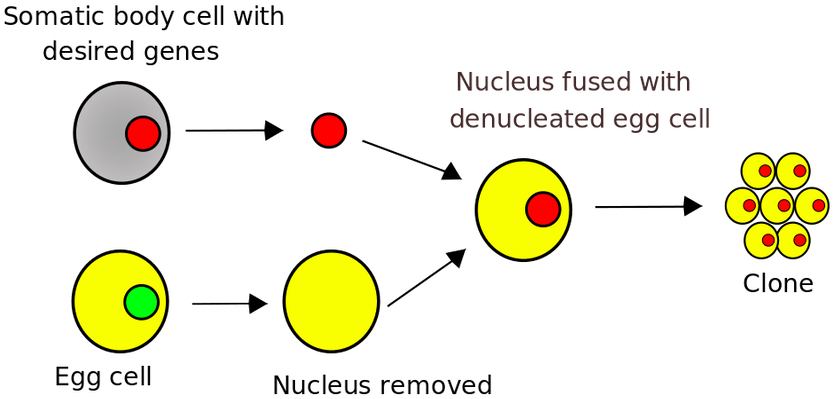
Describe cloning with diagram.
Answer
Cloning is defined as the process of generating copy of a cell, part of body, or a complete organism, which is genetically identical to the parent organism. It is a natural phenomenon seen in asexual reproduction. In artificial biological processes, the generation of an identical copy of desired cell or organism, which in nature show variations due to sexual reproduction, is called cloning. The process is generally used to produce cell or cell products with desirable traits. In molecular biology, the process of cloning is used to replicate $DNA$ and $RNA$. The first successfully cloned animal was a sheep named Dolly.
View full question & answer
Question 224 Marks
Elucidate the life cycle of frog.
Answer
The life cycle of a frog is comprised of three stages, namely the egg, tadpole $($larva$)$ and the adult frog. In its life cycle, the frog shows drastic changes in the physical appearance of each stage. That is, the tadpole undergoes drastic changes to transform into an adult frog, in terms of body parts. This change is termed as metamorphosis.
$-$ The first stage of life cycle of a frog is the egg. Eggs of a frog are present as a cluster and are slimy in nature. They hatch in around $3-25$ days, depending on species and temperature of water. The hatched egg proceed to next stage, the tadpole.
$-$ The second stage is the tadpole. These are long, slender organisms, which metamorphose into an adult frog, over weeks. It has an ill$-$defined head$-$body and tail, as body parts.
$-$ The last stage is of the adult frog, which is the transformed tadpole. It has no tail, but limbs, and a properly differentiated body and head.
View full question & answer
Question 234 Marks
Hens and frogs are both oviparous exhibiting different types of fertilisation. Explain.
Answer
Hens are oviparous in which internal fertilisation takes place. The fertilised egg divides repeatedly to form an embryo inside the body. The embryo however, travels down the oviduct with many protective layers forming around it. After the hard egg shell is formed around the developing embryo, the hen lays the eggs oustide. After about $3$ weeks, the development of chick from egg takes place.
On the contrary, frogs are oviparous in which external fertilisation occurs. The frogs lay eggs and sperms in water, which comes in contact to undergo fertilisation. In this way, a female frog’s eggs get fertilised by sperms outside its body, i.e. external fertilisation.
The fertilised eggs are covered by a jelly for protection. The development of embryo takes place in the egg in water, i.e. they are oviparous.
View full question & answer
Question 244 Marks
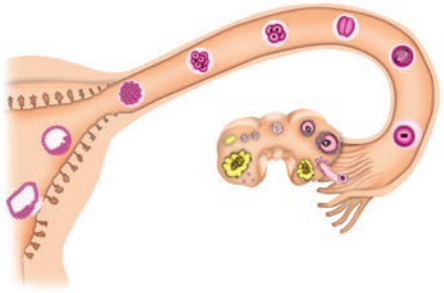
Observe the following figures.


$i.$ Identify the stages a to d in Fig. during development of human baby.
$ii.$ Arrange the stages in correct sequence of development.
$iii.$ Explain the development that takes place in any one stage.
Answer
$1.$ The figures showing stages during development of embryo are identified as:
$a.$ Embedding of the embryo in the uterus $($implantation$).$
$b.$ Fertilisation $($fusion of egg and sperm$).$
$c.$ Stages in development of an embryo from the zygote in the oviduct, till it gets embedded in uterus.
$d.$ Zygote $($showing fusion of nuclei$).$
$2.$ The above stages in sequence are:
$3.$ Development of embryo The embryo after being implanted in uterus, continues to develop and divide and differentiate into body parts. The stage of embryo when body parts become distinct and identified is called foetus. After complete development of foetus, mother gives birth to baby.
View full question & answer
questions in details [4 marks ] - Science STD 8 Questions - Vidyadip