Questions

2 Marks Questions

🎯

Test yourself on this topic

9 questions · timed · auto-graded

Question 12 Marks
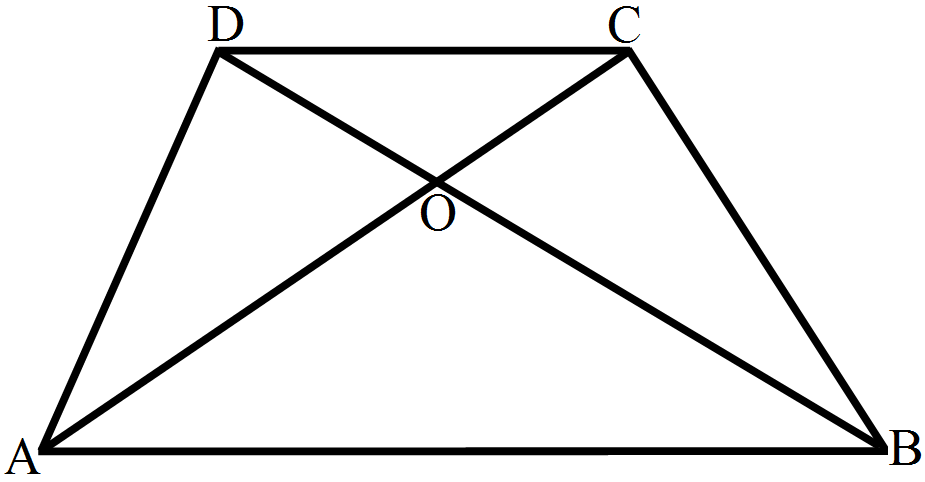
In the adjoining figure, $ABCD$ is a trapezium in which $AB \| DC$ and its diagonals $AC$ and $BD$ intersect at $O.$
Prove that $\text{ar}(\triangle\text{AOD})=\text{ar}\triangle\text{BOC}.$
Answer
$\triangle\text{CDA}$ and $\triangle\text{CBD}$ lies on the same base and between the same parallel lines.
So,
$\text{ar}(\triangle\text{CDA})=\text{ar}(\triangle\text{CDB})\dots(1)$
Subtracting $\text{ar}(\triangle\text{OCD})$ from both sides of equation $(1)$, we get:
$\text{ar}(\triangle\text{CDA})-\text{ar}(\triangle\text{OCD})=\text{ar}(\triangle\text{CDB})-\text{ar}(\triangle\text{OCD})$
$\Rightarrow\ \text{ar}(\triangle\text{AOD})=\text{ar}\triangle\text{BOC}.$
View full question & answer
Question 22 Marks
Find the area of a figure formed by joining the midpoints of the adjacent sides of a rhombus with diagonals $12\ cm$ and $16\ cm.$
Answer
Area of rhombus $=\frac{1}{2}\times\text{Product of diagonal}$
$=\frac{1}{2}\times12\times16$
$=96\text{cm}^2$
Area of figure formed by joining the mid-points of rhombus $=\frac{1}{2}\times\text{Area of rhombus}$
$=\frac{1}{2}\times96$
$=48\text{cm}^2$
View full question & answer
Question 32 Marks
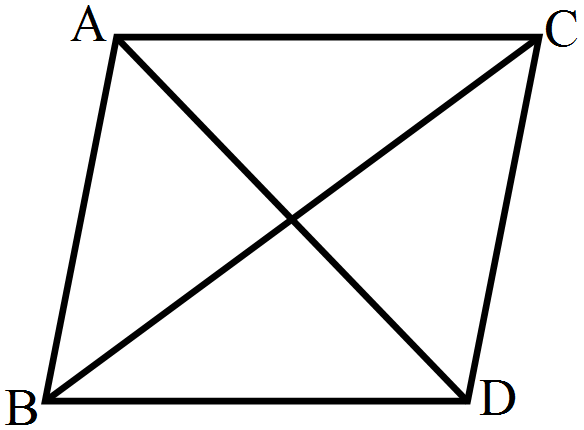
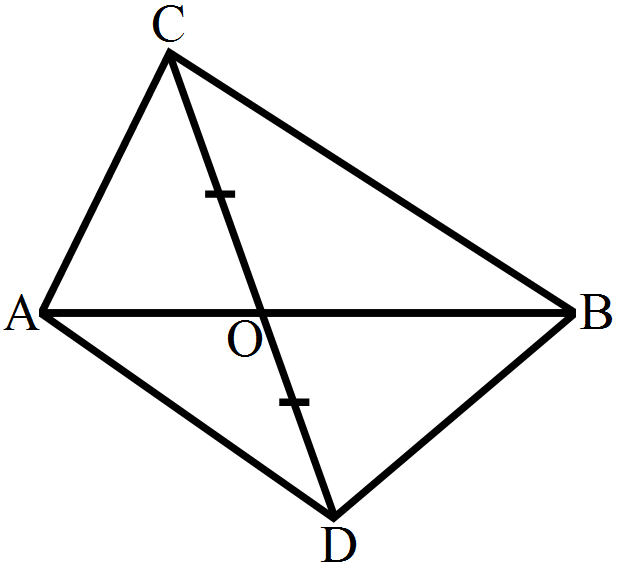
In the adjoining figure, $ABC$ and $ABD$ are two triangles on the same base $AB$. If line segment $CD$ is bisected by $AB$ at $O$, show that $\text{ar}(\triangle\text{ABC})=\text{ar}(\triangle\text{ABD}).$
Answer
We know that median of a triangle divides it into two triangles of equal area. Now, $AO$ is the median of $\triangle\text{ACD}.$
$\Rightarrow\ \text{A}(\triangle\text{COA})=\text{A}(\triangle\text{DOA})\dots(1)$ And, Bo is the median of $\triangle\text{BCD}.$
$\Rightarrow\ \text{A}(\triangle\text{COB})=\text{A}(\triangle\text{DOB})\dots(2)$ Adding $(1)$ and $(2),$ we get: $\text{A}(\triangle\text{COA})+\text{A}(\triangle\text{COB})=\text{A}(\triangle\text{DOA})+\text{A}(\triangle\text{DOB})$
$\Rightarrow\ \text{A}(\triangle\text{ABC})=\text{A}(\triangle\text{ABD})$
View full question & answer
Question 42 Marks
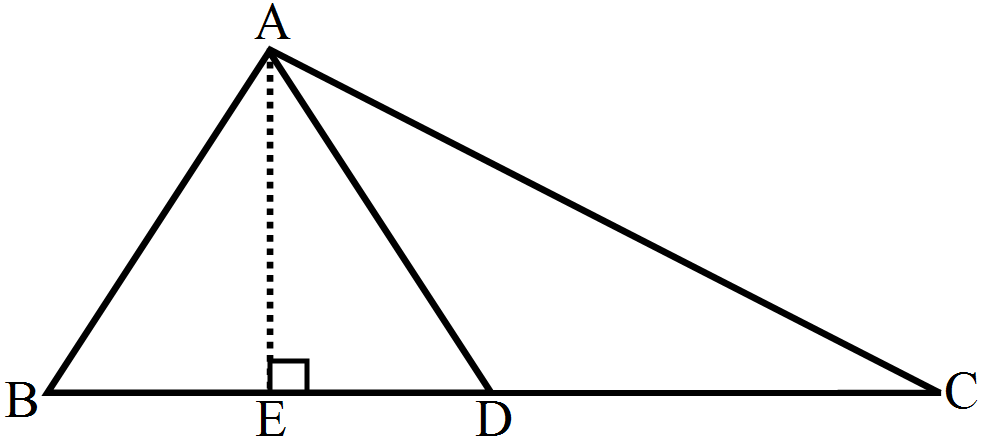
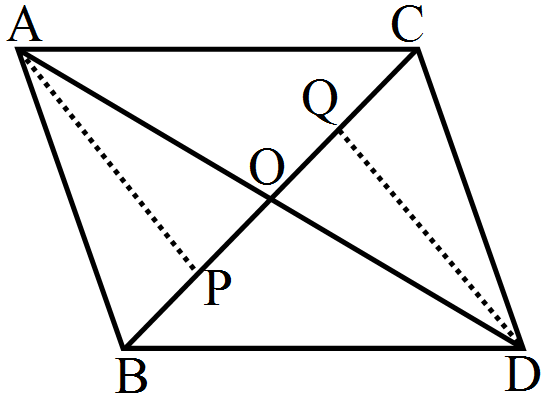
Prove that a median divides a triangle into two triangles of equal area.
Answer
Given: $ABC$ is a triangle in which $AD$ is the median. To prove: $\text{ar}(\triangle\text{ABD})=\text{ar}(\triangle\text{ACD})$Construction:
Draw $\text{AE}\perp\text{BC}$
View full question & answer
Question 52 Marks
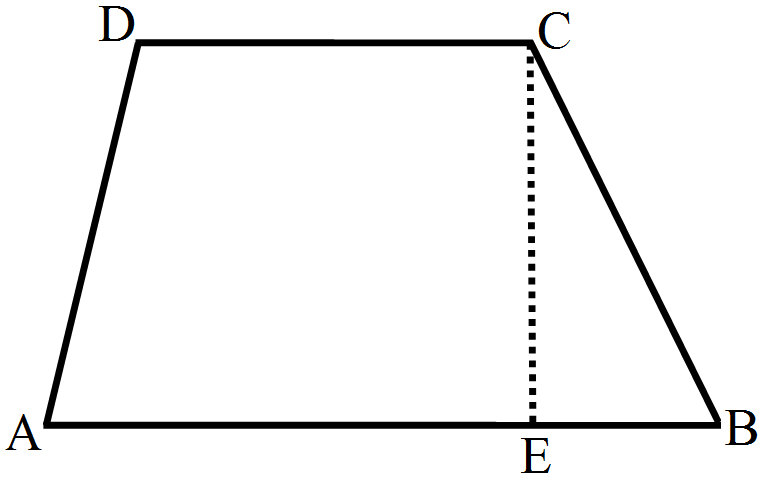
Find the area of a trapezium whose parallel sides are $9\ cm$ and $6\ cm$ respectively and the distance between these sides is $8\ cm.$
Answer
$ABCD$ is a trapezium in which, $AB \| CD.$
$AB = 9cm$ and $CD = 6cm.$
$CE$ is a perpendicular drawn to $AB$ through $C$ and $CE = 8cm.$

Area of trapezium
$=\frac{1}{2}(\text{Sum of parallel sides})\times\text{Distance between them}$
$=\Big[\frac{1}{2}(9+6)\times8\Big]\text{cm}^2$
$=\Big(\frac{1}{2}\times15\times8\Big)\text{cm}^2$
$=60\text{cm}^2$
$\therefore$ Area of trapezium = $60\text{cm}^2$.
View full question & answer
Question 62 Marks
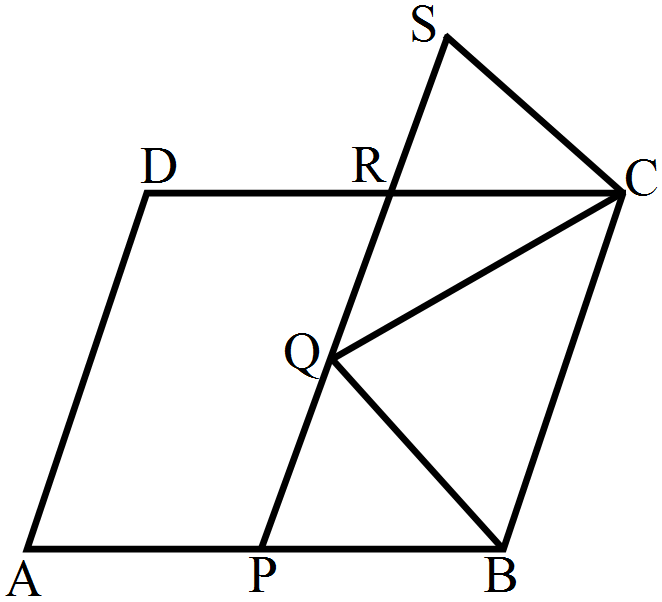
In the adjoining figure, $ABCD$ and $BQSC$ are two parallelograms. Prove that $\text{ar}(\triangle\text{RSC})=\text{ar}(\triangle\text{PQB}).$
Answer
In $\triangle\text{RSC}$ and $\triangle\text{PQB},$
$\angle\text{CRS}=\angle\text{BPQ}$ [$RC \| PB$, corresponding angles] $\angle\text{RSC}=\angle\text{PQB}$ [$RC \| PB,$ corresponding angles] $\text{SC}=\text{QB}$ [Opposite sides of a parallelogram BQSC]
$\therefore\ \triangle\text{RSC}\cong\triangle\text{PQB}$ [by $AAS$ congruence criterion]
$\Rightarrow\ \text{ar}(\triangle\text{RSC})=\text{ar}(\triangle\text{PQB})$
View full question & answer
Question 72 Marks
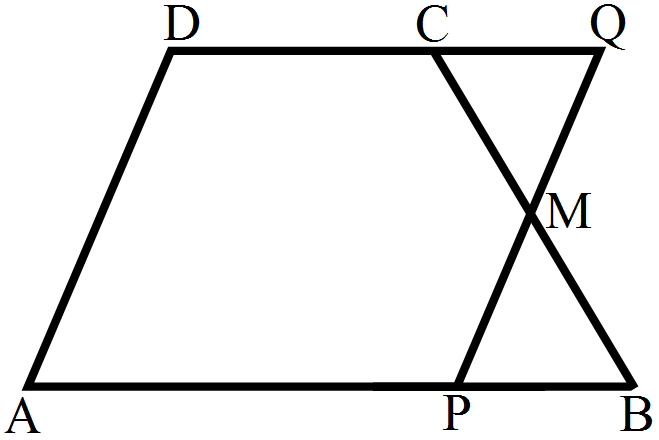
In a trapezium $A B C D, A B \| D C$ and $M$ is the midpoint of $B C$. Through $M$, a line $P Q \| A D$ has been drawn which meets $A B$ in $P$ and $D C$ produced in $Q$, as shown in the adjoining figure. Prove that $A(A B C D)=A(A P Q D)$.
Answer
In $\triangle\text{MCQ}$ and $\triangle\text{MPB},$
$\angle\text{QCM}=\angle\text{PBM}$ [alternate angles]
$CM = BM$ [$M$ is the mid-point of BC] $\angle\text{CMQ}=\angle\text{PMB}$ [vertically opposite angles]
$\therefore\ \triangle\text{MCQ}\cong\triangle\text{MPB}$
$\Rightarrow\ \text{A}(\triangle\text{MCQ})=\text{A}(\triangle\text{MPB})$
Now, $\text{A}(\text{ABCD})=\text{A}(\text{APQD})+\text{A}(\text{DMPB})-\text{A}(\triangle\text{MCQ})$
$\Rightarrow\ \text{A}\text{(ABCD)}=\text{A}(\text{APQD})$
View full question & answer
Question 82 Marks
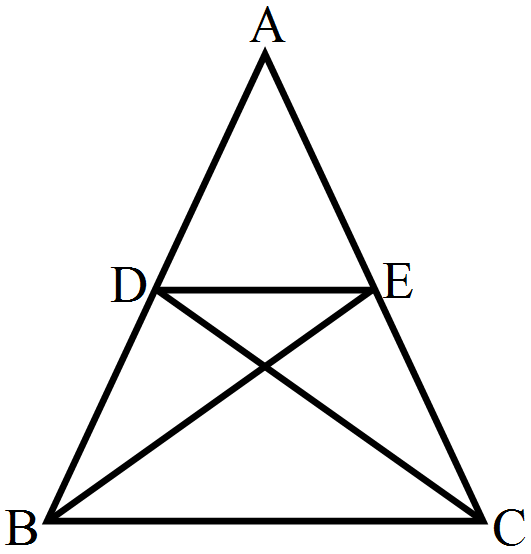
$D$ and $E$ are points on sides $AB$ and $AC$ respectively of $\triangle\text{ABC}$ such that$\text{ar}(\triangle\text{BCD})=\text{ar}(\triangle\text{BCE}).$ Prove that $DE \| BC.$
Answer

Since $\triangle\text{BCD}$ and $\triangle\text{BCE}$ are equal in area and have a same base $BC$.
Therefore, Altitude from $D$ of $\triangle\text{BCD}$ = Altitude from $E$ of $\triangle\text{BCE}.$
$\Rightarrow\ \triangle\text{BCD}$ and $\triangle\text{BCE}.$ are between the same parallel lines.
$\Rightarrow DE \| BC.$
View full question & answer
Question 92 Marks
In the adjoining figure, $\triangle\text{ABC}$ and $\triangle\text{DBC}$ are on the same base $BC$ with $A$ and $D$ on opposite sides of $BC$ such that $\text{ar}(\triangle\text{ABC})=\text{ar}(\triangle\text{DBC}).$ Show that $BC$ bisects $AD.$
Answer
Given: Two triangle, $\text{i.e.}\triangle\text{ABC}$ and $\triangle\text{DBC}$ which have same base $BC$ and point $A$ and $D$ lie on opposite sides of $BC$ and $\text{ar}(\triangle\text{ABC})=\text{ar}(\triangle\text{DBC}).$
View full question & answer
2 Marks Questions - MATHS STD 9 Questions - Vidyadip