Questions · Page 4 of 5

M.C.Q

MCQ 1511 Mark
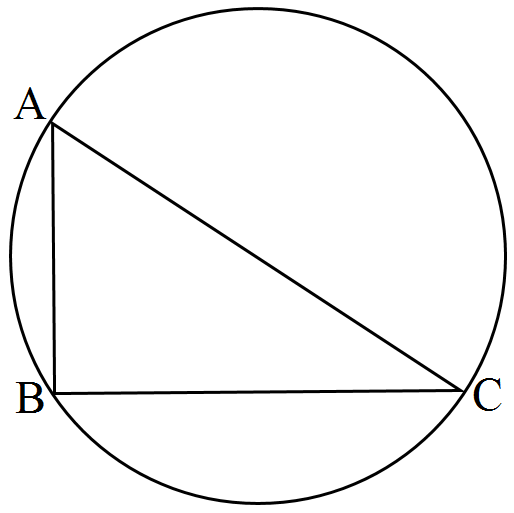
$AB$ is a chord of a circle with radius $r.$ if $P$ is any point on the circle such that $\angle\text{APB}$ is a right angle, then $AB$ is equal to:
  • A
    $r^2$
  • B
    $3r$
  • C
    $r$
  • $2r$
Answer
Correct option: D.
$2r$

Since the angle subtended by the diameter or the semicircle is a right angle, therefore the $AB$ is nothing but the diameter. Hence, it is equal to $2r, r$ being the radius.

View full question & answer
MCQ 1521 Mark
Two circle are congruent if they have equal.
  • A
    Diameter
  • B
    Chord
  • Radii
  • D
    Secant
Answer
Correct option: C.
Radii

As per theorem,
two circles are congruent only if they have same radii.
View full question & answer
MCQ 1531 Mark
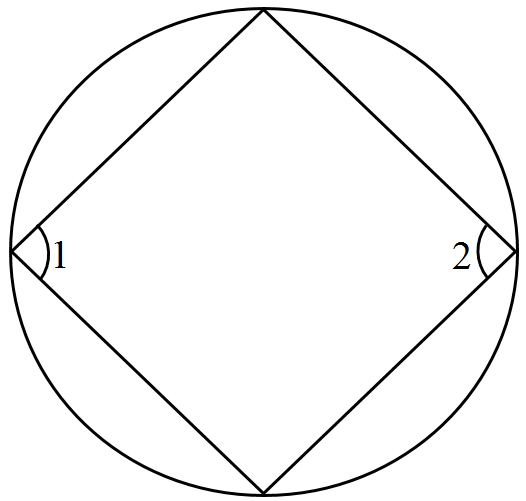
The sum of either pair of opposite angle of cyclic quadrilateral is:
  • $180^\circ $
  • B
    $360^\circ$
  • C
    $90^\circ$
  • D
    $270^\circ$
Answer
Correct option: A.
$180^\circ $


As per theorem,
he sum of either pair of opposite angles of a cyclic quadrilateral is $180^\circ .$
Here, ​​$\angle1+\angle2=180^\circ$

View full question & answer
MCQ 1541 Mark
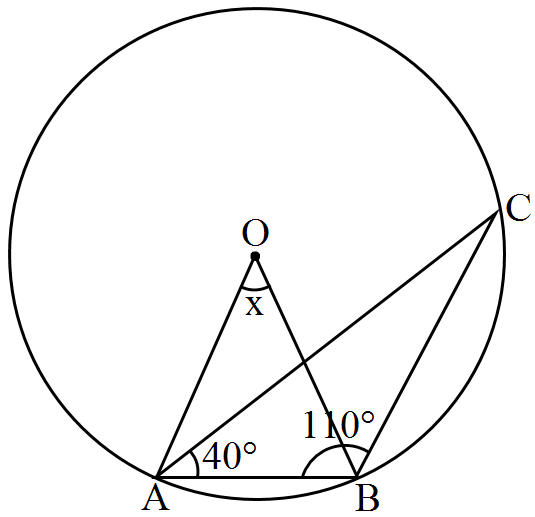
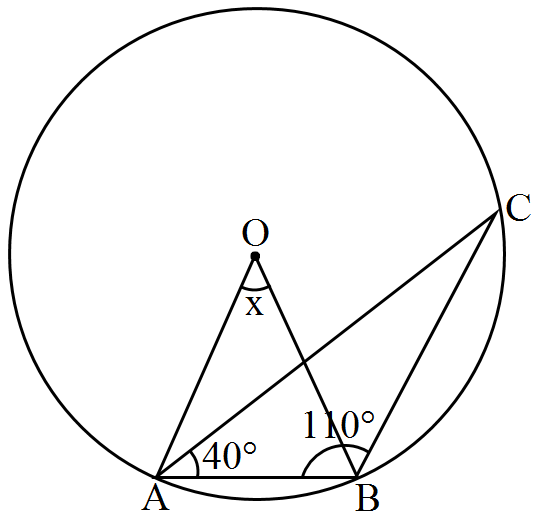
In the given figure, $O$ is the centre of the circle. If $\angle\text{CAB}=40^\circ$ and $\angle\text{CBA}=110^\circ,$ the value of $x$ is:
  • A
    $55^\circ$
  • B
    $80^\circ$
  • $60^\circ$
  • D
    $50^\circ$
Answer
Correct option: C.
$60^\circ$

In $\triangle\text{ABC}$
$\angle\text{A}+\angle\text{B}+\angle\text{C}=180^\circ$
$\Rightarrow\angle\text{C}=180^\circ-40^\circ-110=30^\circ$
Since $AB$ is a chord and angle made by a chord at the centre is twice the angle made by it on any point on the circumference, therefore:-
$x = 2 \times 30^\circ = 60^\circ$
View full question & answer
MCQ 1551 Mark
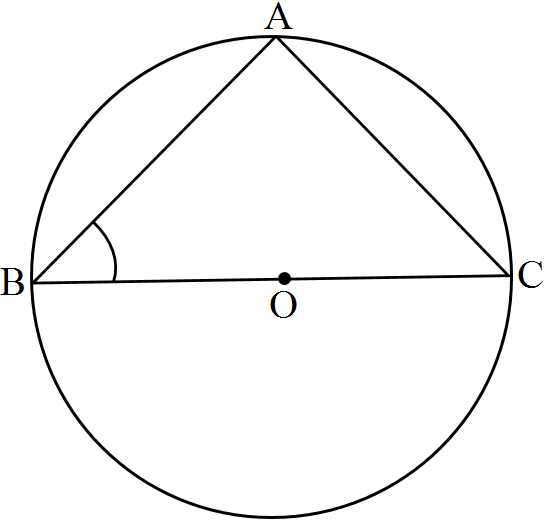
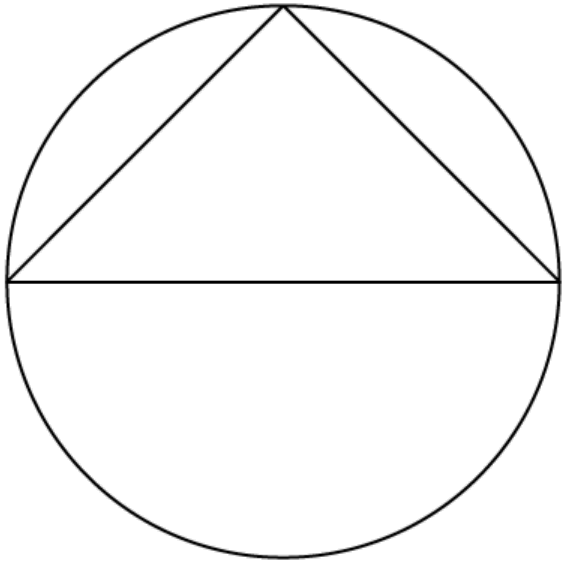
In the given figure, $BOC$ is a diameter of a circle and $AB = AC.$ Then, $\angle\text{ABC}=?$
  • A
    $90^\circ$
  • B
    $30^\circ$
  • C
    $60^\circ$
  • $45^\circ$
Answer
Correct option: D.
$45^\circ$

Since an angle in a semicircle is a right angle, $\angle\text{BAC}=90^\circ$
$\therefore\angle\text{ABC}+\angle\text{ACB}=90^\circ ....(\text{i})$
Now, $AB = AC ($Given$)$
$\Rightarrow\angle\text{ABC}=\angle\text{ACB}=45^\circ\ ....(\text{ii})$
$\Rightarrow\angle\text{ABC}+\angle\text{ABC}=90^\circ [$From $(i)$ and $(ii)]$
$\Rightarrow2\angle\text{ABC}=90$
$\Rightarrow\angle\text{ABC}=45^\circ$

View full question & answer
MCQ 1561 Mark
Angle inscribed in a semicircle is:
  • A
    $120^\circ$
  • $90^\circ$
  • C
    $75^\circ$
  • D
    $60^\circ$
Answer
Correct option: B.
$90^\circ$

Angle inscribed in a semicircle is a right angle. Its a given theorem.

View full question & answer
MCQ 1571 Mark
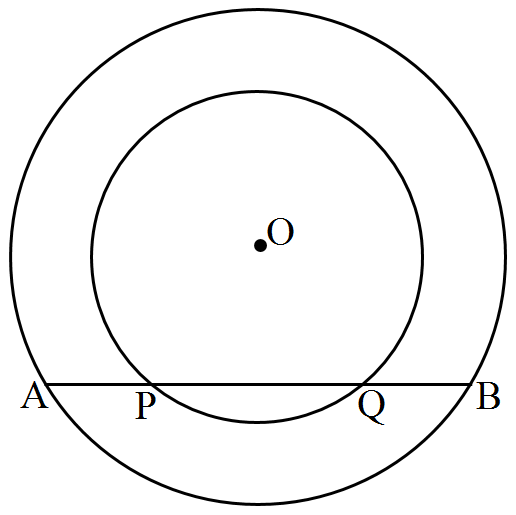
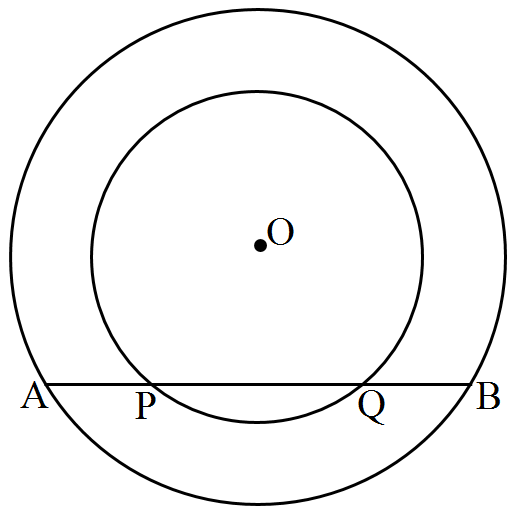
If a straight line $APQB$ is drawn to cut two concentric circles, then:
  • A
    $AP >> BQ$
  • B
    $AP << BQ$
  • $AP = BQ$
  • D
    $AQ >> PB$
Answer
Correct option: C.
$AP = BQ$


Let $OD$ is perpendicular to $AB.$ Then $AD = DB.$
Also $DP = DQ$
Therefore, $AP = AD - PD$
$= BD - DQ$
$= BQ$
Hence, $AP = BQ$

View full question & answer
MCQ 1581 Mark
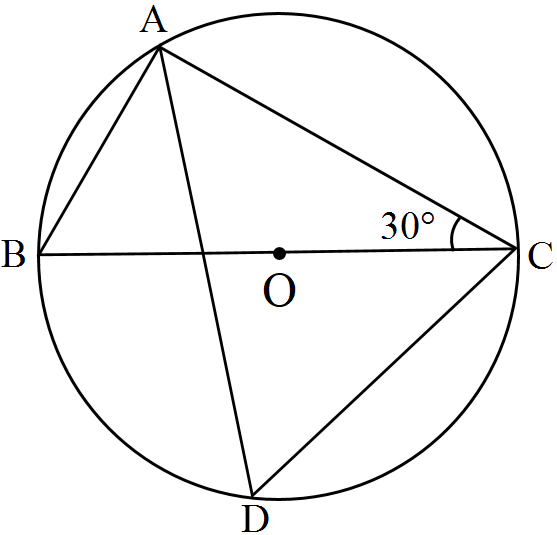
In the given figure, $BOC$ is a diameter of a circle with centre $O.$ If $\angle\text{BCA}=30^\circ,$ then $\angle\text{CDA}=?$
  • A
    $50^\circ$
  • B
    $45^\circ $
  • C
    $30^\circ$
  • $60^\circ$
Answer
Correct option: D.
$60^\circ$

Angles in a semi-circle measure $90^\circ .$
$\therefore\angle\text{BAC}=90^\circ$
In $\triangle\text{ABC},$ we have:
$\angle\text{BAC}+\angle\text{ABC}+\angle\text{BCA}=180^\circ$ (Angle sum property of a triangle)
$\therefore90^\circ+\angle\text{ABC}+30^\circ=180^\circ$
$\Rightarrow\angle\text{ABC}=(180^\circ-120^\circ)=60^\circ$
$\therefore\angle\text{CDA}=\angle\text{ABC}=60^\circ$ (Angles in the same segment of a circle)
$\Rightarrow\angle\text{CDA}=60^\circ$

View full question & answer
MCQ 1591 Mark
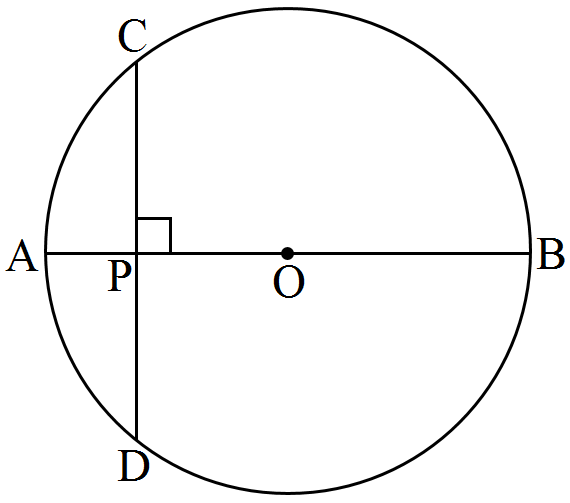
$P$ is a point on the diameter $AB$ of a circle and $CD$ is a chord perpendicular to $AB$. If $AP = 4\ cm$ and $PB = 16\ cm,$ the length of chord $CD$ is:
  • A
    $20\ cm$
  • $16\ cm$
  • C
    $10\ cm$
  • D
    $8\ cm$
Answer
Correct option: B.
$16\ cm$


Join $A C, B C$. Let $C D=2 x$. Then $C P=x$
Now, in triangle $A C P$,
$\Rightarrow A C^2=A P^2+P C^2$
$\Rightarrow A C^2=4^2+x^2 ....(1)$
And $B C 2=C P^2+B P^2$
$\Rightarrow B C^2=x^2+16^2...(2)$
Again, in triangle $A B C$,
$\Rightarrow A B^2=B C^2+A C^2$
$\Rightarrow 20^2=x^2+4^2+x^2+16^2$
$\Rightarrow 400=2 x^2+16+256$
$\Rightarrow 128=2 x^2$
$\Rightarrow x^2=64$
$\Rightarrow x=8 \mathrm{~cm}$
$\Rightarrow 2 x=16 \mathrm{~cm}$
$C D=16 \mathrm{~cm}$

View full question & answer
MCQ 1601 Mark
Angle formed in minor segment of a circle is:
  • A
    Acute.
  • Obtuse.
  • C
    Right angle.
  • D
    None of these.
Answer
Correct option: B.
Obtuse.

Angle formed in a minor segment is always a obtuse angle.
View full question & answer
MCQ 1611 Mark
How many circle can pass through three non$-$collinear points?
  • A
    Three
  • One
  • C
    Two
  • D
    Four
Answer
Correct option: B.
One
Only one circle can be drawn from three distinct points.
Join any two sets of points.
Make their respective perpendicular bisectors.
The point where the two bisectors meet act as the centre of such a circle.
Taking the distance between the centre and any of the given points as radius, we can draw the circle.
Such a circle would definitely pass through the remaining two points as well.
View full question & answer
MCQ 1621 Mark
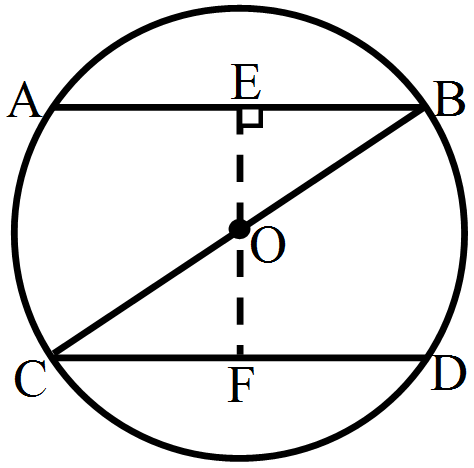
In the given figure, $BOC$ is a diameter of a circle with centre $O.$ If $AB$ and $CD$ are two chords such that $AB || CD$. If $AB = 10\ cm,$ then $CD = ?$
  • A
    $5\ cm$
  • B
    $12.5\ cm$
  • C
    $15\ cm$
  • $10\ cm$
Answer
Correct option: D.
$10\ cm$

In $\triangle\text{BEO}$ and $\triangle\text{CFO},$
$OB = OC [$Radii of the same circle$]$
$\angle\text{OBE}=\angle\text{OCF} [$Alternate angles since $AB || CD]$
$\angle\text{BOE}=\angle\text{COF} [$Vertically angles$]$
$\Rightarrow\ \triangle\text{BEO}\cong\triangle\text{CFO} [ASA$ congruence criterion$]$
$⇒ OE = OF [C.P.C.T.]$
Since chord are equidistant from the centre are equal, $AB = CD = 10\ cm.$

View full question & answer
MCQ 1631 Mark
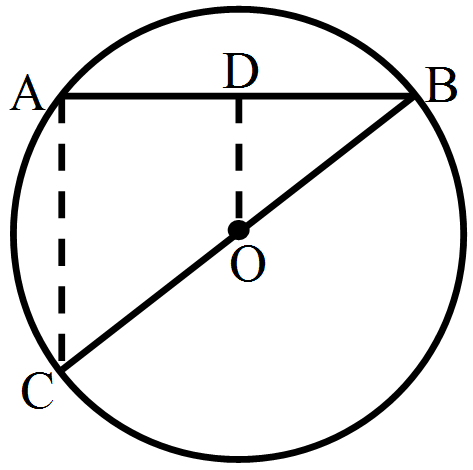
In the given figure, $AB$ is a chord of a circle with centre $O$ and $BOC$ is a diameter. If $\text{OD}\perp\text{AB}$ such that $OD = 6\ cm,$ then $AC = ?$
  • A
    $9\ cm$
  • $12\ cm$
  • C
    $15\ cm$
  • D
    $7.5\ cm$
Answer
Correct option: B.
$12\ cm$

In $\triangle\text{BOD}$ and $\triangle\text{CAB},$
Since BOC is the diameter, $\angle\text{CAB}=90^\circ.$
Also, $\angle\text{ODB}=90^\circ.$
So, $\angle\text{DBO}=\angle\text{ABC} [$Common angles$]$
$\Rightarrow\ \triangle\text{BOD}\sim\triangle\text{BCA} [AA $ congruence criterion$]$
$\Rightarrow\ \frac{\text{OD}}{\text{CA}}=\frac{\text{BO}}{\text{BA}}$
$\Rightarrow\ \frac{\text{OD}}{\text{CA}}=\frac{1}{2} [$Since radius $= 2$ diameter$]$
$\Rightarrow\ \frac{6}{\text{CA}}=\frac{1}{2}$
$⇒ CA = 12\ cm$ that is, $AC = 12\ cm.$

View full question & answer
MCQ 1641 Mark
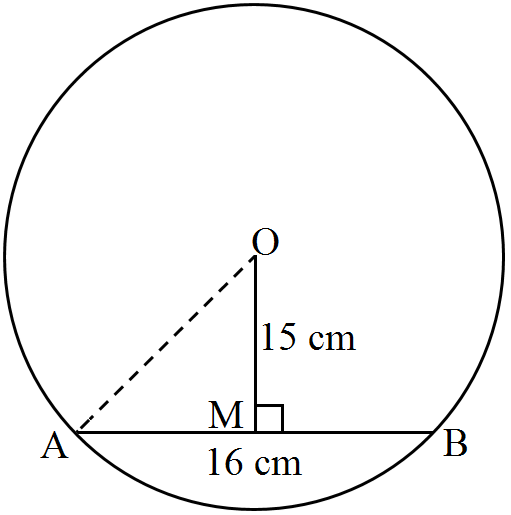
If the length of a chord of a circle is $16\ cm$ and is at a distance of $15\ cm$ from the centre of the circle, then the radius of the circle is:
  • A
    $15\ cm$
  • B
    $34\ cm$
  • $17\ cm$
  • D
    $16\ cm$
Answer
Correct option: C.
$17\ cm$
We will represent the given data in the figure

In the diagram, $AB$ is the given chord of $16\ cm$ length and $OM$ is the perpendicular distance from the centre to $AB.$
We know that perpendicular from the centre to any chord divides it into two equal parts.
So, $\text{AM}=\text{MB}=\frac{16}{2}=8\text{cm}.$
Now consider right triangle $\triangle\text{OMA}$ and by using Pythagoras theorem $\angle\text{OMA}=90^\circ$
$AO^2= AM^2 + OM^2$
$AO^2 = 8^2 + 15^2$
$AO^2 = 64 + 225 = 289$
$\text{AO}=\sqrt{289}=17\text{cm}$
View full question & answer
MCQ 1651 Mark
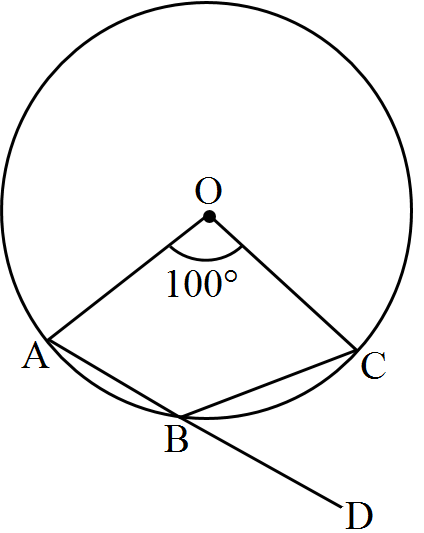
In the given figure, $O$ is the centre of a circle in which $\angle\text{AOC}=100^\circ.$ Side $AB$ of quad. $OABC$ has been produced to $D.$ Then, $\angle\text{CBD}=?$
  • A
    $80^\circ $
  • $50^\circ $
  • C
    $40^\circ $
  • D
    $25^\circ $
Answer
Correct option: B.
$50^\circ $

Take a point $E$ on the remaining part of the circumference.
Join $AE$ and $CE.$
Then, $\angle\text{AEC}=\frac{1}{2}\angle\text{AOC}=(\frac{1}{2}\times100^\circ)=50^\circ$
Now, side $AB$ of the cyclic quadrilateral $ABCE$ has been produced to $D.$
$\therefore$ Exterior $\angle\text{CBD}=\angle\text{AEC}=50^\circ$
$\Rightarrow\angle\text{CBD}=50^\circ$

View full question & answer
MCQ 1661 Mark
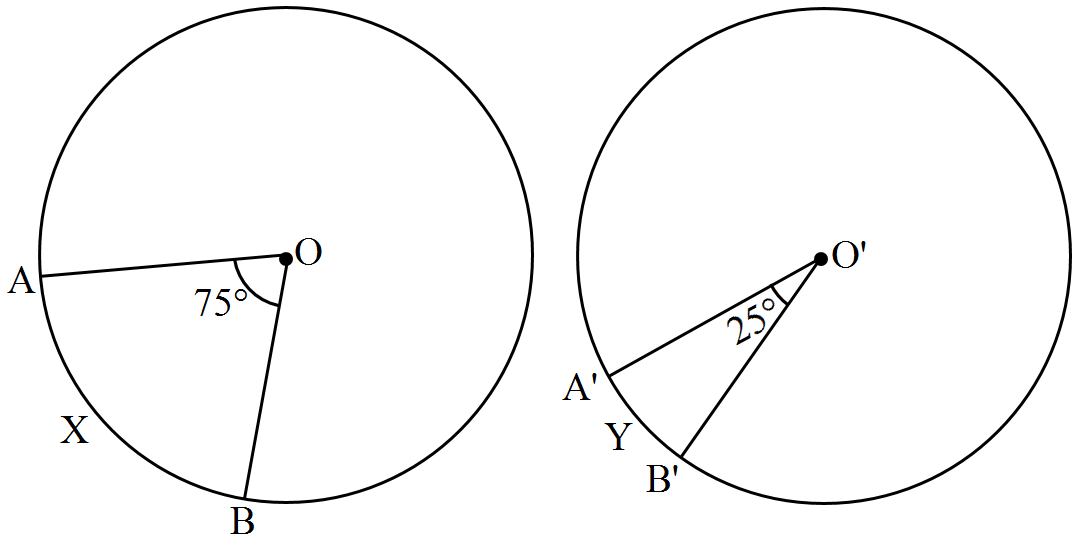
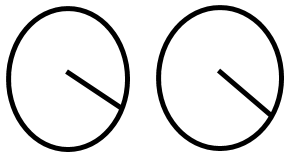
The given figures show two congruent circles with centre $O$ and $O’$. Arc $AXB$ subtends an angle of $75^\circ$ at the centre and arc $A’YB’$ subtends an angle of $25^\circ $ at the centre $O’.$ Then, the ratio of arcs $AXB$ to $A ‘YB’$ is:
  • A
    It is $2 : 1$
  • It is $3 : 1$
  • C
    It is $1 : 3$
  • D
    It is $1 : 2$
Answer
Correct option: B.
It is $3 : 1$

Since, circles are congruent thus we can consider the two arcs as in the same circle. Now the length of the arcs is directly proportional the angle subtended by the arcs. Therefore the lengths of the given arcs would be same in ratio as the ratio of the given angles.
Hence the required ratio is $\frac{75}{25}=\frac{3}{1}.$

View full question & answer
MCQ 1671 Mark
Number of circles that can be drawn through three non-collinear points is:
  • $1$
  • B
    $0$
  • C
    $2$
  • D
    $3$
Answer
Correct option: A.
$1$


Three non-collinear points make a triangle and there is only one circle that can pass through all three points,
i.e. circumcircle of that triangle.

View full question & answer
MCQ 1681 Mark
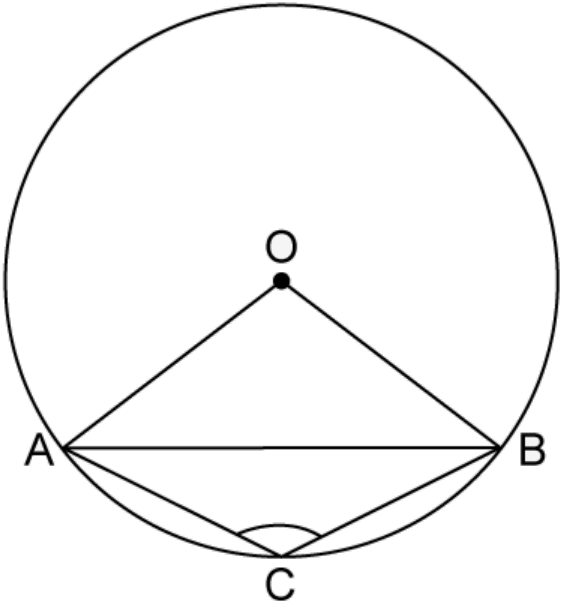
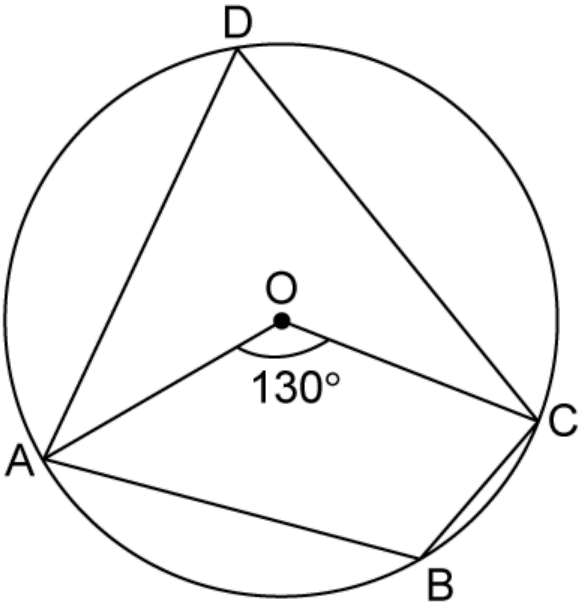
In the given figure, $O$ is the centre of the circle such that $\angle\text{AOC} = 130^\circ,$ then $\angle\text{ABC} =$
  • A
    $130^\circ$
  • $115^\circ$
  • C
    $65^\circ$
  • D
    $165^\circ$
Answer
Correct option: B.
$115^\circ$


$\angle\text{ADC}=\frac{1}{2}\angle\text{AOC}$
$\big\{\angle\text{ADC}$ and $\angle\text{AOC}$ are made by same $\widehat{\text{AC}}$ on centre and cricumference$\big\}$
$\Rightarrow\angle\text{ADC}=\frac{1}{2}\times130^\circ=65^\circ$
$ADCB$ is a cyclic Quadrilateral.
$\Rightarrow\angle\text{D}+\angle\text{B}=180^\circ$
$\Rightarrow\angle\text{ABC}=180^\circ-65^\circ=115^\circ$

View full question & answer
MCQ 1691 Mark
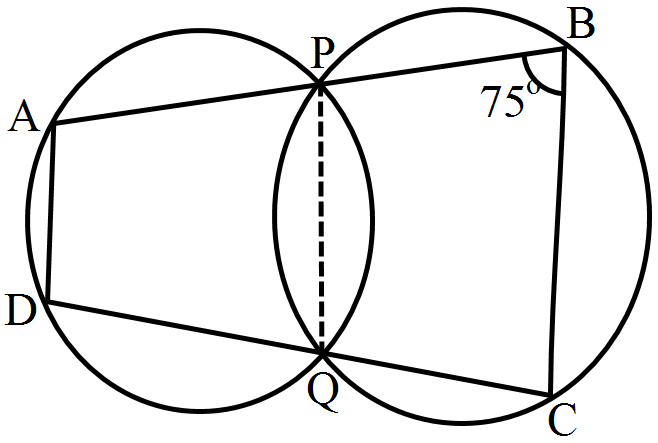
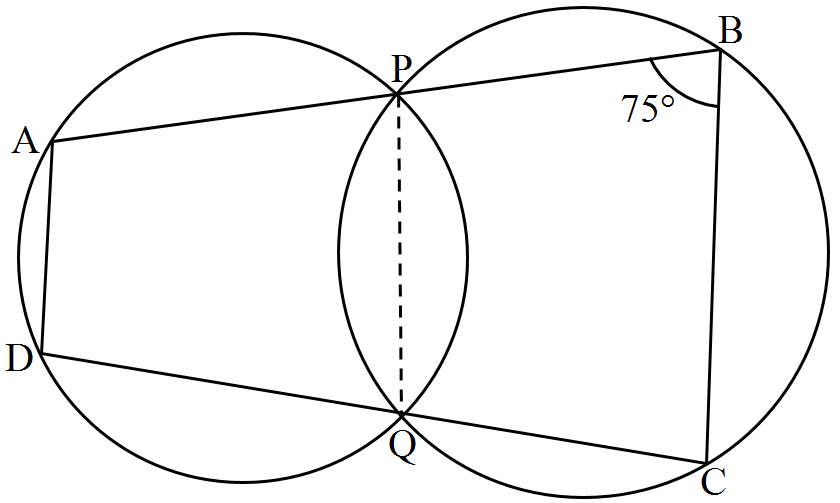
The given figure shows two intersecting circles. If $\angle\text{ABC}=75^\circ,$ then the measure of $\angle\text{PAD}$ is:
  • A
    $75^\circ$
  • $105^\circ$
  • C
    $150^\circ$
  • D
    $125^\circ$
Answer
Correct option: B.
$105^\circ$

Since $\angle\text{PQC}+\angle\text{PBC}=180^\circ$ (Opposite angles of a cyclic quadrilateral))
$\angle\text{PQC}=180^\circ-75^\circ=105^\circ$
Again, $\angle\text{DPQ}+\angle\text{PQC}=180^\circ$ (Linear Pair)
so, $\angle\text{DPQ}=75^\circ$
Also, $\angle\text{PAD}+\angle\text{DQP}=180^\circ$ (Opposite angles of a cyclic quadrilateral)
$\angle\text{PAD}=105^\circ$
View full question & answer
MCQ 1701 Mark
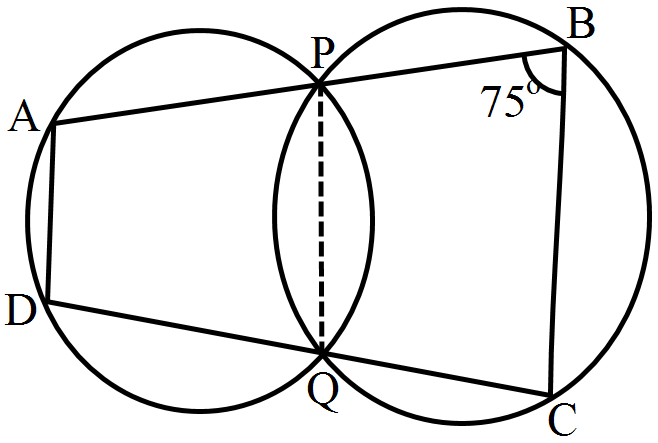
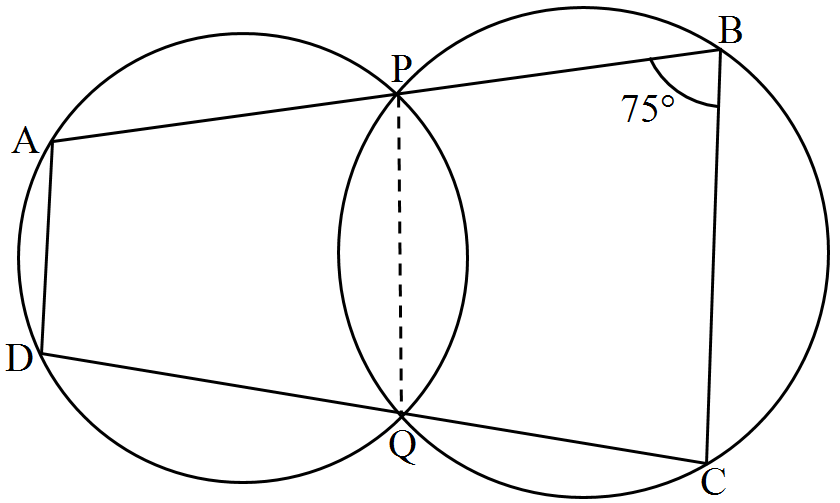
The given figure shows two intersecting circles. If $\angle\text{ABC}=75^\circ$ then the measure of $\angle\text{PAD}$ is:
  • $105^\circ$
  • B
    $150^\circ$
  • C
    $125^\circ$
  • D
    $75^\circ$
Answer
Correct option: A.
$105^\circ$


Since $\angle\text{PQC}+\angle\text{PBC}=180^\circ$ (Opposite angles of a cyclic quadrilateral)
$\angle\text{PQC}=180^\circ-75^\circ=105^\circ$
Again, $\angle\text{DQP}+\angle\text{PQC}=180^\circ$ (Linear Pair)
So, $\angle\text{DQP}=75^\circ$
Also, $\angle\text{PAD}+\angle\text{DQP}=180^\circ$ (Opposite angles of a cyclic quadrilateral)
$\angle\text{PAD}=105^\circ$

View full question & answer
MCQ 1711 Mark
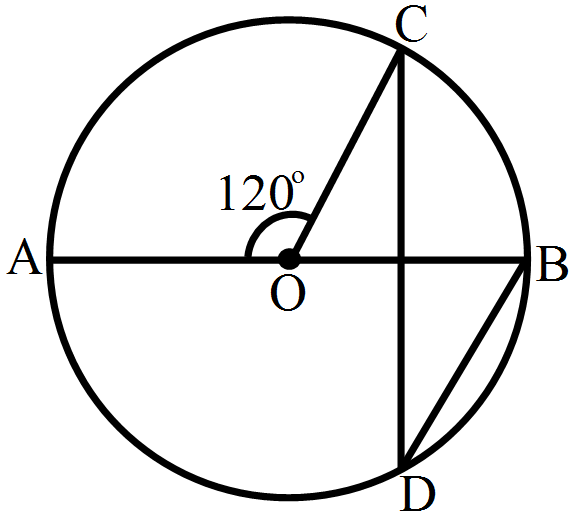
In the given figure, $O$ is the centre of a circle and $\angle\text{AOC}=120^\circ.$ Then, $\angle\text{BDC}=?$
  • A
    $60^\circ$
  • B
    $45^\circ$
  • $30^\circ$
  • D
    $15^\circ $
Answer
Correct option: C.
$30^\circ$

Since $BOA$ is a diameter.
$\angle\text{AOC}+\angle\text{BOC}=180^\circ$
$\Rightarrow\ 120^\circ+\angle\text{BOC}=180^\circ$
$\Rightarrow\ \angle\text{BOC}=60^\circ$
So, $\angle\text{BDC}=\frac{1}{2}\angle\text{BOC}=\frac{1}{2}(60^\circ)=30^\circ$

View full question & answer
MCQ 1721 Mark
If the angles subtended by two chords of a circle at the centre are equal then the chords are:
  • A
    Angle equal.
  • Equal.
  • C
    None of these.
  • D
    Not equal.
Answer
Correct option: B.
Equal.
If the angles subtended by two chords of a circle at the centre are equal then the chords are equal.
It's a theorem.
View full question & answer
MCQ 1731 Mark
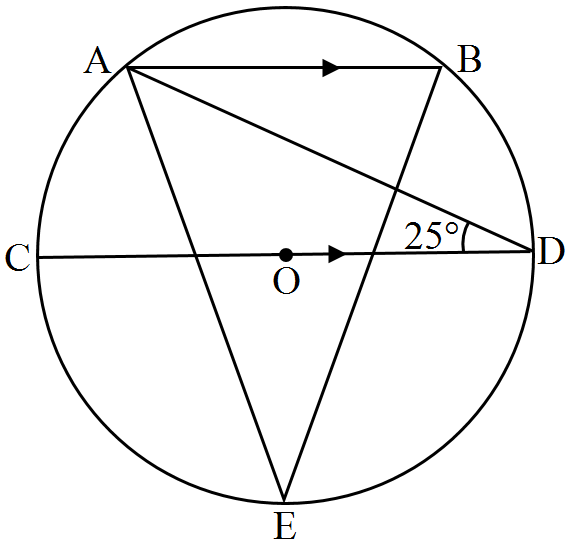
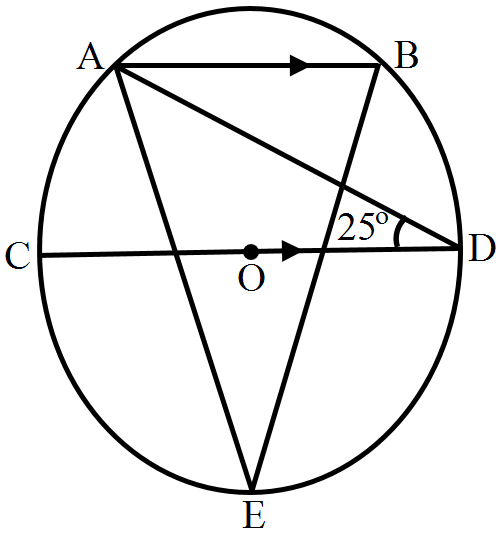
In the given figure, $AB ||\ || CD$ and $O$ is the centre of the circle. If $\angle\text{ADC}=25^\circ,$ then the measure of $\angle\text{AEB}$ is:
  • $40^{\circ}$
  • B
    $25^{\circ}$
  • C
    $80^{\circ}$
  • D
    $60^{\circ}$
Answer
Correct option: A.
$40^{\circ}$


Here, $AB ||\ || CD$ and $\angle\text{ADC}=25^\circ$
So, $\angle\text{DAB}=25^\circ$ (opposite interior angles are equal)
Now, $\angle\text{ADC}=25^\circ,$ so, $\angle\text{AOC}=50^\circ$ (Angle subtended by arc $AC$ at centre is twice the angle subtended at circumference)
Similarly, $\angle\text{DAB}=25^\circ,$ So, $\angle\text{DOB}=50^\circ$(Angle subtended by arc $BD$ at centre is twice the angle subtended at circumference)
$\angle\text{AOB}+\angle\text{DOB}+\angle\text{AOC}=180^\circ$ (All lie in straight line)
$\angle\text{AOB}=180-50=80^\circ$
Now, $\angle\text{AEB}=40^\circ$ (Angle subtended by arc $AB$ at centre is twice the angle subtended at circumference)

View full question & answer
MCQ 1741 Mark
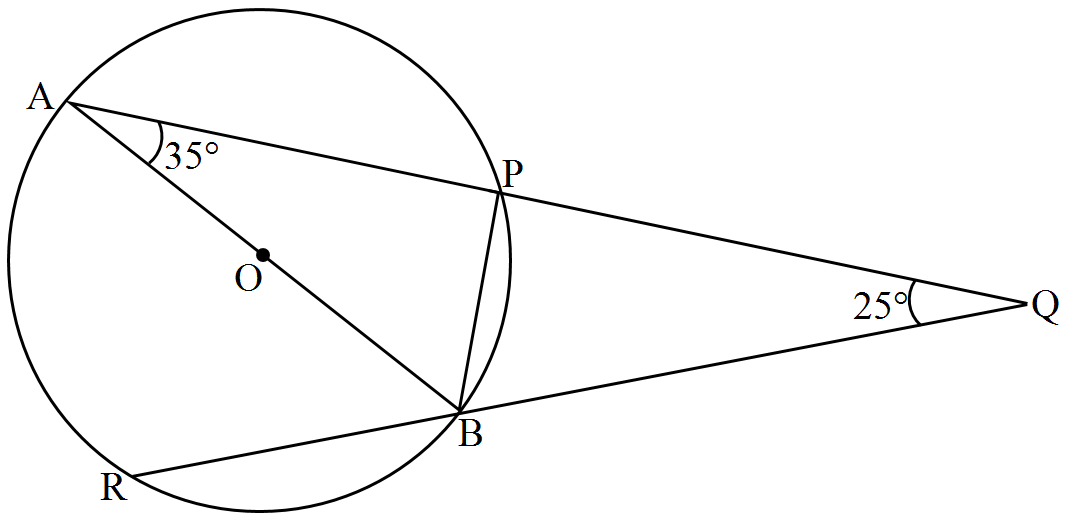
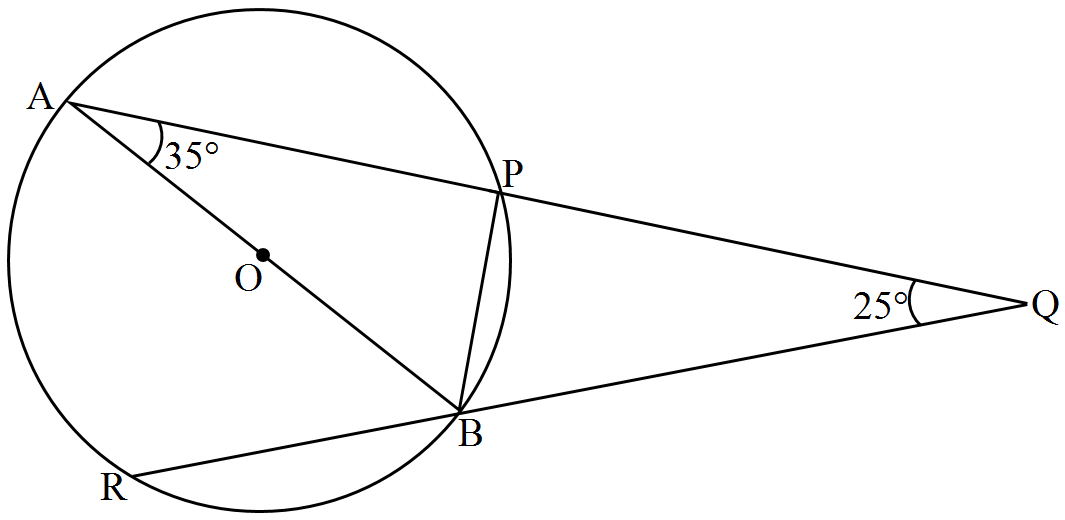
In the given figure, $AB$ is a diameter of the circle $APBR.\ APQ$ and $RBQ$ are straight lines. If $\angle\text{A}=35^\circ$ and then the measure of $\angle\text{PBR}$ is:
  • A
    $135^\circ$
  • B
    $155^\circ$
  • C
    $165^\circ$
  • $115^\circ$
Answer
Correct option: D.
$115^\circ$


$\angle\text{APB}=\angle\text{BPQ}=90^\circ$
Now,
In $\triangle\text{APB},$
$\angle\text{BAP}+\angle\text{APB}+\angle\text{ABP}=180^\circ$
$35^\circ+90^\circ+\angle\text{ABP}=180^\circ$
$\angle\text{ABP}=55^\circ$
Again,
In $\triangle\text{BPQ}$
$\Rightarrow\angle\text{BPQ}+\angle\text{PQB}+\angle\text{PBQ}=180^\circ$
$\Rightarrow90^\circ+25^\circ+\angle\text{PBQ}=180^\circ$
$\Rightarrow\angle\text{PBQ}=65^\circ$
Since, RBQ is a straight line,
$\angle\text{RBA}+\angle\text{ABP}+\angle\text{PBQ}=180^\circ$
$\angle\text{RBA}+55^\circ+65^\circ=180^\circ$
$\angle\text{RBA}=60^\circ$
Finally,
$\angle\text{PBR}=\angle\text{ABP}+\angle\text{RBA}$
$=55^\circ+60^\circ=115^\circ$

View full question & answer
MCQ 1751 Mark
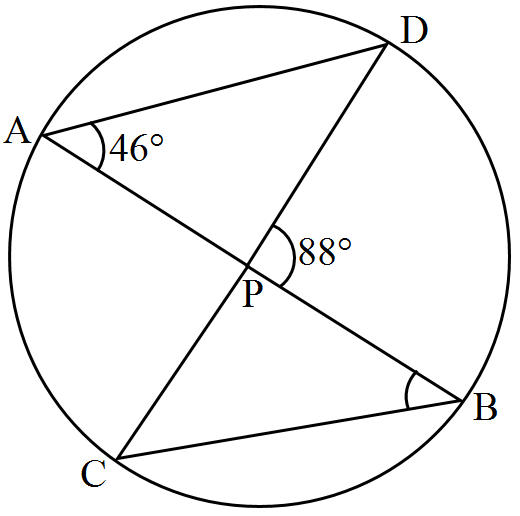
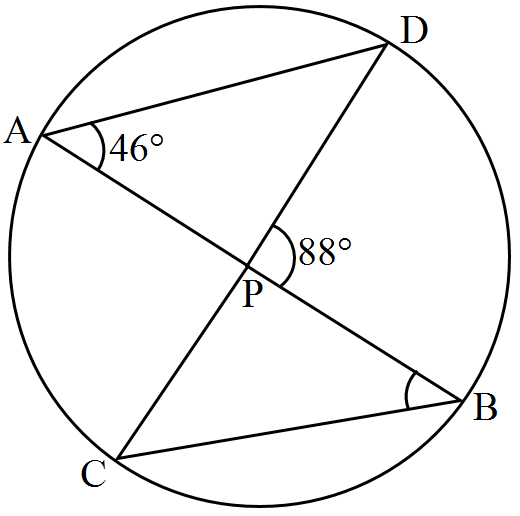
In the given figure, chords $AB$ and $CD$ intersect at $P.$ If $\angle\text{DPB}=88^\circ$ and $\angle\text{DAP}=46^\circ,$ then the measure of $\angle\text{ABC}$ is:
  • A
    $44^\circ $
  • $42^\circ$
  • C
    $48^\circ$
  • D
    $46^\circ$
Answer
Correct option: B.
$42^\circ$


$\angle\text{PCB}=46^\circ ($Angles of same arc$)$
$\angle\text{CPB}=180^\circ-88^\circ=92^\circ ($Linear Pair$)$
So, $\angle\text{PBC}=180^\circ-46^\circ-92^\circ=42^\circ ($Using angle sum property in triangle $PCB)$

View full question & answer
MCQ 1761 Mark
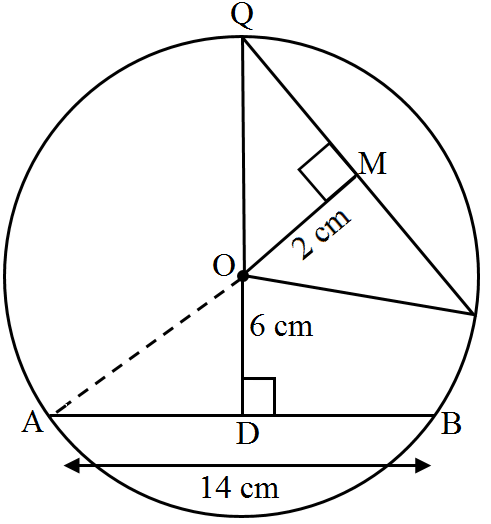
A chord of length $14\ cm$ is at a distance of $6\ cm$ from the centre of a circle. The length of another chord at a distance of $2\ cm$ from he centre of the circle is:
  • A
    $12\ cm$
  • $18\ cm$
  • C
    $14\ cm$
  • D
    $16\ cm$
Answer
Correct option: B.
$18\ cm$

We are given the chord of length $14\ cm$ and perpendicular distance from the centre to the chord is $6\ cm.$ We are asked to find the length of another chord at a distance of $2\ cm$ from the centre.
We have the following figure

We are given $AB = 14\ cm, OD = 6\ cm, MO = 2\ cm, PQ = ?$
Since, perpendicular from centre to the chord divide the chord into two equal parts
Therefore
$A O^2=A D^2+O D^2 \text { [using paythagoras theorem] }$
$=7^2+6^2$
$=49+36$
$\mathrm{AO}=\sqrt{85}$
Now consider the $\triangle O P Q$ in which $O M=2 \mathrm{~cm}$
So using Pythagoras theorem in $\triangle \mathrm{OPM}$
$P M^2=O P^2-O M^2$
$=(\sqrt{85})^2-2^2(\because O P=A O=\text { radius })$
$P M^2=81$
$P M=9 \mathrm{~cm}$
Hence $P Q=2 P M$
$=2 \times 9$
$P Q=18 \mathrm{~cm}$

View full question & answer
MCQ 1771 Mark
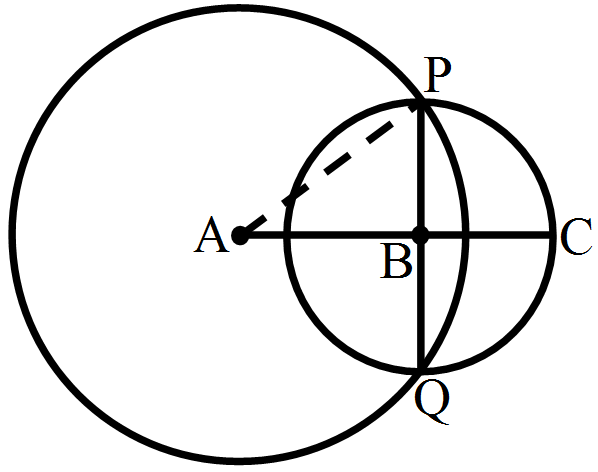
In the given figure, $A$ and $B$ are the centres of two circles having radii $5\ cm$ and $3\ cm$ respectively and intersecting at points $P$ and $Q$ respectively. If $AB = 4\ cm,$ then the length of common chord $PQ$ is:
  • A
    $3\ cm$
  • $6\ cm$
  • C
    $7.5\ cm$
  • D
    $9\ cm$
Answer
Correct option: B.
$6\ cm$
We know that, the line joining centres is the perpendicular bisector of the common chord.
Then,
$\mathrm{AP}=5 \mathrm{~cm}, \mathrm{BP}=3 \mathrm{~cm} \text { and } \mathrm{AB}=4 \mathrm{~cm}$
$A P^2=5^2=25$
$\mathrm{BP}^2+\mathrm{AB}^2=3^2+4^2=25$
$\text { In } \triangle \mathrm{ABP},$
$\text { Since } A P^2=\mathrm{BP}^2+\mathrm{AB}{ }^2$
$\triangle \mathrm{ABP} \text {, is a right-angled triangle and } P Q=2 B P=2(3)=6 \mathrm{~cm} \text {. }$
View full question & answer
MCQ 1781 Mark
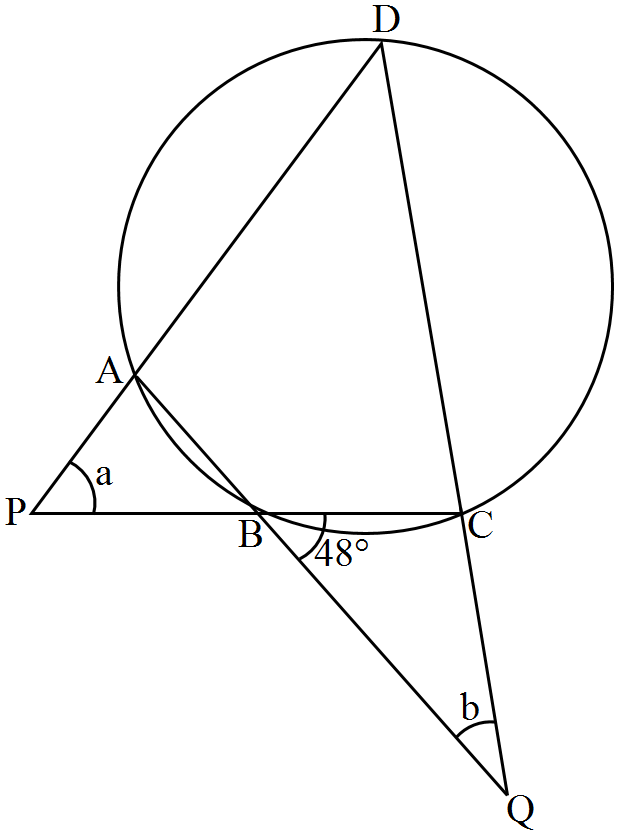
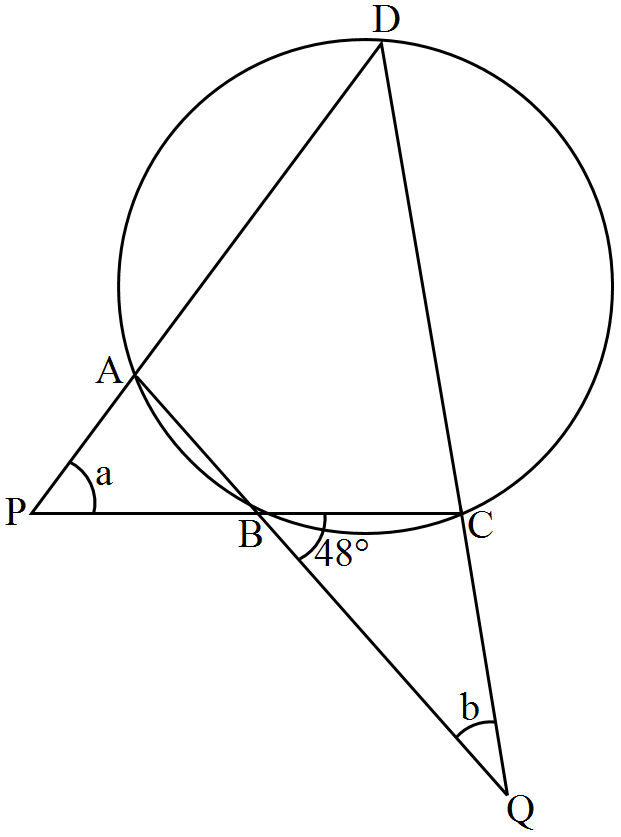
In the given figure, $ABCD$ is a cyclic quadrilateral, $\angle\text{CBQ}=48^\circ$ and $a = 2b.$ Then, $b$ is equal to:
  • A
    $48^\circ$
  • $28^\circ$
  • C
    $38^\circ$
  • D
    $18^\circ$
Answer
Correct option: B.
$28^\circ$

Here, $\angle\text{ABC}$ is supplementary to $\angle\text{CBQ}$
So, $\angle\text{ABC}=180-48=132^\circ.$
Since, $ABCD$ is cyclic quadrilateral, $\angle\text{B}+\angle\text{D}=180^\circ$ {opposite angles are supplementery}
So, $\angle\text{D}=180-132=48^\circ$
Now, in triangle PDC, $\angle\text{P}+\angle\text{D}+\angle\text{C}=180^\circ$
$= a + 48^\circ + (48^\circ + b) = 180^\circ $ {since, $\angle\text{C}$ is external angle to B and b, and sum of two opposite interior angles is equal to external angle}
$= 3b + 96 = 180^\circ $
$3b = 180 - 96 = 84$
$b = 28^\circ $
View full question & answer
MCQ 1791 Mark
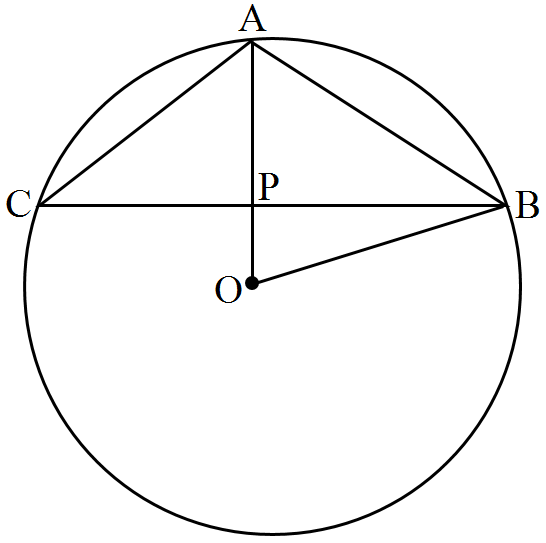
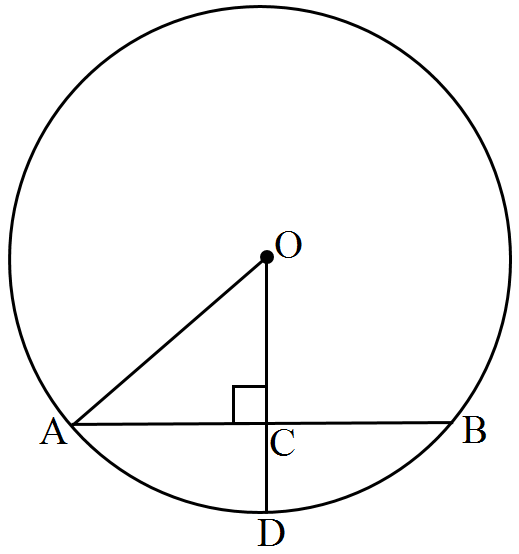
In the given figure if $OA = 5\ cm, AB = 8\ cm$ and $OD$ is perpendicular to $AB$, then $CD$ is equal to:
  • A
    $4\ cm$
  • B
    $5\ cm$
  • $2\ cm$
  • D
    $3\ cm$
Answer
Correct option: C.
$2\ cm$

$AC =4 cm$ and In triangle $ACO$
$AC ^2+ OC ^2= AO$
$42+ OC ^2=52$
$16+ OC ^2=25$
$OC ^2=25-16$
$O C^2=9$
$O C=3$
Now $O D$ being the radius is $5 \ cm$ and $O C$ is $3\ cm$
So, $C D=O D-O C=5-3=2\ cm$
View full question & answer
MCQ 1801 Mark
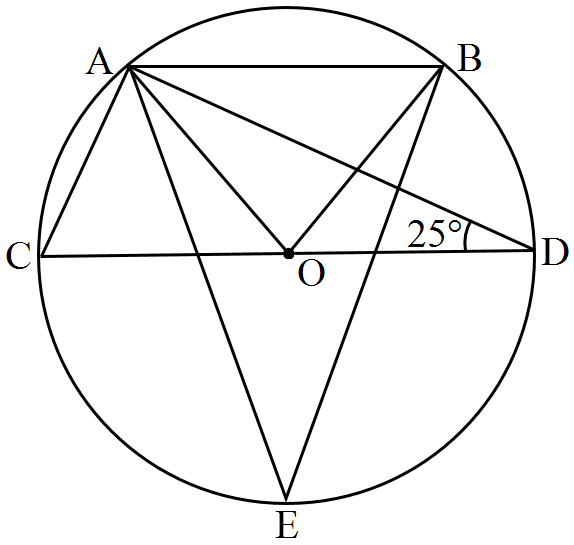
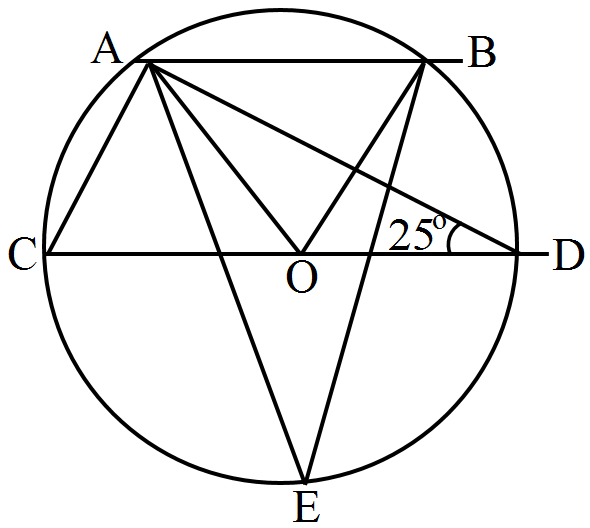
In the given figure, $AB || CD$ and $O$ is the centre of the circle. If $\angle\text{ADC}=25^\circ,$ then the measure of $\angle\text{AEB}$ is:
  • $40^\circ$
  • B
    $80^\circ$
  • C
    $25^\circ$
  • D
    $80^\circ$
Answer
Correct option: A.
$40^\circ$

Here, $AB || CD$ and $\angle\text{ADC}=25^\circ,$
So, $\angle\text{DAB}=25^\circ,$ (opposite interior angles are equal)
Now, $\angle\text{ADC}=25^\circ,$ so, $\angle\text{AOC}=50^\circ$ (Angle subtended by arc $AC$ at centre is twice the angle subtended at circumference)
Similarly, $\angle\text{DAB}=25^\circ,$ so, $\angle\text{DOB}=25^\circ$ (Angle subtended by arc $BD$ at centre is twice the angle subtended at circumference)
$\angle\text{AOB}+\angle\text{DOB}+\angle\text{AOC}=180^\circ$ (All lie in straight line)
$\angle\text{AOB}=180-50-50=80^\circ$
Now, $\angle\text{AEB}=40^\circ$ (Angle subtended by arc $AB$ at centre is twice the angle subtended at circwnference)
View full question & answer
MCQ 1811 Mark
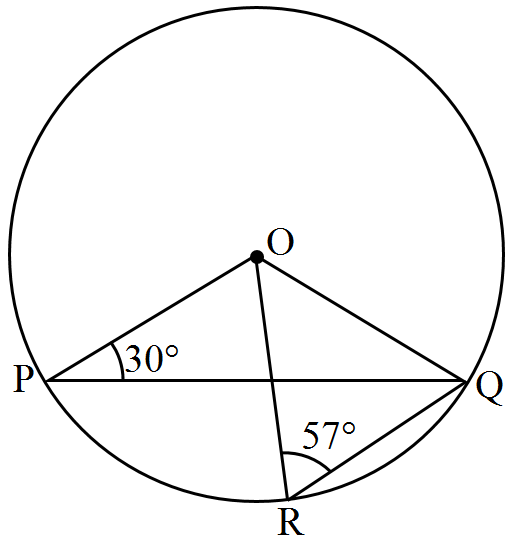
In the given figure, $\angle\text{OPQ}=30^\circ$ and $\angle\text{ORQ}=57^\circ.$ Then, the measure of $\angle\text{POR}$ is:
  • A
    $66^\circ $
  • B
    $33^\circ $
  • $54^\circ $
  • D
    $36^\circ$
Answer
Correct option: C.
$54^\circ $

$\angle\text{OPQ}=\angle\text{OQP}=30^\circ ($Angles of isosceles triangle $OPQ)$
Also, in triangle $OPQ,$
$\angle\text{O}+\angle\text{P}+\angle\text{Q}=180^\circ$
$\angle\text{O}=30^\circ+30^\circ=180^\circ$
$\angle\text{O}=180^\circ-60^\circ=120^\circ$
So, $\angle\text{POQ}=120^\circ\ ...(\text{i})$
Again, in triangle $ORQ$
$\angle\text{R}=\angle\text{Q}=57^\circ$
And $\angle\text{O}+\angle\text{R}+\angle\text{Q}=180^\circ$
$\angle\text{O}+57^\circ+57^\circ=180^\circ$
$\angle\text{O}+180^\circ-114^\circ=66^\circ$
So, $\angle\text{ROQ}=66^\circ\ ...(\text{ii})$
From$(1)$ and $(2)$, we get :-
$\angle\text{POR}=\angle\text{POQ}-\angle\text{ROQ}$
$\Rightarrow\angle\text{POR}=120^\circ-66^\circ=54^\circ$

View full question & answer
MCQ 1821 Mark
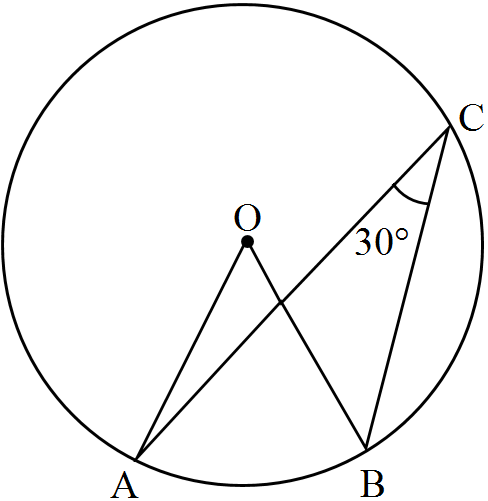
In the given figure, $O$ is the centre of a circle and $\angle\text{ACB}=30^\circ.$ Then, $\angle\text{AOB}=?$
  • $60^\circ$
  • B
    $90^\circ$
  • C
    $30^\circ$
  • D
    $15^\circ$
Answer
Correct option: A.
$60^\circ$

We know that the angle at the centre of a circle is twice the angle at any point on the remaining part of the circumference. Angles $\angle\text{AOB}$ and $\angle\text{ACB}$ are on the same arc $AB.$
Thus, $\angle\text{AOB}=(2\times\angle\text{ACB})=(2\times30^\circ)=60^\circ$

View full question & answer
MCQ 1831 Mark
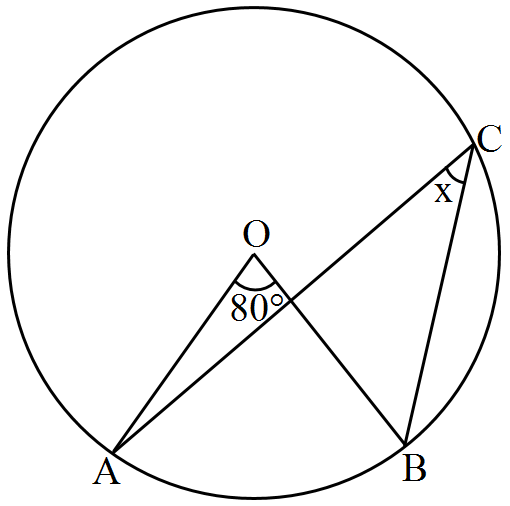
In the figure, $O$ is the centre of eh circle and $\angle\text{AOB}=80^\circ.$ The value of $x$ is:
  • $40^\circ$
  • B
    $30^\circ$
  • C
    $160^\circ$
  • D
    $60^\circ$
Answer
Correct option: A.
$40^\circ$

Angle made by a chord at the centre is twice the angle made by it on any point on the circumference.
$\text{x}=\frac{\angle\text{AOB}}{2}=\frac{80^\circ}{2}=40^\circ$

View full question & answer
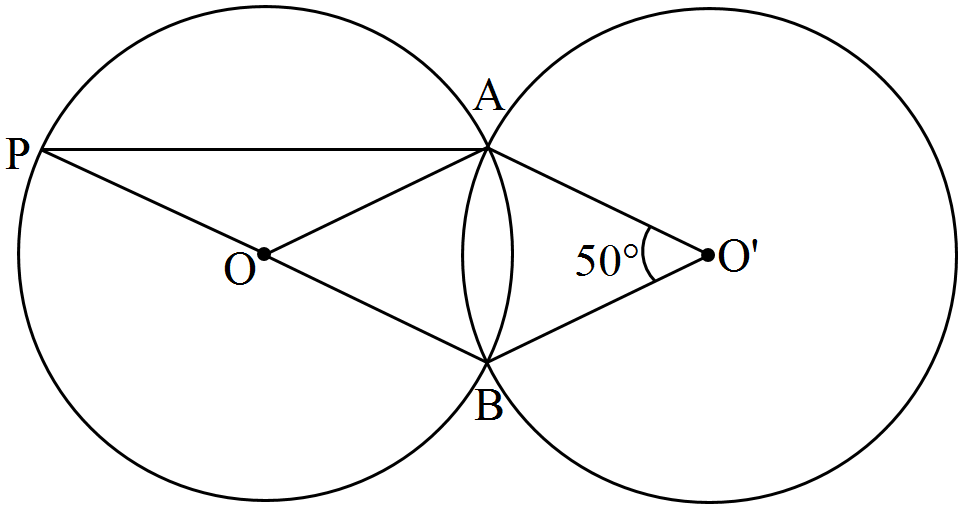
MCQ 1841 Mark
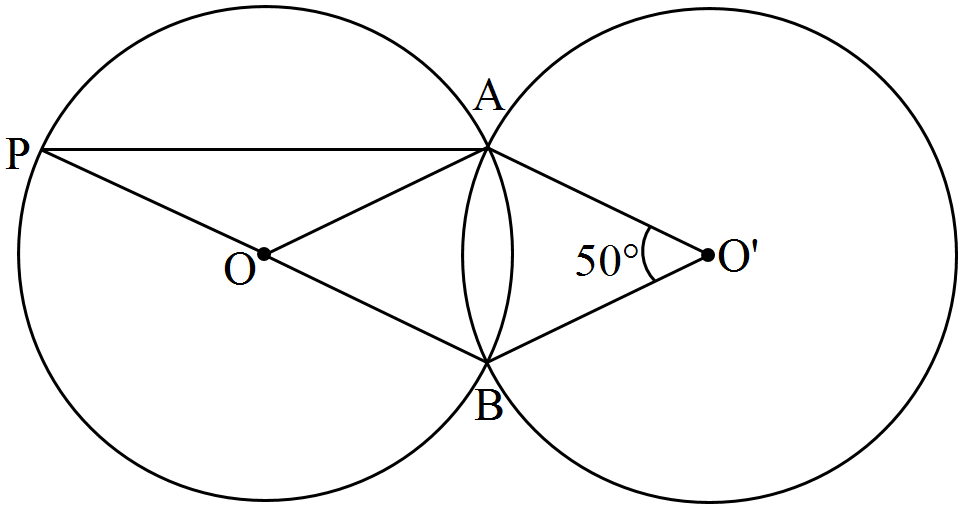
The given figure shows two congruent circles with centre $O$ and $O’$ intersecting at $A$ and $B$. If $\angle\text{AO}'\text{B}=50^\circ,$ then the measure of $\angle\text{APB}$ is:
  • $25^\circ $
  • B
    $50^\circ$
  • C
    $45^\circ$
  • D
    $40^\circ$
Answer
Correct option: A.
$25^\circ $


Since both the triangles are congruent,
So, $OA = O'A,$
$OB = O'B$
$AB = AB ($Common$)$
Hence, $\triangle\text{AOB}\cong\triangle\text{AO}'\text{B}$
Thus, $\angle\text{AOB}=\angle\text{AO}'\text{B}=50^\circ$
Since, PB is a straight line, therefore:-
$\angle\text{AOP}+\angle\text{AOB}=180^\circ$
$\Rightarrow\angle\text{AOP}=180^\circ-50^\circ=130^\circ$
Again, In triangle $OPA,$
$\Rightarrow\angle\text{P}=\angle\text{A}$
$\Rightarrow\angle\text{A}+\angle\text{P}+\angle\text{O}=180^\circ$
$\Rightarrow2\angle\text{P}+130^\circ=180^\circ$
$\Rightarrow\angle\text{P}=\frac{50^\circ}{2}=25^\circ$
Thus, $\angle\text{OPA}=25^\circ$

View full question & answer
MCQ 1851 Mark
If $P$ and $Q$ are any two points on a circle then $PQ$ is called a:
  • Chord
  • B
    Diameter
  • C
    Secant
  • D
    Radius
Answer
Correct option: A.
Chord

A chord is a line formed by any two points on a circle.

View full question & answer
MCQ 1861 Mark
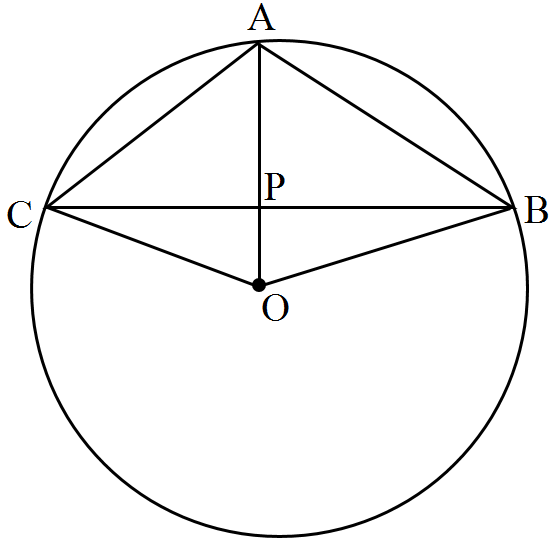
In the given, $AB$ is side of regular five sided polygon and $AC$ is a side of a regular six sided polygon inscribed in the circle with centre $O. AO$ and $CB$ intersect at $P,$ then $\angle\text{APB}$ is equal to:
  • A
    $72^\circ$
  • B
    $90^\circ$
  • C
    $86^\circ$
  • $96^\circ$
Answer
Correct option: D.
$96^\circ$


Here $AC$ is side of hexagon, so it will subtend $60^\circ $ angle at centre and also sides & radius are equal.
Thus, $AC = OC = OA$ and $\angle\text{COA}=\angle\text{OAC}=\angle\text{ACO}=60^\circ$
AB is side of pentagon, so it would subtend angle of $\frac{360}{5}=72^\circ$ angle at centre.
So, $\angle\text{BOP}=72^\circ$
So, $\angle\text{COB}=72+60=132^\circ$
Also since, $\text{OC},\text{OB},\angle\text{OCP}=\text{OBP}$
$\triangle\text{COB}\angle\text{COB}+\angle\text{OBC}+\angle\text{OCB}=180^\circ$
$2\angle\text{OBC}=180-(132)=48^\circ$
$\angle\text{OBC}=24^\circ$
Now, $\triangle\text{BOP}\angle\text{BOP}+\angle\text{OPB}+\angle\text{PBO}=180^\circ$
$\angle\text{OPB}=180-(24+72)=180-96=84^\circ$
Now,
$\angle\text{APB}$ and $\angle\text{OPB}$ lie on straight line, so they are supplementry angles.
$\angle\text{APB}=180-\angle\text{OPB}=180-84=96^\circ$
View full question & answer
MCQ 1871 Mark
The constant distance of a point on a circle from the centre of the circle is called.
  • A
    Diameter
  • B
    Circle
  • Radius
  • D
    Centre
Answer
Correct option: C.
Radius
Radius is the fixed distance of a fixed point from a point on the circle.
Also more precisely, a circle is the locii or the path of a point that moves maintaing a fixed distance from a given point.
View full question & answer
MCQ 1881 Mark
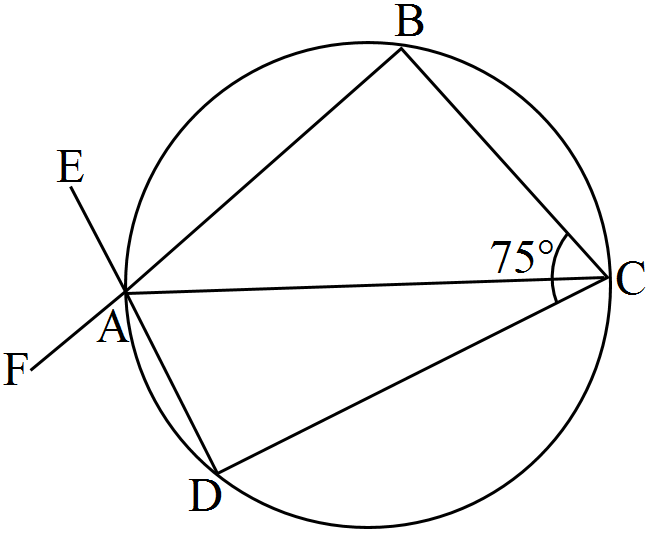
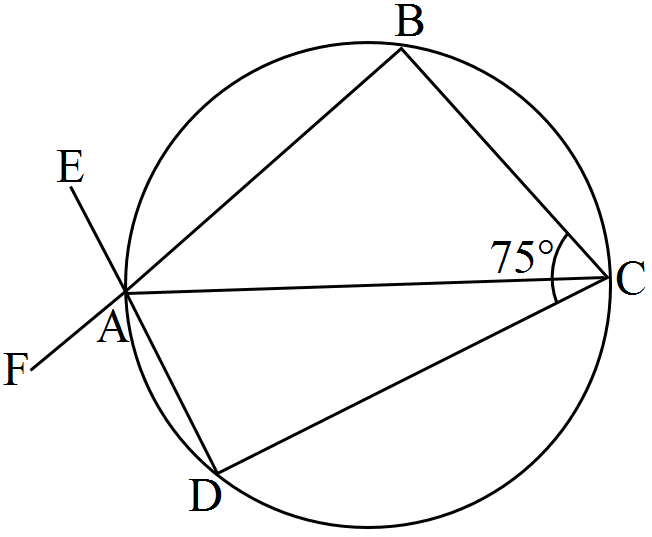
In the given figure, $AC$ is a diameter of the given circle and $\angle\text{BCD}=50^\circ$ Then, $\angle\text{EAF}-\angle\text{ABC}$ is equal to:
  • A
    $25^\circ$
  • $15^\circ$
  • C
    $20^\circ$
  • D
    $10^\circ$
Answer
Correct option: B.
$15^\circ$

$\angle\text{B}=90^\circ$ (Angle in semicircle)
$\angle\text{BAD}=180^\circ-75^\circ=105^\circ$
$\angle\text{EAF}=\angle\text{BAD}=105^\circ$
$\angle\text{EAF}-\angle\text{ABC}=105^\circ-90^\circ=15^\circ$

View full question & answer
MCQ 1891 Mark
One chord of a circle is known to be $10\ cm.$ The radius of this circle must be:
  • A
    $5\ cm.$
  • Greater than $5\ cm$
  • C
    Greater than or equal to $5\ cm$
  • D
    Less than $5\ cm$
Answer
Correct option: B.
Greater than $5\ cm$

The longest chord of a circle is its diameter.
$⇒$ Diameter $>\ 10\ cm$
$⇒ 2\ × \ $Radius $>\ 10\ cm$
$⇒$ Radius $>\ 5\ cm$

View full question & answer
MCQ 1901 Mark
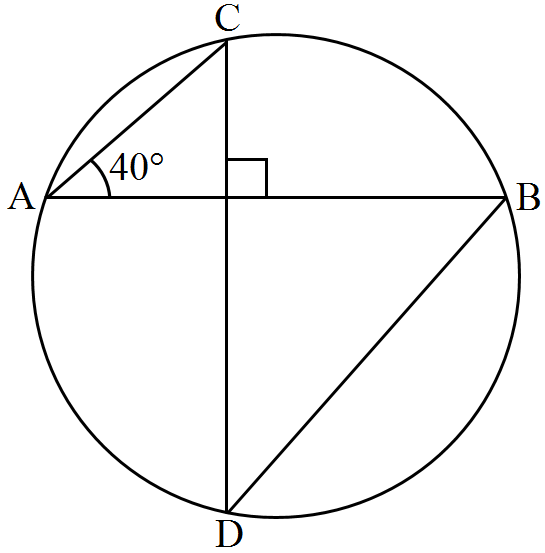
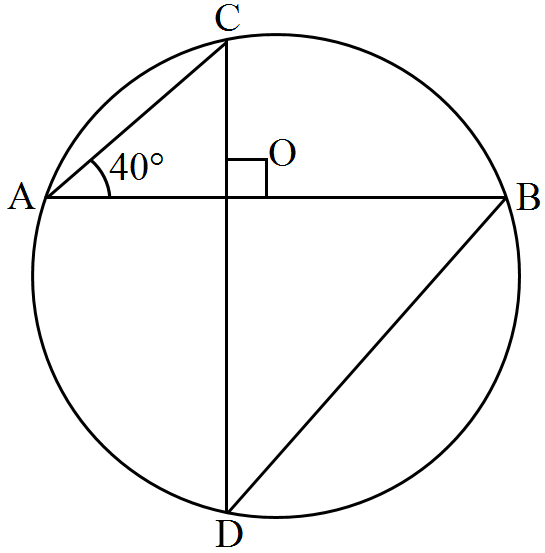
Two chords $AB$ and $CD$ intersect at right angles. If, $\angle\text{BAC}=40^\circ,$ then $\angle\text{ABD}$ is equal to:
  • $50^\circ$
  • B
    $55^\circ$
  • C
    $45^\circ$
  • D
    $60^\circ$
Answer
Correct option: A.
$50^\circ$


Let $AB$ and $CD$ intersect at $O.$ Then In the triangle $ACO,$
$\angle\text{A}+\angle\text{C}+\angle\text{D}=180^\circ$
$40^\circ+\angle\text{C}+90^\circ=180^\circ$
$130^\circ+\angle\text{C}=180^\circ$
$\angle\text{C}=50^\circ$
As per the theorem, Angles in the same segment of a circle are equal.
Hence, $\angle\text{ABD}=\angle\text{C}=50^\circ$

View full question & answer
MCQ 1911 Mark
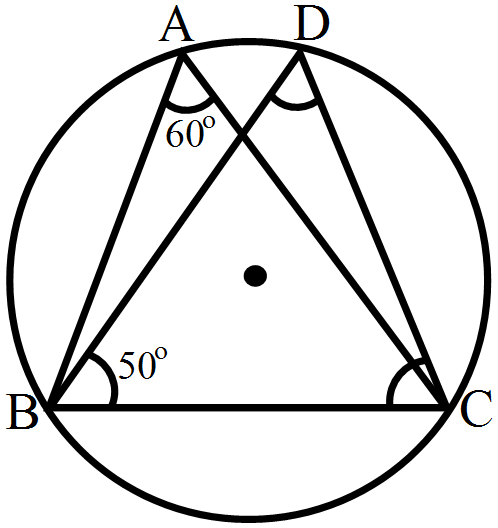
In the given figure, $\triangle\text{ABC}$ and $\triangle\text{DBC}$ are inscribed in a circle such that $\angle\text{BAC}=60^\circ$ and $\angle\text{DBC}=50^\circ.$ Then $\angle\text{BCD}=?$
  • A
    $50^\circ$
  • B
    $60^\circ$
  • $70^\circ$
  • D
    $80^\circ$
Answer
Correct option: C.
$70^\circ$

Since angles in the same segment of a circle are equal.
$\angle\text{BAC}=\angle\text{BDC}=60^\circ.$
In $\triangle\text{BDC},$
$\angle\text{BDC}+\angle\text{DBC}+\angle\text{BCD}=180^\circ.$
$\Rightarrow\ 60^\circ+50^\circ+\angle\text{BCD}=180^\circ$
$\Rightarrow\ \angle\text{BCD}=70^\circ$

View full question & answer
MCQ 1921 Mark
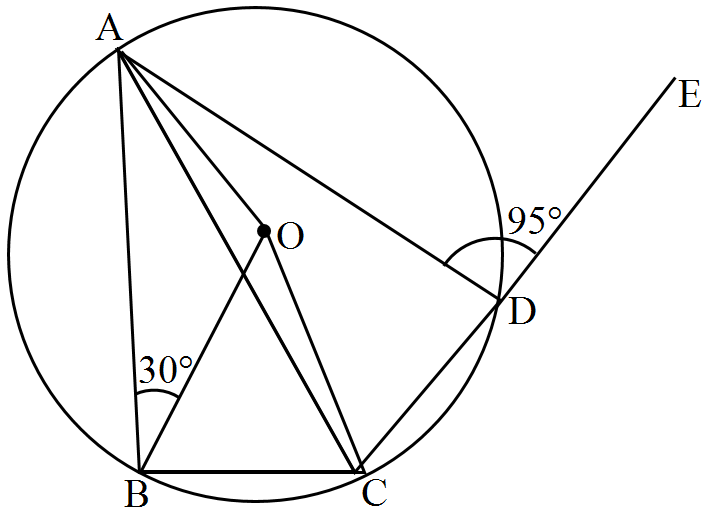
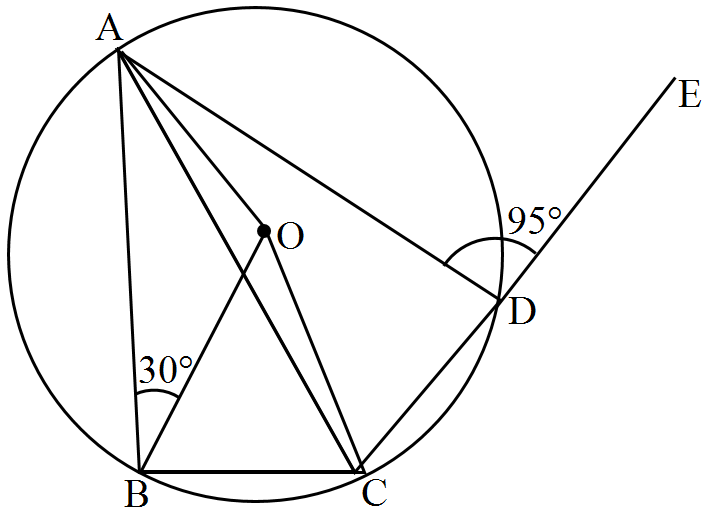
In the given figure, $ABCD$ is a quadrilateral inscribed in circle with centre $O$. $CD$ is produced to $E$. If $\angle\text{ADE}=95^\circ$ and $\angle\text{OBA}=30^\circ,$ then $\angle\text{OAC}$ is equal to:
  • A
    $10^\circ$
  • B
    $20^\circ$
  • C
    $15^\circ$
  • $5^\circ$
Answer
Correct option: D.
$5^\circ$

Here, $\angle\text{ADC}$ and $\angle\text{ADE}$ are supplementary to each other,
So, $\angle\text{ADC}=180-95=85^\circ$
Also, $ABCD$ is also a cyclic quadrilateral so, $\angle\text{ADC}$ and $\angle\text{ABC}$ are supplementary
So, $\angle\text{ABC}=\angle\text{ADC}=180^\circ$
$\angle\text{ABC}=180-95=85^\circ$
angle subtended at centre is double the angle suntended at circumference.
So, $\angle\text{AOC}=170^\circ$
Now, in triangle $AOC, OA = OC($Radii$)$ so, $\angle\text{OAC}=\text{OCA}$
$\angle\text{OCA}+\angle\text{OAC}+\angle\text{AOC}=180^\circ$
$2\angle\text{OAC}=180-170=10^\circ$
$\angle\text{OAC}=5^\circ$
View full question & answer
MCQ 1931 Mark
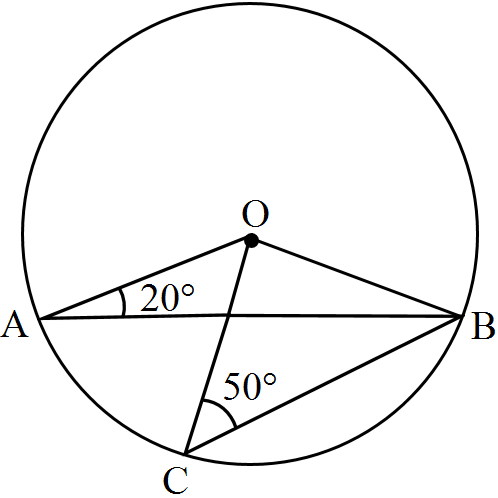
In the given figure, $O$ is the centre of a circle in which $\angle\text{OAB}=20^\circ$ and $\angle\text{OCB}=50^\circ.$ Then, $\angle\text{AOC}=?$
  • A
    $20^\circ$
  • $60^\circ$
  • C
    $70^\circ$
  • D
    $50^\circ$
Answer
Correct option: B.
$60^\circ$

$\text{OA}=\text{OB}\Rightarrow\angle\text{OBA}=\angle\text{OAB}=20^\circ.$
In $\triangle\text{OAB},$
$\angle\text{OAB}+\angle\text{OBA}+\angle\text{AOB}=180^\circ$
$\Rightarrow20^\circ+20^\circ+\angle\text{AOB}=180^\circ$
$\Rightarrow\angle\text{AOB}=140^\circ.$
$\text{OB}=\text{OC}\Rightarrow\angle\text{OBC}=\angle\text{OCB}=50^\circ.$
In $\triangle\text{OCB},$
$\angle\text{OCB}+\angle\text{OBC}+\angle\text{COB}=180^\circ$
$\Rightarrow50^\circ+50^\circ+\angle\text{COB}=180^\circ$
$\Rightarrow\angle\text{COB}=80^\circ.$
$\angle\text{AOB}=140^\circ\Rightarrow\angle\text{AOC}+\angle\text{COB}=140^\circ$
$\Rightarrow\angle\text{AOC}+80^\circ=140^\circ$
$\Rightarrow\angle\text{AOC}=140^\circ-80^\circ$
$\Rightarrow\angle\text{AOC}=60^\circ.$

View full question & answer
MCQ 1941 Mark
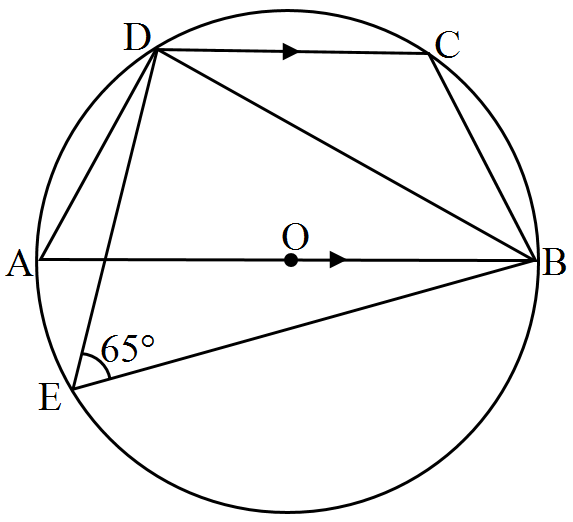
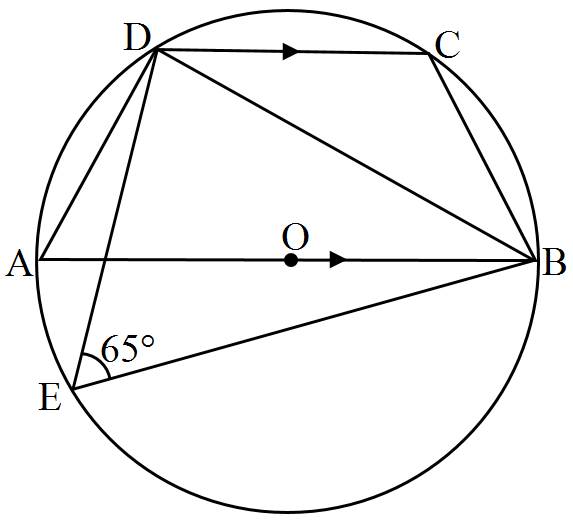
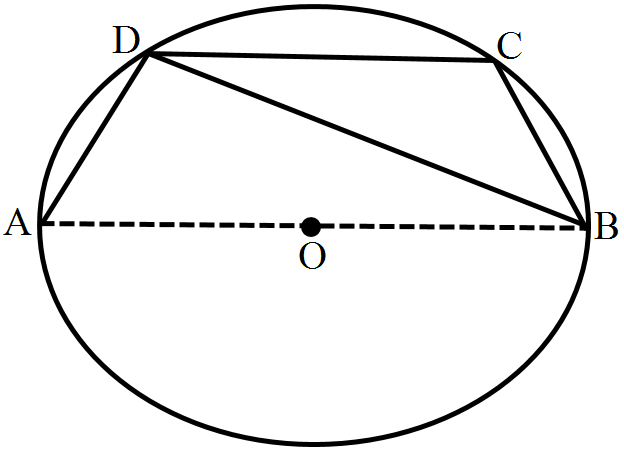
$AOB$ is the diameter of the circle. $ABCD$ is a cyclic trapezium in which $AB || DC.$ If $\angle\text{BED}=65^\circ,$ then $\angle\text{BDC}$ is equal to:
  • A
    $40^\circ$
  • $25^\circ$
  • C
    $65^\circ$
  • D
    $75^\circ$
Answer
Correct option: B.
$25^\circ$

$AB$ is diameter and $ABCD$ is semi-circle, so $\angle\text{ADB}=90^\circ$
Also, $\angle\text{BED}=\angle\text{BAD}=65^\circ$ {Angles in same segment}
so, in $\triangle\text{ABD},\angle\text{BAD}+\angle\text{ABD}+\angle\text{ADB}=180^\circ$
$\angle\text{ADB}=180-155=25^\circ$
Now, since, $AB || CD$
So, $\angle\text{ADB}=\angle\text{BDC}=25^\circ$ {alternate interior angles}
View full question & answer
MCQ 1951 Mark
If $AB = 12\ cm, BC = 16$ and $AB$ is perpendicular to $BC,$ then the radius of the circle passing through the points $A, B$ and $C$ is:.
  • A
    $12\ cm$
  • B
    $6\ cm$
  • C
    $8\ cm$
  • $10\ cm$
Answer
Correct option: D.
$10\ cm$


Since $AB$ is perpendicular to $BC,$ therefore $ABC$ is a right-angled triangle right angled at $B$. As clear from the figure, $AC$ would act as the diameter
$\mathrm{AB}^2+\mathrm{BC}^2=\mathrm{AC}^2$
$12^2+16^2=A C^2$
$A C=20$
Since $AC$ is diameter so radius $= 10\ cm.$

View full question & answer
MCQ 1961 Mark
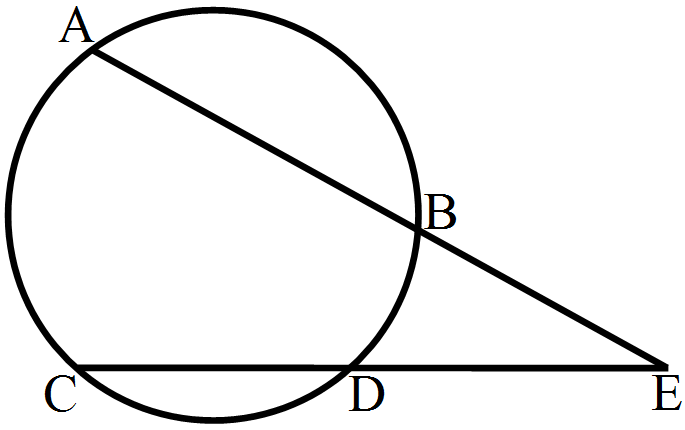
Two chords $AB$ and $CD$ of a circle intersect each other at a point E outside the circle. If $AB = 11\ cm, BE = 3\ cm$ and $DE = 3.5\ cm,$ then $CD = ?$
  • A
    $10.5\ cm$
  • B
    $9.5\ cm$
  • $8.5\ cm$
  • D
    $7.5\ cm$
Answer
Correct option: C.
$8.5\ cm$
Construction: Join $AC$.
$\frac{\text{AE}}{\text{CE}}=\frac{\text{DE}}{\text{BE}}$
$\Rightarrow AE \times BE = DE \times CE ...(i)$
Then,
$AE = AB + BE = 11 + 3 = 14\ cm, BE = 3\ cm, CE = (x + 3.5)\ cm$ and $DE = 3.5\ cm$
So, from $(i),$ we get
$14 \times 3 = 3.5 \times (CD + 3.5)$
$\Rightarrow\ \frac{14\times3}{3.5}=\text{CD}+3.5$
$\Rightarrow 12 = CD + 3.5$
$\Rightarrow CD = 8.5\ cm$
View full question & answer
MCQ 1971 Mark
In the given figure, if $\angle\text{ADC}=118^\circ,$ then the measure of $\angle\text{BDC}$ is:
  • A
    $32^\circ$
  • B
    $38^\circ$
  • $28^\circ$
  • D
    $22^\circ$
Answer
Correct option: C.
$28^\circ$
$\angle\text{ADB}+\angle\text{BDC}=118^\circ$
$90^\circ+\angle\text{BDC}=118^\circ\Rightarrow\angle\text{BDC}=28^\circ$
View full question & answer
MCQ 1981 Mark
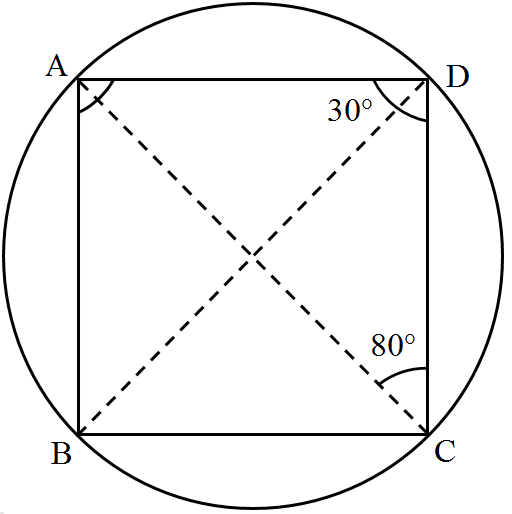
$ABCD$ is a cyclic quadrilateral such that $\angle\text{ADB}=30^\circ$ and $\angle\text{DCA}=80^\circ,$ then $\angle\text{DAB}=$
  • A
    $125^\circ$
  • $70^\circ$
  • C
    $150^\circ$
  • D
    $100^\circ$
Answer
Correct option: B.
$70^\circ$
It is given that $ABCD$ is cyclic quadrilateral $\angle\text{ADB}=90^\circ$ and $\angle\text{DCA}=80^\circ.$ We have to find $\angle\text{DAB}.$
We have the following figure regarding the given information

$\angle\text{BDA}=\angle\text{BCA}=30^\circ$ (Angle in the same segment are equal)
Now, since $ABCD$ is a cyclic quadrilateral
So, $\angle\text{DAB}+\angle\text{BCD}=180^\circ$
$\angle\text{DAB}+\angle\text{BCA}+\angle\text{DCA}=180^\circ\ [\angle\text{BCD}=\angle\text{BCA}+\angle\text{DCA}]$
$\angle\text{DAB}+30^\circ+80^\circ=180^\circ$
$\angle\text{DAB}=180^\circ-110^\circ$
$\angle\text{DAB}=70^\circ$
View full question & answer
MCQ 1991 Mark
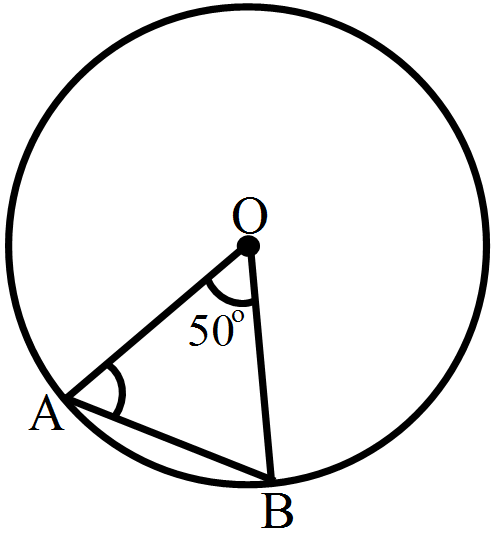
In the given figure, $O$ is the centre of a circle. Then, $\angle\text{OAB}=?$
  • A
    $50^\circ$
  • B
    $60^\circ$
  • C
    $55^\circ$
  • $65^\circ $
Answer
Correct option: D.
$65^\circ $
$OA = OB [$Radii of the same circle$]$
$\Rightarrow\ \angle\text{OAB}=\angle\text{OBA}$
In $\triangle\text{OAB},$
$\angle\text{BOA}+\angle\text{OAB}+\angle\text{OBA}=180^\circ$ [Angle sum property]
$\Rightarrow\ 50^\circ+\angle\text{OAB}+\angle\text{OAB}=180^\circ$
$\Rightarrow\ 2\angle\text{OAB}=130^\circ$
$\Rightarrow\ \angle\text{OAB}=65^\circ$
View full question & answer
MCQ 2001 Mark
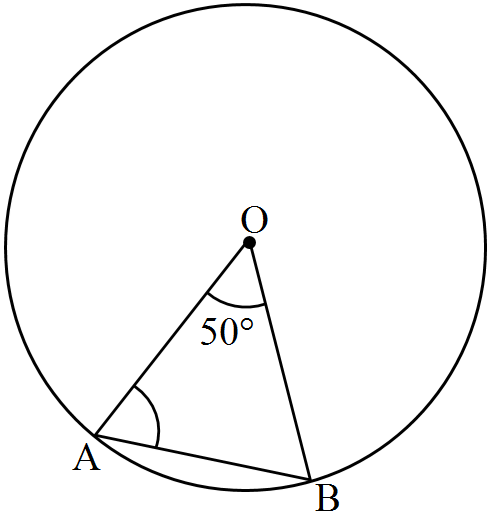
In the given figure, $O$ is the centre of a circle. Then, $\angle\text{OAB}=$
  • A
    $50^\circ $
  • B
    $55^\circ$
  • C
    $60^\circ$
  • $65^\circ$
Answer
Correct option: D.
$65^\circ$
$OA = OB ($Radii of a circle$)$
Let $\angle\text{OAB}=\angle\text{OBA}=\text{x}^\circ$
In $\triangle\text{OAB},$ we have:
$x^\circ + x^\circ + 50^\circ = 180^\circ ($Angle sum property of a triangle$)$
$\Rightarrow 2x^\circ = (180^\circ - 50^\circ ) = 130^\circ $
$\Rightarrow\text{x}^\circ=(\frac{130}{2})^\circ=65^\circ$
Hence, $\angle\text{OAB}=\text{x}^\circ=65^\circ$
View full question & answer
M.C.Q - Page 4 - MATHS STD 9 Questions - Vidyadip