Questions

5 Marks Questions

🎯

Test yourself on this topic

6 questions · timed · auto-graded

Question 15 Marks
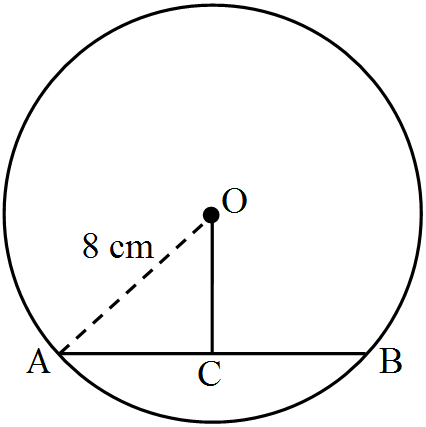
The radius of a circle is $8\ cm$ and the length of one of its chords is $12\ cm$. Find the distance of the chord from the centre.
Answer
Given that,

Radius of circle $(OA) = 8cm$ Chord $(AB) = 12cm$
Draw $\text{OC}\perp\text{AB}$
We know that,
The perpendicular from centre to chord bisects the chord$\therefore\text{AC}=\text{BC}=\frac{12}{2}=6$
Now in $\triangle\text{OCA,}$ by Pythagoras theorem
$AC^2+ OC^2= OA^2$
$\Rightarrow 6^2 + OC^2 = 8^2$
$\Rightarrow 36 + OC^2 = 64$
$\Rightarrow OC^2 = 64 - 36$
$\Rightarrow OC^2 = 28$
$\Rightarrow\text{OC}=\sqrt{28}$
$\Rightarrow OC = 5.291cm$
View full question & answer
Question 25 Marks
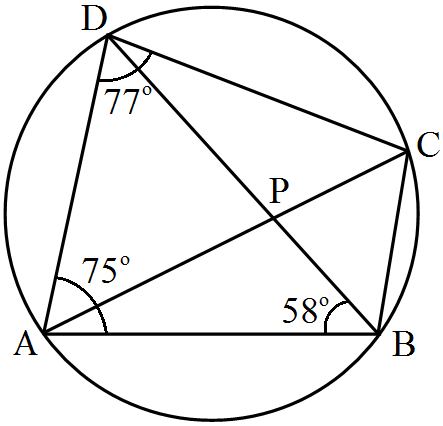
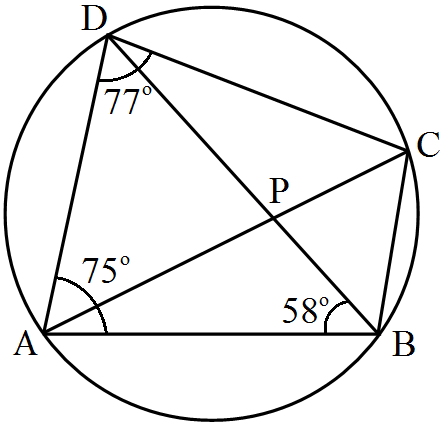
In the given figure, $ABCD$ is a cyclic quadrilateral in which $\angle\text{BAD} = 75^\circ,\ \angle\text{ABD} = 58^\circ$ and $\angle\text{ADC} = 77^\circ, AC$ and $BD$ intersect at $P.$ Then, find $\angle\text{DPC}.$
Answer
In a cyclic quadrilateral it is known that the opposite angles are supplementary, meaning that the opposite angles add up to $180^\circ .$ Here we have a cyclic quadrilateral $ABCD.$ The centre of this circle is given as $‘O’.$

​​​​​​​ Since in a cyclic quadrilateral the opposite angles are supplementary, here $\angle\text{ADC}+\angle\text{ABD}+\angle\text{CBD}=180^\circ$
$\angle\text{CBD}=180^\circ-\angle\text{ADC}-\angle\text{ABD}$
$=180^\circ-77^\circ-58^\circ$
$\angle\text{CBD}=45^\circ$ Whenever a chord is drawn in a circle two segments are formed. One is called the minor segment while the other is called the major segment. The angle that the chord forms with any point on the circumference of a particular segment is always the same.
 Here, $‘CD’$ is a chord and $‘A’$ and $‘B’$ are two points along the circumference on the major segment formed by the chord $‘CD’.$
So, $\angle\text{CBD}=\angle\text{CAD}=45^\circ$
Now, $\angle\text{BAD}=\angle\text{BAC}+\angle\text{CAD}$
$\angle\text{BAC}=\angle\text{BAD}-\angle\text{CAD}$
$=75^\circ-75^\circ$
$\angle\text{BAC}=30^\circ$ In any triangle the sum of the interior angles need to be equal to $180^\circ .$
 Consider the triangle $\triangle\text{ABP},$
$\angle\text{PAB}+\angle\text{ABP}+\angle\text{APB}=180^\circ$
$\Rightarrow\angle\text{APB}=180^\circ-30^\circ-58^\circ$
$\Rightarrow\angle\text{APB}=92^\circ$ From the figure, since $‘AC’$ and $‘BD’$ intersect at $‘P’ $ we have, $\angle\text{APB}=\angle\text{DPC}=92^\circ$ Hence the measure of $\angle\text{DPC}$ is $92^\circ .$
View full question & answer
Question 35 Marks
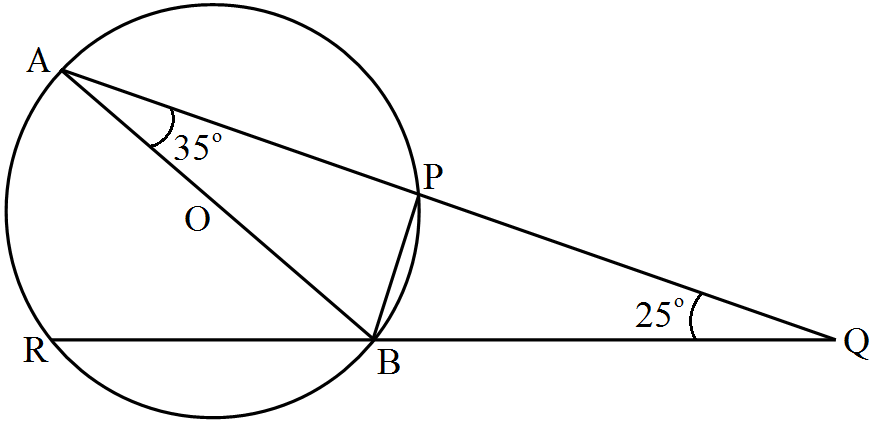
In the given figure, $AB$ is a diameter of the circle such that $\angle\text{A}=35^\circ$ and $\angle\text{Q}=25^\circ,$ find $\angle\text{PBR.}$
 
Answer
Let us first consider the triangle $\triangle\text{ABQ}.$

It is known that in a triangle the sum of all the interior angles add up to $180^\circ .$
So here in our triangle $\triangle\text{ABQ}$
we have, $\angle\text{BAQ}+\angle\text{AQB}+\angle\text{ABQ}=180^\circ$
$\angle\text{ABQ}=180^\circ-\angle\text{BAQ}-\angle\text{AQB}$
$=180^\circ-35^\circ-25^\circ$
$\angle\text{ABQ}=120^\circ$ By a property of the circle we know that an angle formed in a semi-circle will be $90^\circ .$
 In the given circle since $‘AB’$ is the diameter of the circle the angle $\angle\text{APB}$ which is formed in a semi-circle will have to be $90^\circ .$
So, we have $\angle\text{APB}=90^\circ$
Now considering the triangle $\triangle\text{APB}$
we have, $\angle\text{APB}+\angle\text{BAP}+\angle\text{ABP}=180^\circ$
$\angle\text{APB}=180^\circ-\angle\text{APB}-\angle\text{BAP}$
$=180^\circ-90^\circ-35^\circ$
$\angle\text{ABP}=55^\circ$ From the given figure it can be seen that,
$\angle\text{ABP}+\angle\text{PBQ}=\angle\text{ABQ}$
$\angle\text{PBQ}=\angle\text{ABQ}-\angle\text{ABP}$
$=120^\circ-55^\circ$
$\angle\text{PBQ}=65^\circ$
Now, we can also say that, $\angle\text{PBQ}+\angle\text{PBR}=180^\circ$
$\angle\text{PBR}=180^\circ-\angle\text{PBQ}$
$=180^\circ-65^\circ$
$\angle\text{PBR}=115^\circ$
​​​​​​​Hence the measure of the angle $\angle\text{PBR}$ is $115^\circ .$
View full question & answer
Question 45 Marks
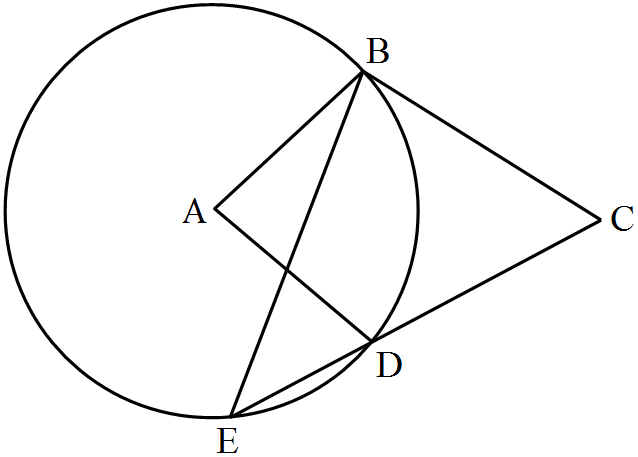
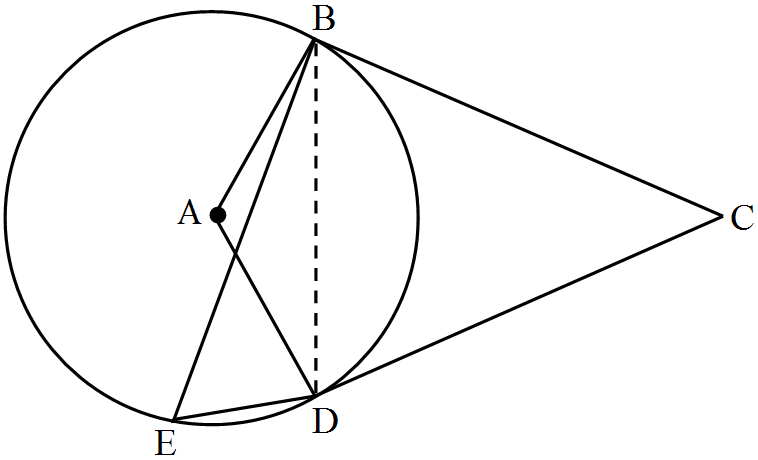
In the given figure, A is the centre of the circle. $ABCD$ is a parallelogram and $CDE$ is a straight line. Find $\angle\text{BCD}:\angle\text{ABE}.$
Answer
It is given that $‘ABCD’$ is a parallelogram. But since $‘A’$ is the centre of the circle, the lengths of $‘AB’$ and $‘AD’$ will both be equal to the radius of the circle.

So, we have $AB = AD$.
Whenever a parallelogram has two adjacent sides equal then it is a rhombus.
So $‘ABCD’$ is a rhombus.
Let $\angle\text{BDE}=\text{x}^\circ.$
We know that in a circle the angle subtended by an arc at the centre of the circle is double the angle subtended by the arc in the remaining part of the circle.
By this property we have
$\angle\text{BAD}=2(\angle\text{BDE})$
$\angle\text{BAD}=\text{2x}^\circ$
In a rhombus the opposite angles are always equal to each other.
So, $\angle\text{BAD}=\angle\text{BCE}=\text{2x}^\circ$
Since the sum of all the internal angles in any triangle sums up to $180^\circ $ in triangle $\triangle\text{BEC},$ we have
$\angle\text{BEC}+\angle\text{BCE}+\angle\text{EBC}=180^\circ$
$\angle\text{EBC}=180^\circ-\angle\text{BEC}-\angle\text{BCE}$
$=180^\circ-\text{x}^\circ-\text{2x}^\circ$
$\angle\text{EBC}=180^\circ-\text{3x}^\circ$
In the rhombus $‘ABCD’$ since one pair of opposite angles are '$2x^ \circ$ ' the other pair of opposite angles have to be $(180^\circ-\text{2x}^\circ)$
From the figure we see that,
$\angle\text{EBC}+\angle\text{AEB}=\angle\text{ABC}$
$\angle\text{ABE}=\angle\text{ABC}-\angle\text{EBC}$
$180^\circ-\text{2x}^\circ-(180^\circ-\text{3x}^\circ)$
$\angle\text{AEB}=\text{x}^\circ$
So now we can write the required ratio as,
$\frac{\angle\text{BCD}}{\angle\text{ABE}}=\frac{\text{2x}^\circ}{\text{x}^\circ}$
$\frac{\angle\text{BCD}}{\angle\text{ABE}}=\frac{2}{1}$
Hence the ratio between the given two angles is $2 : 1$
View full question & answer
Question 55 Marks
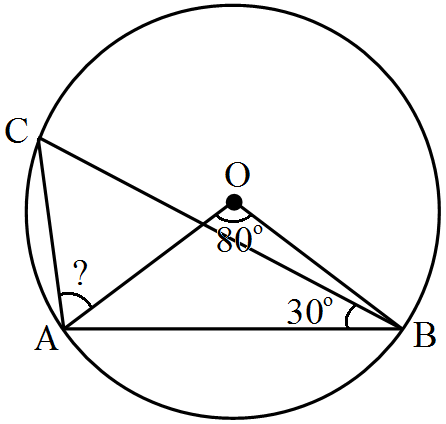
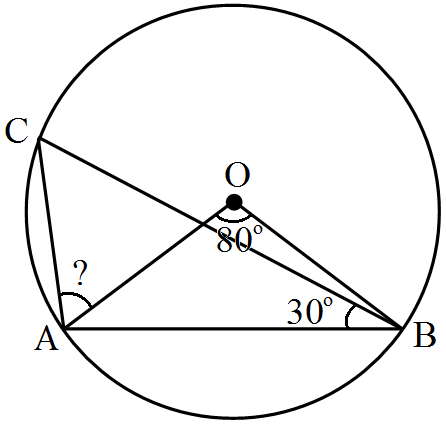
In the given figure, if $\angle\text{AOB} = 80^\circ$ and $\angle\text{ABC} = 30^\circ,$ then find $\angle\text{CAO.}$
Answer
Consider the given circle with the centre $‘O’.$ Let the radius of this circle be $‘r’.$ $‘AB’$ forms a chord and it subtends an angle of 80° with its centre, that is $\angle\text{AOB}=80^\circ.$ The angle subtended by an arc at the centre of the circle is double the angle subtended by the arc in the remaining part of the circle.

So, here we have $\angle\text{ACB}=\frac{\angle\text{AOB}}{2}$
$=\frac{80^\circ}{2}$
$\angle\text{ACB}=40^\circ$ In any triangle the sum of the interior angles need to be equal to $180^\circ .$
Consider the triangle $\triangle\text{AOB}$
$\angle\text{AOB}+\angle\text{OAB}+\angle\text{OBA}=180^\circ$
​​​​​​​Since, $OA = OB = r, $ we have $\angle\text{OAB}=\angle\text{OBA}.$
So the above equation now changes to $\angle\text{AOB}+\angle\text{OAB}+\angle\text{OBA}=180^\circ$
$2\angle\text{OAB}=180^\circ-\angle\text{AOB}$
$=180^\circ-80^\circ$
$2\angle\text{OAB}=100^\circ$
$\angle\text{OAB}=50^\circ$ Considering the triangle $\triangle\text{ABC}$ now, $\angle\text{ACB}+\angle\text{OAB}+\angle\text{OAC}+\angle\text{ABC}=180^\circ$
$\angle\text{OAC}=180^\circ-\angle\text{ACB}-\angle\text{OAB}-\angle\text{ABC}$
$=180^\circ-40^\circ-50^\circ-30^\circ$
$\angle\text{OAC}=60^\circ$
 Hence, the measure of $\angle\text{CAO}$ is $60^\circ .$
View full question & answer
Question 65 Marks
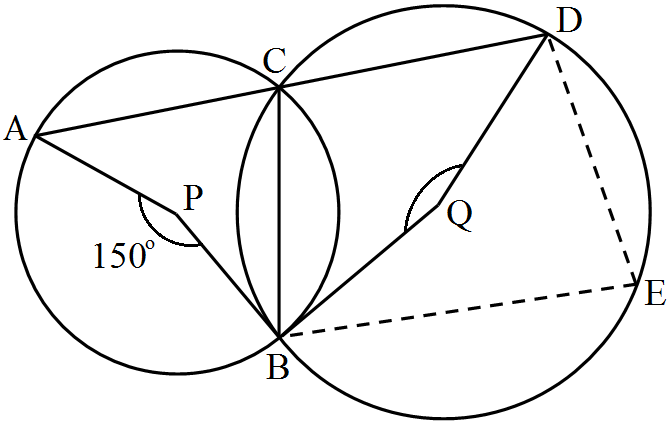
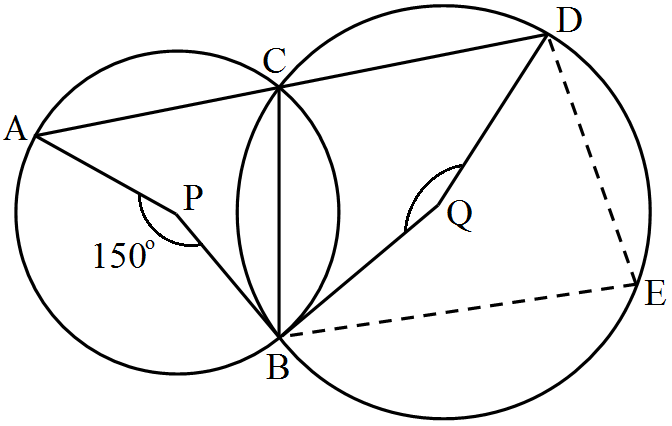
In the given figure, $P$ and $Q$ are centres of two circles intersecting at $B$ and $C.\  ACD$ is a straight line. Then, $\angle\text{BQD} =$
Answer
Consider the circle with the centre $‘P’.$ The angle subtended by an arc at the centre of the circle is double the angle subtended by the arc in the remaining part of the circle.

 So, here we have $\angle\text{ACB}=\frac{\angle\text{APB}}{2}$
$=\frac{150^\circ}{2}$
$\angle\text{ACB}=75^\circ$ Since $‘ACD’$ is a straight line,
we have $\angle\text{ACB}+\angle\text{BCD}=180^\circ$
$\angle\text{BCD}=180^\circ-\angle\text{ACB}$
$=180^\circ-75^\circ$
$\angle\text{BCD}=105^\circ$ Now let us consider the circle with centre $‘Q’.$
Here let $‘E’$ be any point on the circumference along the major arc $‘BD’.$
Now $‘CBED’$ forms a cyclic quadrilateral. In a cyclic quadrilateral it is known that the opposite angles are supplementary, meaning that the opposite angles add up to $180^\circ .$
So here, $\angle\text{BCD}+\angle\text{BED}=180^\circ$
$\angle\text{BED}=180^\circ-\angle\text{BCD}$
$=180^\circ-105^\circ$
$\angle\text{BED}=75^\circ$ The angle subtended by an arc at the centre of the circle is double the angle subtended by the arc in the remaining part of the circle.
So, now we have $\angle\text{BQD}=2\angle\text{BED}$
$=2(75^\circ)$
$\angle\text{BQD}=150^\circ$ Hence, the measure of $\angle\text{BQD}$ is $150^\circ .$
View full question & answer