MCQ 1011 Mark
A river $1.5m$ deep and $30m$ wide is flowing at the rate of $3\ km$ per hour. The volume of water that rims into the sea per minute is.
- ✓
$2250\ m^3$
- B
$2750\ m^3$
- C
$2500\ m^3$
- D
$2000\ m^3$
AnswerCorrect option: A. $2250\ m^3$
Length of the river $= 1.5\ m$
Breadth of the river $= 30\ m$
Depth of the river $= 3\ km = 3000m$
Now, volume of water that runs into the sea $= 1. 5 × 30 × 3000\ m^3= 135000\ m^3$
$\therefore$ Volume of water that runs into the sea per minute $=\frac{135000}{60}=2250\text{m}^3$
View full question & answer→MCQ 1021 Mark
Write the correct answer in the following: The radii of two cylinders are in the ratio of $2 : 3$ and their heights are in the ratio of $5 : 3.$ The ratio of their volumes is:
- A
$10 : 17.$
- ✓
$20 : 27.$
- C
$17 : 27.$
- D
$20 : 37.$
AnswerCorrect option: B. $20 : 27.$
Let the radii of two cylinders be $2r$ and $3r$ respectively and their heights are in the ratio $5h$ and $3h.$ Their volumes be $\mathrm V_1$ and $\mathrm V_2$. Than,
$\frac{\text{V}_1}{\text{V}_2}=\frac{\pi(2\text{r})^2(5\text{h})}{\pi(3\text{r})^2(3\text{h})}=\frac{4\text{r}^2\times5\text{h}}{9\text{r}^2\times3\text{h}}=\frac{20}{27}$
Hence, $(b)$ is the correct answer.
View full question & answer→MCQ 1031 Mark
A solid metal ball of radius $8\ cm$ is melted and cast into smaller balls, each of radius $2\ cm.$ The number of such balls is:
AnswerLet the required number of balls be $n.$
$\Rightarrow\text{n}\times\frac{4}{3}\pi\times(2)^3=\frac{4}{3}\pi\times(8)^3$
$\Rightarrow\text{n}=\frac{8^3}{2^3}$
$\Rightarrow\text{n}=\frac{8\times8\times8}{8}$
$\Rightarrow\text{n}=64$
View full question & answer→MCQ 1041 Mark
Two circular cylinders of equal volume have their heights in the ratio $1 : 2$ Ratio of their radii is:
- A
$1:\sqrt{2}$
- ✓
$\sqrt{2}:1$
- C
$1:2$
- D
$1:4$
AnswerCorrect option: B. $\sqrt{2}:1$
Volume of cylinder $1, \text{v}_1=\pi\text{r}^2_1\text{h}_1$
Volume of cylinder $1, \text{v}_2=\pi\text{r}^2_2\text{h}_2$
$\frac{\text{v}_1}{\text{v}_2}=\frac{\text{r}^2_1}{\text{r}^2_2}\frac{\text{h}_1}{\text{h}_2}...(1)$
Now, $\mathrm {v}_1=\mathrm {v}_2$ and $\frac{\text{h}_1}{\text{h}_2}=\frac{1}{2}$
Hence, Equation $(1)$ reduces to
$1=\frac{\text{r}^2_1}{\text{r}^2_2}=\frac{1}{2}$
$\Rightarrow\frac{\text{r}^2_2}{\text{r}^2_1}=\frac{1}{2}$
$\Rightarrow\frac{\text{r}^2_1}{\text{r}^2_2}=2$
$\Rightarrow\frac{\text{r}^2_1}{\text{r}^2_2}=\frac{\sqrt{2}}{1}$
$\Rightarrow\text{r}_1:\text{r}_2=\sqrt{2}:1$
View full question & answer→MCQ 1051 Mark
The ratio between the curved surface area and the total surface area of a right circular cylinder is $1 : 2.$ If the total surface area is $616\ cm^2$, then the volume of the cylinder is:
- ✓
$1078\ cm^3$
- B
$1232\ cm^3$
- C
$1848\ cm^3$
- D
$924\ cm^3$
AnswerCorrect option: A. $1078\ cm^3$
The ratio between the curved surface area and total surface area given by,
$\frac{2\pi\text{rh}}{2\pi\text{rh}+2\pi\text{r}^2}=\frac{1}{2}$
$\Rightarrow\frac{2\pi\text{r}(\text{h})}{2\pi\text{r}(\text{h}+\text{r})}=\frac{1}{2}$
$\Rightarrow\frac{\text{h}}{\text{h}+\text{r}}=\frac{1}{2}$
$\Rightarrow\text{h}+\text{r}=2\text{h}$
$\Rightarrow\text{h}=\text{r}$
Given total surface area $=2\pi\text{rh}+2\pi\text{r}^2=2\pi\text{r}(\text{h}+\text{r})=616$
$\Rightarrow2\pi\text{r}(\text{h}+\text{r})=616$
$\Rightarrow2\pi\text{r}(\text{r}+\text{r})=616$ $(\because\text{h}=\text{r})$
$\Rightarrow2\pi\text{r}(2\text{r})=616$
$\Rightarrow4\pi\text{r}^2=616$
$\Rightarrow4\times\frac{22}{7}\times\text{r}^2=616$
$\Rightarrow\text{r}^2=\frac{616\times7}{88}$
$\Rightarrow\text{r}^2=49$
$\Rightarrow\text{r}=7\text{cm}$
$\Rightarrow\text{h}=7\text{cm}$ $(\because\text{h}=\text{r})$
Volume of the cylinder$=\pi\text{r}^2\text{h}$
$=\frac{22}{7}\times7\times7\times7$
$=1078\text{cm}^3$
View full question & answer→MCQ 1061 Mark
A conical tent is to accommodate $11$ persons such that each person occpies $4m^2$ of space on the ground. They have $220m^3$ of air to breathe. The height of the cone is:
AnswerArea of the ground $=$ number of person $×$ the amount of space each person occupies
$= 11 × 4$
$\Rightarrow\pi\text{r}^2=44\text{m}^2\ ...(\text{i})$
Given that the volume $= 220m^3$
$\Rightarrow\frac{1}{3}\pi\text{r}^2\text{h}=220$
$\Rightarrow\frac{1}{3}\times44\times\text{h}=220 ...($from $(i))$
$\Rightarrow\text{h}=\frac{220\times3}{44}$
$\Rightarrow\text{h}=15\text{m}$
$⇒$ Height of the cone $= 15m.$
View full question & answer→MCQ 1071 Mark
The total surface area of a cube is $96\ cm^2$. The volume of the cube is:
- A
$512\ cm^3$
- B
$27\ cm^3$
- ✓
$64\ cm^3$
- D
$8\ cm^3$
AnswerCorrect option: C. $64\ cm^3$
Surface area of a cube $= 96\ cm^2$
Surface area of a cube $= 6 ($Side$)^2 = 96$
$⇒ ($Side$)^2 = 16$
$⇒ ($Side$) = 4\ cm$
$[$taking positive square root because side is always a positive quantity$]$
Volume of cube $= ($Side$)^3 = (4)^3 = 64\ cm^3$
Hence, the volume of the cube is $64\ cm^3.$
View full question & answer→MCQ 1081 Mark
The difference between the total surface area of a cube of side $4\ cm$ and its lateral surface area is:
- A
$16\ cm^2$
- ✓
$32\ cm^2$
- C
$24\ cm^2$
- D
$20\ cm^2$
AnswerCorrect option: B. $32\ cm^2$
$TSA$ of cube $-\ LSA$ of cube
$= 6a^2 - 4a^2$
$= 2a^2$
$= 2 × 4 × 4$
$= 32\ cm^2$
View full question & answer→MCQ 1091 Mark
The diameter of a sphere is $6\ cm.$ It is melted and drawn into a wire of diameter $2\ mm.$ The length of the wire is.
AnswerRadius of the sphere $= 3\ cm$
Volume of a sphere $=\frac{4}{3}\pi\text{r}^3$
$=\frac{4}{3}\pi(3)^3$
$=36\pi\text{cm}^3$
On recasting a sphere into cylinder wire, the volume will remain same
Volume of a cylinder $=\pi\text{r}^2\text{h}$
$1\ cm = 10\ mm$
$⇒ 2\ mm = 0.2\ cm$
Radius $= 0.1\ cm$
$\Rightarrow\pi(0.1)^2\text{h}=36\pi$
$\Rightarrow\text{h}=36\times\frac{1}{0.01}$
$⇒ h = 3600\ cm$
$⇒ h = 36m (\therefore 1m = 100\ cm)$
View full question & answer→MCQ 1101 Mark
The volume of a spherical shell is given by:
- A
$\frac{4}{3}\pi(\text{R}^2-\text{r}^2)$
- ✓
$\frac{4}{3}\pi(\text{R}^3-\text{r}^3)$
- C
$\pi(\text{R}^3-\text{r}^3)$
- D
${4}\pi(\text{R}^3-\text{r}^3)$
AnswerCorrect option: B. $\frac{4}{3}\pi(\text{R}^3-\text{r}^3)$
The volume of a spherical shell is given by $\frac{4}{3}\pi(\text{R}^3-\text{r}^3)$ where $R =$ Larger radius and $r =$ smaller radius.
View full question & answer→MCQ 1111 Mark
The volume of a cone is $1570\ cm^3$ and its height is $15\ cm.$ What is the radius of the cone$? \big(\text{Use}\ \pi=3.14\big).$
- ✓
$10\ cm$
- B
$9\ cm$
- C
$12\ cm$
- D
$8.5\ cm$
AnswerCorrect option: A. $10\ cm$
Let $r$ be the radius of the cone.
Volume $= 1570\ cm^3$
$1570=\frac{1}{3}\times3.14\times\text{r}^2\times15$
$\Rightarrow1570=3.14\times\text{r}^2\times15$
$\Rightarrow\text{r}^2=100$
$\Rightarrow\text{r}=10\text{cm}$
View full question & answer→MCQ 1121 Mark
If a sphere is inscribed in a cube, then the ratio of the volume of the cube to the volume of the sphere is:
- A
$\pi:6$
- B
$4:\pi$
- C
$\pi:4$
- ✓
$6:\pi$
AnswerCorrect option: D. $6:\pi$
Let side of cube be a
Here, side of cube$=$ diameter of sphere
So, radius of sphere $=\frac{\text{a}}{2}$
The volume of cube $:$ volume of sphere
$\text{a}^3:\frac{4}{3}\pi\text{r}^3$
$\text{a}^3:\frac{4}{3}\pi\Big(\frac{\text{a}}{2}\Big)^3$
$3\times8\times\text{a}^3:4\pi\text{a}^3$
$6:\pi$
View full question & answer→MCQ 1131 Mark
If the ratio of the volumes of two spheres is $1 : 8$ then the ratio of their surface area is$:$
- A
$1 : 2$
- ✓
$1 : 4$
- C
$1 : 8$
- D
$1 : 16$
AnswerCorrect option: B. $1 : 4$
The ratio of the volumes of two sphere is given by $\frac{\frac{4}{3}\pi\text{r}^3}{\frac{4}{3}\pi\text{R}^3}.$
$\Rightarrow\frac{\frac{4}{3}\pi\text{r}^3}{\frac{4}{3}\pi\text{R}^3}=\frac{1}{8}$
$\Rightarrow\frac{\text{r}^3}{\text{R}^3}=\frac{1}{8}$
$\Rightarrow\Big(\frac{\text{r}}{\text{R}}\Big)^3=\frac{1}{8}$
$\Rightarrow\frac{\text{r}}{\text{R}}=\frac{1}{2}\ ...(\text{i})$
$⇒$ Ratio of the volumes $= 1 : 2$
Now,
Ratio of their surface area $=\frac{4\pi\text{r}^2}{4\pi\text{R}^2}$
$=\frac{\text{r}^2}{\text{R}^2}$
$=\Big(\frac{\text{r}}{\text{R}}\Big)^2$
$=\Big(\frac{1}{2}\Big)^2 ...($from $(i))$
$=\frac{1}{4}$
$⇒$ Ratio of their surface area $= 1 : 4.$
View full question & answer→MCQ 1141 Mark
If the ratio of volumes of two spheres is $1 : 8$, then the ratio of their surface areas is:
- ✓
$1 : 4$
- B
$1 : 2$
- C
$1 : 16$
- D
$1 : 8$
AnswerCorrect option: A. $1 : 4$
Ratio of volume of spheres $= ($ratio of radius$)^3$
Given, ratio of volumes of two spheres is $1 : 8$
$⇒ ($ratio of radius$)^3 = 1 : 8$
$⇒$ ratio of radius $= 1 : 2$
Ratio of surface area $= ($ratio of radius$)^2$
$⇒$ Ratio of surface area $= 1 : 4$
View full question & answer→MCQ 1151 Mark
Directions: In the following questions, the Assertions $(A)$ and Reason$(s) (R)$ have been put forward. Read both the statements carefully and choose the correct alternative from the following:
Assertion: Circle, rectangles, square and triangles arevplane figure.
Reason: Plane figure posses perimeter and area.
- A
Both Assertion and reason are correct and reason is correct explanation for Assertion.
- ✓
Both Assertion and reason are correct but reason is not correct explanation for Assertion.
- C
Assertion is correct but reason is false.
- D
Both Assertions and reason are false.
AnswerCorrect option: B. Both Assertion and reason are correct but reason is not correct explanation for Assertion.
Both Assertion and reason are correct but reason is not correct explanation for Assertion.
View full question & answer→MCQ 1161 Mark
A cylinder with radius $r$ and height $h$ is closed on the top and bottom. Which of the following expressions represents the total surface area of this cylinder$?$
- ✓
$2\pi\text{r}(\text{r}+\text{h})$
- B
$\pi\text{r}(2\text{r}+\text{h})$
- C
$2\pi\text{r}^2+\text{h}$
- D
$\pi\text{r}(\text{r}+2\text{h})$
AnswerCorrect option: A. $2\pi\text{r}(\text{r}+\text{h})$
Let $S$ be the total surface area of the closed cylinder with radius $r$ and height $h,$ then
$\text{S}=2\pi\text{r}^2+2\pi\text{rh}$
$\Rightarrow\text{S}=2\pi\text{r}+2(\text{r}+\text{h})$
View full question & answer→MCQ 1171 Mark
The volume of a right circular cylinder is $2310\ cm^3$. If the radius of its base is $7\ cm,$ then its height is
- A
$7.5\ cm$
- B
$22.5\ cm$
- ✓
$15\ cm$
- D
$30\ cm$
AnswerCorrect option: C. $15\ cm$
Volume of cylinder $=\pi\text{r}^2\text{h}$
$2310=\frac{22}{7}\times7\times7\times\text{h}$
$\text{h}=\frac{2310}{22\times7}$
$\text{h}=15\text{cm}$
$=15\text{cm}$
View full question & answer→MCQ 1181 Mark
The ratio between the radius of the base and the height of a cylinder is $2 : 3.$ If its volume is $1617\ cm^3$ then its total surface area is:
- A
$308\ cm^2$
- B
$462\ cm^2$
- ✓
$770\ cm^2$
- D
$540\ cm^2$
AnswerCorrect option: C. $770\ cm^2$
$\frac{\text{r}}{\text{h}}=\frac{2}{3}$
$\text{r}=\frac{2}{3}\text{h}$
Volume of cylinder $=\pi\text{r}^2\text{h}$
$1617=\frac{22}{7}\cdot\frac{2}{3}\text{h}\cdot\frac{2}{3}\text{h}\cdot\frac{2}{3}\text{h}\cdot\text{h}$
$\text{h}^3=\frac{1617.7.9}{22.4}$
$\text{h}=\frac{21}{2}\text{cm}\text{r}=7\text{cm}$
Total surface area of cylinder $=2\pi\text{rh}+2\pi\text{r}^2$
$=2\cdot\frac{22}{7}\big(7\cdot\frac{21}{2}+7\cdot7\big)$
$=770\text{cm}^2$
View full question & answer→MCQ 1191 Mark
The slant height of a cone is increased by $10\%.$ If the radius remains the same, the curved surface area is increased by.
- ✓
$10\%$
- B
$21\%$
- C
$12.1\%$
- D
$20\%$
AnswerCorrect option: A. $10\%$
The formula of the curved surface area of a cone with base radius $'r'$ and slant height '' is given as
Curved Surface Area $=\pi\text{rl}$
Now, it is said that the slant height has increase by $10\%.$ So the new slant height $'1.1 l'$
So, now
New Curved Surface Area $=1.1\pi\text{rl}$
We see that the percentage increase of the Curved Surface Area is $10\%$
View full question & answer→MCQ 1201 Mark
Write the correct answer in the following: The total surface area of a cone whose radius is $\frac{\text{r}}{2}$ and slant height 2l is:
- A
$2\pi\text{r}(\text{l+r})$
- ✓
$\pi\text{r}\Big(\text{l+}\frac{\text{r}}{4}\Big)$
- C
$\pi\text{r}(\text{l+r})$
- D
$2\pi\text{rl}$
AnswerCorrect option: B. $\pi\text{r}\Big(\text{l+}\frac{\text{r}}{4}\Big)$
Total surface area of cone $=$ Area of the base $+$ Curved Surface area of cone
$=\pi\Big(\frac{\text{r}}{2}\Big)^2+\pi\Big(\frac{\text{r}}{2}\Big)\times2\text{l}=\frac{\pi\text{r}}{2}\Big(\frac{\text{r}}{2}+2\text{l}\Big)$
$=\frac{\pi\text{r}}{4}(\text{r}+4\text{l})=\pi\text{r}\Big(\text{l}+\frac{\text{r}}{4}\Big)$
Hence, $(b)$ is the correct answer.
View full question & answer→MCQ 1211 Mark
The diameter of the base of a cylinder is $6\ cm$ and its height is $14\ cm.$ The volume of the cylinder is:
- ✓
$396\ cm^3$
- B
$495\ cm^3$
- C
$297\ cm^3$
- D
$198\ cm^3$
AnswerCorrect option: A. $396\ cm^3$
Volume of a cylinder $=\pi\text{r}^2\text{h}$
Diameter $= 6\ cm$
$⇒$ radius $= 3\ cm$
$\Rightarrow\text{Volume}=\frac{22}{7}\times3^2\times14$
$= 22 × 9 × 2 = 396\ cm^3$
View full question & answer→MCQ 1221 Mark
The difference between the total surface area of a cube of side $4\ cm$ and its lateral surface area is:
- A
$24\ cm^2$
- B
$20\ cm^2$
- C
$16\ cm^2$
- ✓
$32\ cm^2$
AnswerCorrect option: D. $32\ cm^2$
$TSA$ of cube $-\ LSA$ of cube
$= 6a^2 - 4a^2$
$= 2a^2$
$= 2 × 4 × 4$
$= 32\ cm^2$
View full question & answer→MCQ 1231 Mark
If the ratio of the radii of bases of two cones is $3 : 1$ and the ratio of their heights is $1 : 3,$ then the ratio of their volumes is:
- A
$2 : 1$
- B
$1 : 3$
- ✓
$3 : 1$
- D
$1 : 2$
AnswerCorrect option: C. $3 : 1$
Volume of cone$^1$ : Volume of cone$^2$
$\frac{1}{3}\pi\text{r}^2_1:\frac{1}{3}\pi\text{r}^2_2\text{h}_2$
$=3^2\times1:1^2\times3=9:3$
$3:1$
View full question & answer→MCQ 1241 Mark
A cone, a hemisphere and a cylinder stand on equal bases and have the same height. The ratio of their volumes is:
- ✓
$1 : 2 : 3$
- B
$2 : 1 : 3$
- C
$2 : 3 : 1$
- D
$3 : 2 : 1$
AnswerCorrect option: A. $1 : 2 : 3$
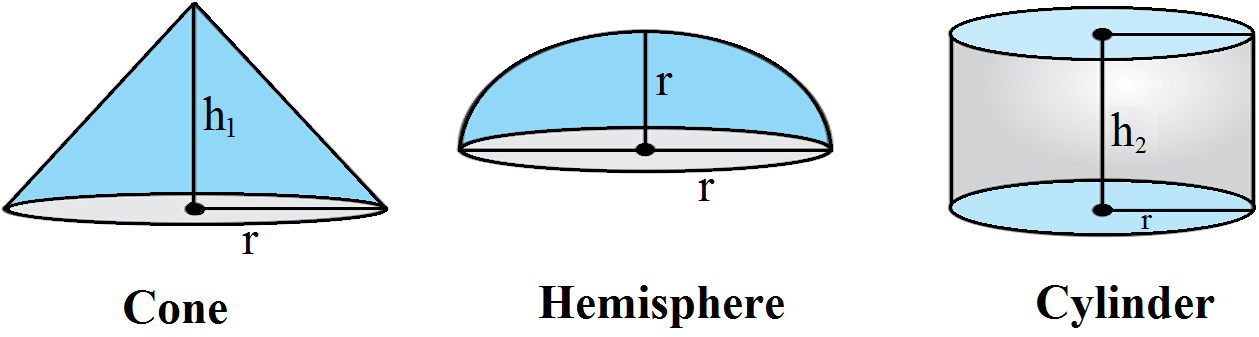
If all of these have equal bases, then their radii are equal.
Their heights are same. (given)
$\text{r}=\text{h}_1=\text{h}_2$
$\text{V}_\text{cone}=\frac{1}{3}\pi\text{r}^2\text{h}_1=\frac{1}{3}\pi\text{r}^2(\text{r})=\frac{1}{3}\pi\text{r}^3$
$\text{V}_\text{hemisphere}=\frac{2}{3}\pi\text{r}^3$
$\text{V}_\text{cylinder}=\pi\text{r}^2\text{h}_2=\pi\text{r}^2(\text{r})=\pi\text{r}^3$
$\text{V}_\text{cone}:\text{V}_\text{hemisphere}:\text{V}_\text{cylinder}=\frac{1}{2}:\frac{2}{3}:1=1:2:3$
Hence, correct option is $(a).$
View full question & answer→MCQ 1251 Mark
The height of a solid cone is $12\ cm$ and the area of the circular base is $6\pi\text{cm}^2.$ A plane parallel to the base of the cone cuts through the cone $9\ cm$ above the vertex of the cone, the area of the base of the new cone so formed is:
- A
$16\pi\text{cm}^2$
- B
$25\pi\text{cm}^2$
- ✓
$36\pi\text{cm}^2$
- D
$9\pi\text{cm}^2$
AnswerCorrect option: C. $36\pi\text{cm}^2$
Height of a solid cone $(h) = 12\ cm$
Area of circular base $=6\pi\text{cm}^2$
$\therefore\text{Radius}=\sqrt\frac{\text{Area}}{\pi}=\sqrt{\frac{64\pi}{\pi}}\text{cm}$
$=\sqrt{64}=8\text{cm}$
$\text{in }\triangle\text{AB}\text{ and }\triangle\text{OCD}$
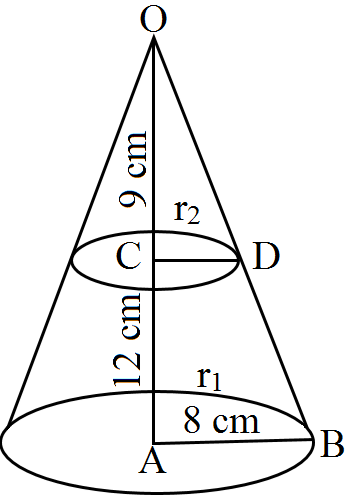
$\angle0=\angle0(\text{common)}$
$\angle\text{OAB}=\angle\text{OCD}(\text{Each }90^\circ)$
$\therefore\triangle\text{OAB}\sim\triangle\text{OCD}$
Now in cone $OCD,$
Radius $= 6\ cm$
$\therefore$ Base area $=\pi(\text{radius)}^2$
$=\pi\times6\times6=36\pi\text{cm}^2$ View full question & answer→MCQ 1261 Mark
The volumes of two spheres are in the ratio $64 : 27$ and the sum of their radii is $7\ cm.$ The difference in their total surface areas is:
- A
$38\ cm^2$
- B
$58\ cm^2$
- C
$78\ cm^2$
- ✓
$88\ cm^2$
AnswerCorrect option: D. $88\ cm^2$
Let the radii be $x\ cm$ and $(7 - x)cm.$
Volume of the two spheres are in the ratio $64 : 27.$
$\Rightarrow\frac{\frac{4}{3}\pi\text{x}^3}{\frac{4}{3}\pi(7-\text{x})^3}=\frac{64}{27}$
$\Rightarrow\Big(\frac{\text{x}}{7-\text{x}}\Big)^3=\Big(\frac{4}{3}\Big)^3$
$\Rightarrow\frac{\text{x}}{7-\text{x}}=\frac{4}{3}$
$\Rightarrow\text{x}=4\text{cm}$
So, their radii are $4\ cm$ and $3\ cm.$
Difference of their tital surface areas
$=4\pi(4)^2-4\pi(3)^2$
$=4\times\frac{22}{7}(16-9)$
$=88\text{cm}^2$
View full question & answer→MCQ 1271 Mark
A hemispherical bowl of radius $9\ cm$ contains a liquid. This liquid is to be filled into cylindrical small bottles of diameter $3\ cm$ and height $4\ cm.$ How many bottles will be needed to empty the bowl$?$
AnswerLet the number of bottles be $n.$
The number of bottles needed to empty the bowl $= n\ ×$ volume of each cylinder
that is, volume of the hemispherical bowl $= n\ ×$ volume of each cylinder
$\Rightarrow\frac{2}{3}\pi(9)^2=\text{n}\times\pi(1.5)^2(4)$
$\Rightarrow\text{n}=54$
Thus, there are $54$ bottles.
View full question & answer→MCQ 1281 Mark
Volume of a cuboid is $12\ cm^3$. The volume $($in $cm^3)$ of a cuboid whose sides are double of the above cuboid is.
AnswerLet the dimensions of Cuboid be $a, b, c$ respectively.
Volume, $V = abc = 12\ cm^3$
If $a^{\prime}=2 a, b^{\prime}=2 b, c^{\prime}=2 c,$ then
$V^{\prime}=a^{\prime} b^{\prime} c^{\prime}=8 a b c=8 \times 12=96 \mathrm{~cm}^3$
View full question & answer→MCQ 1291 Mark
What is the maximum length of a pencil that can be placed in a rectangular box of dimensions $(8\ cm × 6\ cm × 5\ cm)? ($Given $\sqrt{5}=2.24.$)
- A
$9.5\ cm$
- B
$19\ cm$
- ✓
$11.2\ cm$
- D
$8\ cm$
AnswerCorrect option: C. $11.2\ cm$
Maximum length of a pencil $=$ diagonal of the cuboid
Now, the diagonal of cuboid is $=\sqrt{1^2+\text{b}^2+\text{h}^2}$
Thus,
Length of longest rod $=\sqrt{8^2+{6}^2+5^2}$
$=\sqrt{64+36+25}$
$=\sqrt{125}$
$=5\sqrt{5\text{cm}}$
$=5(2.24)\text{cm}$
$=11.2\text{cm}$
View full question & answer→MCQ 1301 Mark
The diameter of a roller, $1m$ long, is $84\ cm.$ If it takes $500$ complete revolutions to level a playground, the area of the playground is:
- A
$1440m^2$
- ✓
$1320m^2$
- C
$1260m^2$
- D
$1550m^2$
AnswerCorrect option: B. $1320m^2$
The diameter of the roller $=84\text{cm}=\frac{84}{100}\text{m}$
So, the radius $=\frac{84}{200}\text{m}$
The area covered by the roller in $1$ revolution
$=2\pi\text{rh}$
$=2\times\frac{22}{7}\times\frac{84}{200}\times1$
$=2.64\text{m}^2$
$\therefore$ Area covered in $500$ complete revolution $= 500 × 2.64 = 1320m^2$
Thus, the area of the playground is $1320m^2$.
View full question & answer→MCQ 1311 Mark
The total surface area of a cone of radius $\frac{\text{r}}{2}$ and length $2l,$ is:
- A
$2\pi\text{r}(\text{l}+\text{r})$
- ✓
$\pi\text{r}\Big(\text{l}+\frac{\text{r}}4{}\Big)$
- C
$\pi\text{r}(\text{l}+\text{r})$
- D
$2\pi\text{r}\text{l}$
AnswerCorrect option: B. $\pi\text{r}\Big(\text{l}+\frac{\text{r}}4{}\Big)$
Total surface area of a cone $=\pi\text{R}(\text{L}+\text{R})$
Where, $R =$ Radius and $L =$ Slant height
$\therefore\text{T.S.A.}=\pi\Big(\frac{\text{r}}{2}\Big)\Big(\text{2l}+\frac{\text{r}}{2}\Big)$
$=\pi\text{r}\Big(\text{l}+\frac{\text{r}}{4}\Big)$
View full question & answer→MCQ 1321 Mark
If the sum of all the edges of a cube is a $36\ cm,$ them the volume $($in $cm^3)$ of that cube is:
AnswerA cube has total $12$ edges.
Let, $a →$ edge of the cube
Sum of all the edges of the cube $= 12a$
$36 = 12a$
$a = 3\ cm$
Volume of that cube,
$V = a^3$
$= 3^3$
$= 27\ cm^3$
Volume of the cube is $27\ cm^3$.
Hence, the correct option is $(b).$
View full question & answer→MCQ 1331 Mark
How many lead shots, each $0.3\ cm$ in diameter, can be made from a cuboid of dimensions $9\ cm × 11\ cm × 12\ cm?$
- A
$72000$
- B
$7200$
- ✓
$84000$
- D
$8400$
AnswerCorrect option: C. $84000$
Volume of a cuboid $= l × b × h = 9 × 11 × 12\ cm^3$
Radius of a lead shot $= 0.15\ cm$
Volume of a lead shot $=\frac{4}{3}\pi\text{r}^3=\frac{4}{3}\pi(0.15)^3\text{cm}^3$
No. of lead shot $=\frac{\text{Volume of a cuboid }}{\text{Volume of a lead shot }}$
$=\frac{9\times11\times12}{\frac{4}{3}\pi(0.15)^2}$
$=\frac{9\times11\times3\times3}{\frac{22}{7}\times0.003375}$
$=84000$
View full question & answer→MCQ 1341 Mark
A shoe box is a $15\ cm$ long, $10\ cm$ broad and $9\ cm$ high. The volume of the box is:
- A
$1500\ cu. cm$
- B
$1000\ cu. cm$
- C
$1200\ cu. cm$
- ✓
$1350\ cu. Cm$
AnswerCorrect option: D. $1350\ cu. Cm$
The volume of cuboid $= l × b × h$
$= 15 × 10 × 9$
$= 1350\ cu. Cm$
View full question & answer→MCQ 1351 Mark
If $A_1, A_2$ and $A_3$ denote the areas of three adjacent faces of a cuboid, then its volume is:
AnswerCorrect option: C. $\sqrt{\text{A}_1\text{A}_2\text{A}_3}$
We have;
Here $A_1, A_2$ and $A_3$ are the area of three adjacent faces of a cuboid.
But the areas of three adjacent faces of a cuboid are $lb, bh$ and $hl$ where,
$I \rightarrow$ Length of the cuboid
$b \rightarrow$ Breadth of the cuboid
$h \rightarrow$ Height of the cuboid
We have to find the volume of the cuboid
Here,
$A _1 A_2 A_3=( lb )( bh )( hl )$
$=( lbh )( lbh )$
$= V ^2\{$Since,$V = Ibh \}$
$V =\sqrt{ A _1 A_2 A_3}$
Thus, volume of the cuboid is $\sqrt{ A _1 A_2 A_3}$.
Hence, the correct choice is $(c).$
View full question & answer→MCQ 1361 Mark
If the volume of a cube is $343\ cu.cm,$ then its edge is:
- A
$49\ cm$
- ✓
$7\ cm$
- C
$8\ cm$
- D
$9\ cm$
AnswerCorrect option: B. $7\ cm$
The volume of the cube $= 343\ cu. cm$
$⇒ a^3 = 343$
$⇒ a^3 = 7^3$
$⇒ a = 7\ cm$
View full question & answer→MCQ 1371 Mark
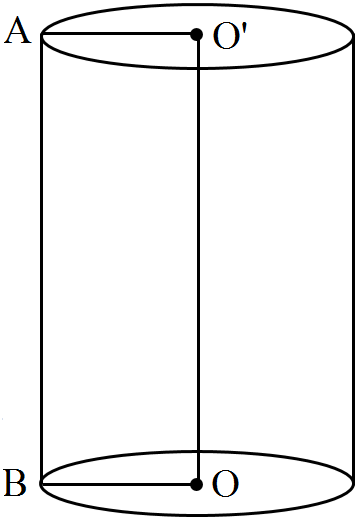
The number of surfaces in right cylinder is.
AnswerIn a cylinder there are three surfaces, one is curved surface area and other two are circular discs.
View full question & answer→MCQ 1381 Mark
If the curved surface area of a cylinder is $1760\ cm^2$ and its base radius is $14\ cm$, then its height is:
- A
$10\ cm$
- B
$15\ cm$
- ✓
$20\ cm$
- D
$40\ cm$
AnswerCorrect option: C. $20\ cm$
Given that, $r = 14\ cm$
Curved surface area $= 1760\ cm^2$
Now,
Curved surface area $=2\pi\text{rh}$
$\Rightarrow1760=2\times\frac{22}{7}\times14\times\text{h}$
$\Rightarrow1760=88\times\text{h}$
$\Rightarrow\text{h}=\frac{1760}{88}$
$\Rightarrow\text{h}=20\text{cm}$
View full question & answer→MCQ 1391 Mark
If a cone is cut into two parts by a horizontal plane passing through the mid-point of its axis, the axis, the ratio of the volumes of upper and lower part is:
- A
$1 : 2$
- B
$2 : 1$
- ✓
$1 : 7$
- D
$1 : 8$
AnswerCorrect option: C. $1 : 7$
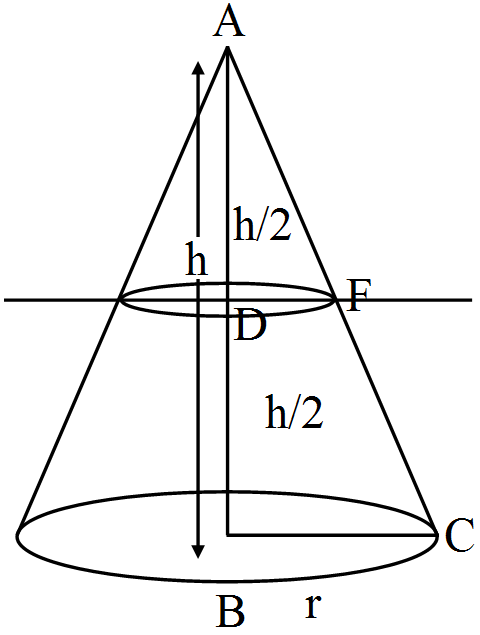
$\frac{\text{AD}}{\text{AB}}=\frac{\text{DF}}{\text{BC}}$
$\Rightarrow\frac{\frac{\text{h}}2{}}{\frac{\text{h}}{2}+\frac{\text{h}}{2}}=\frac{\text{DF}}{\text{BC}}$
$\Rightarrow\frac{\text{DF}}{\text{BC}}=\frac{1}{2}$
$\Rightarrow\text{DF}=\frac{\text{BC}}{2}=\frac{\text{r}}{2}$
Volume of full cone $=\frac{1}3{}\pi\text{r}^2\text{h}$
Volumeof small cone formed $=\frac{1}{3}\pi\Big(\frac{\text{r}}{2}\Big)^2\frac{\text{h}}{2}$
$=\frac{1}{3}\pi\frac{\text{r}^2}{4}\frac{\text{h}}{2}$
$=\frac{1}{8}\Big(\frac{\pi\text{r}^2\text{h}}{3}\Big)$
Ratio of volume of two parts $=\frac{\text{Volume of small cone}}{\text{Volume of full cone}-\text{Volume of small cone}}$
$=\frac{\frac{1}{8}\Big(\frac{\pi\text{r}^2\text{h}}{3}\Big)}{\frac{\pi\text{r}^2\text{h}}{3}-\frac{\pi\text{r}^2\text{h}}{8\times3}}$
$=\frac{1}{7}$
View full question & answer→MCQ 1401 Mark
The number of planks of dimension $(4m × 5m × 2m)$ that can be stored in a pit which is $40m$ long, $12m$ wide and $16m$ deep, is:
AnswerNumber of planks $=\frac{\text{Volume}\ \text{of}\ \text{the}\ \text{pit}}{\text{Volume}\ \text{of}\ 1\ \text{plank}}$
$=\frac{40\times12\times16}{4\times5\times2}$
$=192$
View full question & answer→MCQ 1411 Mark
If the height and radius of a cone of volume $V$ are doubled, then the volume of the cone, is:
Answer$\text{V}=\frac{1}{3}\pi\text{R}^2\text{H}$
If $R' = 2R$ and $H' = 2H, $then
$\text{V}'=\frac{1}{3}\pi(\text{2R})^2(\text{2H})$
$=8\Big(\frac{1}{3}\pi\text{R}^2 \text{H}\Big)$
$=\text{8V}$
$\Rightarrow\text{V}'=\text{8V}$
View full question & answer→MCQ 1421 Mark
The $CSA$ of a right circular cylinder whose base radius is $x$ units and height is $z$ units is:
- A
$\pi\text{xz}\text{ sq.units}$
- ✓
$2\pi\text{xz}\text{ sq.units}$
- C
$\pi\text{x}^2\text{z}\text{ sq.units}$
- D
$2\pi\text{ sq.units}$
AnswerCorrect option: B. $2\pi\text{xz}\text{ sq.units}$
Since $CSA$ of a right circular cylinder $=2\pi\text{rh}\text{ sq.units}$
Therefore, according to the question,
$CSA$ of a right circular cylinder $=2\pi\text{xz}\text{ sq.units}$
View full question & answer→MCQ 1431 Mark
The height of a cone is $21\ cm$ and its slant height is $28\ cm.$ The volume of the cone is:
- A
$7356\ cm^3$
- ✓
$7546\ cm^3$
- C
$7506\ cm^3$
- D
$7564\ cm^3$
AnswerCorrect option: B. $7546\ cm^3$
Let $r$ be the radius of the cone.
$\mathrm{I}^2=\mathrm{h}^2+\mathrm{r}^2$
$\Rightarrow \mathrm{r}^2=\mathrm{I}^2-\mathrm{h}^2$
$=28^2-21^2$
$=49 \times 7$
$\Rightarrow\text{r}=7\sqrt{7}\text{cm}$
Volume of the cone $=\frac{1}{3}\pi\text{r}^2\text{h}$
$⇒$ Volume of the cone $=\frac{1}{3}\times\frac{22}{7}\times(7\sqrt{7})^2\times21$
$⇒$ Volume of the cone $=7546\text{cm}^3$
View full question & answer→MCQ 1441 Mark
Three equal cubes are placed adjacently in a row. The ratio of the total surface area of the resulting cuboid to the sum of the surface areas of three cubes, is:
- ✓
$7 : 9$
- B
$49 : 81$
- C
$9 : 7$
- D
$27 : 23$
AnswerCorrect option: A. $7 : 9$
Let,
$a →$ Side of each cube
So, the dimensions of the resulting cuboid are,
Length $(l) = 3a$
Breadth $(b) = a$
Height $(h) = a$
Total surface area of the cuboid,
$= 2(lb + bh + hl)$
$= 2[(3a)a + a × a + a(3a)]$
$= 14a^2$
Sum of the surface area of the three cubes,
$= 3(6a^2$)
$= 18a^2$
Required ratio,
$=\frac{14\text{a}^2}{18\text{a}^2}$
$= 7 : 9$
Thus, the required ratio is $7 : 9.$
Hence, the correct choise is $(a).$
View full question & answer→MCQ 1451 Mark
The curved surface area of a right circular cylinder is $4400\ cm^2$ If the circumference of its base is $110\ cm,$ then its height is.
- A
$36\ cm.$
- ✓
$40\ cm$
- C
$38\ cm$
- D
$42\ cm$
AnswerCorrect option: B. $40\ cm$
The circumference of its base $= 110\ cm$
$2\pi\text{r}=110$
$\text{r}=\frac{35}{2}$
$CSA = 4400\ cm^2$
$2\pi\text{rh}=4400$
$ \text{h}=\frac{4000}{2\pi\text{r}}$
$=\frac{4400}{110}$.
$=40\text{cm}$
View full question & answer→MCQ 1461 Mark
The height of a cone is $24\ cm$ and the diameter of its base is $14\ cm$. The curved surface area of the cone is:
- A
$528\ cm^2$
- ✓
$550\ cm^2$
- C
$616\ cm^2$
- D
$704\ cm^2$
AnswerCorrect option: B. $550\ cm^2$
The height of the cone is $24\ cm$ and the diameter of its base is $14\ cm.$
So, its radius $= 7\ cm.$
$\text{l}=\sqrt{\text{r}^2+\text{h}^2}$
$\text{l}=\sqrt{7^2+24^2}$
$\text{l}=\sqrt{49+576}$
$\text{l}=25\text{cm}$
So, curved surface area of the cone $=\pi\text{r}=\frac{22}{7}\times7\times25=550\text{cm}^2$
View full question & answer→MCQ 1471 Mark
The height of sand in a cylindrical shaped can drops $3$ inches when $1$ cubic foot of sand is poured out. What is the diameter, in inches, of the cylinder$?$
- A
$\frac{24}{\sqrt{\pi}}$
- ✓
$\frac{48}{\sqrt{\pi}}$
- C
$\frac{32}{\sqrt{\pi}}$
- D
$\frac{48}\pi$
AnswerCorrect option: B. $\frac{48}{\sqrt{\pi}}$
When sand is poured out, height dropped $= 3$ inches
Volume vacant $=\pi\text{r}^2\times3\text{ inches}$
Now, Volume vacant $=$ Volume of sand poured out $= 1$ cubic foot
$1$ foot $= 12$ inches
$1$ cubic foot $= 12 × 12 × 12$ inches $= 1728$ inches
Thus, We have
$3\pi\text{r}^2=1728$
$\Rightarrow\pi\text{r}^2=576$
$\Rightarrow\text{r}^2=\frac{576}{\pi}$
$\Rightarrow\text{r}=\frac{24}{\sqrt{\pi}}$
$⇒$ Diameter $= 2r =2\times\frac{24}{\sqrt{\pi}}=\frac{48}{\sqrt{\pi}}$
View full question & answer→MCQ 1481 Mark
If the heights of two cones are in the ratio of $1 : 4$ and the radii of their bases are in the ratio $4 : 1$, then the ratio of their volumes is:
- ✓
$4 : 1$
- B
$2 : 3$
- C
$1 : 2$
- D
$3 : 4$
AnswerCorrect option: A. $4 : 1$
The formula of the volume of a cone with base radius $' r\ '$ and vertical height $' h\ '$ is given as Volume $=\frac{1}{3} \pi r^2 h$
Let the base radius and the height of the two cones be $r_1, h_1$ and $r_2, h_2$ respectively
It is given that the ratio between the heights of the two cones is $1: 4$
Since only the ratio is given, to use them in our equation we introduce a constant $' k\ '$
So, $h_1=1 k$
$h _2=4 k$
It is also given that the ratio between the base radius of the two cones is $4: 1$
Again, since only the ratio is given, to use them in our equation we introduce another constant $' p\ '$
So, $r_1=4 p$
$r_2=1 p$
Substituting these values in the formula for volume of cone we get,
$\left(\frac{\text { Volume of cone } 1}{\text { Volume of cone } 1}\right)=\frac{(\pi)(4 p )(4 p )(1 k )(3)}{(3)(\pi)(1 p )(1 p )(4 k )}$
$=\frac{4}{1}$
View full question & answer→MCQ 1491 Mark
If the surface area of a sphere is $(144\pi)\text{m}^2$ then its volume is:
- A
$(288\pi)\text{m}^3$
- ✓
$(188\pi)\text{m}^3$
- C
$(300\pi)\text{m}^3$
- D
$(316\pi)\text{m}^3$
AnswerCorrect option: B. $(188\pi)\text{m}^3$
Given that surface area of a sphere $=144\pi\text{m}^2$
$\Rightarrow4\pi\text{r}^2=144\pi$
$\Rightarrow4\times\text{r}^2=144$
$\Rightarrow\text{r}^2=\frac{144}{4}$
$\Rightarrow\text{r}^2=36$
$\Rightarrow\text{r}=6\text{ cm}$
Volume of sphere $=\frac{4}{3}\pi\text{r}^3$
$=\frac{4}{3}\times\pi\times6\times6\times6$
$=4\times\pi\times2\times6\times6$
$=288\pi\text{m}^3$
View full question & answer→MCQ 1501 Mark
The number of surfaces in right cylinder is:
AnswerNumber of Surfaces In a Right cylinder are $3.$
Top surface, bottom surface and curved surface.
View full question & answer→