MCQ 1511 Mark
If the volume of a sphere is $4851\ cm^3$, then its surface area is:
- A
$1039.5\ cm^2$
- ✓
$1386\ cm^2$
- C
$2079\ cm^2$
- D
$693\ cm^2$
AnswerCorrect option: B. $1386\ cm^2$
Given,
Volume of sphere $=4851=\frac{4}{3}\pi\text{r}^3$
$4851=\frac{4}{3}\times\frac{22}{7}\times\text{r}^3$
$\text{r}^3=\frac{4851\times21}{88}=1157.625$
$\text{r}=\sqrt[3]{1157.625}$
$\text{r}=10.5$
Now, surface area of sphere $=4\pi\text{r}^2$
$=4\times\frac{22}{7}\times10.5\times10.5$
$=1386\text{cm}^2$
View full question & answer→MCQ 1521 Mark
Surface area of sphere of diameter $14\ cm$ is:
- ✓
$616\ cm^2$
- B
$516\ cm^2$
- C
$2244\ cm^2$
- D
$400\ cm^2$
AnswerCorrect option: A. $616\ cm^2$
Surface area of sphere $=4\pi\text{r}^2$
Given that Diameter $= 14\ cm$
Radius $=\frac{14}{2}=7\text{cm}$
The surface area of sphere $=4\pi\text{r}^2$
$=4\times\frac{22}{7}\times7^2$
$=616\text{cm}^2$
View full question & answer→MCQ 1531 Mark
Vertical cross$-$section of a right circular cylinder is always $a:$
AnswerVertical cross$-$section of cylinder will always be a Rectangle of sides $'h\ ',$ and $'r\ ',$
where $h$ is the height of a cylinder and $r$ is the radius of a cylinder
View full question & answer→MCQ 1541 Mark
Three cubes of metal with edges $3\ cm, 4\ cm$ and $5\ cm$ respectively are melted to form a single cube. The lateral surface area of the new cube formed is.
- A
$256\ cm^2$
- B
$128\ cm^2$
- C
$72\ cm^2$
- ✓
$144\ cm^2$
AnswerCorrect option: D. $144\ cm^2$
Volume of the new cube formed $=$ total volume of the three cubes
Suppose that a cm is the edge of the new cube, then
$a^3=3^3+4^3+5^3=27+64+125=216=6 \mathrm{~cm}$
$\therefore$ Lateral surface area of the new cube $= 4 a^2=4 \times 6 \times 6=144 \mathrm{~cm}^2$
View full question & answer→MCQ 1551 Mark
Volume of hollow cylinder of height $h,$ with outer radius $R$ and inner radius $r.$
AnswerCorrect option: C. $\pi(\text{R}^2-\text{r}^2)\text{h}$
Volume of cylinder is $\pi\text{R}^2\text{h} ($outer$)$
Volume of cylinder is $\pi\text{r}^2\text{h} ($inner$)$
Since, it is hollow,
Volume of hollow cylinder $=\pi\text{R}^2\text{h}-\pi\text{r}^2\text{h}=\pi(\text{R}^2-\text{r}^2)\text{h}$
View full question & answer→MCQ 1561 Mark
How many lead shots, each $0.3\ cm$ in diameter, can be made from a cuboid of dimension $9\ cm × 11\ cm × 12\ cm?$
- A
$7200$
- B
$8400$
- C
$72000$
- ✓
$84000$
AnswerCorrect option: D. $84000$
Let the number of lead shots be $n.$
Volume of the cuboid $= n\ ×$ volume of each lead shot
$\Rightarrow9\times11\times12=\text{n}\times\frac{4}{3}\pi\Big(\frac{0.3}{2}\Big)^3$
$...\Big(\text{since}\ \text{radius}=\frac{0.3}{2}\text{cm}\Big)$
$\Rightarrow9\times11\times12=\text{n}\times\frac{4}{3}\times\frac{22}{7}\times\frac{27}{8000}$
$\Rightarrow\text{n}=84000$
Thus, there are $84000$ lesd shots.
View full question & answer→MCQ 1571 Mark
The mid-value of a class interval is $42$ and the class size is $10.$ The lower and upper limits are:
- ✓
$37-47$
- B
$37.5-47.5$
- C
$36.5-47.5$
- D
$36.5-46.5$
AnswerCorrect option: A. $37-47$
Let the lower limit be $x.$
Here,
Class size $= 10$
$\therefore$ Upper limit $=$ Class size $+$ Lower limit
Upper limit $= (x + 10)$
Mid value of the class interval $= 42$
$\therefore\frac{\text{x}+\text{x}+10}{2}=42$
$\Rightarrow\frac{2\text{x}+10}{2}=42$
$\Rightarrow2\text{x}+10=84$
$\Rightarrow2\text{x}=74$
$\Rightarrow\text{x}=37$
Thus, we have:
Lower limit $= 37$
Upper limit $= 37 + 10 = 47$
View full question & answer→MCQ 1581 Mark
The volume of resulting cuboid formed when two cubes each of side $6\ cm$ are joined end to end is:
- ✓
$432\ cm^3$
- B
$648\ cm^3$
- C
$864\ cm^3$
- D
$416\ cm^3$
AnswerCorrect option: A. $432\ cm^3$
Volume of one cube $=$ side$^3$
$= 6^3$
$= 216\ cm^3$
So, volume of cuboid when two cubes are added $= 2 × 216 = 432\ cm^3$
View full question & answer→MCQ 1591 Mark
If the area of the base of a right circular cylinder is $15400\ cm^2$ and its volume is $92400\ cm^3$ then its curved surface area is:
- A
$2880\ cm^2$
- ✓
$2640\ cm^2$
- C
$2760\ cm^2$
- D
$2600\ cm^2$
AnswerCorrect option: B. $2640\ cm^2$
$CSA$ of cylinder $=2\pi\text{rh}$
Now, given, $\pi\text{r}^2=15400 \text{ and }\pi\text{r}^2\text{h}=92400$
area of base $=\frac{22}{7}\times\text{r}^2=15400$
$\text{r}^2=4900$
So, Volume $=\text{r}^2\text{h}=92400$
$=15400\times\text{h}=92400$
$\text{h}=\frac{92400}{15400}$
$\text{h}=6\text{cm}$
Now, $CSA$ is $=2\pi\text{rh}$
$=2\times\frac{22}{7}\times70\times6$
$=2640\text{cm}^2$
View full question & answer→MCQ 1601 Mark
Surface area of sphere of diameter $14\ cm$ is:
- ✓
$616\ cm^2$
- B
$400\ cm^2$
- C
$516\ cm^2$
- D
$2244\ cm^2$
AnswerCorrect option: A. $616\ cm^2$
Surface area of sphere $=4\pi\text{r}^2$
Given that Diametre $= 14\ cm$
Surface area of sphere $=4\pi\text{r}^2$
$=\frac{4\times22}{7\times7^2}$
$= 616\ cm^2$
View full question & answer→MCQ 1611 Mark
The total surface area of a cube is $96\ cm^2.$ Find its lateral surface area.
- ✓
$64\ cm^2$
- B
$512\ cm^2$
- C
$27\ cm^2$
- D
$32\ cm^2$
AnswerCorrect option: A. $64\ cm^2$
Total surface area of cube $=6 a ^2$ (let a be a side of cube)
So, $6 a^2=96$
$a^2=\frac{96}{6}=16$
$a=4 cm$
Now, lateral surface area of cube is $4 a^2$
So, $4 a^2=4 \times(4)^2$
$=4 \times 16$
$=64 cm^2$
View full question & answer→MCQ 1621 Mark
The largest sphere is cut off from a cube of side $6\ cm.$ The volume of the sphere will be:
- A
$27\pi\ \text{cm}^2$
- ✓
$36\pi\ \text{cm}^3$
- C
$108\pi\ \text{cm}^3$
- D
$12\pi\ \text{cm}^3$
AnswerCorrect option: B. $36\pi\ \text{cm}^3$
The largest sphere that can be cut from a cube of side $6\ cm$ will have its diameter $=$ side of cube.
i. e. $2r = 6\ cm ⇒ r = 3\ cm$
Volume of that sphere $=\frac{4}{3}\pi\text{r}^3=\frac{4}{3}\pi\times3\times3\times3=36\pi\text{ cm}^3$
Hence, correct option is $(b)$
View full question & answer→MCQ 1631 Mark
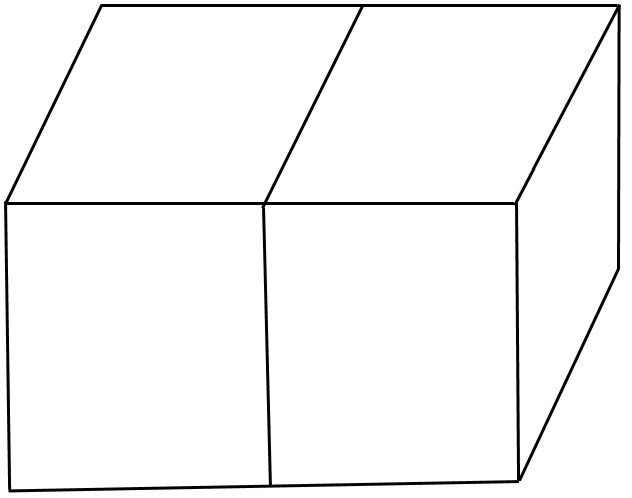
If two identical solid cubes of side $‘x’$ are joined end to end, then the $TSA$ of the resulting solid is.
- A
$x^2x^2$
- ✓
$10x^2$
- C
$12x^212x^2$
- D
$15x^215x^2$
AnswerCorrect option: B. $10x^2$
Length of resulting cuboid $= x + x = 2x$
Breadth of resulting cuboid $= x$
And Height of the resulting cuboid $= x$
$\therefore TSA$ of cuboid $= 2(lb + bh + hl)$
$= 2(2x × x + x × × + x × 2x)$
$= 2(5x^2) = 10x^2$
View full question & answer→MCQ 1641 Mark
The volume of a cone is $1570\ cm^2$. If it is $15\ cm$ high, then its base area is:
- A
$514\ cm^2$
- B
$415\ cm^2$
- ✓
$314\ cm^2$
- D
$413\ cm^2$
AnswerCorrect option: C. $314\ cm^2$
Volume of cone $=\frac{1}{3}\times\pi\times\text{r}^2\times\text{h}$
$1570=\frac{1}{3}\times\pi\times\text{r}^2\times15$
$\pi\text{r}^2=314\text{cm}^2$
Base area is $314\ cm^2$
View full question & answer→MCQ 1651 Mark
If each bag containing rice occupies $2.1m^3$ of space, then the number of full bags which can be emptied into a drum of radius $4.2m$ and height $3.5m$ is:
- A
$138.$
- ✓
$92.$
- C
$69.$
- D
$46.$
AnswerNumber of bags $=\frac{\text{Volume of drum}}{\text{volume of one bag}}$
$=\frac{2\pi\text{rh}}{2.1}$
$=\frac{\Big((2\times\frac{22}{7}\times4.2\times3.5)\Big)}{2.1}$
$=92$
View full question & answer→MCQ 1661 Mark
The circumference of the base of a right circular cylinder is $44\ cm.$ If its whole surface area is $968\ cm^2$ than the sum of its height and radius is:
- A
$16\ cm.$
- B
$20\ cm$
- ✓
$22\ cm$
- D
$18\ cm$
AnswerCorrect option: C. $22\ cm$
Given,
The circumference of the base of a right circular cylinder $= 44\ cm$
$2\pi\text{r}=44$
$\text{r}=44\times\frac{7}{22\times2}$
Whole surface area $=2\pi\text{rh}+2\pi\text{r}^2$
$968=2\times\frac{22}{7}\times7(\text{h}+\text{r})$
$\text{h}+\text{r}=22\text{cm}$
View full question & answer→MCQ 1671 Mark
The surface area of a cuboid whose length, breadth, and height are $15\ cm, 10\ cm$ and $20\ cm$ respectively is:
- A
$650\ cm^2$
- ✓
$1300\ cm^2$
- C
$1950\ cm^2$
- D
$2600\ cm^2$
AnswerCorrect option: B. $1300\ cm^2$
$CSA$ of cuboid $= 2(lb + bh + hl)$
$= 2(15 × 10 + 10 × 20 + 20 × 15)$
$= 2(150 + 200 + 300)$
$= 2 × 650$
$= 1300\ cm^2$
View full question & answer→MCQ 1681 Mark
The diameter of the base of a cone of height $15\ cm$ and volume $ 770\ cm^3$ is:
- ✓
$14\ cm.$
- B
$7\ cm.$
- C
$21\ cm.$
- D
$10.5\ cm.$
AnswerCorrect option: A. $14\ cm.$
Volume of cone $=\frac{1}{3}\pi\text{r}^2\text{h}$
$770=\frac{1}{3}\times\frac{22}{7}\times\text{r}^2\times15$
$\text{r}^2=\frac{770\times3\times7}{22\times15}$
$\text{r}^2=49$
$\text{r}=7\text{cm}$
Thus, diameter $2r = 14\ cm$
View full question & answer→MCQ 1691 Mark
The number of coins $1.5\ cm$ in diameter and $0.2\ cm$ thick to be melted to form a right circular cylinder of height $10\ cm$ and diameter $4.5\ cm$ is:
AnswerLet the required number of coins be $n.$
Since the $n$ coins are melted form a right circular cylinder,
$\text{n}\times\pi\times\Big(\frac{1.5}{2}\Big)^2\times0.2=\pi\times\Big(\frac{4.5}{2}\Big)^2\times10$
$\Rightarrow\text{n}\times\Big(\frac{15}{10}\Big)^2\times\frac{2}{10}=\Big(\frac{45}{20}\Big)^2\times10$
$\Rightarrow\text{n}\times\frac{9}{16}\times\frac{2}{10}=\frac{81}{16}\times10$
$\Rightarrow\text{n}=\frac{81\times10\times16\times10}{16\times9\times2}$
$\Rightarrow\text{n}=450$
View full question & answer→MCQ 1701 Mark
A cylindrical rod whose height is $8$ times of its radius is melted and recast into spherical balls of same radius. The number of balls will be:
AnswerVolume of a sphere $=(\frac{4}{3})\pi\text{r}^3$
Volume of a cylinder $=\pi\text{r}^2\text{h}$
Given, cylindrical rod whose height is $8$ times of its radius is melted and recast into spherical balls of same radius.
Let the number of such balls be $‘a’.$
$\Rightarrow\pi\times\text{r}^2\times8\text{r}=\text{a}\times\big(\frac{4}{3}\big)\pi\times\text{r}^3$
$\Rightarrow\text{a}=6$
View full question & answer→MCQ 1711 Mark
A sphere is placed inside a right circular cylinder so as to touch the top, base and lateral surface of the cylinder. If the radius of the sphere is $r,$ then the volume of the cylinder is
AnswerCorrect option: C. $2\pi\text{r}^3$
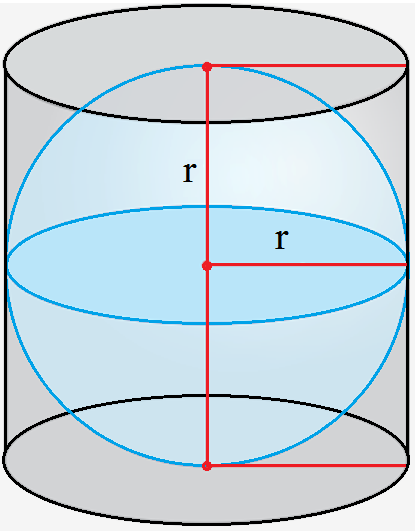
Radius of sphere $= r$
Sphere touches cylinder at Top, Base and Lateral Surface.
Then,
$2r =$ height of cylinder $= h$
$r =$ Radius of cylinder
Volume of cylinder $=\pi\text{r}^2\text{h}$
$=\pi\text{r}^2(2\text{r})$
$=2\pi\text{r}^3$
Hence, correct option is $(c).$ View full question & answer→MCQ 1721 Mark
The radii of two cylinders are in the ratio $2 : 3$ and their heights are in the ratio $5 : 3.$ The ratio of their volumes is:
- A
$27 : 20$
- ✓
$20 : 27$
- C
$4 : 9$
- D
$9 : 4$
AnswerCorrect option: B. $20 : 27$
$\text{Let}\Rightarrow\frac{\text{r}_1}{\text{r}_2}=\frac{2}{3}\ \text{and}\ \frac{\text{h}_1}{\text{h}_2}=\frac{5}{3}$
Ratio of the surface area $=\frac{\pi\text{r}_1\text{h}_1}{\pi\text{r}_2\text{h}_2}$
$=\Big(\frac{\text{r}_1}{\text{r}_2}\Big)\times\Big(\frac{\text{h}_1}{\text{h}_2} \Big)$
$=\Big(\frac{2}{3}\Big)^2\times\Big(\frac{5}{3}\Big)^2$
$=\frac{4}{9}\times\frac{5}{3}$
$=\frac{20}{27}$
$=20:27$
View full question & answer→MCQ 1731 Mark
The height of a cylinder is $14\ cm$ and its curved surface area is $264\ cm^2$. The volume of the cylinder is.
- ✓
$396\ cm^3$
- B
$1848\ cm^3$
- C
$1232\ cm^3$
- D
$308 \ cm^3$
AnswerCorrect option: A. $396\ cm^3$
Here $h = 14\ cm$ and $2\pi\text{rh}=260\text{cm}^2$
$\therefore2\times\frac{22}{7}\times\text{r}\times14=264$
$\Rightarrow\text{r}=\frac{264}{88}=3\text{cm}$
$\therefore\text{Volume}=\pi\text{r}^2\text{h}=\Big(\frac{22}{7}\times3\times3\times14\Big)\text{cm}^3=396\text{cm}^3$
View full question & answer→MCQ 1741 Mark
$2.2\ dm^3$ of lead is to be drawn into a cylindrical wire $0.50\ cm$ in diameter. The length of the wire is:
- A
$110m$
- ✓
$112m$
- C
$98m$
- D
$124m$
AnswerCorrect option: B. $112m$
We know that $1dm = 10\ cm.$
Given that $2.2\ dm^3$ is drawn into a cylindrical wire.
That is, $(2.2 × 1000) = 2200\ cm^3$ is drawn into a cylindrical wire.
Let the radius of the wire be r and the height be h.
Volume of the cylindrical $= 2200$
$\Rightarrow\pi\text{r}^2\text{h}=2200$
$\Rightarrow\frac{22}{7}\times0.25\times0.25\times\text{h}=2200 ...($Since the diameter $= 0.50\ cm)$
$\Rightarrow\text{h}=11200\text{cm}$
$\Rightarrow\text{h}=112\text{m}$
So, the length of the wire is $112m.$
View full question & answer→MCQ 1751 Mark
If each edge of a cube is increased by $50\%,$ then the percentage increase in its surface area is:
- A
$50\%$
- B
$75\%$
- C
$100\%$
- ✓
$125\%$
AnswerCorrect option: D. $125\%$
Let each edge be $a$
$⇒$ its surface area $ = 6a^2$
Now,
New edge $= 150\%$ of $a$
$=\frac{150}{100}\times\text{a}$
$=\frac{3\text{a}}{2}$
New surface area $=6\times\Big(\frac{3\text{a}}{2}\Big)^2$
$=\frac{27\text{a}^2}{2}$
Increase surface area $=\frac{27\text{a}^2}{2}-6\text{a}^2$
$=\frac{27\text{a}^2-12\text{a}^2}{2}$
$=\frac{15\text{a}^2}{2}$
Percentage increase in its surface area
$=\frac{\text{Increase}\ \text{in}\ \text{the}\ \text{surface}\ \text{area}}{\text{original}\ \text{surface}}\times100$
$=\frac{15\text{a}^2}{2}\times\frac{1}{6\text{a}^2}\times100$
$=125\%$
View full question & answer→MCQ 1761 Mark
Surface area of bowl of radius $r\ cm$ is:
- ✓
$3\pi\text{r}^2$
- B
$2\pi\text{r}^2$
- C
$4\pi\text{r}^2$
- D
$\pi\text{r}^2$
AnswerCorrect option: A. $3\pi\text{r}^2$
$\text{CSA}$ of hemisphere $=2\pi\text{r}^2$
But Given that there is a bowl which is considered to be a hollow hemisphere.
So, $\text{TSA}$ of hollow hemisphere $=2\pi\text{r}^2+\pi\text{r}^2($area of the brim, which is a circle$)$
$\text{TSA}$ of hollow hemisphere $=3\pi\text{r}^2$
View full question & answer→MCQ 1771 Mark
If the diameter of a cylinder is $28\ cm$ and its height is $20\ cm$ then its curved surface area is:
- A
$880\ cm^2$
- ✓
$1760\ cm^2$
- C
$3520 \ cm^2$
- D
$2640 \ cm^2$
AnswerCorrect option: B. $1760\ cm^2$
Given, $d = 628$
$r = 14\ cm$
$h = 20\ cm$
Now,
Curved surface area $=2\pi\text{rh}$
$=2\times\frac{22}{7}\times14\times20$
$=1760\text{cm}^2$
View full question & answer→MCQ 1781 Mark
The diameter of a roller, $1m$ long, is $84\ cm.$ If it takes $500$ complete revolutions to level a playground, the area of the playground is.
- A
$1550\ m^2$
- ✓
$1320\ m^2$
- C
$1260\ m^2$
- D
$1440\ m^2$
AnswerCorrect option: B. $1320\ m^2$
Area covered by the roller in $1$ revolution $=2\pi\text{rh}$
$\frac{2\times22}{7\times42\times100}=100=44\times600=26400\text{cm}^2$
$\therefore$ Area covered in $500$ revolutions $= 26400 × 500\ cm^2$
Area of playground $= 1320\ m^2$
View full question & answer→MCQ 1791 Mark
If the $\text{TSA}$ of a solid hemisphere is $12\pi\text{ sq.cm}$ then its $\text{CSA}$ is:
- A
$2\pi\text{ sq.cm}$
- B
$12\pi\text{ sq.cm}$
- ✓
$8\pi\text{ sq.cm}$
- D
$16\pi\text{ sq.cm}$
AnswerCorrect option: C. $8\pi\text{ sq.cm}$
Given: $\text{TSA}$ of solid hemisphere $=12\pi\text{ sq.cm}$
$\Rightarrow3\pi\text{r}^2=12\pi$
$\Rightarrow\text{r}^2=4$
$\Rightarrow\text{r}=2\text{ cm}$
$\therefore \text{CSA}$ of hemisphere $=2\pi\text{r}^2=2\pi(2)^2=8\pi\text{ sq.cm}$
View full question & answer→MCQ 1801 Mark
The total surface area of a hemisphere of radius $r$ is:
- A
$\pi\text{r}^2$
- B
$2\pi\text{r}^2$
- ✓
$3\pi\text{r}^2$
- D
$4\pi\text{r}^2$
AnswerCorrect option: C. $3\pi\text{r}^2$
A hemisphere has two surfaces: one top surface and other curved surface.
$T.S.A =2\pi\text{r}^2+(\pi\text{r}^2)$ $\{$Area of Top-face = $\pi\text{r}^2\}$
$=3\pi\text{r}^2$
Hence, correct option is $(c).$
View full question & answer→MCQ 1811 Mark
$2.2\ dm^3$ of lead is to be drawn into a cylindrical wire $0.50\ cm$ in diameter. The length of the wire is.
- ✓
$112m$
- B
$98m$
- C
$124m$
- D
$110m$
AnswerCorrect option: A. $112m$
Volume of the wire $ = (2.2 × 10 × 10 × 10)\ cm^3= 2200\ cm^3$
Radius of the wire $= 0.25\ cm =\frac{25}{100}\text{cm}=\frac{1}{4}\text{cm}$
Let the length of wire be $h\ cm.$ Then,
$\pi\times\frac{1}{4}\times\frac{1}{4}\text{h}=2200\Rightarrow\frac{22}{7}\times\frac{1}{16}\times\text{h}=2200$
$\Rightarrow\text{h}=(2200\times\frac{7}{22}\times{16})\text{cm}=\Big(\frac{11200}{100}\Big)\text{m}=112\text{m}$
View full question & answer→MCQ 1821 Mark
A spherical ball of radius $3\ cm$ is melted and recast into three spherical balls. The radii of two of these balls are $1.5\ cm$ and $2\ cm.$ The radius of the third ball is.
- A
$1.5cm$
- B
$0.5cm$
- ✓
$2.5cm$
- D
$1cm$
AnswerCorrect option: C. $2.5cm$
Volume of a sphere $=\frac{4}{3}\pi\text{r}^3$
Volume of a spherical ball $=\frac{4}{3}\pi(3)^3\text{cm}^3$
Volume of three balls $=\frac{4}{3}\pi(1.5)^3+\frac{4}{3}\pi(2)^3+\frac{4}{3}\pi\text{r}^3$
$\Rightarrow\frac{4}{3}\pi(3.375+8+\text{r}^3)$ (On recasting this sphere into three spherical balls, Volume Will remain same)
$\Rightarrow\frac{4}{3}\pi(3.375+8+\text{r}^3)=\frac{4}{3}\pi(3)^3$
$\Rightarrow11.375+\text{r}^3=27$
$\Rightarrow\text{r}^3=15.626$
$\Rightarrow\text{r}=2.5\text{cm}$
View full question & answer→MCQ 1831 Mark
The height of a cone of diameter $10\ cm$ and slant height $13\ cm,$ is.
- A
$13\text{cm}$
- B
$\sqrt{194}\text{cm}$
- ✓
$12\text{cm}$
- D
$\sqrt{69}\text{cm}$
AnswerCorrect option: C. $12\text{cm}$
Diameter of cone $= 10\ cm$
Radius of cone $\text{r}=\frac{10}{2\text{cm}}=5\text{cm}$
Slant height of cone, $l = 13\ cm$
Suppose height of the cone is $h$
$⇒ h^2 = l^2− r^2$
$\Rightarrow\text{h}=\sqrt{13^2-5^2}=\sqrt{169-25}=\sqrt{144}$
$\Rightarrow\text{h}=12\text{cm}$
View full question & answer→MCQ 1841 Mark
A cube whose volume is $\frac18$ cubic centimeter is placed on a cube whose volume is $1\ cm^3$. The two cubes are then placed on top a third cube whose volume is $8\ cm^3$. The heigght of the stacked cubes is:
- ✓
$3.5\ cm$
- B
$3\ cm$
- C
$7 \ cm$
- D
AnswerCorrect option: A. $3.5\ cm$
Let,
$V _1, V_2, V_3 \rightarrow$ Volume of the three cubes
$a_1, a_2, a_3 \rightarrow$ Side of the three cubes
We know that,
$a^3=V$
So,
$a _1^3 = V$
$a _1^3 =\frac{1}{8}$
$a _1 =\frac{1}{2} \ cm$
Similarly,
$a _2^3 =1$
$a _2 =1\ cm$
And;
$a _3^3 =8$
$a _2 =2\ cm$
So the height of the resulting structure,
$=\frac{1}{2}+1+2$
$=0.5+1+2$
$=3.5\ cm$
The height of the structure is $3.5\ cm$ .
Hence, the correct choice is $(a)$.
View full question & answer→MCQ 1851 Mark
A right circular cylindrical tunnel of diameter $2m$ and length $40m$ is to be constructed from a sheet of iron. The area of the iron sheet required in $m^2$, is:
- A
$40\pi$
- ✓
$80\pi$
- C
$160\pi$
- D
$200\pi$
AnswerCorrect option: B. $80\pi$
Cylinderical tunnel will be hollow cylinder of radius $= 1m$
$\big\{\text{r}=\frac{\text{d}}{2}=\frac{2}{2}=1\text{m}\big\}$
Length $= 40m$
Area of iron sheet $=$ Curved surface area of cylinder
$=2\pi\text{rh}$
$=2\pi(1)40$
$=80\pi$
View full question & answer→MCQ 1861 Mark
The surface area of a sphere is $1386\ cm^2$. Its volume is:
- A
$1617\ cm^3$
- B
$3234\ cm^3$
- ✓
$4851\ cm^3$
- D
$9702\ cm^3$
AnswerCorrect option: C. $4851\ cm^3$
Given surface area of a sphere $= 1386\ cm^2$
$\Rightarrow4\pi\text{r}^2=1386$
$\Rightarrow4\times\frac{22}{7}\times\text{r}^2=1386$
$\Rightarrow\frac{88}{7}\times\text{r}^2=1386$
$\Rightarrow\text{r}^2=\frac{1386\times7}{88}$
$\Rightarrow\text{r}^2=\frac{441}{88}$
$\Rightarrow\text{r}=\sqrt{\frac{441}{4}}$
$\Rightarrow\text{r}=\frac{21}{2}\text{cm}$
Volume of sphere $=\frac{4}{3}\pi\text{r}^3$
$=\frac{4}{3}\times\frac{22}{7}\times\frac{21}{2}\times\frac{21}{2}\times\frac{21}{2}$
$=11\times21\times21$
$=4851\text{cm}^3$
View full question & answer→MCQ 1871 Mark
If two solid$-$hemispheres of same base radius $r$ are joined together along their bases, then curved surface area of this new solid is:
- A
$6\pi\text{r}^2$
- B
$8\pi\text{r}^2$
- C
$3\pi\text{r}^2$
- ✓
$4\pi\text{r}^2$
AnswerCorrect option: D. $4\pi\text{r}^2$
Because curved surface area of a hemisphere is $2\pi\text{r}^2$ and here,
we join two solid hemisphere along their bases of radius $r,$ from which we get a solid sphere.
Hence, the curved surface area of new solid $=2\pi\text{r}^2+2\pi\text{r}^2=4\pi\text{r}^2$
View full question & answer→MCQ 1881 Mark
If the radius of the sphere is $2\ cm$ then its curved surface area is:
- A
$12\pi\text{cm}^2$
- ✓
$16\pi\text{cm}^2$
- C
$8\pi\text{cm}^2$
- D
$4\pi\text{cm}^2$
AnswerCorrect option: B. $16\pi\text{cm}^2$
Here the radius of the sphere $= 2\ cm$
$\therefore CSA$ of sphere $=4\pi^2=4\pi(2)^3$
$=16\pi\text{cm}^2$
View full question & answer→MCQ 1891 Mark
The radius of a hemispherical balloon increases from $6\ cm$ to $12\ cm$ as air is being pumped into it. The ratios of the surface areas of the balloon in the two cases is.
- ✓
$1 : 4$
- B
$2 : 3$
- C
$1 : 3$
- D
$2 : 1$
AnswerCorrect option: A. $1 : 4$
Total surface area of a hemisphere $=2\pi\text{r}^2+\pi\text{r}^2=3\pi\text{r}^2$
$r = 6,$ surface area $=3\pi(6)^2=36$
$r = 12,$ surface area $=3\pi(12)^2=144$
Ratio $= 36 : 144$
$= 1 : 4$
View full question & answer→MCQ 1901 Mark
The surface area of a sphere is $1386\ cm^2$. Its volume is.
- A
$3234\ cm^3$
- ✓
$4851\ cm^3$
- C
$9702\ cm^3$
- D
$1617\ cm^3$
AnswerCorrect option: B. $4851\ cm^3$
Surface area of sphere $=4\pi\text{r}^2$
Given surface area $= 1386\ cm^2$
$\Rightarrow4\times\frac{22}{7}\times\text{r}^2=1386$
$\Rightarrow\text{r}^2=\frac{1386\times7}{88}=\frac{441}{4}$
$\Rightarrow\text{r}=\frac{21}{2}$
Volume of sphere $=\frac{4}{3}\pi\text{r}^3$
Volume $=\frac{4}{3}\pi\Big(\frac{21}{2}\Big)^3$
$=\frac{4}{3}\times\frac{22}{7}\times\Big(\frac{21}{2}\Big)^3$
$=4851\text{cm}^2$
View full question & answer→MCQ 1911 Mark
If I is the length of a diagonal of a cube of volume $V,$ then.
- A
$\sqrt{3\text{V}}=\text{l}^3$
- B
$3\sqrt{3\text{V}}=2\text{l}^3$
- ✓
$3\sqrt{3\text{V}}=\text{l}^3$
- D
$3\text{V}=\text{l}^3$
AnswerCorrect option: C. $3\sqrt{3\text{V}}=\text{l}^3$
$l \rightarrow $ Diagonal of the cube
$V \rightarrow$ Volume of the cube
$a \rightarrow $ Side of the cube
We know that
$\text{l}={\text{a}}\sqrt{3}$
${\text{l}}^3=3\sqrt{3}{\text{a}^3}$
$3\sqrt{3\text{V}} \{$Since, $V = a^3)$
$3\sqrt{3\text{V}}=\text{l}^3$
View full question & answer→MCQ 1921 Mark
If the height of a cylinder is doubled and radius remains the same, then volume will be:
AnswerLet $V_1$ be the volume of the cylinder with radius $r_1$ and height $h_1$, then
$V _1=\pi r _1^2 h_1 \ldots( i )$
Now, let $V_2$ be the volume after changing the dimension, then
$\text{r}^2=\text{r}_1,\text{h}_2=2\text{h}_1$
So,
$\text{V}_2=\pi\text{r}^2_2\text{h}_2=\pi\times\text{r}^2_1\times2\text{h}_1$
$\Rightarrow\text{V}_2=2\times\pi\text{r}^2_1\text{h}_1=2\text{V}_1$
View full question & answer→MCQ 1931 Mark
If the ratio of volumes of two spheres is $1 : 8,$ then the ratio of their surface areas is
- A
$1 : 2$
- ✓
$1 : 4$
- C
$1 : 8$
- D
$1 : 16$
AnswerCorrect option: B. $1 : 4$
Volume of sphere $=\frac{4}{3}\pi\text{r}^3=\text{v}$
$\frac{\text{V}_1}{\text{V}_1}=\frac{\frac{4}{3}\pi\text{r}^3}{\frac{4}{3}\pi\text{r}^3_2}=\frac{\text{r}^3_1}{\text{r}^3_2}=\frac{1}{8}$
$\Rightarrow\frac{\text{r}_1}{\text{r}_2}=\frac{1}{2}$
now, Surface Area of Sphere $=4\pi\text{r}^2=\text{S}$
$\frac{\text{S}_1}{\text{S}_2}=\frac{4\pi\text{r}^2_1}{4\pi\text{r}^2_2}=\Big(\frac{\text{r}_1}{\text{r}_2}\Big)^2=\frac{1}{4}=1:4$
Hence, correct option is $(b).$
View full question & answer→MCQ 1941 Mark
A solid sphere of radius $3\ cm$ is melted and then cast into small spherical balls, each of diameter $0.6\ cm.$ The number of small balls so obtained is:
- A
$800$
- ✓
$1000$
- C
$500$
- D
$2000$
AnswerCorrect option: B. $1000$
Let number of ball formed be $n$
Volume of sphere $= n($volume of one spherical ball$)$
$\frac{4}{3}\pi\text{R}^3=\text{n}(\frac{4}{3}\pi\text{r}^3)$
$\text{n}=(\frac{\text{R}}{\text{r}})^3$
$\text{n}=(\frac{3}{0.3})^3$
$\text{n}=1000$
View full question & answer→MCQ 1951 Mark
If the sum of all the edges of a cube is $36\ cm,$ then the volume $($in $cm^3)$ of that cube is:
AnswerLength of all edges $= 36$
Length of one edge $=\frac{36}{12}=3$
Volumes of cube $= 3 × 3 × 3 = 27$
View full question & answer→MCQ 1961 Mark
A rectangular piece of paper is $44\ cm$ long and $18\ cm$ wide. If a cylinder is formed by rolling the paper along its length, then the radius of the base of the cylinder is:
- A
$14\ cm$
- B
$22\ cm$
- C
$21\ cm$
- ✓
$7\ cm$
AnswerCorrect option: D. $7\ cm$
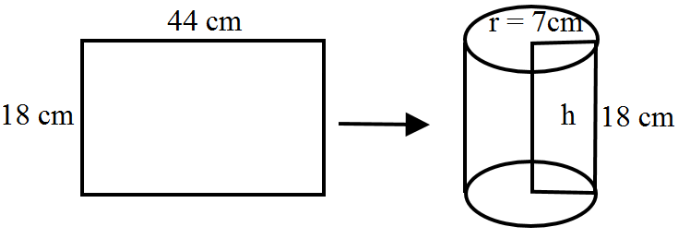
Let be $r$ the radius of the cylinder
Given: Circumference of cylinder $= 44\ cm$
$=2\pi\text{r}=44$
$\Rightarrow2\times\frac{22}{7}\times\text{r}=44$
$\Rightarrow\text{r}=7\text{r}=7\text{cm}$
View full question & answer→MCQ 1971 Mark
The diameter of a sphere is $42\ cm.$ It is melted and drawn into a cylindrical wire of diameter $2.8\ cm.$ Then, the length of the wire is:
- A
$6.3m$
- ✓
$63m$
- C
$63\ cm$
- D
$126\ cm$
AnswerVolume of sphere $=$ volume of cylindrical wire
$\frac{4}{3}\pi\text{R}^3=\pi\text{r}^2\text{h}$
$\frac{4}{3}\pi\times21^3=\pi\times(1.4)^2\times\text{h}$
$\text{h}=\frac{4\times21\times21\times21}{3\times1.4\times1.4}$
$\text{h}=6300\text{cm } \text{or }63\text{m}$
View full question & answer→MCQ 1981 Mark
Write the correct answer in the following:
The length of the longest pole that can be put in a room of dimensions $(10m × 10m × 5m)$ is:
AnswerGiven, dimensions of a room, $l = 10m, b = 10m, h = 5m$
$\therefore$ Length of the longest pole = Diagonal of a cuboid (room)
$=\sqrt{\text{l}^2+\text{b}^2+\text{h}^2}$
$=\sqrt{(10)^2+(10)^2+(5)^2}$
$=\sqrt{100+100+25}$
$=\sqrt{225}=15\text{m}$
Hence, the length of the longest pole is $15m.$
View full question & answer→MCQ 1991 Mark
If a sphere of radius $2r$ has the same volume as that of a cone with a circular base of radius $r,$ then the height of the cone is:
AnswerGiven, Volume of sphere $=$ Volume of cone
$\frac{4}{3}\pi(2\pi)^3=\frac{1}{3}\pi\text{r}^2\text{h}$
$4\times8\text{r}^3=\text{r}^2\text{h}$
$\text{h}=32\text{r}$
View full question & answer→MCQ 2001 Mark
In a sphere the number of faces is:
AnswerSphere has only one surface i.e. curved surface, so number of faces $= 1$
Hence, correct option is $(a).$
View full question & answer→