Question 14 Marks
$O$ is a point in the interior of a square $ABCD$ such that $OAB$ is an equilateral triangle. Show that $ΔOCD$ is an isosceles triangle.
AnswerGiven $O$ is a point in the interior of a squaren $ABCD$ such that an euailateral triangle.
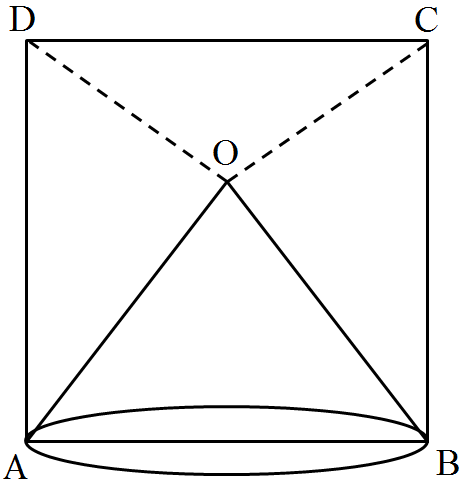
Since, $AOB$ is an triangle. $\angle\text{OAB}=\angle\text{OBA}=60^{\circ}\ ...(\text{i})$
$\angle\text{DAB}=\angle\text{CBA}=90^{\circ}\ ...(\text{ii})$ From eq. $(i)$ and $(ii)$
$\angle\text{DAB}-\angle\text{OAB}=\angle\text{CBA}=\angle\text{OBA}$
$\angle\text{DAO}=\angle\text{CBO}=90^{\circ}$
$\Rightarrow\text{AO}=\text{BO}$
$\Rightarrow \text{AD}=\text{BC}$
$\Rightarrow \text{OC}=\text{OD}$
Hence, an isosceles triangle. View full question & answer→Question 24 Marks
$ABC$ is an isosceles triangle with $AB = AC$ and $BD, CE$ are its two medians. Show that $BD = CE.$
AnswerGiven $\triangle\text{ABC}$ is an isosceles triangle in which $AB = AC$ and $BD, CE$ are its two medians. To show $BD = CE.$
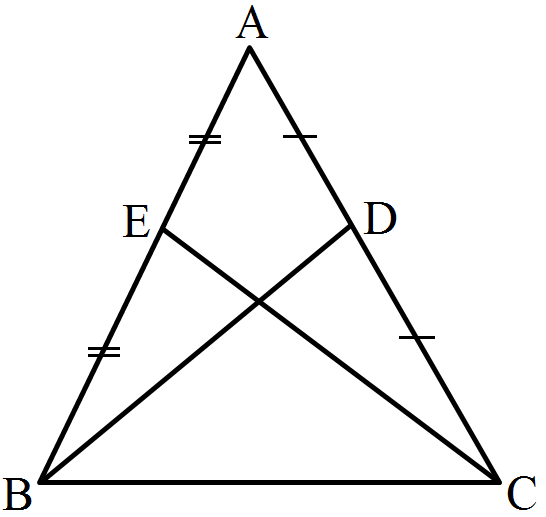
In $\triangle\text{ABD}$ and $\triangle\text{ACE},$
$\text{AB}=\text{AC}$
$\angle\text{A}=\angle\text{A}$
$\text{AD}=\text{AC}$
$\frac{1}{2}\text{AB}=\frac{1}{2}\text{AC}$
$\text{AE}=\text{AD}$ AS $D$ is the mid-point of $AC$ and $E$ is the mid-point of $AB.$
$\triangle\text{ABC}\cong\triangle\text{ACE}$ View full question & answer→Question 34 Marks
In $D$ and $E$ are points on side $BC$ of a $\triangle\text{ABC}$ such that $BD = CE$ and $AD = AE.$ Show that $\triangle\text{ABC}\cong\triangle\text{ACE}.$
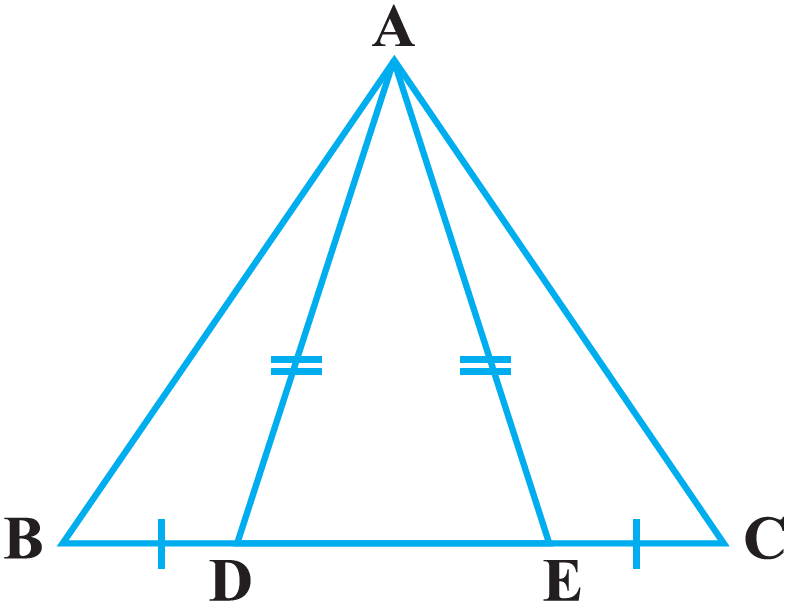
AnswerGiven, $\triangle\text{ABC}$ in which $BD = CE$ and $AD = AE$
$\triangle\text{ABC}\cong\triangle\text{ACE}$ In $\triangle\text{ADE},$
we have $\text{AD}=\text{AE}$
$\angle\text{ADE}=\angle\text{AED}$
Now, $\angle\text{ADE}+\angle\text{AEC}=180^{\circ}\ ...(\text{i})$
$\angle\text{AED}+\angle\text{AEC}=180^{\circ}\ ...(\text{ii})$ For eq.$(i)$ and $(ii),$
$\angle\text{ADE}+\angle\text{ADB}=\angle\text{AED}+\angle\text{AEC}$
$\Rightarrow\angle\text{ADB}=\angle\text{AEC}$
In $\triangle\text{ABD},$ we have $\text{BD}=\text{CE}$
So, by $SAS$ criterion of congrurncr,
we have $\triangle\text{ABC}\cong\triangle\text{ACE}.$
View full question & answer→Question 44 Marks
$ABCD$ is quadrilateral such that $AB = AD$ and $CB = CD.$ Prove that $AC$ is the perpendicular bisector of $BD.$
AnswerGiven In quadrilateral $ABCD, AB = AD$ and $CB = CD$. constrion: To prove $AC$ is the petpendicular bisector of $BD.$ uction Join $AC$ and $BD.$
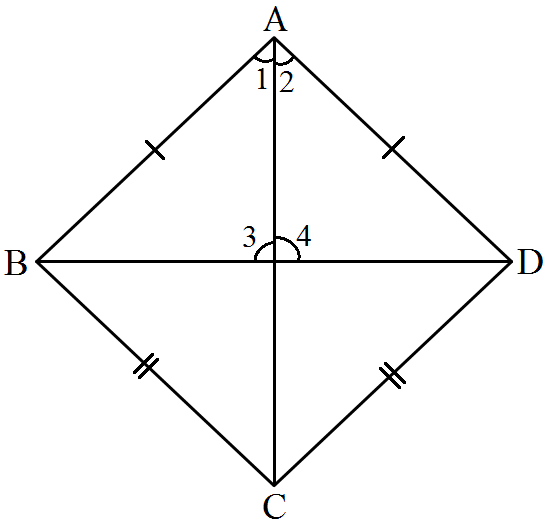
Proof In $\triangle\text{ABC}\text{ and }\triangle\text{ADC},$
$\text{AB}=\text{AD}$ [given] $\text{BC}=\text{CD}$ [given] $\text{and}\ \text{AC}=\text{AC}$ [common side]
$\therefore \triangle\text{ABC}\cong\triangle\text{ADC}[$ by $SSS$ congruence rule$]$
$\Rightarrow\ \angle1=\angle2[$ by $CPCT]$
now, in $\triangle\text{AOB}\text{ and }\triangle\text{AOD},\ \text{AB}=\text{AD}$ [given]
$\Rightarrow\ \angle1=\angle2[ $proved above$]$
$\text{and}\ \text{AO}=\text{AO} [$common side$]$
$\therefore\ \triangle\text{AOB}\cong\triangle\text{AOD}[$ by $SAS$ congruence rule$]$
$\Rightarrow\ \text{BO}=\text{DO} [$by $CPCT]$
$\text{and}\ \angle3=\angle4 [$by $CPCT]...(i) $
But $\angle3+\angle4=180^\circ$[linear pair axiom]
$\angle3+\angle3=180^\circ [$from Eq. $(i)]$
$\Rightarrow\ 2\angle3=180^\circ$
$\Rightarrow\ \angle3=\frac{180^\circ}{2}$
$\therefore\ \angle3=90^\circ$ i.e., $AC$ is perpendicular bisector of $BD.$ View full question & answer→Question 54 Marks
In a triangle $ABC, D$ is the mid-point of side AC such that $\text{BD}=\frac{1}{2}\text{AC}.$Show that $\angle\text{ABC}$ is a right angle.
AnswerWe have to prove that $\angle\text{ABC}=90^\circ$ As is the mid-point of $AC$, so, $AD = DC$
Also, $\text{BD}=\frac{\text{1}}{\text{2}}\text{AC}=\text{AD}$
$\big[\therefore D$ is the mid-point of $AC\big]$
$\therefore BD = AD = DC$
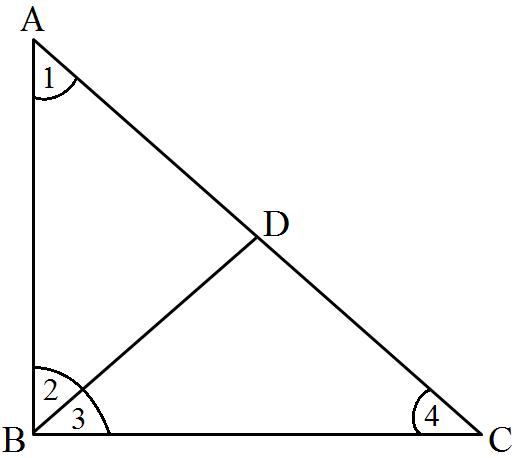
In $\triangle\text{ABC},$ We have $BD = AD$
$\therefore\angle1=\angle2\ ...(1)$
$\big[\because$ Angles opposite to equal sides are equal$\big]$ In $\triangle\text{BCD},$
We have $BD = DC,$
$\therefore\angle\text{3}=\angle4 ...(2)$ In $\triangle\text{ABC},$
We have $\angle1+\angle\text{ABC}+\angle4=180^\circ$
$\Rightarrow\angle\text{1}+\angle\text{2}+\angle\text{3}\angle+\text{4}=180^\circ$
$\Rightarrow2(\angle\text{2}+\angle\text{3})=180^\circ)$
$\Rightarrow\angle2+\angle3=90^\circ$
$\Rightarrow\angle=90^\circ$ Hence proved. View full question & answer→Question 64 Marks
$S$ is any point on side $QR$ of a $\triangle\text{PQR}.$ show that $PQ + QR + RP > 2PS.$
AnswerGiven $A$ point $S$ on $QR.$
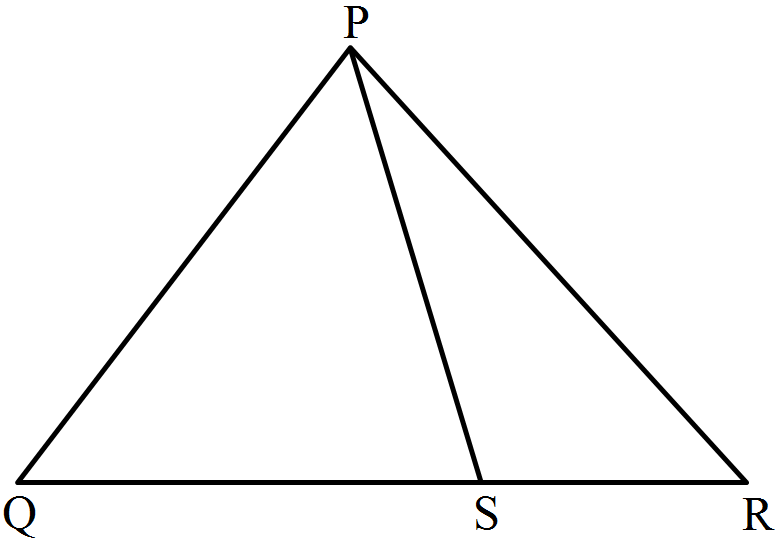
In $\triangle\text{PQS},$ we have $\text{PQ}+\text{QS}>\text{PS}\ ...(\text{i})$
Now, in $\triangle\text{PSR},$
we have $\text{RS}+\text{RP}>\text{PS}\ ...(\text{ii})$ From eq.$(i)$ and $(ii),$
$\text{PQ}+\text{QS}+\text{RS}+\text{RP}>2\text{PS}$
$\Rightarrow\text{PQ}+\text{QR}+\text{RP}>2\text{PS}$ View full question & answer→Question 74 Marks
$ABC$ is an isoscles triangle in which $AC = BC. AD$ are respectively two altitudes to sides $BC$ and $BC.$ prive that $AE = BD.$
AnswerIn $\triangle\text{ABC}$ and $\angle\text{DBC}$ we have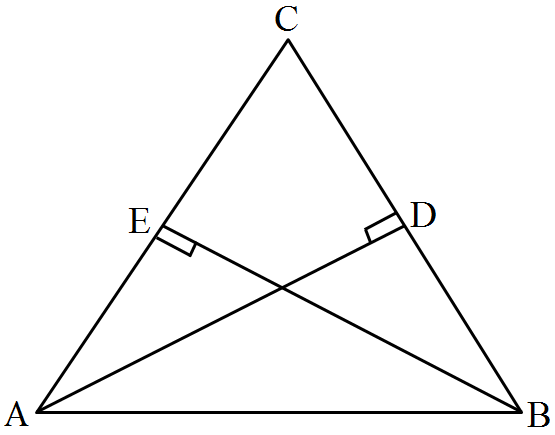 $\text{AB}=\text{AC}$ $\angle\text{ABD}=\angle\text{ACD}$ $\angle\text{BAD}=\angle\text{CAD}$ $\therefore\triangle\text{ADC}\cong\triangle\text{BCD}$$\therefore\text{AB}=\text{AC}$
$\text{AC}-\text{CE}=\text{BC}-\text{CD}$ $\Rightarrow\text{AE}=\text{BD}$ View full question & answer→Question 84 Marks
Prove that sum of any two sides of a triangle is greater than twice the median with respect to the third side.
AnswerGivan in $\triangle\text{ABC}, AD$ is a median.
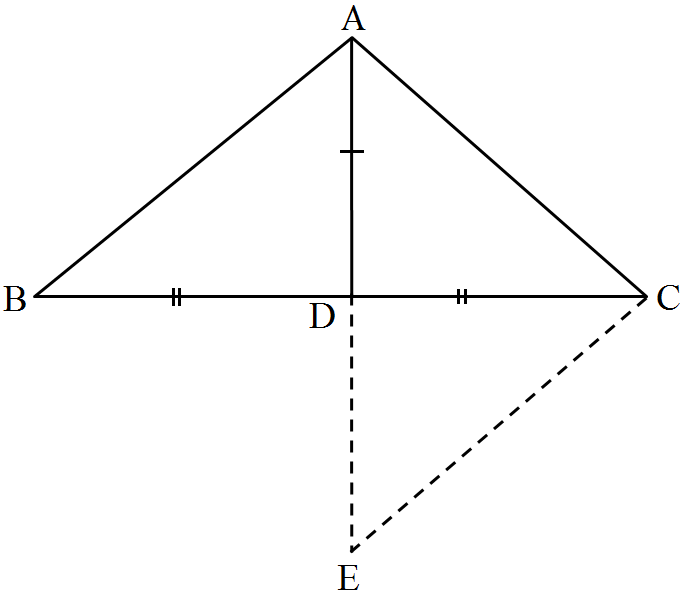
Construction produce $AD$ to a point $E$ such that $AD = DE$ and join $CE$. To prove $AC + AB > 2AD$ Proof in $\triangle\text{ABD}\text{ and } \triangle \text{ECD},$
$\text{AD}=\text{DE}$ [by construction] $\text{BD}=\text{CD}$ [given $AD$ is the media] and $\angle\text{ADB}=\angle\text{CDE}$ [vertically opposite angle] $\therefore\ \triangle\text{ABD}\cong\text{ECD}$ [by $SAS$ congruence rule] $\Rightarrow\ \text{AB}=\text{CE} [$by $CPCT]...(i)$ Now, in $\triangle\text{AEC},$
$\text{AC}+\text{EC}>\text{AE}$
$\therefore\ \text{AC}+\text{AB}>2\text{AD} $ [Sum of two sides of a triangle is greater than the third side] [from Eq. (i) and also taken that $AD = DE$] Hence proved. View full question & answer→Question 94 Marks
$ABC$ and $DBC$ are two triangles on the same base $BC$ such that $A and D$ lie on the opposite sides of $BC, AB = AC$ and $DB = DC.$ Show that $AD$ is the perpendicular bisector of $BC.$
AnswerGiven two $\triangle\text{ABC}$ and $\angle\text{DBC}$ are formed on the same base $BC$ Such that $A$ and $D$ lie on the opposite side of $AB = AC$ and $DB = DC.$
In $\triangle\text{ABD}$ and $\triangle\text{ACD},$
$\text{AB}=\text{AC}$
$\angle\text{ABD}=\angle\text{ACD}$
$\angle\text{BAD}=\angle\text{CAD}$
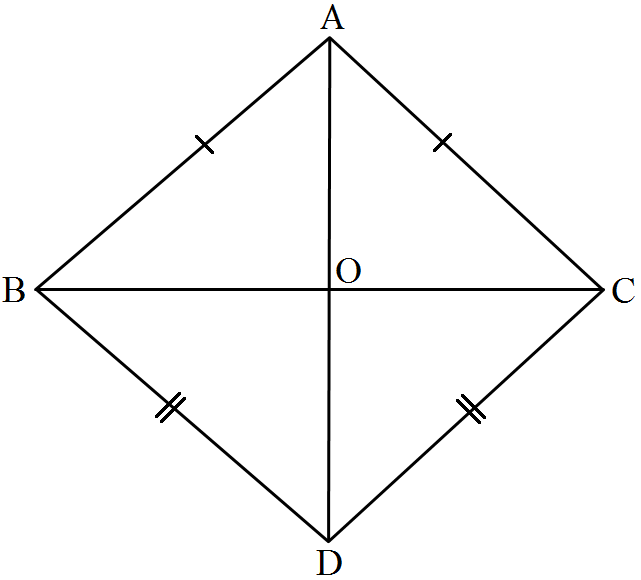
In $\triangle\text{ABO},$
$\text{AB}=\text{AC}$
$\angle\text{AOB}+\angle\text{AOB}=180^{\circ}$
$2\angle\text{AOB}=180^{\circ}$
$\angle\text{AOB}=\frac{180^{\circ}}{2}=180^{\circ}$
Hence, $AD$ is the perpendicular of $BC.$ View full question & answer→Question 104 Marks
$Q$ is point on the side $SR$ of a $\triangle\text{PSR}$ such that $PQ = PR.$ prove that $PS > PQ.$
AnswerGiven, $PQ = PR$
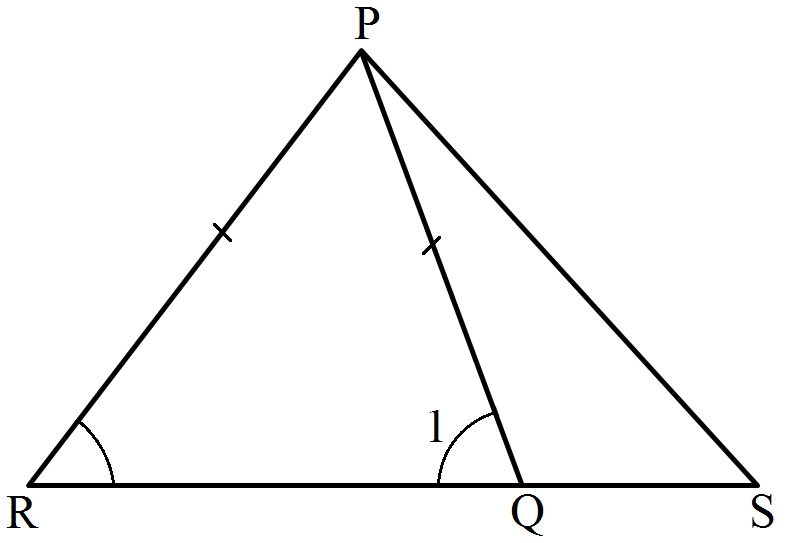
In $\triangle\text{PRQ},$ we have $\text{PR} =\text{PQ}$
$\Rightarrow\angle\text{1}=\angle\text{R}$ But, $\angle\text{1}>\angle\text{S}$
$\Rightarrow\angle\text{R}>\angle\text{S}$
$\Rightarrow\text{PS}>\text{PR}$
$\Rightarrow\text{PS}=\text{PQ}$ View full question & answer→Question 114 Marks
$ABC$ is a right triangle such that $AB = AC$ and bisector of angle $C$ intersects the side $AB$ at $D.$ Prove that $AC + AD = BC.$
AnswerGiven in right angled $\triangle\text{ABC},\text{AB}= \text{AC}\text{ and }\text{CD}$ is the bisector of $\angle\text{C}.$ contruction draw $\text{DE}\ \bot\ \text{BC}.$ to prove $\text{AC}+\text{AD}= \text{BC}$ proof in right angled $\triangle\text{ABC},\text{AB}=\text{AC}\text{ and }\text{BC}$ is a hypotenuse [given]
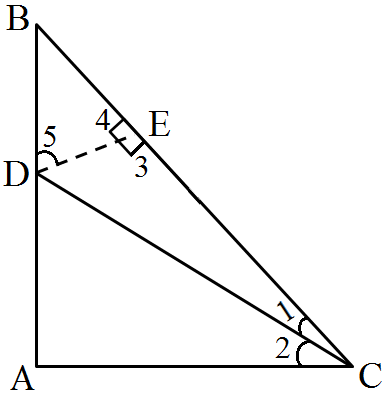
$\angle1=\angle2$ [given,$\text{CD}$ isthe bisector of $\angle\text{C}$]
$\text{DC}=\text{DC} [$common sides$]$
$\therefore\ \triangle\text{DAC}\cong\triangle\text{DEC}$ [by AAS congruence rule]
$\Rightarrow\ \text{DA}=\text{DE}. [$by $CPCT]...(i)$
$\text{and}\ \text{AC}=\text{EC} ...(ii)$
$\text{ln}\ \triangle\text{ABC},\ \text{AB}=\text{AC}$
$\angle\text{C}=\angle{B}[$ angle opposite to equal sides are equal$]...(iii) $Again,in $\triangle\text{ABC},\ \angle\text{A}+\angle\text{B}+\angle\text{C}= 180^\circ$ [by angle sum property of a triangle] $\Rightarrow\ 90^\circ+\angle\text{B}+\angle\text{B}=180^\circ$
$\Rightarrow\ 2\angle\text{B}=180^\circ-90^\circ[$from Eq.$(iii)]$
$\Rightarrow\ 2\angle\text{B}=90^\circ$
$\Rightarrow\ \angle\text{B}=45^\circ$
$\text{ln}\ \triangle\text{BED},\ \angle5=180^\circ-\big(\angle\text{B}+\angle{4}\big)$ [by angle sum property of a triangle] $=180^\circ-(45^\circ+90^\circ)$
$=180^\circ-135^\circ=45^\circ$
$\therefore\ \angle\text{B}=\angle{5}$
$\Rightarrow\ \text{DE}=\text{BE}\ [\because$ sides opposite to equal angle are equal$] ...(iv)$ from Eqs. $(i)$ and $(iv),$ $\text{DA}=\text{DE}=\text{BE} ...(v)$
$\because\text{BC}=\text{CE}+\text{EB}$
$=\text{CA}+\text{DA} [$from Eqs. $(ii)$ and $(v)]$
$\therefore\text{AD}+\text{AC}=\text{BC}$ Hence proved. View full question & answer→Question 124 Marks
Prove that in a triangle, other than an equilateral triangle, angle opposite the longest side is greater than $\frac{2}{3}$ of a right angle.
AnswerConsider $\triangle\text{ABC}$ in which $BC$ is the longest side. To prove $\angle\text{A}=\frac{2}{3}$ right angle Proof In $\triangle\text{ABC},\ \text{BC}>\text{AB}.$
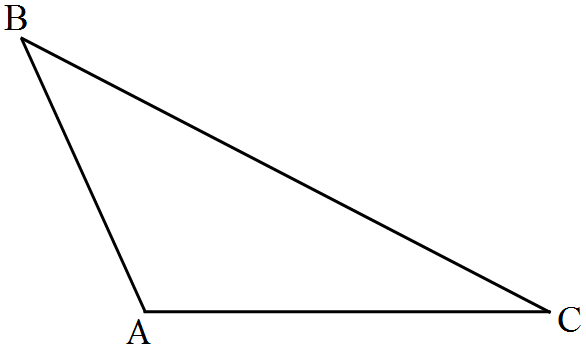
$[$consider $BC$ is the largest side$]$
$\Rightarrow\ \angle\text{A}>\angle\text{C} ...(i) [$angle opposite the lngest side is greatest$]$
$\text{and}\ \text{BC}>\text{AC}$
$\Rightarrow\ \angle\text{A}>\angle\text{B}, [$angle opposite the longest side is greatest$]$
On adding Eqs. $(i)$ and $(ii),$ we get $2\angle\text{A}>\angle\text{B}+\angle\text{C}$
$\Rightarrow\ 2\angle\text{A}+\angle\text{A}>\angle\text{A}+\angle\text{C}$ [adding $\angle\text{A}$ both sides]
$\Rightarrow\ 3\angle\text{A}>\angle\text{A}+\angle\text{B}+\angle\text{C}$
$\Rightarrow\ 3\angle\text{A}>180^\circ [$sum of the angles of a triangle is $180^\circ ]$
$\Rightarrow\ \angle\text{A}>\frac{2}{3}\times90^\circ$
i.e., $\angle\text{A}>\frac{2}{3}$ of a right angle Hence proved. View full question & answer→Question 134 Marks
$P$ is point on the bisector of $\angle\text{ABC}.$ if the line throught $P,$ parallel to $BA$ meet $BC$ at $Q,$ prove that $BPQ$ is an isosceles triangle.
AnswerWe have to prove thet $BPQ$ is an isosceles triangle.
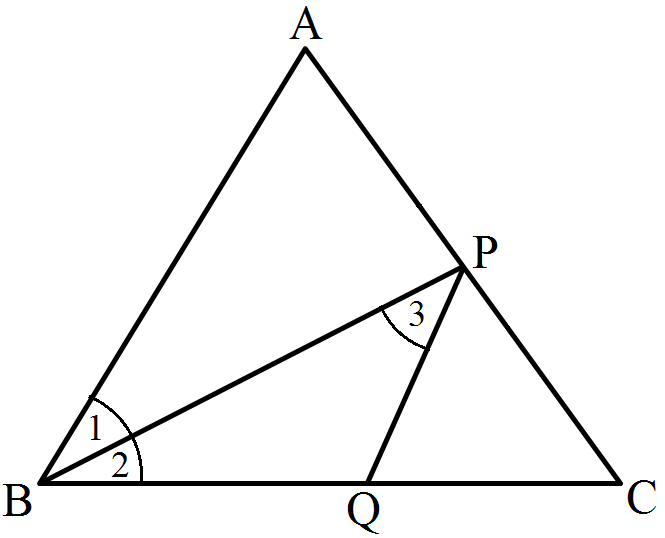
$\angle\text{1}=\angle\text{2}\ ...(\text{i})$
Now, $PQ$ is paraller to $BA$ and $BP$ cuts them
$\therefore \angle\text{1}=\angle\text{3}\ ...(\text{ii})$ from $(i)$ and $(ii),$ In $\triangle\text{BPQ},$
we have $\angle\text{2}=\angle\text{3}$
$\therefore\text{PQ}=\text{BQ}$
Hence, $BPQ$ is an isosceles triangle. View full question & answer→Question 144 Marks
Show that in a quadrilateral $ABCD, AB + BC + CD + DA < 2 (BD + AC)$
AnswerGiven, A quadrilateral $ABCD.$
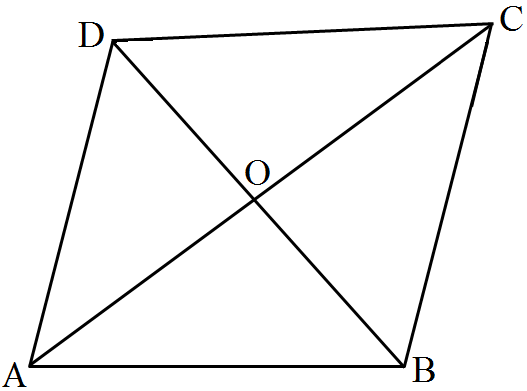
To prove: $AB + BC + CD + DA < 2(BD + AC)$
Proof: In $\triangle\text{AOD}$ We have $\therefore\text{OA}+\text{OB}>\text{AB }...(\text{i}) $
$\big[\therefore$ Sum of the lengths of any sides of a triangle must be greater than rhird side$\big]$
In $\triangle\text{BOC}$ We have $OB + OC + > BC ...(2) [$Same reason$]$
In $\triangle\text{COD},$ We have $OC + OD + > CD ...(3) [$Same reason$]$
In $\triangle\text{DOA},$ We have $OD + OA > DA ...(4) [$Same reason$]$
Adding $(1), (2), (3)$ and $(4),$
We get $OA + B + OB + OC + OC + OD + OA + > AB + BC + CD +DA $
$\Rightarrow 2(OA + OB + OC + OD) > AB + BC + CD + DA $
$\Rightarrow 2{(OA + OC) + (OB + OD)} > AB + BC + CD + DA $
$\Rightarrow 2(AC + BD) > AB + BC + CD + DA $
$\Rightarrow AB + BC + CD + DA < 2(BD + AC)$
Hence, proved. View full question & answer→Question 154 Marks
Line segment joining the mid-points $M$ and $N$ of parallel sides $AB$ and $DC,$ respectively of a trapezium $ABCD$ is perpendicular to both the sides $AB$ and $DC$ Prove that $AD = BC.$
AnswerGiven in trapezium $ABCD,$ points $M$ and $N$ are the mid-points of parallel sides $AB$ and $DC$ respectively and join $MN,$ which is perpendicular to $AB$ and $DC.$ To prove: proof since, $M$ is the mid-point of $AB$
$\therefore \text{AM} = \text{MB}$
Now, in $\triangle \text{AMN} \text{ and } \triangle \text{BMN},\ \text{AM} = \text{MB}$ [proved above]
$\angle 3 = \angle 4$ [each 90^\circ ] $\text{MN} = \text{MN}$ [common side]
$\therefore \triangle \text{AMN} \cong \text{BMN}$ [by SAS congruence rule]
$\therefore \angle 1 = \angle 2 [$by $CPCT]$
On multiplying both sides of above equation by $- 1$ and than adding $90^\circ$ both sides,
we get $90^\circ - \angle 1 = 90^\circ - \angle 2$
$\Rightarrow \angle \text{AND} = \angle \text{BNC}$
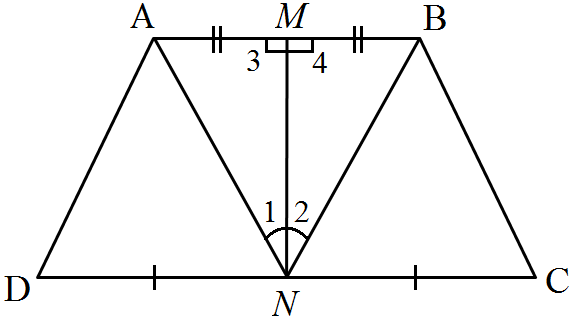
Now, in $\triangle \text{ADN} \text{ and } \triangle \text{BNC}$
$\angle \text{AND} = \angle \text{BNC}$ [from Eq.(i)] $\text{AN} = \text{BN}$
$\big[\because\ \triangle\text{AMN}\ \cong\ \triangle\text{BMN}\big]$
$\text{and}\ \text{DN}\ =\ \text{NC}$
$\big[\because N$ is the mid-point of $CD$ (given)$\big]$
$\therefore\ \triangle\text{ADN}\ \cong\ \triangle\text{BCN} [$by $SAS$ congruence rule$]$
Hence,$\text{AD}\ =\ \text{BC} [$by $CPCT] $ Hence proved. View full question & answer→Question 164 Marks
Question 15: Two lines $l$ and $m$ intersect at the point $0$ and $P$ is a point on a line $n$ passing through the point $0$ such that $P$ is equidistant from $l$ and $m.$ Prove that $n$ is the bisector of the angle formed by $l$ and $m.$
AnswerGiva two lines $L$ and $M$ intersect at the point $O$ and $P$ is a point on a line $n$ passing through $O$ such that $P$ is equidistant from $L$ and $M,$ i.e.,$ PQ = PR,$
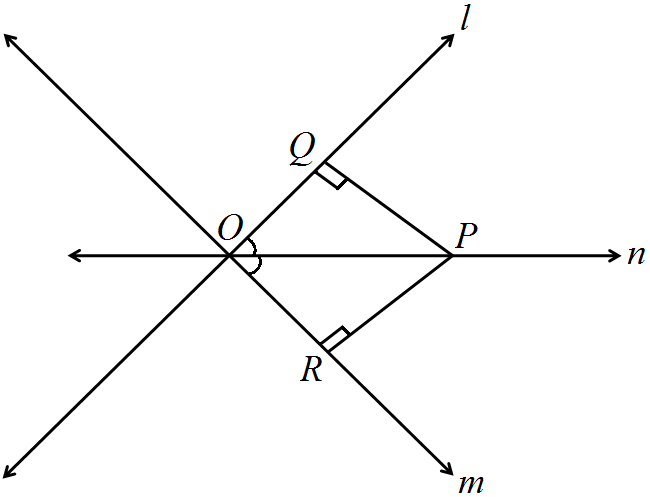
To prove $N$ is the bisector of the angle formed by $L$ and $M$ i.e., $n$ is the bisector of $\angle\text{QOR},$
Proof In $\triangle\text{OQP}\text{ and }\triangle\text{ORP} $,
$\angle\text{PQO}=\angle\text{PRO}=\text{90}^0$
$[$since,$P$ in equidistant from $L$ and $M,$ so $PQ$ and $PR$ should be perpendicular to lines $L$ and $M$ respectively$] OP = OP [$commo side$] P = PR [$given$]$
$\therefore\triangle\text{OQP}\cong\triangle\text{ORP} [$by $RHS$ congruence rule$]$ $\Rightarrow\angle\text{POQ}=\angle\text{POR} [$by $CPCT]$
Hence,n is the bisector of $\angle\text{QOR}.$Hence proved. View full question & answer→Question 174 Marks
$ABC$ is a right triangle such that $AB = AC$ and bisector of angle $C$ intersects the side $AB$ at $D.$ Prove that $AC + AD = BC.$
AnswerGiven In quadrilateral $ABCD, AB$ is the smallest and $CD$ is largest side to find $\angle\text{B}>\angle\text{D}\text{ or }\angle\text{D}>\angle\text{B}.$
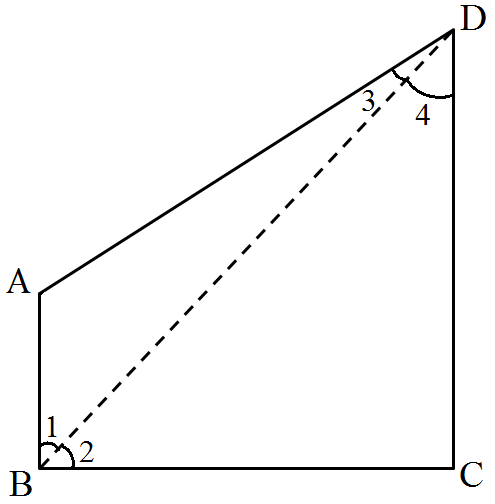
Construction Join $BD.$
Now, in $\triangle\text{ABD},\ \text{AD}>\text{AB} [$since, $AB$ is the smallest side in $ABCD]$
$\Rightarrow\ \angle{1}>\angle{3}[$ angle opposite to larger side is greater$]...(i)$
$\text{In }\triangle\text{ABCD},\ \text{CD}>\text{BC}[$ since, $CD$ is the largest side in $ABCD]$
$\Rightarrow\ \angle{2}>\angle{4}[$angle opposite to larger side is greater$]...(ii)$
On adding Eqs.$(i)$ and $(ii), $we get $\angle1+\angle2+\angle3+\angle4$
Hence, $\angle\text{B}>\angle\text{D}$ View full question & answer→Question 184 Marks
The image of an object placed at a point A before a plane mirror $LM$ is seen at the point B by an observer at $D$ as shown in figure. Prove that the image is as far behind the mirror as the object is in front of the mirror.
AnswerGiven, An object placed at a point $A$ before a plane mirror $LM$ is seen at the point $B$ by an observer at $D$ as shown in figure. The image is as far behind the mirror as the object is in front of the mirror $OB = OA.$
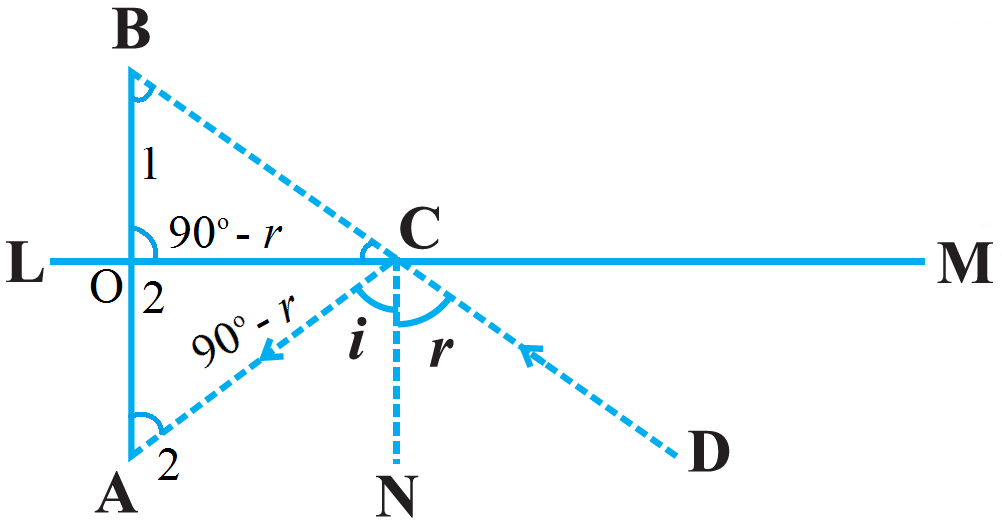
$\therefore\text{CN}\perp\text{LM}$ and $\text{AB}\perp\text{LM}$
$\text{AB}\ ||\ \text{CN}$
$\angle\text{A}=\angle\text{i}\ ...(\text{i})$
$\angle\text{B}=\angle\text{r}\ ...(\text{ii})$
$\angle\text{i}=\angle\text{r}\ ...(\text{iii})$ From eq.$(i), (ii)$ and $(iii)$
$\angle\text{A}=\angle\text{B}$ In $\triangle\text{COB},$
$\angle\text{B}=\angle\text{A}$
$\angle\text{1}=\angle\text{2}$
$\text{OB}=\text{OA}$ In $\triangle\text{OBC},$
$\angle\text{1}=\angle\text{2}$
$\angle\text{i}=\angle\text{r}$
On mulitiplying both sides of then adding both sides,
$90^{\circ}-\angle\text{i}=90^{\circ}-\angle\text{r}$
$\Rightarrow \angle\text{ACO}=\angle\text{BCO}$
$\Rightarrow \text{OC}=\text{OC}$
$\therefore\triangle\text{OBC}=\triangle\text{OAC}$
$\Rightarrow \text{OB}=\text{OA}$
Hence, the image is as far behind the mirror as the object is in front of the mirror. View full question & answer→Question 194 Marks
Bisectors of the angles $B$ and $C$ of an isosceles triangle with $AB = AC$ intersect each other at $O.\ BO$ is produced to a point M. Prove that $\angle\text{MOC}=\angle\text{ABC}.$
AnswerGiven Lines, $OB$ and $OC$ are angle bisectore of $\angle\text{B}$ and $\angle\text{C}$ an isosceles $\triangle\text{ABC}$ such that $AB = AC$ which intersrct each other at $O$ and $BO$ is produced to $M.$
$\angle\text{MOC}=\angle\text{ABC}$
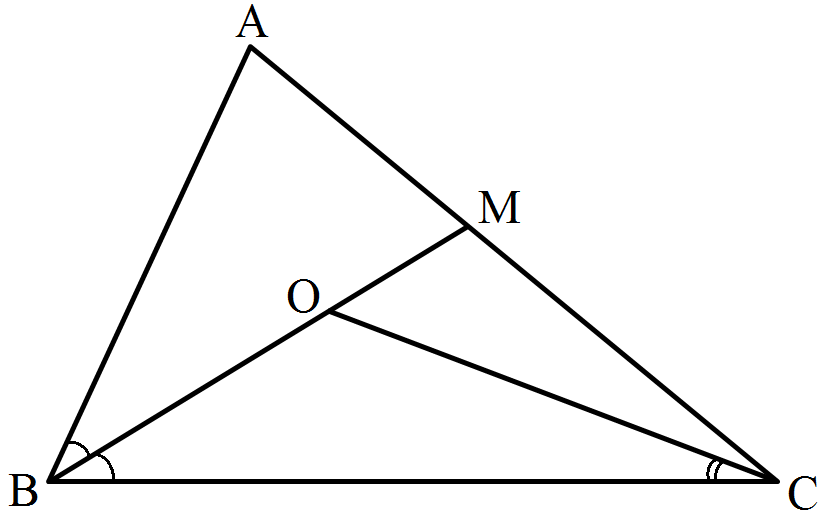
In $\triangle\text{ABC},$
$\text{AB}=\text{AC}$
$\frac{1}{2}\angle\text{ACB}=\frac{1}{2}\angle\text{ABC}$
$\angle\text{OCB}=\angle\text{OBC}$
Now, $\angle\text{MOC}=\angle\text{OBC}+\angle\text{OCB}$
$\Rightarrow\angle\text{MOC}=\angle\text{OBC}+\angle\text{OBC}$
$\Rightarrow \angle\text{MOC}=2\angle\text{OBC}$
$\Rightarrow \angle\text{MOC}=\angle\text{ABC}$ View full question & answer→Question 204 Marks
Show that in a quadrilateral $ABCD, AB + BC + CD + DA > AC + BD$
AnswerGiven $ABCD$ is a quadilateral,
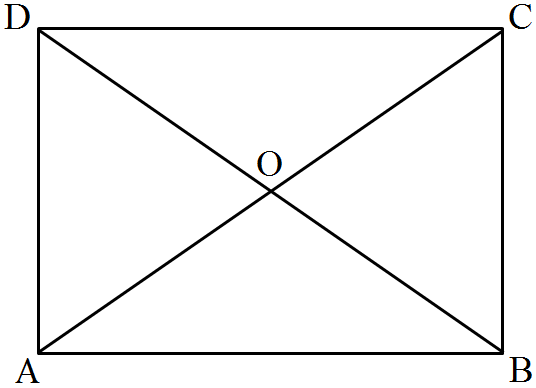
Construction join diagonais $AC$ and $BD.$ To show $AB + BC + CD + DA > AC + BD$
In $\triangle\text{ABC}, AB + BC > AC [$Sum of two sides of a triangle is greater than the third side$] ...(i)$
In $\triangle\text{BCD}, BC + CD > BD [$Sum of two sides of a triangle is greater than the third side$] ...(ii)$
In $\triangle\text{CDA}, CD + DA > AC [$Sum of two sides of a triangle is greater than the third side$] ...(iii)$
In $\triangle\text{DAB}, DA + AB + > BD [$Sum of two sides of a triangle is greater than the third side$] ...(iv)$
On adding Eqs. $(i), (ii), (iii) (iv),$
We get $2(AB + BC + CD + DA) > 2 (AC + BD) $
$⇒ AB + BC + CD + DA > AC + BD$ View full question & answer→Question 214 Marks
$ABC$ is a right triangle with $AB = AC.$ If bisector of meets $BC$ at $D ,$ then prove that $BC = 2AD.$
AnswerIn $\triangle\text{ABC}$ is a right angle triangle with $AB = AC$, is the Bisector.
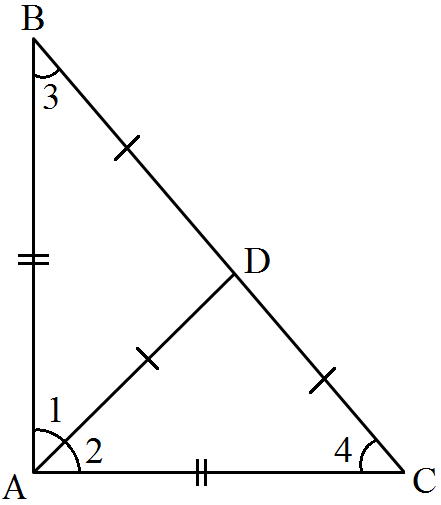
$\text{BC}=2\text{AD}$
$\text{AB}=\text{AC}$
$\angle\text{C}=\angle\text{B}$
Now, in right angle $\triangle\text{ABC},$
$\angle\text{A}+\angle\text{B}+\angle\text{C}=180^{\circ}$
$\Rightarrow 90^{\circ}+\angle\text{B}+\angle\text{B}=180^{\circ}$
$\Rightarrow 2\angle\text{B}=90^{\circ}$
$\Rightarrow \angle\text{B}=45^{\circ}$
$\Rightarrow \angle\text{B}=\angle\text{C}=45^{\circ}$
$\Rightarrow \angle\text{3}=\angle\text{4}=45^{\circ}$
$\Rightarrow \angle\text{1}=\angle\text{2}=45^{\circ}$
$\text{BD}=\text{AD},\text{DC}=\text{AD}$ Hence, $\text{BC}=\text{BD}+\text{CD}$
$=\text{AD}+\text{AD}$
$=2\text{AD}$ View full question & answer→Question 224 Marks
In a right triangle, prove that the line-segment joining the mid-point of the hypotenuse to the opposite vertex is half the hypotenuse.
AnswerWe have to prove that $\angle\text{ABC}=90^\circ$ As is the mid-point of $AC$, so, $AD = DC$
Also, $\text{BD}=\frac{\text{1}}{\text{2}}\text{AC}=\text{AD}$
$\big[\therefore D$ is the mid-point of $AC\big]$
$\therefore BD = AD = DC$
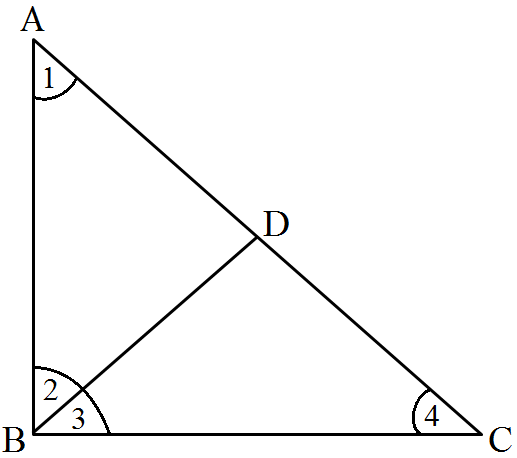
In $\triangle\text{ABC},$
We have $BD = AD$
$\therefore\angle1=\angle2\ ...(1)$
$\big[\because$ Angles opposite to equal sides are equal$\big]$
In $\triangle\text{BCD},$
We have $BD = DC,$
$\therefore\angle\text{3}=\angle4 ...(2)$
In $\triangle\text{ABC},$
We have $\angle1+\angle\text{ABC}+\angle4=180^\circ$
$\Rightarrow\angle\text{1}+\angle\text{2}+\angle\text{3}\angle+\text{4}=180^\circ$
$\Rightarrow2(\angle\text{2}+\angle\text{3})=180^\circ)$
$\Rightarrow\angle2+\angle3=90^\circ$
$\Rightarrow\angle=90^\circ$
Hence proved. View full question & answer→