Questions

2 Marks Questions

🎯

Test yourself on this topic

10 questions · timed · auto-graded

Question 12 Marks
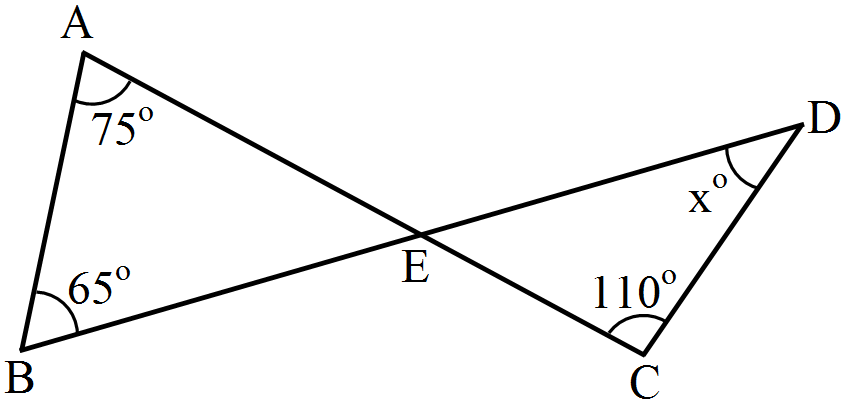
Calculate the value of $x$ in the following figures.
Answer
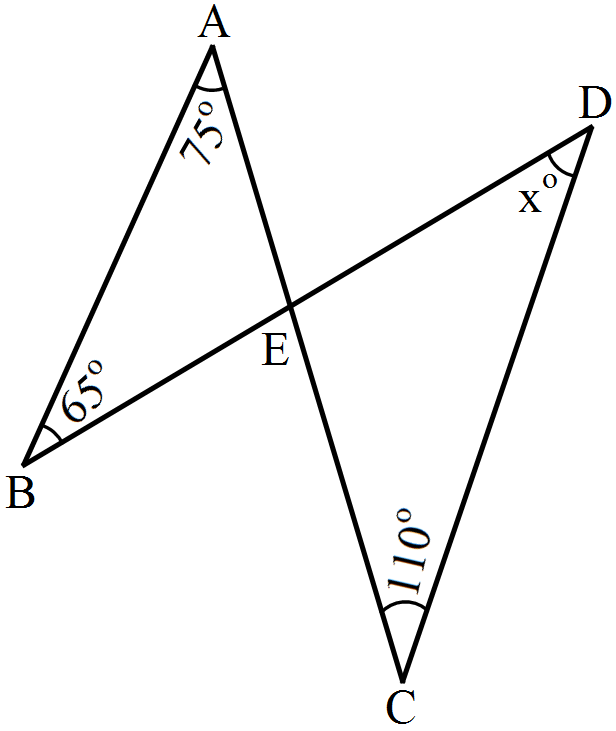
In $\triangle\text{ABE},$ we have, $\angle\text{A}+\angle\text{B}+\angle\text{E}=180^\circ$
$\Rightarrow75^\circ+65^\circ+\angle\text{E}=180^\circ$
$\Rightarrow140^\circ+\angle\text{E}=180^\circ$
$\Rightarrow\angle\text{E}=180^\circ-140^\circ=40^\circ$ Now, $\angle\text{CED}=\angle\text{AEB}$ [Vertically opposite angles] $\Rightarrow\angle\text{CED}=40^\circ$ Now, in $\triangle\text{CED},$ we have, $\angle\text{C}+\angle\text{E}+\angle\text{D}=180^\circ$
$\Rightarrow110^\circ+40^\circ+\text{x}^\circ=180^\circ$
$\Rightarrow150^\circ+\text{x}^\circ=180^\circ$
$\Rightarrow\text{x}^\circ=180^\circ-150^\circ=30^\circ$
$\therefore\text{x}=30$
View full question & answer
Question 22 Marks
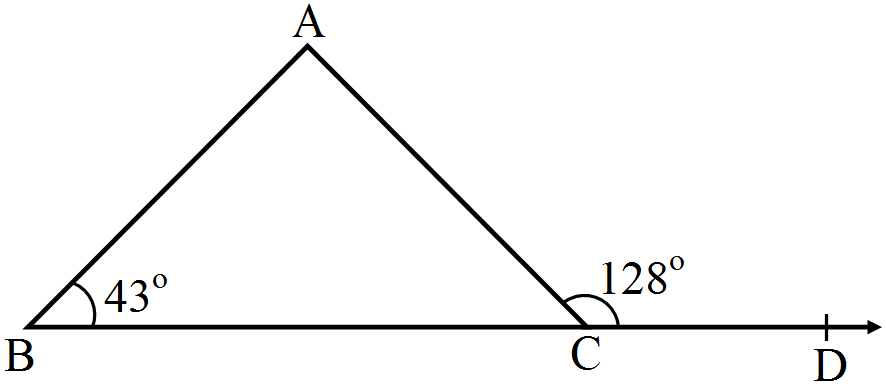
In the given figure, side $BC$ of $\triangle\text{ABC}$ is produced to $D$. If $\angle\text{ACD}=128^\circ$ and $\angle\text{ABC}=43^\circ,$ find $\angle\text{BAC}$ and $\angle\text{ACB}.$
Answer
Since $\angle\text{ACB}$ and $\angle\text{ACD}$ form a linear pair. So, $\angle\text{ACB}+\angle\text{ACD}=180^\circ$
$\Rightarrow\angle\text{ACB}+128^\circ=180^\circ$
$\Rightarrow\angle\text{ACB}=180^\circ-128=52^\circ$ Also, $\angle\text{ABC}+\angle\text{ACB}+\angle\text{BAC}=180^\circ$
$\Rightarrow43^\circ+52^\circ+\angle\text{BAC}=180^\circ$
$\Rightarrow95^\circ+\angle\text{BAC}=180^\circ$
$\Rightarrow\angle\text{BAC}=180^\circ-95^\circ=85^\circ$
$\therefore\angle\text{ACB}=52^\circ$ and $\angle\text{BAC}=85^\circ.$
View full question & answer
Question 32 Marks
In $\triangle\text{ABC},$ if $\angle\text{B}=76^\circ$ and $\angle\text{C}=48^\circ,$ find $\angle\text{A}.$
Answer
Since, sum of the angles of a triangle is $180^\circ$
$\angle\text{A}+\angle\text{B}+\angle\text{C}=180^\circ$
$\Rightarrow\angle\text{A}+76^\circ+48^\circ=180^\circ$
$\Rightarrow\angle\text{A}=180^\circ-124^\circ=56^\circ$
$\therefore\angle\text{A}=56^\circ$
View full question & answer
Question 42 Marks
If each angle of a triangle is less than the sum of the other two, show that the triangle is acute-angled.
Answer
Let $ABC$ be a triangle. So, $\angle\text{A}<\angle\text{B}+\angle\text{C}$ Adding $\angle\text{A}$ to both sides of the inequality, $\Rightarrow2\angle\text{A}$
View full question & answer
Question 52 Marks
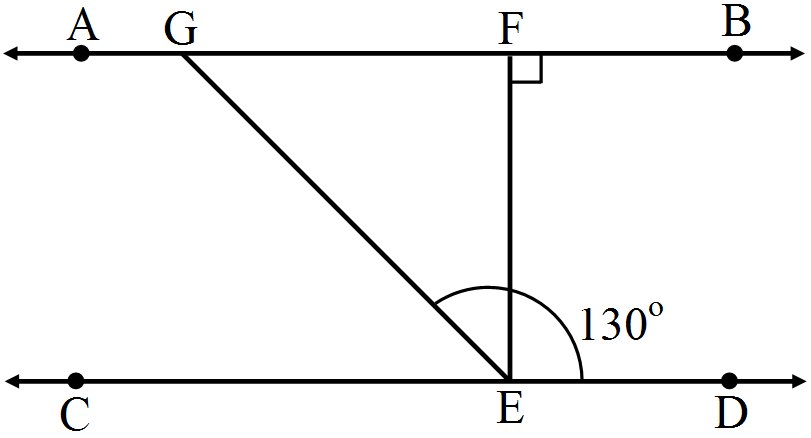
In the given figure, $AB \| CD$ and $\text{EF}\perp\text{AB}.$ If EG is the transversal such that $\angle\text{GED}=130^\circ,$ find $\angle\text{EGF}.$
Answer
$AB \| CD$ and $GE$ is the transversal.
$\Rightarrow\angle\text{EGF}+\angle\text{GED}=180^\circ$ (interior angles are supplementary)
$\Rightarrow\angle\text{EGF}+130^\circ=180^\circ$
$\Rightarrow\angle\text{EGF}=50^\circ$
View full question & answer
Question 62 Marks
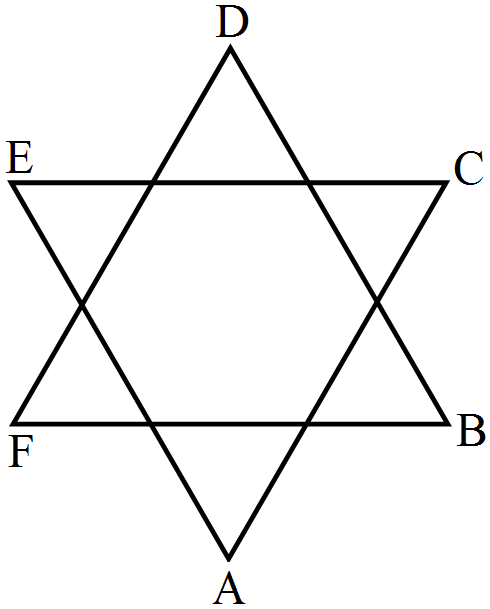
In the adjoining figure, show that $\angle\text{A}+\angle\text{B}+\angle\text{C}+\angle\text{D}+\angle\text{E}+\angle\text{F}=360^\circ.$
Answer
In $\triangle\text{ACE},$ we have, $\angle\text{A}+\angle\text{C}+\angle\text{E}=180^\circ\ ...(\text{i)}$
In $\triangle\text{BDF},$ we have, $\angle\text{B}+\angle\text{D}+\angle\text{F}=180^\circ\ ...(\text{ii)}$
Adding both sides of $(i)$ and $(ii),$
we get, $\angle\text{A}+\angle\text{C}+\angle\text{E}+\angle\text{B}$
$+\angle\text{D}+\angle\text{F}=180^\circ+180^\circ$
$\Rightarrow\angle\text{A}+\angle\text{B}+\angle\text{C}+\angle\text{D}+\angle\text{E}+\angle\text{F}=360^\circ.$
View full question & answer
Question 72 Marks
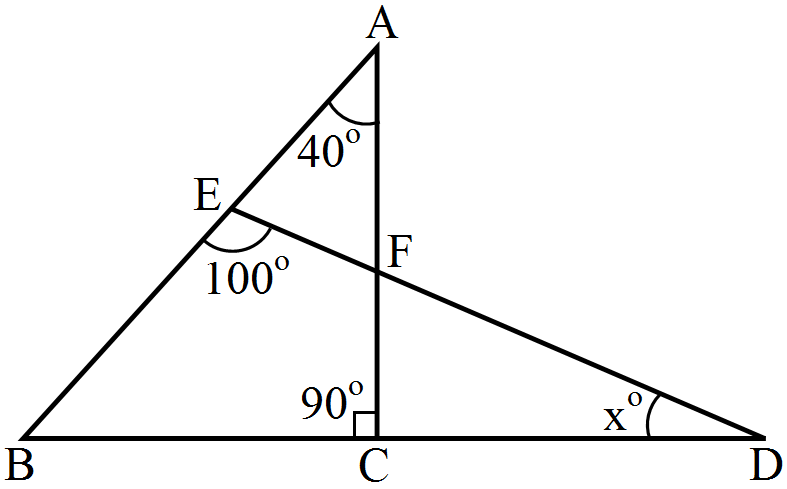
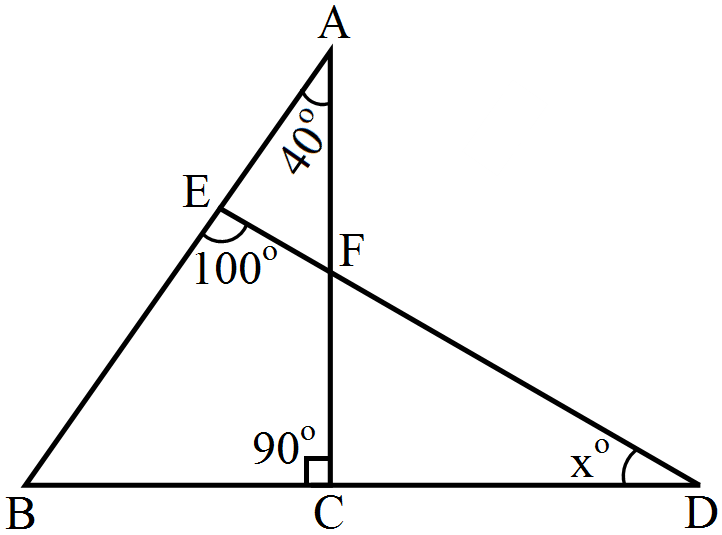
Calculate the value of $x$ in the following figures.
Answer

In $\triangle\text{AEF},$ Exterior $\angle\text{BED}=\angle\text{EAF}=\angle\text{EFA}$
$\Rightarrow100^\circ=40^\circ+\angle\text{EFA}$
$\Rightarrow\angle\text{EFA}=100^\circ-40^\circ=60^\circ$
Also, $\angle\text{CFD}=\angle\text{EFA}$ [Vertically Opposite angles]
​​​​​​​$\Rightarrow90^\circ=60^\circ+\text{x}^\circ$
$\Rightarrow\text{x}^\circ=90^\circ-60^\circ=30^\circ$
$\therefore\text{x}=30$
View full question & answer
Question 82 Marks
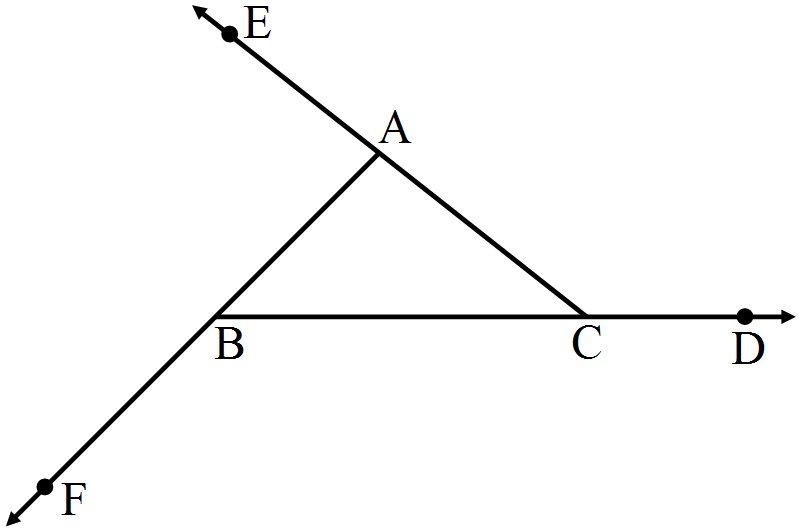
If the sides of a triangle are produced in order, prove that the sum of the exterior angles so formed is equal to four right angles.
Answer
Given: A $\triangle\text{ABC}$ in which $BC, CA$ and $AB$ are produced to $D, E$ and $F$ respectively.
To prove: Exterior $\angle\text{DCA}=\angle\text{A}+\angle\text{B}\ .....(\text{i)}$
Exterior $\angle\text{FAE}=\angle\text{B}+\angle\text{C}\ .....(\text{ii)}$
Exterior $\angle\text{FBD}=\angle\text{A}+\angle\text{C}\ .....(\text{iii)}$
Adding $(i), (ii)$ and $(iii),$ we get,
$\text{Ext}.\angle\text{DCA}+\text{Ext}.\angle\text{FAE}+\text{Ext}.\angle\text{FBD}$
$=\angle\text{A}+\angle\text{B}+\angle\text{B}+\angle\text{C}+\angle\text{A}+\angle\text{C}$
$=2\angle\text{A}+2\angle\text{B}+2\angle\text{C}$
$=2(\angle\text{A}+\angle\text{B}+\angle\text{C})$
$=2\times180^\circ$
[Since, in triangle the sum of all three angle is $180^\circ ]$
$= 360^\circ $
Hence, proved.
View full question & answer
Question 92 Marks
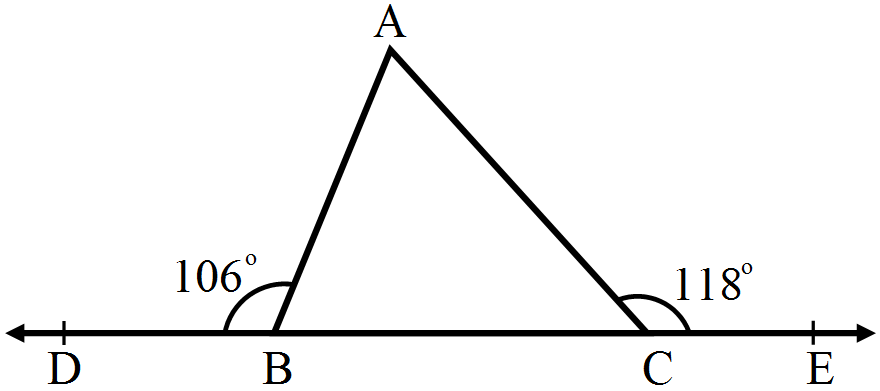
In the given figure, the side BC of $\triangle\text{ABC}$ has been produced on both sides-on the left to $D$ and on the right to $E.$ If $\angle\text{ABD}=106^\circ$ and $\angle\text{ACE}=118^\circ,$ find the measure of each angle of the triangle.
Answer
As $\angle\text{DBA}$ and $\angle\text{ABC}$ form a linear pair.
So, $\angle\text{DBA}+\angle\text{ABC}=180^\circ$
$\Rightarrow106^\circ+\angle\text{ABC}=180^\circ$
$\Rightarrow\angle\text{ABC}=180^\circ-106^\circ=74^\circ$
Also, $\angle\text{ACB}$ and $\angle\text{ACE}$ form a linear pair.
So, $\angle\text{ACB}+\angle\text{ACE}=180^\circ$
$\Rightarrow\angle\text{ACB}+118^\circ=180^\circ$
$\Rightarrow\angle\text{ACB}=180^\circ-118^\circ=62^\circ$
In $\triangle\text{ABC},$ we have,
$\angle\text{ABC}+\angle\text{ACB}+\angle\text{BAC}=180^\circ$
$74^\circ+62^\circ+\angle\text{BAC}=180^\circ$
$\Rightarrow136^\circ+\angle\text{BAC}=180^\circ$
$\Rightarrow\angle\text{BAC}=180^\circ-136^\circ=44^\circ$
$\therefore$ In triangle ABC, $\angle\text{A}=44^\circ,\angle\text{B}=74^\circ$ and $\angle\text{C}=62^\circ$
View full question & answer
Question 102 Marks
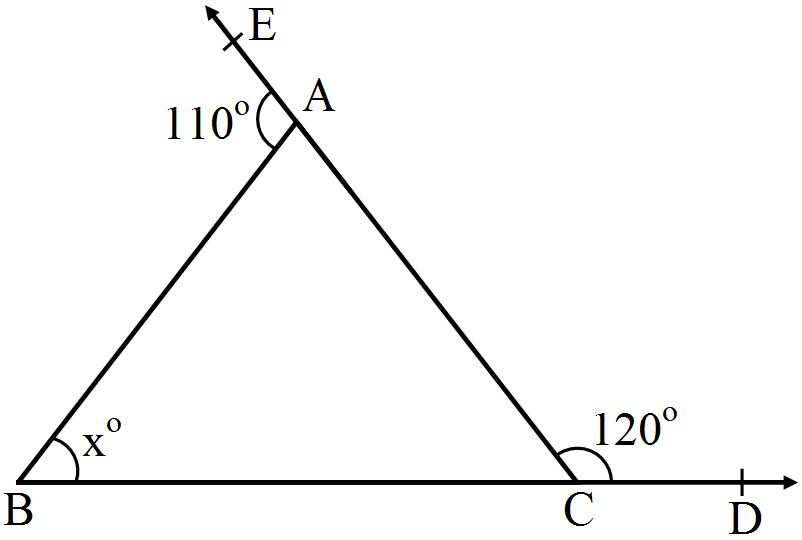
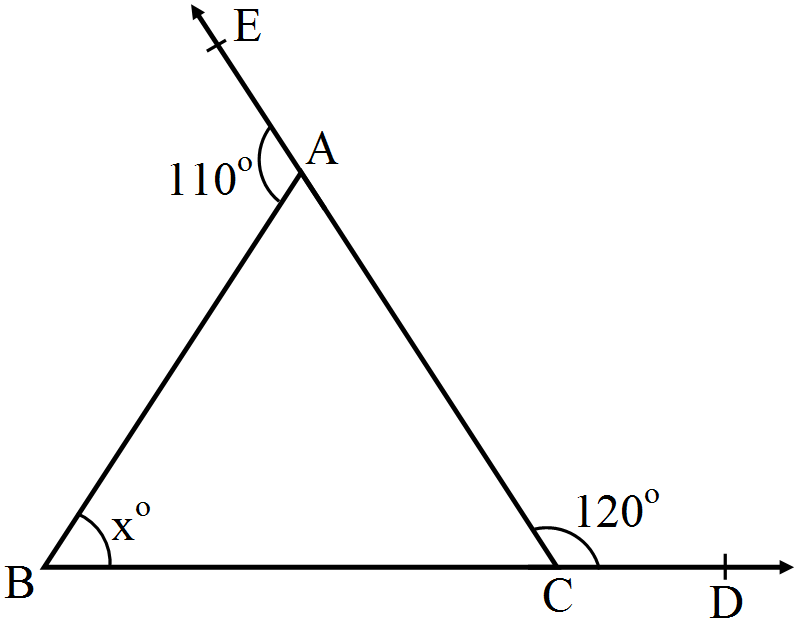
Calculate the value of x in the following figures.

Answer
$\angle\text{EAB}+\angle\text{BAC}=180^\circ$ [Linear pair angles]

$110^\circ+\angle\text{BAC}=180^\circ$
$\Rightarrow\angle\text{BAC}=180^\circ-110^\circ=70^\circ$
Again, $\angle\text{BCA}+\angle\text{ACD}=180^\circ$ [Linear pair angles]
$\Rightarrow\angle\text{BCA}+120^\circ=180^\circ$
$\Rightarrow\angle\text{BCA}=180^\circ-120^\circ=60^\circ$
Now, in $\triangle\text{ABC},$
$\angle\text{ABC}+\angle\text{BAC}+\angle\text{ACB}=180^\circ$
$\text{x}+70^\circ+60^\circ=180^\circ$
$\Rightarrow\text{x}+130^\circ=180^\circ$
$\Rightarrow\text{x}=180^\circ-130^\circ=50^\circ$
$\therefore\text{x}=50$
View full question & answer
2 Marks Questions - MATHS STD 9 Questions - Vidyadip