Question 13 Marks
A stone is thrown vertically upwards with a speed of $20m/s$. How high will it go before it begins to fall? $(g = 9.8m/s^2)$
AnswerInitial velocity, $\mathrm{u}=20 \mathrm{~m} / \mathrm{s}$
Final velocity, $\mathrm{v}=0$
Acceleration due to gravity, $\mathrm{g}=-9.8 \mathrm{~m} / \mathrm{s}^2$
Height, $\mathrm{h}=$ ?
Using relation, for a freely falling body: $\mathrm{v}^2=\mathrm{u}^2+2 \mathrm{gh}(0)^2=(20)^2+2 \times(-9.8) \times \mathrm{h} 0-400=-19.6 \mathrm{~h} \mathrm{~h}=\frac{400}{19.6}=20.4 \mathrm{~m}$
View full question & answer→Question 23 Marks
A stone is dropped from a height of $20m$. What will be its speed when it hits the ground? $(g = 10m/s^2)$
AnswerHeight, $s = 20m$ Initial velocity, $u = 0$
Acceleration due to gravity, $g = 10m/s^2$
Final velocity, $v = ?$
Time taken, $t = ?$ For a
freely body. $\text{v}^2=\text{u}^2+2\text{gh}$
$=(0)^2+2\times(10)\times(20)$ So, $\text{v}^2=400$
$\text{v}=\sqrt{400}=20\text{m/s}$
The speed of stone when it hits the ground will be $20m/s.$
View full question & answer→Question 33 Marks
A student thought that two bricks tied together would fall faster than a single one under the action of gravity. Do you agree with his hypothesis or not? Comment.
AnswerYes, because force depends on the quantity of matter contained in a body or a particle and we know force can change the speed of a moving object so indirectly force depends on distance as it depends on speed too or due to gravitational force. When two bricks are tied together their weight would be greater than a single brick because gravitation due to acceleration depends on weight $\Rightarrow w = m.g \Rightarrow g =$ w.g and greater weight will fall faster.
View full question & answer→Question 43 Marks
A stone is allowed to fall from the top of a tower $100m$ high and at the same time another stone is projected vertically upwards from the ground with a velocity of $25m/ s$. Calculate when and where the two stones will meet.
AnswerLet the two stones meet after a time $t.$
- For the stone dropped from the tower:
Initial velocity, $u = 0$
Let the displacement of the stone in time t from the top of the tower be s.
Acceleration due to gravity, $g = 9.8m s^{−2}$
From the equation of motion,
$\text{s}=\text{ut}+\frac{1}2\text{gt}^2$
$=0\times \text{t}+\frac{1}2\times9.8\times\text{t}^2$
$\therefore\ \text{s}=4.9\text{t}^2\ \dots(1)$
- For the stone thrown upwards: Initial velocity, $u = 25m s^{-1}$ Let the displacement of the stone from the ground in time t be s'. Acceleration due to gravity, $g = -9.8m s^{-2}$ Equation of motion,
$\text{s}'=\text{ut}+\frac{1}2\text{gt}^2$
$=25\text{t}-\frac{1}2\times9.8\times\text{t}^2$
$\therefore\ \text{s}'=25\text{t}-4.9\text{t}^2\ \dots(2)$
The combined displacement of both the stones at the meeting point is equal to the height of the tower 100m.
$\therefore\ \text{s}+\text{s}'=100$
$\frac{1}2\text{gt}^2+25\text{t}-\frac{1}{2}\text{gt}^2=100$
$\therefore\ \text{t}=\frac{100}{25}=4\text{s}$
In 4s, the falling stone has covered a distance given by equation $(1)$ as
$\text{s}=\frac{1}2\times10\times4^2=80\text{m}$
Therefore, the stones will meet after $4s$ at a height $(100 − 80) = 20m$ from the ground. View full question & answer→Question 53 Marks
Explain why, when a person stands on a cushion, the depression is much more than when he lies down on it.
AnswerWhen a person stands on a cushion then only his two feet (having small area) are in contact with the cushion. Due to this the weight of man falls on a small area of the cushion producing a large pressure causing a big depression in the cushion. On the other hand, when the same person lies down on the cushion, then his whole body (having large area) is in contact with the cushion. Here, his weight falls on a much larger area of the cushion producing much smaller pressure and very little depression in the cushion.
View full question & answer→Question 63 Marks
A body drops down a tower and reaches the ground in $0.6s$. If $g = 10m/ s^2$, then find the height of the tower.
AnswerAcording to equation of motion
$\text{H}=\frac{\text{ut}+1}{2\text{at}^2}$
Here,
height $= H$
$u =$ initial velocity
$a =$ acceleration(acceleratio due to gravity ’g’ in this case)
and t is the time taken by object to reach ground.
Here,
$u = 0$
$t = 0.6s$
$a = g = 10m/ s^2$
Putting all these values in equation
$\text{H}=\frac{0+1}{2\times10\times(0.6)^2}$
$\text{H}=1.8\text{m}$
Height of the tower is $1.8m.$
View full question & answer→Question 73 Marks
What is upthrust? What are the quantities that can vary upthrust? How does it account for the floating of a body? When a partially immersed body is pressed down a little, what will happen to the upthrust?
AnswerThe upward force that is exerted by a fluid against a submerging object is called as the Upthrust. It is defined as the loss of weight of the object when in water compared to its weight in air. Upthrust is usually dependent on the density of the liquid and the volume of the body. A change in these quantities can vary the upthrust. The apparent weight of the body may vary due to the upthrust. If the upthrust is equivalent to the weight of the object, then the object will float on the surface of the liquid. However, when an object which is partially immersed is pressed down, there will be an increase in the upthrust.
View full question & answer→Question 83 Marks
A test tube floats in water with a small coin at its bottom. The mass of this test tube is equal to mass of seven coins and external volume is $16cm^3$. It just sinks when the third coin is added. Calculate the mass of each coin. (Density of water is $1g\ cm^{-3}$)
AnswerCondition to just sink:Let
$m =$ mass of each coin
$d =$ density of water
$V =$ volume of test tube
Weight of test tube $+ 3$ coins = Buoyant force
Weight of test tube $+ 3$ coins = Weight of water displaced by test tube
$7mg + 3mg = Vdg$
$10mg = Vdg$
$10m = vd$
$\text{m}=\frac{\text{Vd}}{10}$
$=\frac{16\times1}{10}$
$=1.6\text{grams}$
View full question & answer→Question 93 Marks
A wooden block is kept on a table top. The mass of the wooden block is $5kg$ and its dimensions are $40cm \times 20cm \times 10cm$. Find the pressure exerted by the wooden block on the table top if it is made to lie on the table top with its sides of dimensions, $(a) 20cm \times 10cm$ and $(b) 40cm \times 20cm$.
AnswerMass of the block (m) = 5kg
Acceleration due gravity $(g) = 9.8m/ s^2$
Therefore, force exerted by the block $= m \times g$
$= 5 \times 9.8 = 49\text{N}$
- $\text{Area} = 20\text{cm} \times 10\text{cm}$
$= 200\text{cm}^2$
$= 0.02\text{m}^2$
Therefore,
$\text{P}= \frac{\text{F}}{\text{A}}$
$= \frac{49}{0.02}$
$= 2450\text{Pa}$
- $\text{Area} = 40\text{cm} \times 20\text{cm}$
$= 800\text{cm}^2$
$= 0.08\text{m}^2$
Therefore,
$\text{P}= \frac{\text{F}}{\text{A}}$
$= \frac{49}{0.08}$
$= 612.5\text{Pa}.$ View full question & answer→Question 103 Marks
An object is suspended with a string which gets stretched. When the object is completely immersed in water, the extension of string decreases. Explain why it happens.
AnswerIt happens because of the buoyancy force. The buoyant force is continuously acting on that body immersed in the liquid and that buoyant force is in the up direction, so that's the reason. Although when the object is in air, then also buoyant force is acting but its comparatively less than the buoyant force acting when its immersed in liquid.
View full question & answer→Question 113 Marks
Calculate the force of gravitation between the earth and the Sun, given that the mass of the earth $=6 \times 10^{24} \mathrm{~kg}$ and of the Sun $=2 \times 10^{30} \mathrm{~kg}$. The average distance between the two is $1.5 \times 10^{11} \mathrm{~m}$.
AnswerAccording to question, Msun = Mass of the Sun $=2 \times 10^{30} \mathrm{~kg} ~M_{\text {Earth }}=$
Mass of the Earth $=6 \times 10^{24} \mathrm{~kg} ~R=$
Average distance between the Earth and the Sun $=1.5 \times 10^{11} \mathrm{~m}$
From Universal law of gravitation, $\mathrm{F}=\mathrm{G} \frac{\mathrm{Mxm}}{\mathrm{R}^2}$
Therefore, putting all the values given in question in above equation we get
$\mathrm{F}=6.67 \times 10^{-11} \frac{\left(6 \times 10^{26}\right) \times\left(2 \times 10^{30}\right)}{\left(1.5 \times 10^{11}\right)^2}=3.56 \times 10^{22} \mathrm{~N}$
View full question & answer→Question 123 Marks
$5kg$ of material A occupy $20cm^3$ whereas $20kg$ of material $B$ occupy $90cm^3$. Which has the greater density: $A$ or $B?$ Support your answer with calculations.
AnswerFor material A: Mass $= 5kg$
Volume of $20cm = 20 \times 10^{-6}m^3$
Density of material $\text{A}=\frac{5}{20\times10^{-6}}=0.25\times10^6\text{kg}/\text{m}^3$
For material $B$: Mass $= 20kg$
Volume $= 90cm^3 = 90 \times 10^{-6}m^3$ Density of material $\text{A}=\frac{20}{90\times10^{-6}}=0.22\times10^6\text{kg}/\text{m}^3$
Density of material $A$ is more than density of material $B.$
View full question & answer→Question 133 Marks
Mass of a planet is twice that of the earth and its radius is four times of the earth. Find the value of 'g'on its surface.
AnswerHere mass is twice and radius is 4 times, so, $\text{g} = \frac{\text{G}\times2\text{m}}{4\text{r}^2} $ $\text{g} = \frac{\text{Gm}}{8\text{r}^2}$ $\text{g}= \frac{\text{Gm}}{\text{r}^2}$ for earth and hence it will be, $\frac{9.8}{8} = 1.225\text{m}/ \text{sec}^2$
View full question & answer→Question 143 Marks
A piece of stone is thrown vertically upwards. It reaches the maximum height in $3$ seconds. If the acceleration of the stone be $9.8m/s^2$ directed towards the ground, calculate the initial velocity of the stone with which it is thrown upwards.
AnswerInitial velocity of the stone, $\mathrm{u}=$ ? Final velocity of stone, $\mathrm{v}=0$ Acceleration due to gravity, $\mathrm{g}=-9.8 \mathrm{~m} / \mathrm{s}^2$ Time, $\mathrm{t}=3$ sec Using relation, $v=\mathrm{u}+\mathrm{gt} 0=\mathrm{u}-9.8 \times 3 \mathrm{u}=29.4 \mathrm{~m} / \mathrm{s}$
View full question & answer→Question 153 Marks
A ball thrown up vertically returns to the thrower after $6s$. Findthe velocity with which it was thrown up.
AnswerTime of ascent is equal to the time of descent. The ball takes a total of $6s$ for its upward and downward journey.
Hence, it has taken 3s to attain the maximum height.
Final velocity of the ball at the maximum height, $v = 0$
Acceleration due to gravity, $g = -9.8m s^{-2}$
Equation of motion, $v = u +$ gt will give,
$0 = u + (-9.8 \times 3)$
$u = 9.8 \times 3 = 29.4m s^{-1}$
Hence, the ball was thrown upwards with a velocity of $29.4m s^{-1}$.
View full question & answer→Question 163 Marks
A stone is thrown vertically upward with an initial velocity of $40m/ s$. Taking $g = 10m/ s^2$, find the maximum height reached by the stone. What is the net displacement and the total distance covered by the stone?
AnswerAccording to the equation of motion under gravity: $v^2-u^2=2 \mathrm{gs}$
Where, $u=$ Initial velocity of the stone $=40 \mathrm{~m} / \mathrm{s} \mathrm{~v}$
$=$ Final velocity of the stone $=0 \mathrm{~s}=$
Height of the stone $\mathrm{g}=$
Acceleration due to gravity $=-10 \mathrm{~m} \mathrm{~s}^{-2}$
Let h be the maximum height attained by the stone.
Therefore, $0-(40) 2=2 \times \mathrm{h} \times(-10) \mathrm{h}=40 \times 40 / 20=80 \mathrm{~m}$
Therefore, total distance covered by the stone during its upward and downward journey $=80+80=160 \mathrm{~m}$
Net displacement of the stone during its upward and downward journey $=80+(-80)=0$
View full question & answer→Question 173 Marks
State the universal law of gravitation. Name the scientist who gave this law.
AnswerAccording to universal law of gravitation: Every body in the universe attracts every other body with a force ($F$) which is directly proportional to the product of their masses ($m$ and $M$) and inversely proportional to the square of the distance ($d$) between them. $\text{F}=\text{G}\times\frac{\text{m}\times\text{M}}{\text{d}^2}$ Sir Isaac Newton gave this law.
View full question & answer→Question 183 Marks
Can we apply Newton’s third law to the gravitational force? Explain your answer.
AnswerYes, Newton’s third law of motion holds good for the force of gravitation. This means that when earth exerts a force of attraction on an object, then the object also exerts an equal force on the earth, in the opposite direction.
View full question & answer→Question 193 Marks
A girl is wearing a pair of flat shoes. She weighs $550N$. The area of contact of one shoe with the ground is $160cm^2$. What pressure will be exerted by the girl on the ground:
- If she stands on two feet?
- If she stands on one foot?
AnswerForce, $F = 550N$
Area of contact of one shoe = $160cm^2 = 160 \times 10^{-4}m^2$
Area of contact with two shoes = $160 \times 2 = 320cm^2 = 320 \times 10^{-4}m^2$
- If the girl stands on two feet,
$\text{Pressure}=\frac{\text{Force}}{\text{Area}}$
$=\frac{550}{320\times10^{-4}}=17187.5\text{N}/\text{m}^2$
- If she stands on one foot,
$\text{Pressure}=\frac{\text{Force}}{\text{Area}}$
$=\frac{550}{160\times10^{-4}}=34375\text{N}/\text{m}^2$ View full question & answer→Question 203 Marks
Why does a ship made of iron and steel float in water whereas a small piece of iron sinks in it?
AnswerA ship made of iron and steel is a hollow object which contains a lot of air in it. Due to the presence of a lot of air in it, the average density of the ship becomes less than the density of water. Hence a ship floats in water. On the other hand, a piece of iron is denser than water, so it sinks in water.
View full question & answer→Question 213 Marks
When a cricket ball is thrown vertically upwards, it reaches a maximum height of $5$ meters.
- What was the initial speed of the ball?
- How much time is taken by the ball to reach the highest point? $(g = 10ms^{-2})$
AnswerInitial velocity, $\mathrm{u}=$ ? Final velocity, $\mathrm{v}=0$ Acceleration due to gravity, $\mathrm{g}=-10 \mathrm{~m} / \mathrm{s}^2$ Height, $\mathrm{h}=5 \mathrm{~m}$
- For a freely falling body:
$v^2=u^2+2 g h$
$(0)^2=u^2+2 \times(-10) \times 5$
$0=u^2-100$
$u^2=100$
So, $u=10 \mathrm{~m} / \mathrm{s}$
- Using relation, $v=u+g t$
$0=10+(-10) \mathrm{t}$
$-10=-10 \mathrm{t}$
$\mathrm{t}=1 \mathrm{sec}$ View full question & answer→Question 223 Marks
A man is asked to run with a bag containing $20\ kg$ steel block. Will it be easier for him to run with $20\ kg$ cotton replacing the block. Explain with reason.
AnswerSince volume of the cotton is greater than the volume of the steel block hence due to the buoyancy force weight of the cotton decreases that means actual weight of the cotton is greater than the measured weight hence it would be difficult for the man to run with cotton than steel.
View full question & answer→Question 233 Marks
A ball thrown up vertically returns to the thrower after $6s$. Find the maximum height it reaches.
AnswerLet the maximum height attained by the ball be h . Initial velocity during the upward journey, $\mathrm{u}=29.4 \mathrm{~m} \mathrm{~s}^{-1}$ Final velocity, $v=0$ Acceleration due to gravity, $g=-9.8 \mathrm{~m} \mathrm{~s}^{-2}$ From the equation of motion, $s=u t+1 / 2 \mathrm{at}^2 \mathrm{~h}=29.4 \times 3$ $+1 / 2 \times-9.8 \times(3)^2=44.1 \mathrm{~m}$
View full question & answer→Question 243 Marks
Identical packets are dropped from two aeroplanes, one above the equator and the other above the north pole, both at height h. Assuming all conditions are identical, will those packets take same time to reach the surface of earth. Justify your answer.
AnswerThe value of ‘g’ at the equator of the earth is less than that at poles. Therefore, the packet falls slowly at the equator in comparison to the poles. Thus, the packet will remain in the air for a longer time interval, when it is dropped at the equator.
View full question & answer→Question 253 Marks
How does the weight of an object vary with respect to mass and radius of the earth. In a hypothetical case, if the diameter of the earth becomes half of its present value and its mass becomes four times of its present value, then how would the weight of any object on the surface of the earth be affected?
AnswerThe weight of an object is directly proportional to the mass of the earth and inversely proportional to the square of the radius of the earth.i.e.,
Weight of a body $\propto\frac{\text{M}}{\text{R}^2}$
Original weight $\text{W}_o=\text{mg}=\text{mG}\ \frac{\text{M}}{\text{R}^2}$
When hypothetically M becomes 4M and R becomes $\frac{\text{R}}{2}$
Then weight becomes
$\text{W}_\text{n}=\text{mG}\frac{4\text{M}}{\Big(\frac{\text{R}}{2}\Big)^2}=(16\text{mG})\frac{\text{M}}{\text{R}^2}=16\times\text{W}_o$
The weight will becomes $16$ times the present weight.
View full question & answer→Question 263 Marks
A hollow plastic ball is taken to the bottom of a trough of water and released there (see adjoining figure).
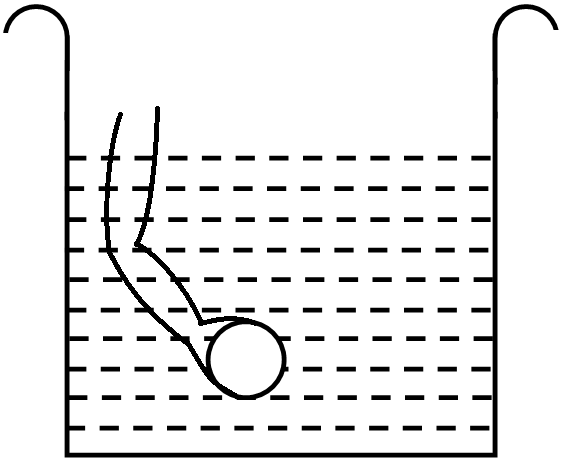
- What happens to the ball?
- Give reason for this phenomenon.
Answer
- The ball will come on the surface of the water and will float there.
- The density of the ball is less than the density of water. The another reason could be the gravitational pull on the ball is less than the upthrust exerted by water.
View full question & answer→Question 273 Marks
A ball thrown up vertically returns to the thrower after $6s$. Find its position after $4s$.
AnswerBall attains the maximum height after 3s. After attaining this height, it will start falling downwards.
In this case,
Initial velocity, $u = 0$
Position of the ball after 4s of the throw is given by the distance travelled by it
during its downward journey in 4s - 3s = 1s.
Equation of motion, $s = ut + 1/2 gt^2$ will give,
$s = 0 \times t + 1/2 \times 9.8 \times 1^2 = 4.9m$
Total height $= 44.1m$
This means that the ball is $39.2m (44.1m - 4.9m)$ above the ground after $4$ seconds.
View full question & answer→Question 283 Marks
Calculate the density of an object of volume $3 \mathrm{~m}^3$ and mass $9 \ kg$ . State wheater this object will float or sink in water.
Give reason for your answer.
AnswerVolume $=3 \mathrm{~m}^3$
Mass $=9 \mathrm{~kg}$
Density of substance $=\frac{\text { Mass of substance }}{\text { Volume of substance }}$
Density of substance $=\frac{9}{3}=3 \mathrm{~kg} / \mathrm{m}^3$ And
density of water $=1000 \mathrm{~kg} / \mathrm{m}^3$
The object will float in the water as the density of the object is less than the density of water.
View full question & answer→Question 293 Marks
The earth is acted upon by gravitation of Sun, even though it does not fall into the Sun. Why?
AnswerThe gravitational force of the sun provides the necessary centripetal force to keep the earth in its orbit. This counters by the centrifugal force which arises due to the circular motion of the earth. Thus, These force balances each other at after every instant so the earth remains in its orbit without either falling into the sun or going away tangentially to its orbit.
View full question & answer→Question 303 Marks
When is the pressure on the ground more-when a man is walking or when a man is standing? Explain.
AnswerWhen a man is walking, then at one time only one foot is on the ground. Due to this, the force of weight of man falls on a smaller area of the ground and produces more pressure on the ground. On the other hand, when the man is standing, then both his feet are on the ground. Due to this, the weight of the man falls on a larger area of the ground and produces lesser pressure on the ground.
View full question & answer→Question 313 Marks
Lead has greater density than iron, and both are denser than water. Is the buoyant force on a lead object greater than, or lesser than or equal to the buoyant force on an iron object of the same volume? Explain your answer giving reason.
AnswerBuoyant force depends on the density is the fluid and the volume of object immersed in the fluid Since the same volume of lead and iron is immersed in water so they both will displace same volume of water. Since they displace same volume of water, the bouyant force on both of them would be the same.
View full question & answer→Question 323 Marks
A stone is thrown vertically upward with an initial velocity of $50m/s$. Take, $g$ as $10m/s^2$ Find the maximum height reached by the stone. What is the net displacement and the total distance covered by the stone?
AnswerAccording to the equation of motion under gravity $\mathrm{v}^2-\mathrm{u}^2=2 \mathrm{gs}$ Where, $\mathrm{u}=$ Initial velocity of the stone $=50 \mathrm{~m} / \mathrm{s} \mathrm{v}=$ Final velocity of the stone $=0 \mathrm{~m} / \mathrm{s} \mathrm{s}=$ Height of the stone $\mathrm{g}=$ Acceleration due to gravity $=-10 \mathrm{~ms}^{-2}$ Let h be the maximum height attained by the stone. Therefore, $0^2-50^2=2(-10) \mathrm{h} \Rightarrow \mathrm{h}=\frac{(50 \times 50)}{20}=125$ Therefore, Total distance covered by the stone during its upward and downward journey $=125+125=250 \mathrm{~m}$ Net displacement during its upward and downward journey $=125+(-125)=0$
View full question & answer→Question 333 Marks
Calculate the acceleration due to gravity on the surface of a satellite having a mass of $7.4 \times 10^{22}kg$ and a radius of $1.74 \times 10^6m (G = 6.7 \times 10^{-11}Nm^2/kg^2)$. Which satellite do you think it could be?
AnswerAcceleration due to gravity, Mass, $M=7.4 \times 10^{22} \mathrm{~kg}$ Radius, $R=1.74 \times 10^6 \mathrm{~m}$ Gravitational constant, $\mathrm{G}=6.7 \times 10^{-}$ ${ }^{11} \mathrm{Nm}^2 / \mathrm{kg}^2 \mathrm{~g}=6.7 \times 10^{-11} \times \frac{7.4 \times 10^{22}}{\left(1.74 \times 10^6\right)^2} \mathrm{~g}=\frac{6.7 \times 7.4}{1.74 \times 1.74 \times 10} \mathrm{~g}=1.637 \mathrm{~m} / \mathrm{s}^2$ As the value of $\mathrm{g}=1.637 \mathrm{~m} / \mathrm{s}^2$, which is one sixth the value of g on earth, the satellite could be moon.
View full question & answer→Question 343 Marks
If the relative density of a substance is $7.1$, what will be its density in $SI$ units?
AnswerRelative Density of substance $=\frac{\text{Density of substance}}{\text{Density of water}}$
$7.1=\frac{\text{Density of substance}}{1000\text{kg}/\text{m}^3}$
Density of substance $=7.1\times10^3\text{kg}/\text{m}^3$
View full question & answer→Question 353 Marks
A sphere of mass $40kg$ is attracted by a second sphere of mass $15kg$ when their centres $320cm$ apart with a force of $0.1$ milligram weight. Calculate the value of gravitational constant.
AnswerHere, $m_1 = 40kg m_2 = 15kg r = 320cm r = 3.2m$
Weight $= 0.1mg$ Or, force, $F = 9.8 \times 10^{-6}N$
Using the expression $\text{G}=\text{F}\times\frac{\text{r}^2}{\text{m}_1\times\text{m}_2}$
We get, $\text{G}=\frac{9.8\times10^{-6}\times3.2\times3.2}{40\times15}$
$\text{G}=\frac{9.8\times10^{-6}\times3.2\times3.2}{600}$
$\text{G}=\frac{100.35\times10^{-6}}{600}$
$\text{G}=\frac{100.35\times10^{-10}}{6}$
$\text{G}=1672.5\times10^{-10}$
$\text{G}=1.672\times10^{-7}$
$\text{G}=1.7\times10^{-7}$
$\text{G}=1.7\times10^{-2}\times\frac{01}{10}$
$\text{G}=1.7\times10^{-8}\text{Ng}^2$
View full question & answer→Question 363 Marks
State Archimedes' principle. List its two applications.
AnswerArchimedes' principle states that the upward buoyant force that is exerted on a body immersed in a fluid, whether fully or partially submerged, is equal to the weight of the fluid that the body displaces and acts in the upward direction at the centre of mass of the displaced fluid.
View full question & answer→Question 373 Marks
The distance of a planet from the sun is $40$ times that of the earth. What is the ratio of their time periods of revolution around the sun?
AnswerFrom Kepler's third law
$\text{T}=\text{kr}^{\frac{3}{2}}$
$T =$ Time period of revolution.
$k =$ Constant.
$r = $ Size of the orbit.
$\frac{\text{T}_\text{S}}{\text{T}_\text{E}}=\frac{\text{kr}^{\frac{3}{2}}_\text{S}}{\text{kr}^{\frac{3}{2}}_\text{E}}$
Given $r_S = 40r_E$
$\frac{\text{T}_\text{S}}{\text{T}_\text{E}}=\frac{(40\text{r}_\text{E})^\frac{3}{2}}{\text{r}_\text{E}^\frac{3}{2}}$
$=252.98$
View full question & answer→Question 383 Marks
A cube of side $5\ cm$ is immersed in water and then in saturated salt solution. In which case will it experience a greater buoyant force. If each side of the cube is reduced to $4\ cm$ and then immersed in water, what will be the effect on the buoyant force experienced by the cube as compared to the first case for water. Give reason for each case.
Answer
- The cube will experience a greater buoyant force in the saturated slt solution because the density of the salt solution is gerater that that of water.
- The smaller cube will experience a lesser buoyant force as its volume is lesser than the initial cube.
View full question & answer→Question 393 Marks
The mass of sun is $2 \times 10^{30} kg$ and the mass of earth is $6 \times 10^{24} kg$. If the average distance between the sun and the earth be $1.5 \times 10^8 km$, calculate the force of gravitation between them.
AnswerDistance $d =1.5 \times 10^8 km=1.5 \times 10^{11} m$
Mass of the sun, $m =2 \times 10^{30} kg$
Mass of the earth, $M=6 \times 10^{24} kg$
Force of gravitation, $\text{F}=\text{G}\times\frac{\text{m}\times\text{M}}{\text{d}^2}$
$\text{F}=6.7\times10^{-11}\times\frac{2\times10^{30}\times6\times10^{24}}{(1.5\times10^{11})^2}$
$\text{F}=\frac{6.7\times10^{-11}\times12\times10^{54}}{1.5\times1.5\times10^{22}}$
$\text{F}=\frac{6.7\times12\times10^{21}}{1.5\times1.5}=3.57\times10^{22}\text{N}$
View full question & answer→Question 403 Marks
Describe how the gravitational force between two objects depends on the distance between them.
AnswerThe gravitational force F between two bodies of masses M and m kept at a distance d from each other is: $\text{F}=\text{G}\times\frac{\text{m}\times\text{M}}{\text{d}^2}$ The force between two bodies is inversely proportional to the square of the distance between them. That is, $\text{F}\propto\cfrac{1}{\text{d}^2}$ Therefore, if we double the distance between two bodies, the gravitational force becomes one-fourth and if we halve the distance between two bodies, then the gravitational force becomes four times.
View full question & answer→Question 413 Marks
Acceleration due to gravity of the earth is less at equator than at poles, why?
AnswerThe obvious geoid shape of the Earth. The effective radius of the Earth is less at the poles as compared to any other place. And according to Newton's law of gravitation,
$\text{g}=\frac{\text{GM}}{\text{R}^2}$
where,
$g$ is the acceleration due to gravity
$G$ is the universal gravitational constant
$M$ is the mass of the Earth
$R$ is the distance of the point from the centre of the Earth
This gives the relation between g and $R$; which is $g$ is inversely proportional to $R^2$. Lesser the radius, greater is the acceleration due to gravity.
View full question & answer→Question 423 Marks
If the distance between masses of two objects is increased by five times, by what factor would the mass of one of them have to be changed to maintain the same gravitational force? Would there be an increase or a decrease in the same?
AnswerAccording to the Newton's universal law of gravitationCase: 1
$\text{F}_1=\frac{\text{Gm}_1\text{M}_1}{\text{R}^2_1}$Case: 2
$\text{F}_2=\frac{\text{Gm}_2\text{M}_2}{\text{R}^2_2}$ But it is given that $R_2 = 5R_1$_ $\text{F}_2=\frac{\text{Gm}_2\text{M}_2}{(5\text{R}_1)^2}$
$\Rightarrow\text{F}_2=\frac{\text{Gm}_1\text{M}_1}{(5\text{R}_1)^2}$
$\Rightarrow\text{F}_2=\frac{\text{Gm}_1\text{M}_1}{(25\text{R}_1)^2}$
$\Rightarrow\text{F}_2=\frac{\text{F}_1}{25}$ From the above equation we can say that if the distance between masses of two objects is increased by five times the gravitational force would be decreased to $25th$ part of the previous gravitational force. So, the masses of one of them have to be altered to $25$ times of the previous case, to maintain the same gravitational force because the gravitational force is directly proportional to the product of the masses.Note:
Even if the product of the masses of them is altered to $25$ times of the previous case and if the distance between the masses is increased for five times gravitational force remains unchanged. Because the gravitational force is directly proportional to the product of the masses and is inversely proportional to the square of the distance between the masses.
View full question & answer→Question 433 Marks
A $\frac{1}{2}\text{kg}$ sheet of tin sinks in water but if the same sheet is converted into a box or boat, it floats. Why?
Answer The sheet of tin sinks in water because the density of tin is higher than that of water. When the same sheet of tin is converted into a box or a boat, then due to the trapping of lot of ‘light’ air in the box or boat, the average density of the box or boat made of tin sheet becomes lower than that of water and hence it floats in water.
View full question & answer→Question 443 Marks
Calculate the average density of the earth in terms of $g, G$ and $R$.
AnswerWe know: $\text{g}=\frac{\text{GM}}{\text{R}^2}$ OR
$\text{M}=\frac{\text{g}\times\text{R}^2}{\text{G}}\Rightarrow\text{Density D}=\frac{\text{mass}}{\text{volume}}=\frac{\text{g}\times\text{R}^2}{\text{G}\times\text{V}_\text{e}}$
(where $V_e$ is the volume of the earth, $M$ is mass of the earth, $R$ is radius of the earth, $G$ is universal gravitional constant)
Hence, $\text{D}=\frac{\text{g}\times\text{R}^2}{\text{G}\times\frac{4}{3}\pi\text{R}^3}=\frac{3\text{r}}{4\pi\text{GR}}$
View full question & answer→Question 453 Marks
When water is drawn from a well, a bucket feels heavier when it is drawn out of water or in the air than inside water. Why?
AnswerThis happens because when the bucket is in water, it experiences an upthrust in the vertically upward direction ($2$ forces acting to pull upwards while one force to pull downwards). Therefore, we can easily pull it in water but once it is out, there is no upthrust and now, there is only $1$ force (muscular force) which is pulling.
View full question & answer→Question 463 Marks
Define gravitational constant. What are the units of gravitational constant?
AnswerThe gravitational constant $G$ is numerically equal to the force of gravitation which exists between two bodies of unit masses kept at a unit distance from each other.
$\text{G}=\text{F}\times\frac{\text{d}^2}{\text{m}\times\text{M}}$
units of gravitational constant $= NM^2/kg^2$.
View full question & answer→Question 473 Marks
Write any two applications of Archimedes' principle.
AnswerArchimedes'
principle state that, “when a body is immersed fully or partially in afluid, it experiences an upward force that is equal to the weight of the liquid displaced by it”.
- It is used in designing ships and submarines.
- It is used in making lactometers, which are used to determine the purity of milk.
View full question & answer→Question 483 Marks
Is the acceleration due to gravity of earth $‘g’$ a constant? Discuss.
AnswerNo, the value of acceleration due to gravity $(g)$ is not constant at all the places on the surface of the earth. Since the radius of the earth is minimum at the poles and maximum at the equator, the value of g is maximum at the poles and minimum at the equator. As we go up from the surface of the earth, the distance from the centre of the earth increases and hence the value of g decreases. The value of g also decreases as we go down inside the earth.
View full question & answer→Question 493 Marks
Suppose a planet exists whose mass and radius both are half that of the earth. The acceleration due to gravity on the surface of this planet will be double? Justify.
Answerg on earth $=\frac{\text{GMe}}{\text{R}^2}$ $\text{Me}=\frac{\text{Me}}{2}$ $\text{R}=\frac{\text{R}}{2}-\text{R}^2$ $=\Big(\frac{\text{R}}{2}\Big)^2=\frac{\text{R}^2}{4}$ Now, g of this planet $=\text{G}\frac{\Big(\frac{\text{Me}}{2}\Big)}{\frac{\text{R}^2}{4}}$ $=\frac{(4\text{GMe})}{2\text{R}^2}$$=\frac{2\text{GMe}}{\text{R}^2}$
$=2(\text{g})$
Thus, the acceleration due to gravity becomes twice.
View full question & answer→