50 questions · timed · auto-graded
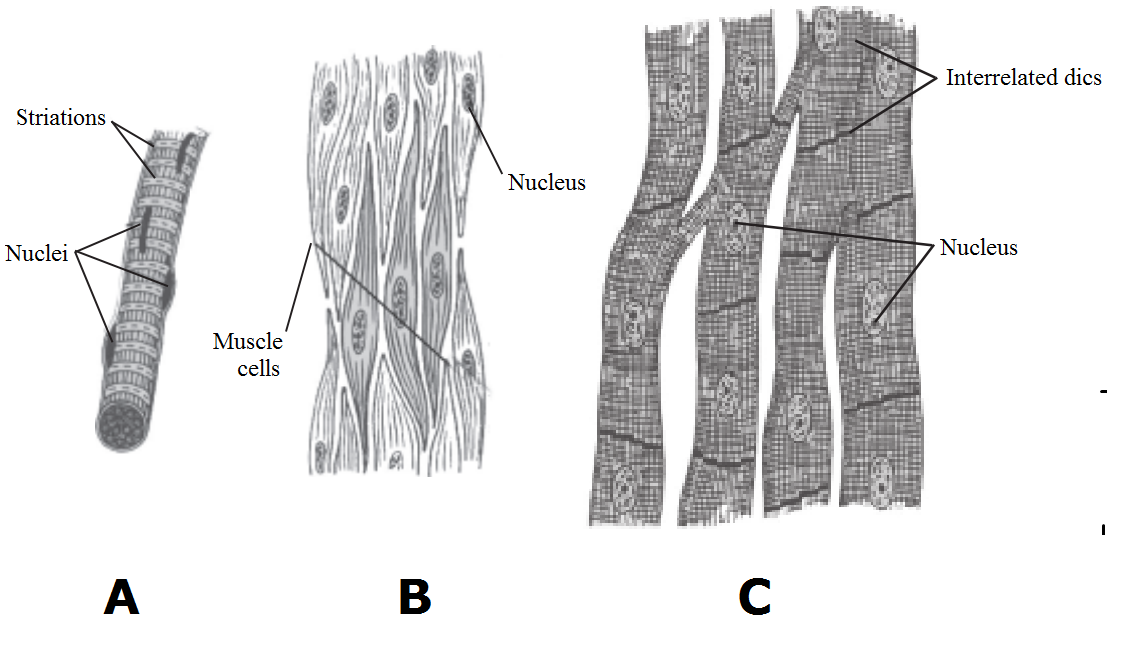
Smooth Muscle: These muscle cells do not have striations or stripes. Hence they are called smooth muscle cells. They are also called involuntary muscles. The cells have a single nucleus and the cells are spindle-shaped.
Skeletal Muscle: The skeletal muscles have stripes or striations. Hence they are also called the striated muscles. These skeletal muscles are the most common and widely distributed muscle tissue in the body.
Cardiac Muscle: This is a muscle that is found only in the heart. The rhythmic contractions of this muscle help in the pumping of blood through the blood vessels to various parts of the body. The brain controls this muscle and is an involuntary muscle. The cells of this muscle tissue are branched and cylindrical with a single nucleus and striations present.
|
|
Tracheids
|
Vessels
|
|
Shape & Size
|
Tracheids are the long elongated cells.
|
Vessels are wider and shorter cells.
|
|
Present
|
Tracheids are present in all vascular plants; in gymnosperms, they occur alone in the woody area of the plant while in angiosperms they are associated with vessels.
|
Vessels are typically found only in the angiosperms.
|
|
Ability to retain the water
|
Tracheids have the higher surface to volume ratio as compared to the vessels that is why they can resist gravity and have the ability to retain the water.
|
Lacks ability to retain water.
|
|
Formation
|
Tracheids are formed with the division of single individual cells.
|
The longitudinal bundle of cells is divided to form vessels.
|
|
Pits
|
Tracheids are imperforate cells, which have large pits that are less in number.
|
Vessels have smaller pits which are multiple in numbers.
|


|
|
Blood
|
|
Lymph
|
|
$1.$
|
Blood is red in colour due to presence of $RBC$s.
|
$1.$
|
Lymphs are colourless due to absence of $RBC$s.
|
|
$2.$
|
Blood plasma contains $RBC$s, $WBC$s and platelets.
|
$2.$
|
The lymph plasma contains $WBC$s.
|
|
$3.$
|
It contains diffusible and non-diffusible proteins like albumin, globulin and fibrinogen.
|
$3.$
|
It contains diffusible proteins.
|
|
$4.$
|
It can clot due to presence of more amount of fibrinogen.
|
$4.$
|
It clotes slowly due to presence of less fibrinogen.
|


|
Tendons
|
Ligament
|
|
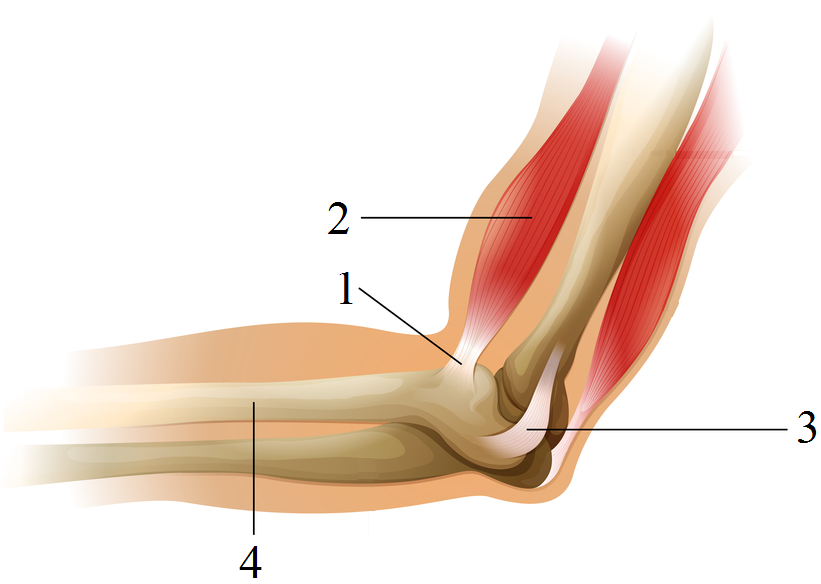
It connects muscles to bones.
|
It connects two bones at joints.
|
|
It made up of white fibres.
|
It is made up of white as well as yellow fibres.
|
|
It is strong and non-flexible.
|
It is elastic and flexible.
|
|
No.
|
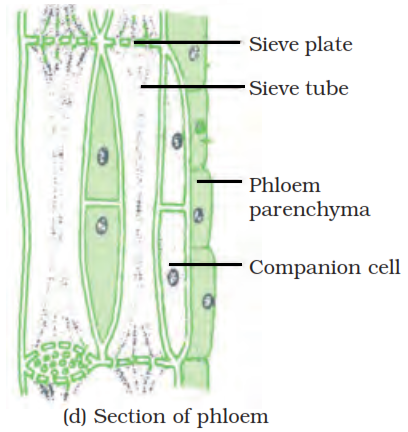
Xylem
|
Phloem
|
|
$1.$
|
Xylem tissues are tubular shaped structure, with the absence of cross walls. This tissue resembles the shape of a star.
|
Phloem tissues are elongated, tubular shaped structures that include thin sieve tubes with walls.
|
|
$2.$
|
Xylem occupies the centre of the vascular bundle.
|
Phloem is located on the outer side of the vascular bundle.
|
|
$3.$
|
Xylem fibres are smaller.
|
Phloem fibres are larger.
|
|
$4.$
|
They are present in leaves, stems, and roots.
|
They are present in leaves, roots, stems but transports and grow in fruits seeds and roots.
|
|
$5.$
|
These tissues move in a Unidirectional. (only in one direction – upward direction)
|
These tissues move in a Bidirectional. (both the ways – up and down)
|
| Simple permanent tissue | Complex permanent tissue | ||
| $(i)$ | Tissues are honmogeneous in nature | $(i)$ | Tissues are heterogeneous in nature. |
| $(ii)$ | It has the cells which are structurally and functionally similiar. | $(ii)$ | The cells are structurally and functionally dissmiliar. |
| $(iii)$ | There are three main type of simple permanent tissue. | $(iii)$ | There are two types of complex permenent tissues. |
| $(iv)$ | The three complex tissues are parenchyma, collenchyma, Sclerenchyma. | $(iv)$ | The two complex tissues are xylem and phloem. |

|
|
Parenchyma
|
|
Collenchyma
|
|
$1.$
|
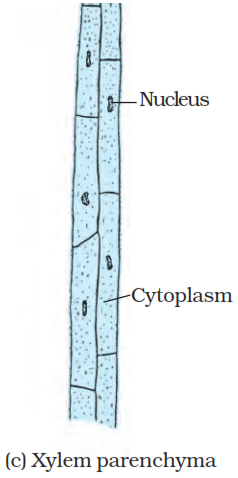
The tissue consists of thin-walled living cells.
|
$1.$
|
The tissue consists of cells having localised thickening in their cell walls.
|
|
$2.$
|
It is distributed in almost all the parts of the plant body.
|
$2.$
|
It occurs mostly in the aerial parts of the plants and is restricted to the other layers.
|
|
$3.$
|
The living cells of parenchyma assimilate and store food. They also store waste products.
|
$3.$
|
Collenchyma is the chief mechanical tissue in parts of a young plant particularly in the young dicotyledonous stems.
|
| Blood | Lymph | ||
| $1.$ | Blood contains blood cells and plasma. | $1.$ | Lymph contains plasma and white blood cells called leucocytes. |
| $2.$ | Blood has more proteins, calcium and phosphorus. | $2.$ | Lymph has fewer proteins with lesser calcium and phosphorus. |

|
|
Axon
|
|
Dendron
|
|
$1.$
|
An axon is a longest tubular process of the cyton.
|
$1.$
|
These are many short processes which arise from the cyton.
|
|
$2.$
|
It is efferent process as it carries impulses away from the cell body.
|
$2.$
|
These are afferent processes as they carry impulses towards the cell body.
|
|
$3.$
|
Nissl’s granules are absent.
|
$3.$
|
Nissl’s granules are present.
|
|
$4.$
|
End of each axon breaks into fine branches called telodendria.
|
$4.$
|
End of each dendron breaks into fine branches called dendrites.
|