Questions

3 Marks Question

Take a timed test

21 questions · self-marked practice — reveal the answer and mark yourself.

Question 13 Marks
What is the effect of $\mathrm{pCO}_2$ on oxygen transport?
Answer
  • $\mathrm{pCO}_2$ plays an important role in oxygen transport.
  • In the alveoli, because of low $\mathrm{pCO}_2$, oxygen binds with haemoglobin resulting in the formation of oxyhaemoglobin.
  • In tissues, high $\mathrm{pCO}_2$ facilitates the dissociation of oxyhaemoglobin.
  • $\mathrm{O}_2$ gets bound to haemoglobin at the lung surface where $\mathrm{pCO}_2$ is low and dissociates at the tissues where $\mathrm{pCO}_2$ is high.
View full question & answer
Question 23 Marks
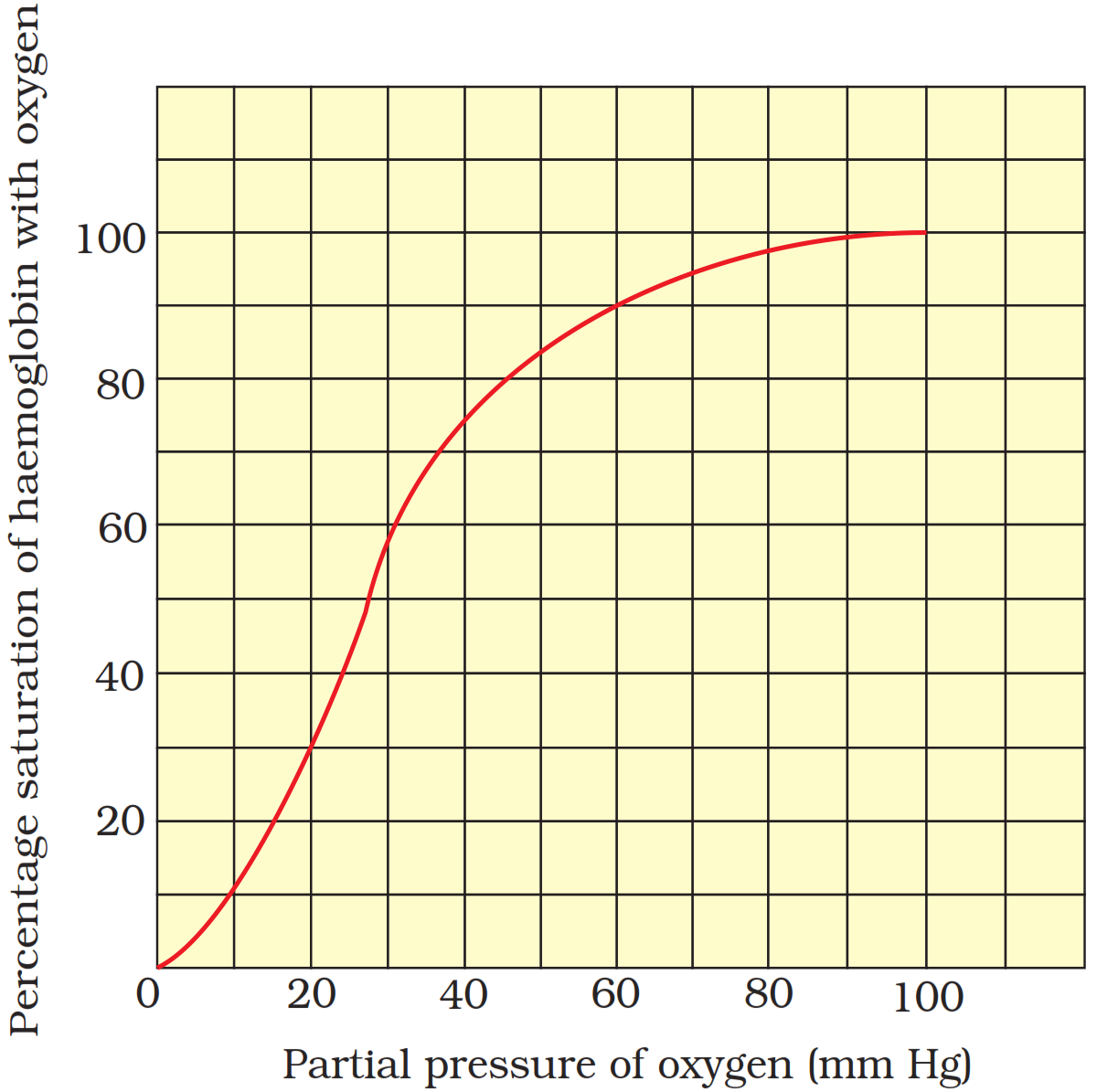
Define oxygen dissociation curve. Can you suggest any reason for its sigmoidal pattern?
Answer
  • The oxygen dissociation curve is a graph obtained when the percentage saturation of haemoglobin with oxygen is plotted against the partial pressure of oxygen.
  • When the first molecule of oxygen binds to haemoglobin, its affinity for the second molecule of oxygen increases.
  • Hence, the formation of oxyhaemoglobin is faster which is indicated by the steep slope of the S curve.
  • When the formation of oxyhaemoglobin comes to rest or when there are no haemoglobin molecules available for binding, the curve achieves a plateau phase.
View full question & answer
Question 33 Marks
What happens to the respiratory process in a man going up a hill?
Answer
As altitude increases, the oxygen level in the atmosphere decreases. Therefore, as a man goes uphill, he gets less oxygen with each breath. This causes the amount of oxygen in the blood to decline. The respiratory rate increases in response to the decrease in the oxygen content of blood. Simultaneously, the rate of heart beat increases to increase the supply of oxygen to blood.
View full question & answer
Question 43 Marks
Neha planned to go the lakeside for picnic with her friends. Suddenly they noticed a man drowning in the lake. Everyone was frightened, but Neha asked them to stop panicking and take the man out of water. After the man was rescued, he was found unconscious. Neha then suggested that mouth to mouth artificial respiration should be given to save the man. One of her friend did as she guided.Finally, the man was saved. He thanked Neha and her friends for their help.
  1. Why is artificial respiration given?
  2. Can artificial respiration bring back a person to consciousness even after death?
  3. What values are shown by Neha?
Answer
  1. Artificial respiration is provided to a person, who has stopped breathing due to smoke inhalation, drowning or electric shock.
  2. No, a person cannot be brought back to life (consciousness) once he is dead.
  3. Neha is an intelligent, sensible, cautious and a helpful, kind and humble girl.
View full question & answer
Question 53 Marks
What do you understand by occupational respiratory disorders?
Answer
In some industries, workers may inhale harmful dust. For example, workers in stone crushing plant may inhale silica dust. When there is long term exposure to such situations, lungs can develop inflammation, which leads to fibrosis and ultimately to serious damage to lungs.
View full question & answer
Question 63 Marks
Explain the role of haemoglobin in transport of oxygen.
Answer
Alveoli are the primary sites of exchange of gases. Exchange of gases also occur between blood and tissues. $O _2$, and $CO _2$, are exchanged in these sites by simple diffusion mainly based on pressure/ concentration gradient. Solubility of the gases as well as the thickness of the membranes involved in diffusion are also some of the important factors that can affect the rate of diffusion. Pressure contributed by an individual gas in a mixture of gases is called partial pressure and is represented as po, for oxygen and pco, for carbon dioxide.
View full question & answer
Question 73 Marks
Hairs in the inner lining of the nasal cavity prevent dust from getting inside the lungs. This is similar to which of the following? Why should we avoid breathing through mouth?
  1. Air filters in automobiles prevent dust from getting into the carburetor
  2. A sieve is used to filter out impurities from a substance
Answer
  1. Air filters in automobiles prevent dust from getting into the carburetor.
Explanation:
We know that the respiratory system has a very good air filter mechanism. Hairs in the inner lining of the nasal cavity; along with mucus; prevent dust particles from entering the lungs. This prevents accumulation of undesirable substances inside the lungs. The oral cavity does not have such air-filter system. When someone breathes through the mouth, he also inhales dust particles and some germs along with the air. The dust particles and germs can prove detrimental for the lungs. While germs can cause infection, dust particles can lead to blisters in the inner B lining of the lungs. Such blisters are often seen in the lungs of workers who work Stein stone quarries.
View full question & answer
Question 83 Marks
For completion of respiration process, write the given steps in sequential manner.
a. Diffusion of gases $\left(\mathrm{O}_2\right.$ and $\left.\mathrm{CO}_2\right)$ across alveolar membrane.
b. Transport of gases by blood.
c. Utilisation of $\mathrm{O}_2$ by the cells for catabolic reactions and resultant release of $\mathrm{CO}_2$.
d. Pulmonary ventilation by which atmos-pheric air is drawn in and $\mathrm{CO}_2$ rich alveolar air is released out.
e. Diffusion of $\mathrm{O}_2$ and $\mathrm{CO}_2$ between blood and tissues.
Answer
Following is the correct sequence:
a. Diffusion of gases $\left(\mathrm{O}_2\right.$ and $\left.\mathrm{CO}_2\right)$ across alveolar membrane.
b. Transport of gases by blood.
c. Utilisation of $\mathrm{O}_2$ by the cells for catabolic reactions and resultant release of $\mathrm{CO}_2$.
d. Pulmonary ventilation by which atmos-pheric air is drawn in and $\mathrm{CO}_2$ rich alveolar air is released out.
e. Diffusion of $\mathrm{O}_2$ and $\mathrm{CO}_2$ between blood and tissues.
View full question & answer
Question 93 Marks
Describe the role played by diaphragm and intercostal muscles in inspiration.
Answer
  1. Inspiration is initiated by the contraction of diaphragm, which increases the volume of the thoracic chamber along the antero-posterior axis.
  2. The contraction of external intercostal muscles lifts the ribs and sternum upwards and increases the volume of the thoracic cavity along the dorso-ventral axis.
  3. The overall increase in the thoracic volume causes an increase in the pulmonary volume.
  4. This decreases the intra-pulmonary pressure to less than that of the atmospheric pressure and hence, air from outside rushes into the lungs, i.e., inspirationis achieved.
View full question & answer
Question 103 Marks
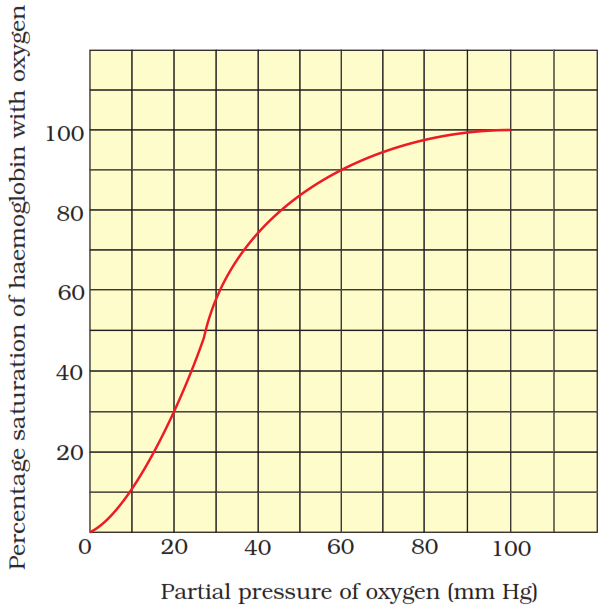
Study the curve given below and answer the questions asked:
  1. What is this curve known as?
  2. What does 'C' depict in the curve?
  3. The effect of which factors can be studied with the help of this curve?
Answer
  1. It is known as oxygen-dissociation curve.
  2. 'C' depicts the saturation point of haemoglobin with oxygen.
  3. The effect of factors like $\mathrm{P}_{\mathrm{CO} 2}$ and $\mathrm{H}^{+}$ ion concentration on the binding of oxygen with haemoglobin can be studied.
View full question & answer
Question 113 Marks
Explain chemical control of respiratory rhythm.
Answer
Large number of chemoreceptors are located in the carotid bodies (lie bilaterally in the bifurcations of the common carotid arteries). Their afferent nerve fibres pass through glossopharyngeal cranial nerve and thus to dorsal respiratory area of the medulla oblongata, sizeable number of chemoreceptors are also located in the aortic bodies (which lie along the arch of aorta). Their afferent nerve fibres pass through the vagus cranial nerve and thus, to dorsal respiratory group of neurons.
View full question & answer
Question 123 Marks
Explain the role of neural system in regulation of respiration.
Answer
The neural system plays an important role in regulation of respiration. Regulation of respiration depends on various intrinsic and extrinsic factors.
  • The respiratory rhythm centre is present in medulla. This is a specialized centre and nnis primarily responsible for the regulation of respiration.
  • The pneumotaxic centre is present in the pons region of the brain. It can moderate the functions of the respiratory rhythm centre. Nerve signals from pneumotaxic centre can reduce the duration of inspiration and can thus alter the respiratory rate. A chemosensitive area is present adjacent to the rhythm centre. This is highly sensitive to $CO _2$ and hydrogen ions. Increase in these substances can activate this.
View full question & answer
Question 133 Marks
Explain the process of gaseous exchange between alveoli and blood, during respiration.
Answer
i. The gases $O _2$ and $CO _2$ are exchanged by simple diffusion, based on the pressure or concentration gradient.
ii. In the alveoli, the $P _{ O 2}$ of alveolar air $(104 mm Hg )$ is higher than that of blood ( 90 mm Hg ); hence oxygen diffuses into the blood vessel from the alveoli.
iii. The $P _{CO2}$ of the blood ( 45 mm Hg ) in the capillaries on the lung surface is higher than that of alveolar air ( 40 mm Hg ); hence carbamino-haemoglobin dissociates and releases $CO _2$ into the alveoli.
View full question & answer
Question 143 Marks
What will be the $\mathrm{pO}_2$ and $\mathrm{pCO}_2$ in the atmospheric air compared to those in the alveolar air?
i. $\mathrm{pO}_2$ lesser and $\mathrm{pCO}_2$ higher.
ii. $\mathrm{pO}_2$ higher and $\mathrm{pCO}_2$ lesser.
iii. $\mathrm{pO}_2$ higher and $\mathrm{pCO}_2$ higher.
iv. $\mathrm{pO}_2$ lesser and $\mathrm{pCO}_2$ lesser.
Answer
i. In the alveolar tissues, where low $\mathrm{pO}_2$, high $\mathrm{pCO}_2$, high $\mathrm{H}^{+}$concentration, these conditions are favourable for dissociation of oxygen from the oxyhaemoglobin.
ii. When there is high $\mathrm{pO}_2$, low $\mathrm{pCO}_2$, less $\mathrm{H}^{+}$concentration and lesser temperature, the factors are all favourable for formation of oxyhaemoglobin.
iii. When $\mathrm{PO}_2$ is high in the alveoli and $\mathrm{pCO}_2$ is high in the tissues then the oxygen diffuses into the blood and combines with oxygen forming oxyhaemoglobin and CO, diffuses out.
iv. When $\mathrm{pO}_2$ is low in the alveoli and $\mathrm{pCO}_2$ is low in the tissues then these conditions are favourable for dissociation of oxygen from the oxyhaemoglobin.
View full question & answer
Question 153 Marks
Describe in proper sequence, the steps involved in pulmonary respiration in human beings.
Answer
Pulmonary respiration involves the following steps:
  1. Breathing or pulmonary ventilation by which atmospheric air is drawn into the lungs and carbon dioxide-rich air is sent out.
  2. Diffusion of the respiratory gases, oxygen and carbon dioxide across the aoveolar membrane into the blood.
  3. Transport of gases in the blood.
  4. Diffusion of oxygen from the blood into the tissues and carbon dioxide from the tissues into the blood.
  5. Utilisation of oxygen by the cells for oxidation and release of carbon dioxide.
View full question & answer
Question 163 Marks
Give a brief account of exchange of gases during respiration.
Answer
Alveoli are the primary sites of exchange of gases. Exchange of gases also occur between blood and tissues. $O _2$, and $CO _2$, are exchanged in these sites by simple diffusion mainly based on pressure/concentration gradient. Solubility of the gases as well as the thickness of the membranes involved in diffusion are also some of the important factors that can affect the rate of diffusion. Pressure contributed by an individual gas in a mixture of gases is called partial pressure and is represented as $pO _2$, for oxygen and $pCO _2$, for carbon dioxide.
View full question & answer
Question 173 Marks
Describe the role of haemoglobin in the transport of respiratory gases.
Answer
  1. Haemoglobin is the respiratory pigment present in the erythrocytes; it transports oxygen and carbon dioxide, the respiratory gases.
Transport of oxygen:
  1. Oxygen combines with the haemoglobin in a reversible manner to form oxyhaemoglobin; each haemoglobin molecule can carry a maximum of four oxygen molecules.
  2. 97% of oxygen is carried as oxyhaemoglobin in the blood and every 100ml of blood can deliver about 5ml of oxygen.
Transport of carbon dioxide:
  1. Carbon dioxide combines with the haemoglobin to form carbaminohaemoglobin in the erythrocytes.
  2. About 20-25 percent of the carbon dioxide is transported as carbaminohaemoglobin and every 100ml of deoxygenated blood transports about 4ml of carbon dioxide.
View full question & answer
Question 183 Marks
  1. List two factors which affect the rate of diffusion of a gas.
  2. What is the term given to the maximum volume of air, a person can breathe in after a forceful expiration?
  3. What is one of the major causes of emphysema?
Answer
  1. The factors which affect the rate of diffusion of a gas are:
  1. The thickness of the membrane.
  2. The solubility of the gas.
  1. Vital capacity.
  2. Cigarette smoking is the major cause of emphysema.
View full question & answer
Question 193 Marks
How is expiration carried out under normal physiological conditions?
Answer
  1. Expiration occurs when the intra-pulmonary pressure is greater than the atmospheric pressure.
  2. The diaphragm muscles and the intercostal muscles relax.
  3. The diaphragm moves upward and the rib cage downward and inward.
  4. This causes a decrease in the volume of the thoracic cavity, that results in an increased intra-pulmonary pressure.
  5. So air rushes out of the lungs (expiration) into the atmosphere.
View full question & answer
Question 203 Marks
A person dies in an accident in which his chest cavity was punctured, but no lung damage was there. Point out the cause of death.
Answer
The movement of air into and out of the lungs is carried out by creating a pressure gradient between the lungs and the atmosphere. The pressure within the lungs is less than the atmospheric pressure so, there is a negative pressure in the lungs with respect to atmospheric pressure. The puncture in the chest affects this pressure gradient maintained by the lungs and thus, may cause cessation of breathing.
View full question & answer
Question 213 Marks
Explain the structure of thoracic chamber.
Answer
Anatomically. thoracic chamber is an air-tight chamber. The thoracic chamber is formed dorsally by the vertebral column, ventrally by the sternum, laterally by the ribs and on the lower side by the dome-shaped diaphragm. The anatomical setup of lungs in thorax is such that any change in the volume of the thoracic cavity will be reflected in the lung pulmonary) cavity. Such an arrangement is essential for breathing, as we cannot directly alter the pulmonary volume.
View full question & answer