Questions

5 Marks Questions

Take a timed test

17 questions · self-marked practice — reveal the answer and mark yourself.

Question 25 Marks
Match the following:
 
Column I
 
Column II
(a)
$T_4$
(i)
Hypothalamus
(b)
PTH
(ii)
Thyroid
(c)
GnRH
(iii)
Pituitary
(d)
LH
(iv)
Parathyroid
Answer
Match the following:
 
Column I
 
Column II
(a)
$T_4$
(ii)
Thyroid
(b)
PTH
(iv)
Parathyroid
(c)
GnRH
(i)
Hypothalamus
(d)
LH
(iii)
Pituitary
View full question & answer
Question 35 Marks
Lakshita was studying endocrine system for her unit test. She was confused how hormones produce their effects on the target tissue. She read many times, but still did not understand the process. She asked the same to her neighbour Stuti, a biology teacher in a school. Stuti explained her about the hormone receptor complex through diagrams and flowcharts.
  1. Name the two types of receptors.
  2. Why do different hormones use different types of receptors?
  3. What are second messengers? Give two examples?
  4. What values reflect from Lakshita's character?
Answer
  1. Two types of receptors are:
  1. Membrane bound extracellular receptors.
  2. Intracellular receptors.
  1. The hormones which cannot enter the target cell, need membrane bound (extracellular) receptors and the hormones which can enter the target cell, need intracellular (mostly nuclear) receptors.
  2. Second messengers are those chemicals, which are generated in the target cells, by those hormones which cannot enter the cells, to bring about the biochemical changes, e.g., Inositol Triphosphate ($\mathrm{IP}_{3}$) Eyclic Adenosine Monophosphate (CAMP).
  3. Lakshita is worried about her studies and has capability to understand things in a better and scientific way, she takes initiative to solve the problem so has problem solving skills.
View full question & answer
Question 45 Marks
Name the hormones secreted by adrenal medulla and enumerate the physiological roles of these hormones.
Answer
Epinephrine/ adrenaline and norepinephrine/ nor adrenaline are the hormones of adrenal medulla. They cause:
  1. Increased alertness.
  2. Dilation of pupils.
  3. Piloerection.
  4. Increased heart beat.
  5. Increased strength of heart contraction.
  6. Increased rate of respiration.
  7. Glycogenolysis and increased blood glucose level.
  8. Lipolysis and proteolysis.
View full question & answer
Question 55 Marks
Mention the major classes of hormones being in humans. Give examples of each.
Answer
Although hormones are chemically diverse, they generally belong to one of four different chemical groups:
  1. Steroid hormones: These hormones are manufactured by endocrine cells from cholesterol, an important type of lipid in the human body. Examples include cortisol, aldosterone, oestrogen, progesterone and testosterone.
  2. Amino acid derivatives: The thyroid hormones ($\mathrm T_3$ and $\mathrm T_4$) are synthesised from the amino acid tyrosine and iodide, respectively. Adrenaline (also known as epinephrine) and noradrenaline (also known as norepinephrine) are produced by the medulla of the adrenal gland, are also derived from tyrosine. Melatonin is synthesised from the amino acid tryptophan.
  3. Protein hormones: These hormones are long, folded chains of amino acids. Included among these hormones are insulin, glucagons, parathyroid hormone, growth hormone, prolactin, etc.
  4. Peptide hormones: Hormones such as oxytocin and antidiuretic hormone are smaller than protein hormone. They are made up of a short chain of amino acids.
View full question & answer
Question 65 Marks
Explain the following by giving scientific reasons:
  1. Hypothalamus and pituitary function as an integrated and coordinated system.
  2. Body growth is greatly accelerated at puberty in males.
Answer
  1. The hypothalamus and pituitary function as an integrated and coordinated system because both of them are connected at the base of the brain.
They interact to each other in two ways:
  1. By the hypophyseal portal system, which is a system of blood vessels that connects part of hypothalamus to the anterior lobe of pituitary gland. Hypothalamus secretes hormones into this portal system and the hormones act on the anterior pituitary, triggering the synthesis/ secretion of pituitary hormone.
  2. The other is that they have direct anatomical connection between the hypothalamus and the posterior lobe of pituitary (posterior pituitary is actually are extension of hypothalamus). Thus, it is said that hormones released through posterior pituitary are actually released from the hypothalamus.
  1. Puberty is the phenomenon of physical changes by which child's body matures into an adult male, capable of sexual reproduction to enable fertilisation. It is initiated by the hormonal signals from the brain to the gonads, i.e., testes in a male. In response to the signals, gonads produce hormones that in turn stimulates libido and the growth, function and transformation of the brain, muscles, blood, hair, sexual organs, etc. An androgen called as testosterone in males, functions as principal sex hormone, producing all changes in male and related to growth and development at puberty.
View full question & answer
Question 75 Marks
What is the role of second messenger in hormone action?
Answer
  1. The hormones which are derivatives of proteins, amino acids or polypeptides are called peptide hormones.
  2. These hormones being insoluble in lipids cannot enter the target cell.
  3. They act as primary messengers on the surface of the target cell and bind to the receptors present on the outer surface of the plasma membrane to form a hormone-receptor complex.
  4. The enzyme Adenylyl cyclase is activated by this complex.
  5. On the inner surface of the plasma membrane, Adenylyl cyclase catalyzes the conversion of ATP to cyclic AMP.
  6. Cyclic AMP (cAMP) acts as the secondary messenger which delivers the information to the inside of the target cell.
  7. This activates an appropriate cellular enzyme system by means of cascade effect.
  8. cAMP is short-lived and rapidly degraded by cAMP phosphodiesterase.
  9. Thus, peptide hormones are quick acting hormones and produce an immediate effect through cAMP.
View full question & answer
Question 85 Marks
Describe thyroid gland.
Answer
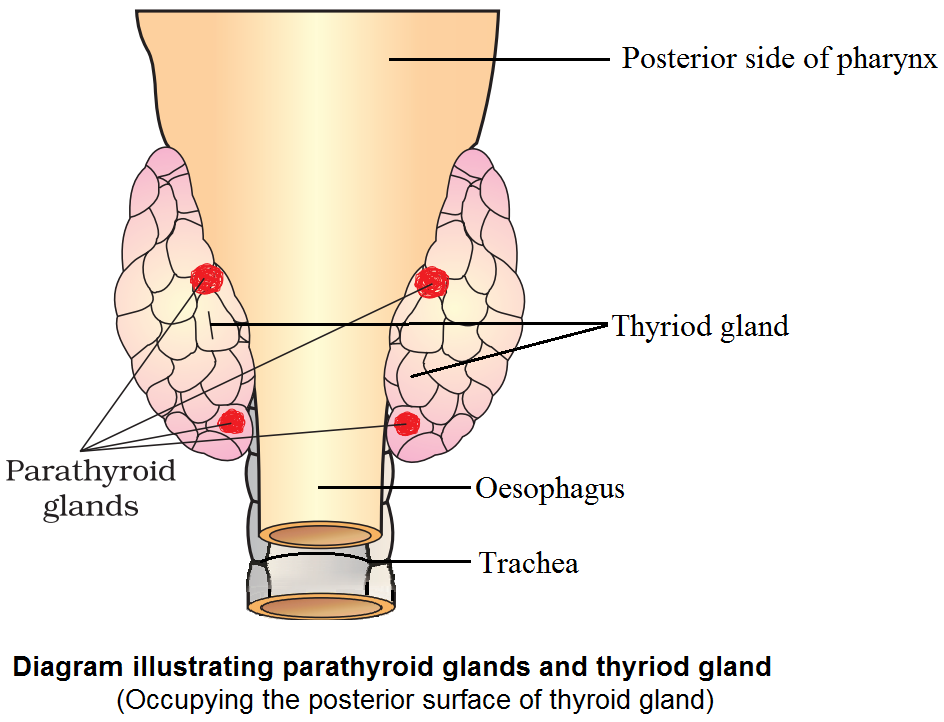
Thyroid Gland: The thyroid gland is composed of two lobes which are located on either side of the trachea. Both the lobes are interconnected with a thin flap of connective tissue called isthmus. The thyroid gland is composed of follicles and stromal tissues. Each thyroid follicle is composed of follicular cells, enclosing a cavity.
These follicular cells synthesise two hormones, tetraiodothyronine or thyroxine ( $T_4$ ) and triiodothyronine $\left(T_3\right)$. Iodine is essential for the normal rate of hormone synthesis in the thyroid. Deficiency of iodine in our diet results in hypothyroidism and enlargement of the thyroid gland, commonly called goitre. Hypothyroidism during pregnancy causes defective development and maturation of the growing baby leading to stunted growth (cretinism), mental retardation, low intelligence quotient, abnormal skin, deaf-mutism, etc. In adult women, hypothyroidism may cause menstrual cycle to become irregular. Due to cancer of the thyroid gland or due to development of nodules of the thyroid glands, the rate of synthesis and secretion of the thyroid hormones is increased to abnormal high levels leading to a condition called hyperthyroidism which adversely affects the body physiology.
Functions of Thyroid Thyroid hormones play an important role in the regulation of the basal metabolic rate. These hormones also support the process of red blood. cell formation. Thyroid hormones control the metabolism of carbohydrates, proteins and fats. Maintenance of water and electrolyte balance is also influenced by thyroid hormones. Thyroid gland also secretes a protein hormone called thyrocalcitonin (TCT) which regulates the blood calcium levels.
View full question & answer
Question 95 Marks
Mention the difference between hypothyroidism and hyperthyroidism.
Answer
  1. Hyperthyroidism is increased levels of thyroid hormones whereas hypothyroidism is decreased levels of thyroid hormones.
  2. Hyperthyroidism can lead to thyrotoxicosis and grave's disease whereas hypothyroidism does not produce those diseases.
  3. There is faster metabolism in hyperthyroidism while there is a slow $\hat{\mathrm{A}}$ metabolism in hypothyroidism.
  4. Hypothyroidism is treated by supplements of thyroid hormones and hyperthyroidism is treated by anti-thyroid drugs.
  5. Hypothyroidism shows decreased levels of $T_3$ and $T_4$ and increased levels of TSH whereas in hyperthyroidism, there is an increased levels of $T_3$ and $T_4$ and a decreased level in TSH.
View full question & answer
Question 105 Marks
George comes on a vacation to India from US. The long journey disturbs his biological system and he suffers from jet lag. What is the cause of his discomfort?
Answer
Jet lag is caused by the disruption of the body clock as it is out of synchronization because of the unfamiliar time zone of the destination. The body experiences different pattern of light and dark conditions than it is normally used to, which disrupts the natural sleep-wake cycle. Melatonin is a hormone that plays a key role in body rhythms and causes jet lag. After the sun sets, eyes perceive darkness and alert the hypothalamus to begin releasing melatonin, which promotes sleep. Conversely, when the eyes perceive sunlight, they tell the hypothalamus to withhold melatonin production. However, the hypothalamus cannot readjust its schedule instantly and it may take several days, to overcome this problem.
View full question & answer
Question 115 Marks
Illustrate the differences between the mechanism of action of a protein and a steroid hormone.
Answer
 
Protein hormones
 
Steroid hormones
i.
They interact with membrane bound receptors.
i.
They interact with intracellular receptors.
ii.
They generate secoun messenger for further action.
ii.
They do not generate second messenger.
iii.
Effect of these hormones alters cellular metabolism.
iii.
Effect of these hormones regulates gene expression or chromosome function.
iv.
Examples: insulin, glucagon, etc.
iv.
Examples: cortisol, testosterone, etc.

View full question & answer
Question 125 Marks
Calcium plays a very important role in the formation of bones. Write on the role of endocrine glands and hormones responsible for maintaining Calcium homeostasis.
Answer
The endocrine glands and hormones that are responsible for maintaining calcium homeostasis are thyroid and parathyroid glands and their associated hormones are calcitonin and Parathyroid Hormone (PTH).
  1. Parathyroid glands are the glands developed from the endoderm of the embryo. The cells of parathyroid glands are of two types, i.e., chief cells and oxyphil cells. The chief cells of the parathyroid glands secrete parathyroid hormone (PTH). This hormone (PTH) is involved in regulating calcium and phosphate balance between the blood and other tissue. It mobilizes the release of calcium into the blood from bones. PTH increases calcium reabsorption by the body organs like intestine and kidneys.
  2. Thyroid gland is the largest endocrine gland located anterior to the thyroid cartilage of the larynx in the neck. This gland plays a vital role in maintaining calcium homeostasis. It releases thyrocalcitonin hormone produced by the parafollicular cells, also called 'C' cells. This hormone is secreted when the calcium level in blood gets high. It is a 32 amino acid peptide hormone that lowers the calcium level by suppressing release of calcium ions from the bones. Thus, calcitonin has an action opposite to that of the parathyroid hormone on calcium homeostasis.
View full question & answer
Question 135 Marks
Hypothalamus is a super master endocrine gland. Elaborate.
Answer
Hypothalamus is a super master endocrine gland as it secretes hormones that regulate the synthesis and secretion of pituitary gland which is a master gland. The hypothalamus is connected to the anterior lobe of pituitary gland by hypophysial portal veins, however, it is connected to the posterior lobe of pituitary gland mainly by axons of nuerosecretory cells. The hormones produced by hypothalamus are of two types, the releasing hormones (which stimulate the secretion of pituitary hormones) and the inhibiting hormones (which inhibit secretions of pituitary hormones). The hormones secreted by hypothalamus are summarized below:
  1. Adrenocorticotropic Releasing Hormone (ARH) or Corticotrophin Releasing Hormone – It stimulates the anterior lobe of the pituitary gland to secrete its adrenocorticotropic hormone (ACTH).
  2. Thyrotrophic Releasing Hormone (TRH)- It stimulates the anterior lobe of the pituitary gland to secrete its thyroid stimulating hormone (TSH). or thyrotrophic.
  3. Growth Hormone-Releasing Hormone (GHRH)- It stimulates the anterior lobe of the pituitary gland to release its growth hormone (GH) or somatotrophin.
  4. Growth Hormone-Inhibitory Hormone (GHIH)- This hormone is also called somatostatin (SS). It inhibits the secretion of growth hormone from the anterior lobe of the pituitary gland.
  5. Gonadotropin Releasing Hormone (GnRH)- It stimulates the anterior lobe of the pituitary gland to secrete two gonadotropic hormones : Follicle Stimulating Hormone (FSH) and Luteinizing Hormone (LH)).
  6. Prolactin Releasing hormone (PRH)- It stimulates the anterior lobe of the pituitary gland to secrete its prolactin hormone.
  7. Prolactin Inhibitory Hormone (PIH)- It inhibits the secretion of prolactin from the anterior lobe of pituitary gland.
  8. MSH Releasing Hormone (MSHRH)- It stimulates the intermediate lobe of the pituitary gland to secrete its melanocyte stimulating hormone (MSH).
  9. MSH Inhibitory Hormone (MSHIH)- It inhibits the secretion of melanocytes stimulating hormone from the intermediate lobe of the pituitary gland.
View full question & answer
Question 145 Marks
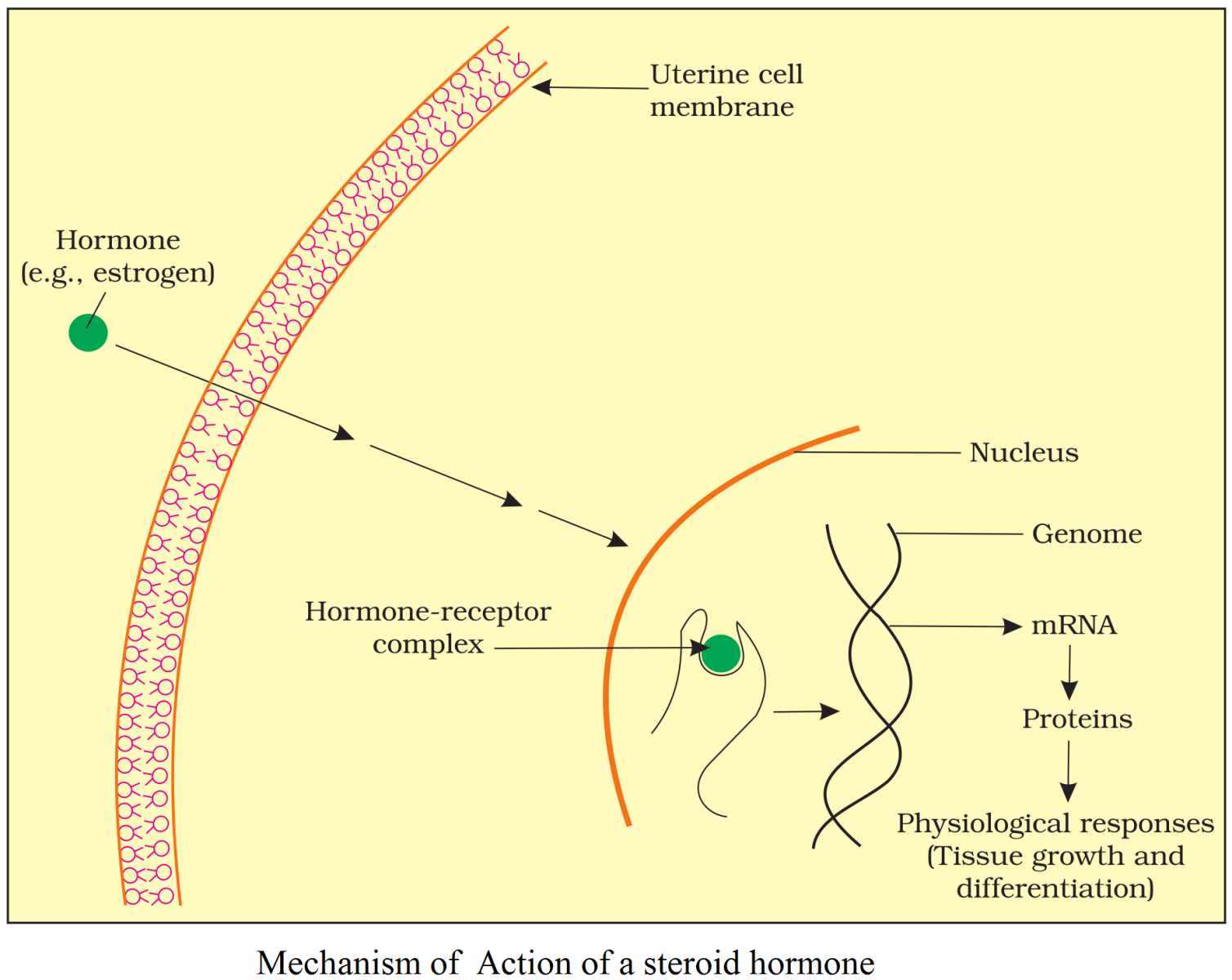
Bring out the differences between the mechanism of action of a protein hormone and a steroid hormone in the human body, along with illustrations.
Answer
Hormones exert their effects on the target organ tissues by binding to specific proteins, called hormone receptors, which are present in the target tissues. The formation of hormone-receptor complex leads to certain biochemical reactions resulting in the metabolism/ physiological functions in the target organs/ tissues.
  1. Protein hormones:
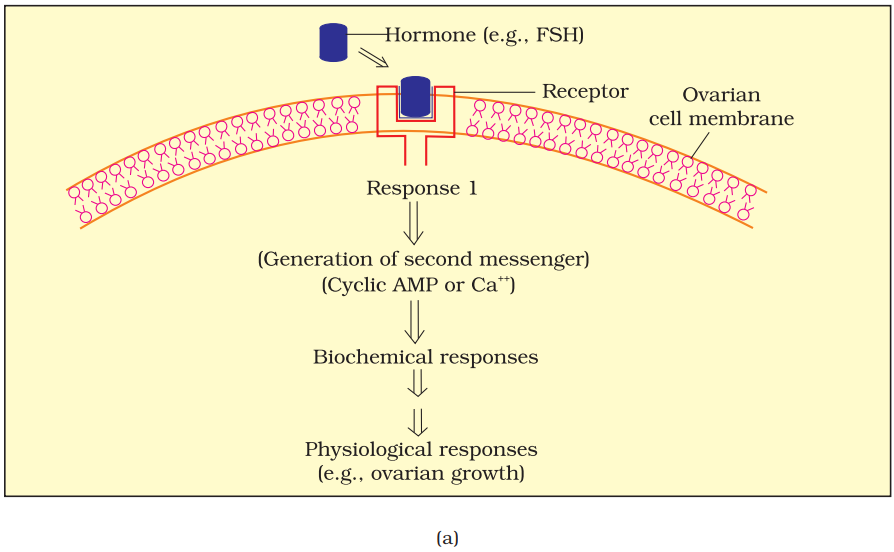
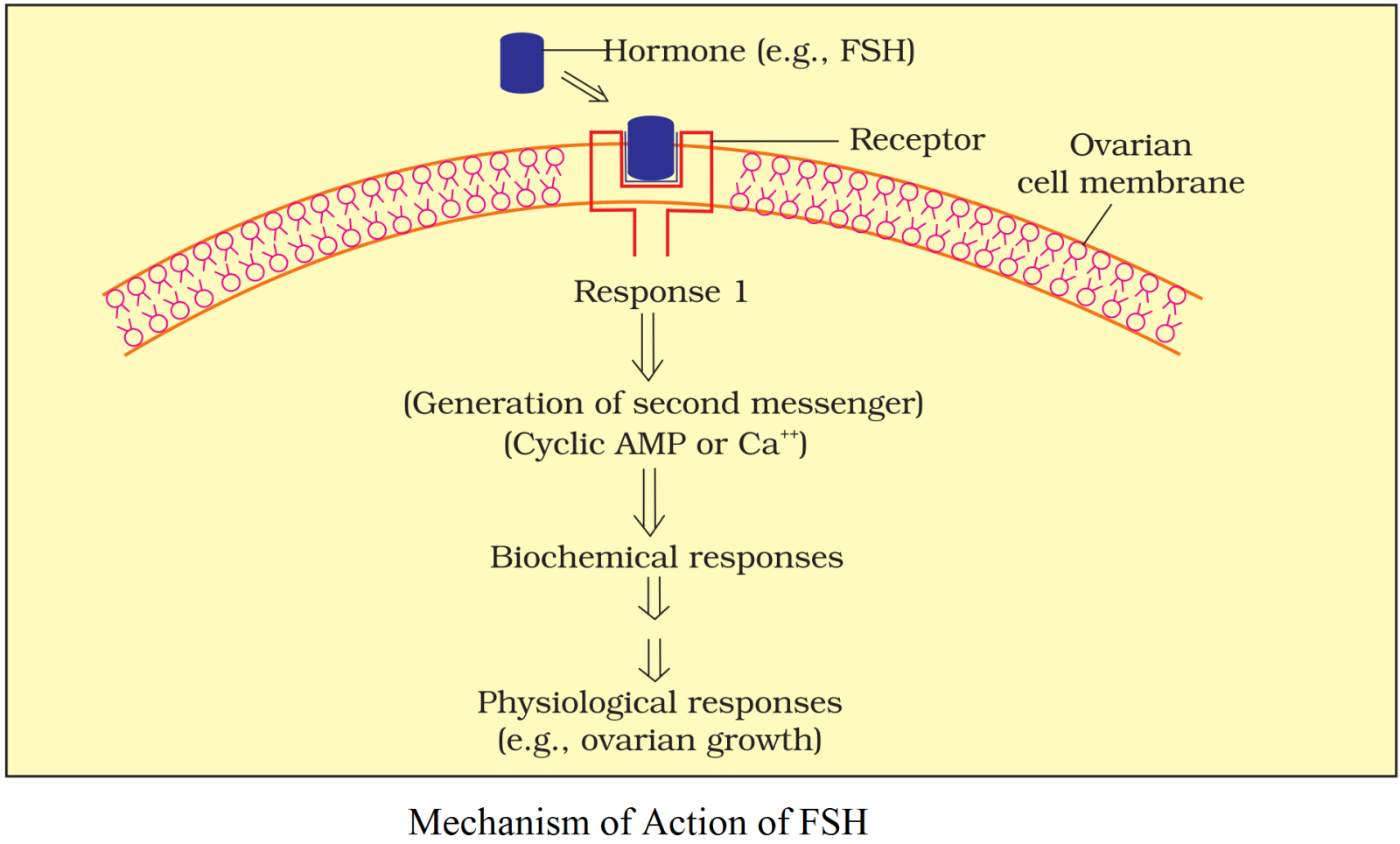
  • The protein hormones like FSH, insulin, etc. interact with the membrane-bound (extracellular) receptors and form hormone receptor complex.
  • They do not enter the cell, but stimulate the cell to produce second messengers like cyclic AmP, $\mathrm{IP}_3$ or $\mathrm{Ca}^{2+}$ ions.
  • The second messengers regulate the cell metabolism.
  1. Steroid hormones:
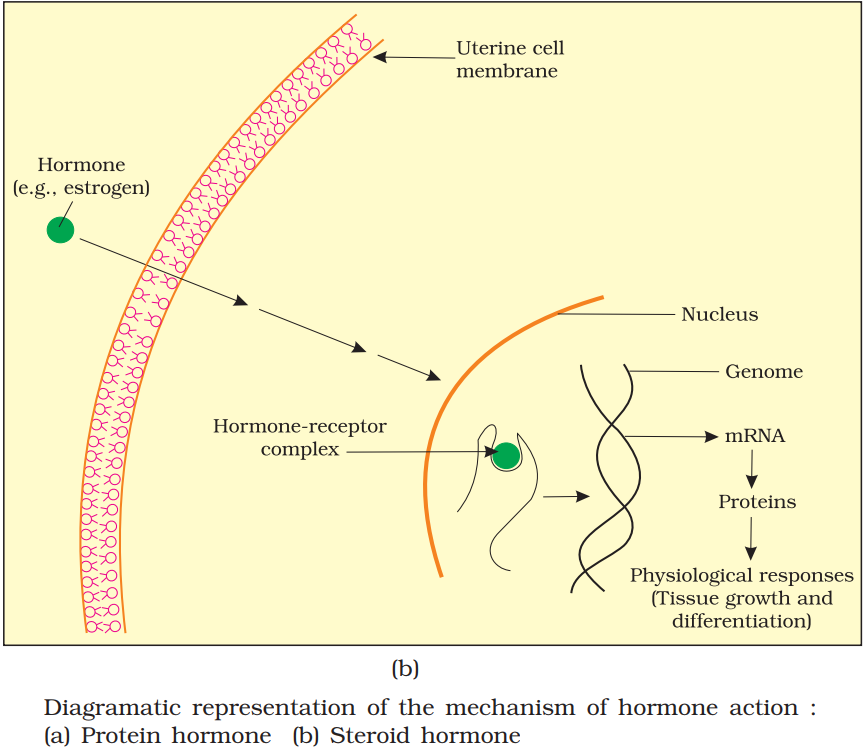
  • The steroid hormones enter the cell.
  • They interact/ bind with the intracellular receptor (mostly nuclear receptors).
  • The hormone-receptor complex binds to the chromosome and regulate gene expression, i.e. synthesis of mRNA and proteins.
  • The biochemical reactions result in physiological and developmental effects.
View full question & answer
Question 155 Marks
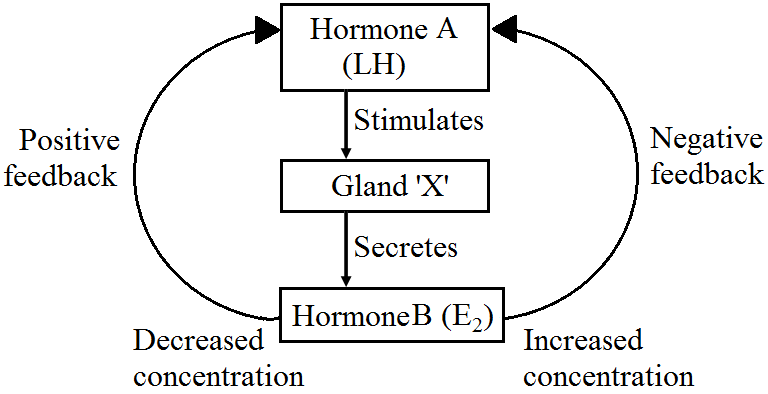
You have learnt that a characteristic feature of endocrine system is the presence of feed back loops. By this what is meant if hormone $A$ stimulates gland ' $X$ ' to secrete hormone $B$, the production of ' $A$ ' could be modified when the level of B changes in our blood. An example is the relation between hormones LH and estrogen ( $\mathrm{E}_2$ ). An old woman exhibits the following features. High levels of LH in blood but low levels of $\mathrm{E}_2$ in the blood. Another woman exhibits high level of LH in blood and also high level of $\mathrm{E}_2$ in the blood. Where is the defect in both these women? Provide suitable diagram to support this answer.
Answer
When the secretion of hormone is under the control of factors or other hormones it is called feedback control.
If there is high concentration of hormone B in our blood then it will have an inhibitory effect on the secretion of hormone A . Decreased secretion of A will eventually result in decrease in production of hormone. This is negative feedback control. If there is B low concentration of hormone B in our blood then it will have a stimulatory effect on the secretion of hormone A. Increased secretion of A will eventually result in increase in production of hormone B. This is positive feedback control. Low level of $\mathrm{E}_2$ should have positive feedback control on secretion of LH resulting in increase in production of $\mathrm{E}_2$. But old woman shows low level of $\mathrm{E}_2$ and high level of hormone LH, this means LH is not stimulating gland X to secrete hormone $\mathrm{E}_2$. High level of $\mathrm{E}_2$ should have negative feedback control on secretion of LH resulting in decrease in production of $\mathrm{E}_2$. But another woman shows high level of both $\mathrm{E}_2$ and LH , this means there is some defect in the negative feedback loop.
View full question & answer
Question 165 Marks
Give a detail explanation of pituitary gland.
Answer
The Pituitary Gland: The pituitary gland is located in a bony cavity called sella tursica and is attached to hypothalamus by a stalk. It is divided anatomically into an adenohypophysis and a neurohypophysis. Adenohypophysis consists of two portions, pars distalis and pars intermedia. The pars distalis region of pituitary, commonly called anterior pituitary, produces following hormones.
  1. Growth hormone (GH): Over-secretion of GH stimulates abnormal growth of the body leading to gigantism and low secretion of GH results in stunted growth resulting in pituitary dwarfism.
  2. Prolactin (PRL): Prolactin regulates the growth of the mammary glands and formation of milk in them.
  3. Thyroid stimulating hormone (TSH): TSH stimulates the synthesis and secretion of thyroid hormones from the thyroid gland.
  4. Adrenocorticotrophic hormone (ACTH): ACTH stimulates the synthesis and secretion of steroid hormones called glucocorticoids from the adrenal cortex.
  5. Luteinizing hormone (LH): LH and FSH stimulate gonadal activity and hence are called gonadotrophins. In males, LH stimulates the synthesis and secretion of hormones called androgens from testis. In females, LH induces ovulation of fully mature follicles (graafian follicles) and maintains the corpus luteum, formed from the remnants of the graafian follicles after ovulation.
  6. Follicle stimulating hormone (FSH): In males, FSH and androgens regulate spermatogenesis. FSH stimulates growth and development of the ovarian follicles in females. MSH acts on the melanocytes (melanin containing cells) and regulates pigmentation of the skin.
Pars intermedia secretes only one hormone called melanocyte stimulating hormone (MSH). However, in humans, the pars intermedia is almost merged with pars distalis.
Neurohypophysis (pars nervosa) also known as posterior pituitary, stores and releases two hormones called oxytocin and vasopressin, which are actually synthesised by the hypothalamus and are transported axonally to neurohypophysis. Oxytocin acts on the smooth muscles of our body and stimulates their contraction. In females, it stimulates a vigorous contraction of uterus at the time of child birth, and milk ejection from the mammary gland. Vasopressin acts mainly at the kidney and stimulates re-absorption of water and electrolytes by the distal tubules and thereby reduces loss of water through urine (diuresis).
Hence, it is also called as anti-diuretic hormone (ADH).
View full question & answer
Question 175 Marks
Mention any five hormones secreted by anterior pituitary and mention their functions.
Answer
The hormones secreted by anterior pituitary and their functions are as follows:
  1. Growth hormone (GH): It regulates the growth of the body, its excess secretion leads to gigantism and low secretion causes dwarfism.
  2. Adrenocorticotropic hormone (ACTH): It stimulates the synthesis and secretion of hormones from adrenal cortex.
  3. Thyroid stimulating hormone (TSH): It stimulates the thyroid gland to synthesise and secrete thyroid hormones.
  4. Follicle stimulating hormone (FSH):
  • Along with the androgens, it regulates spermatogenesis in mole.
  • In females, it stimulates the growth and development of ovarian follicles and secretion of FSH from them.
  1. Luteinising hormone (LH):
  • In males, it acts on the Leydig cells of testes and stimulates the synthesis and secretion of androgens, mainly testosterone.
  • In females, it stimulates ovulation, formation of corpus luteum and secretion of progesterone from it.
  1. Prolactin (PRL): It regulates the growth of mammary glands and formation of milk in them during pregnancy.
View full question & answer