Questions

5 Marks Questions

Take a timed test

35 questions · self-marked practice — reveal the answer and mark yourself.
Question 25 Marks
Explain the mechanism through which a sound produces a nerve impulse in the inner ear.
Answer
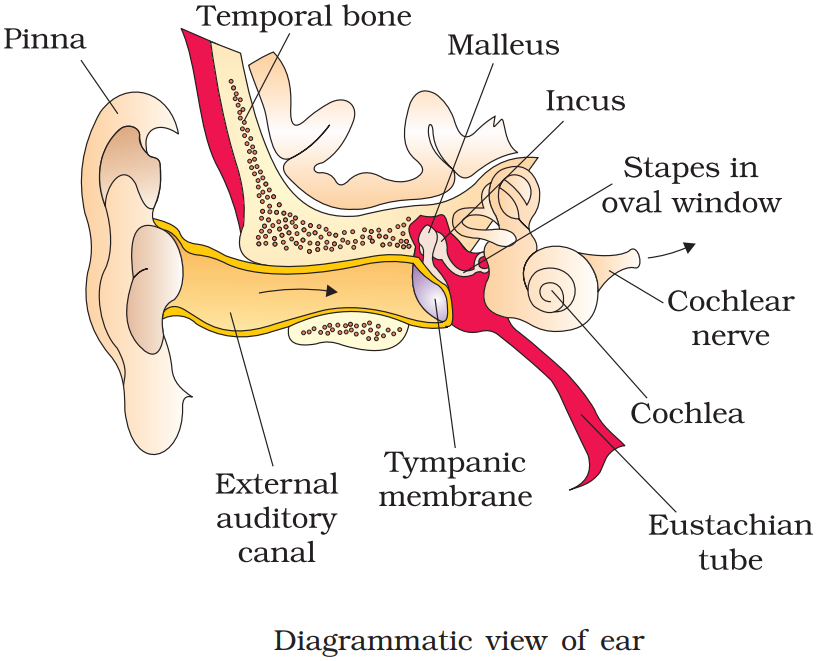
The pinna of the external ear collects the sound waves and directs them to the tympanic membrane (ear drum) via the external auditory canal. The ear drum then vibrates the sound waves and conducts them to the internal ear through the ear ossicles. The ear ossicles increase the intensity of the sound waves. These vibrating sound waves are conducted through the oval window to the fluid in the cochlea. Consequently, a movement is created in the lymph. This movement produces vibrations in the basilar membrane, which in turn stimulate the auditory hair cells. These cells generate a nerve impulse, conducting it to the auditory cortex of the brain via afferent fibres. The auditory cortex region interprets the nerve impulse and sound is recognised.
View full question & answer
Question 35 Marks
Write short note on retina.
Answer
Retina is the innermost layer. It contains three layers of cells – inner ganglion cells, middle bipolar cells, and outermost photoreceptor cells. The receptor cells present in the retina are of two types – rod cells and cone cells.
  1. Rod cells –The rods contain rhodopsin pigment (visual purple), which is highly sensitive to dim light. It is responsible for twilight vision.
  2. Cone cells –The cones contain iodopsin pigment (visual violet) and are highly sensitive to high intensity light. They are responsible for daylight and colour visions.
    The innermost ganglionic cells give rise to optic nerve fibre that forms optic nerve in each eye and is connected with the brain. In this region, the photoreceptor cells are absent. Hence, it is known as the blind spot. At the posterior part, lateral to blind spot, there is a pigmented spot called macula lutea. This spot has a shallow depression at its middle known as fovea. Fovea has only cone cells. They are devoid of rod cells. Hence, it is the place of most distinct vision.
View full question & answer
Question 45 Marks
Explain the role of Na+ in the generation of action potential.
Answer
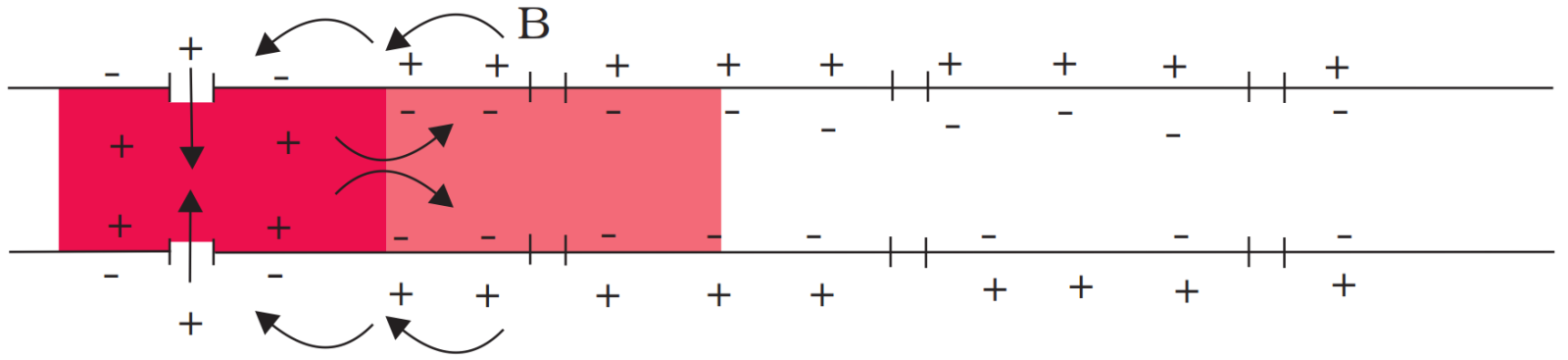
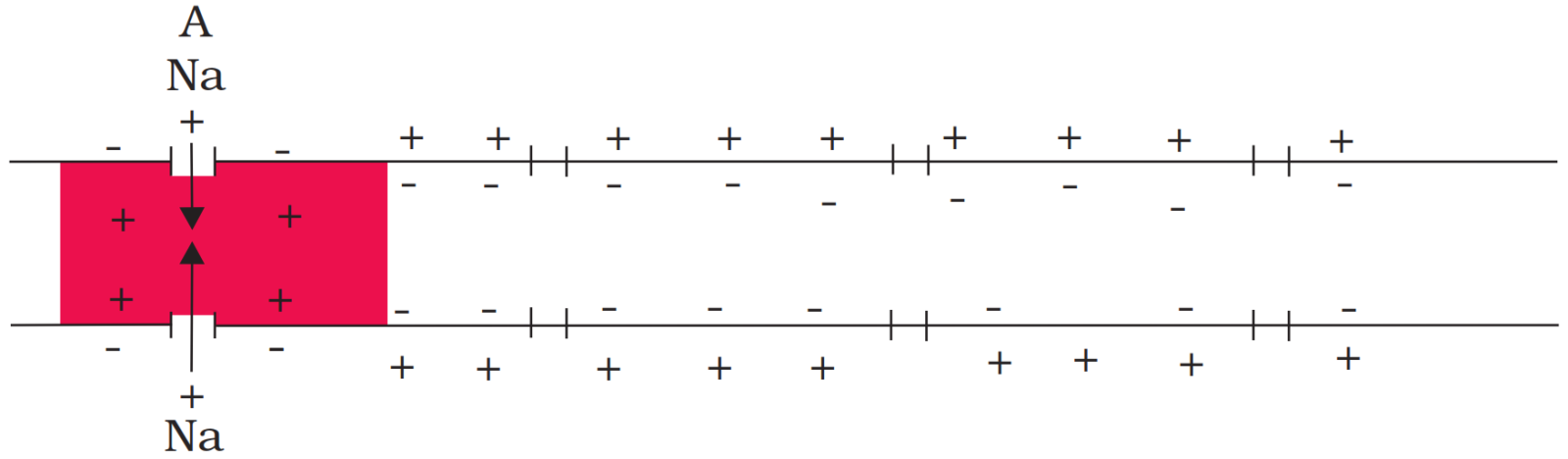
Sodium ions play an important role in the generation of action potential. When a nerve fibre is stimulated, the membrane potential decreases. The membrane becomes more permeable to $\mathrm{Na}^{+}$ions than to $\mathrm{K}^{+}$ions. As a result, $\mathrm{Na}^{+}$diffuses from the outside to the inside of the membrane. This causes the inside of the membrane to become positively-charged, while the outer membrane gains a negatively charge. This reversal of polarity across the membrane is known as depolarisation. The rapid inflow of $\mathrm{Na}^{+}$ions causes the membrane potential to increase, thereby generating an action potential.
View full question & answer
Question 65 Marks
Explain the mechanism of generation of light-induced impulse in the retina.
Answer
Retina is the innermost layer of the eye. It contains three layers of cells – inner ganglion cells, middle bipolar cells, and outermost photoreceptor cells. Photoreceptor cells are composed of a protein called opsin and an aldehyde of vitamin A called retinal. When light rays are focused on the retina through the cornea, retinal gets dissociated from opsin. As a result, the structure of opsin gets changed. This in turn causes the permeability of the membrane to change, thereby generating a potential difference in the cells. Consequently, an action potential is generated in the ganglion cells and is transmitted to the visual cortex of the brain via the optic nerves. In the cortex region of the brain, the impulses are analysed and the image is formed on the retina.
View full question & answer
Question 85 Marks
Write short note on synapse.
Answer
Synapse is a junction between the axon terminal of one neuron and the dendrite of next neuron. It is separated by a small gap known as synaptic cleft. There are two types of synapses:
  1. Electrical synapse
  2. Chemical synapse
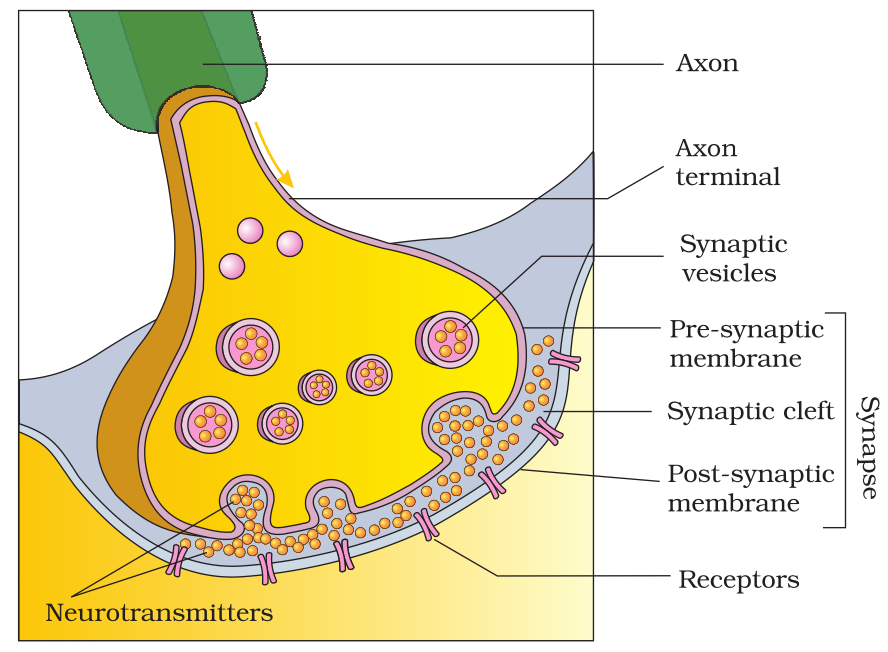
In electrical synapses, the pre and post synaptic neurons lie in close proximity to each other. Hence, the impulse can move directly from one neuron to another across the synapse. This represents a faster method of impulse transmission. In chemical synapses, the pre and post synaptic neurons are not in close proximity. They are separated by a synaptic cleft. The transmission of nerve impulses is carried out by chemicals such as neurotransmitters.
View full question & answer
Question 105 Marks
Explain the following processes: Depolarisation of the membrane of a nerve fibre.
Answer
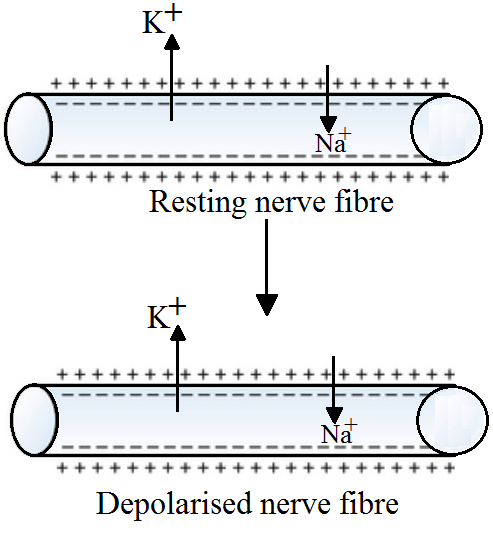
Depolarisation of the membrane of a nerve fibre: When an electrical stimulus is given to a nerve fibre, an action potential is generated. The membrane becomes permeable to sodium ions than to potassium ions. This results into positive charge inside and negative charge outside the nerve fibre. Hence, the membrane is said to be depolarized.
View full question & answer
Question 115 Marks
Explain the following processes:
Polarisation of the membrane of a nerve fibre.
Answer
Polarisation of the membrane of a nerve fibre:
During resting condition, the concentration of $\mathrm{K}^{+}$ions is more inside the axoplasm while the concentration of $\mathrm{Na}^{+}$ions is more outside the axoplasm. As a result, the potassium ions move faster from inside to outside as compared to sodium ions. Therefore, the membrane becomes positively charged outside and negatively charged inside. This is known as polarization of membrane or polarized nerve.
View full question & answer
Question 125 Marks
Write short note on neural coordination.
Answer
The neural system provides rapid coordination among the organs of the body. This coordination is in the form of electric impulses and is quick and short lived. All the physiological processes in the body are closed linked and dependent upon each other. For example, during exercise, our body requires more oxygen and food. Hence, the breathing rate increases automatically and the heart beats faster. This leads to a faster supply of oxygenated blood to the muscles. Moreover, the cellular functions require regulation continuously. These functions are carried out by the hormones. Hence, the neural system along with the endocrine system control and coordinate the physiological processes.
View full question & answer
Question 135 Marks
Give a brief account of mechanism of vision.
Answer
Retina is the innermost layer of eye. It contains three layers of cells – inner ganglion cells, middle bipolar cells, and outermost photoreceptor cells. A photoreceptor cell is composed of a protein called opsin and an aldehyde of vitamin A called retinal. When light rays are focused on the retina through cornea, it leads to the dissociation of retinal from opsin protein. This changes the structure of opsin. As the structure of opsin changes, the permeability of membrane changes, generating a potential difference in the cells. This generates an action potential in the ganglionic cells and is transmitted to the visual cortex of the brain via optic nerves. In the cortex region of brain, the impulses are analysed and image is formed on the retina.
View full question & answer
Question 145 Marks
Give a brief account of mechanism of synaptic transmission.
Answer
Synapse is a junction between two neurons. It is present between the axon terminal of one neuron and the dendrite of next neuron separated by a cleft. There are two ways of synaptic transmission:
  1. Chemical transmission
  2. Electrical transmission
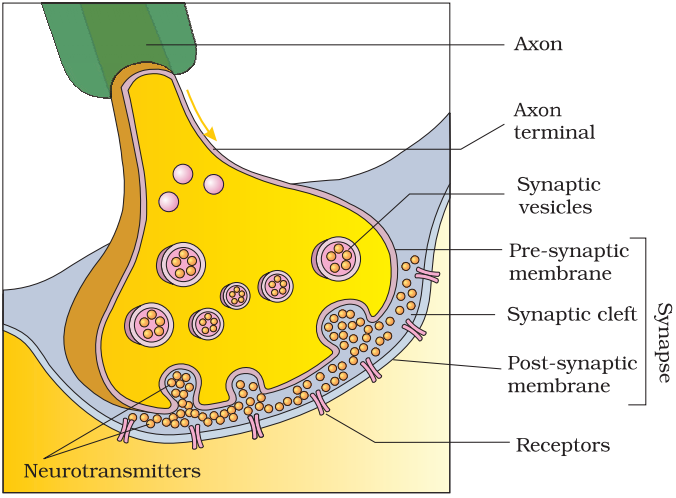
  1. Chemical transmission – When a nerve impulse reaches the end plate of axon, it releases a neurotransmitter (acetylcholine) across the synaptic cleft. This chemical is synthesized in cell body of the neuron and is transported to the axon terminal. The acetylcholine diffuses across the cleft and binds to the receptors present on the membrane of next neuron. This causes depolarization of membrane and initiates an action potential.
  1. Electrical transmission – In this type of transmission, an electric current is formed in the neuron. This electric current generates an action potential and leads to transmission of nerve impulse across the nerve fibre. This represents a faster method of nerve conduction than the chemical method of transmission.
View full question & answer
Question 155 Marks
Write short note on hindbrain.
Answer
It consists of three regions – pons, cerebellum, and medulla oblongata.
  1. Pons is a band of nerve fibres that lies between medulla oblongata and midbrain. It connects the lateral parts of cerebellar hemisphere together.
  2. Cerebellum is a large and well developed part of hindbrain. It is located below the posterior sides of cerebral hemispheres and above the medulla oblongata. It is responsible for maintaining posture and equilibrium of the body.
  3. Medulla oblongata is the posterior and simplest part of the brain. It is located beneath the cerebellum. Its lower end extends in the form of spinal cord and leaves the skull through foramen magnum.
View full question & answer
Question 165 Marks
Explain the following processes: Conduction of a nerve impulse along a nerve fibre.
Answer
Conduction of a nerve impulse along a nerve fibre: There are two types of nerve fibres – myelinated and non-myelinated. In myelinated nerve fibre, the action potential is conducted from node to node in jumping manner. This is because the myelinated nerve fibre is coated with myelin sheath. The myelin sheath is impermeable to ions. As a result, the ionic exchange and depolarisation of nerve fibre is not possible along the whole length of nerve fibre. It takes place only at some point, known as nodes of Ranvier, whereas in non-myelinated nerve fibre, the ionic exchange and depolarization of nerve fibre takes place along the whole length of the nerve fibre. Because of this ionic exchange, the depolarized area becomes repolarised and the next polarized area becomes depolarized.
View full question & answer
Question 175 Marks
Briefly describe the structure of ear.
Answer
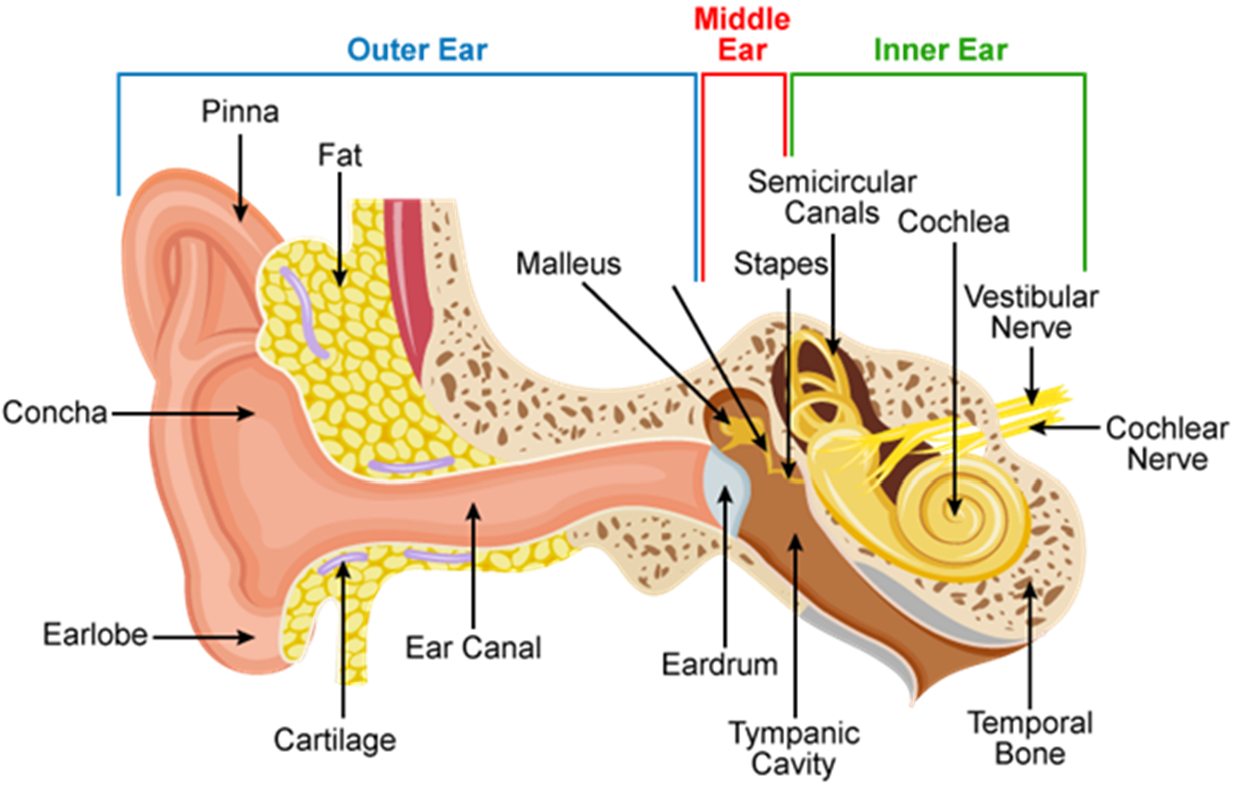
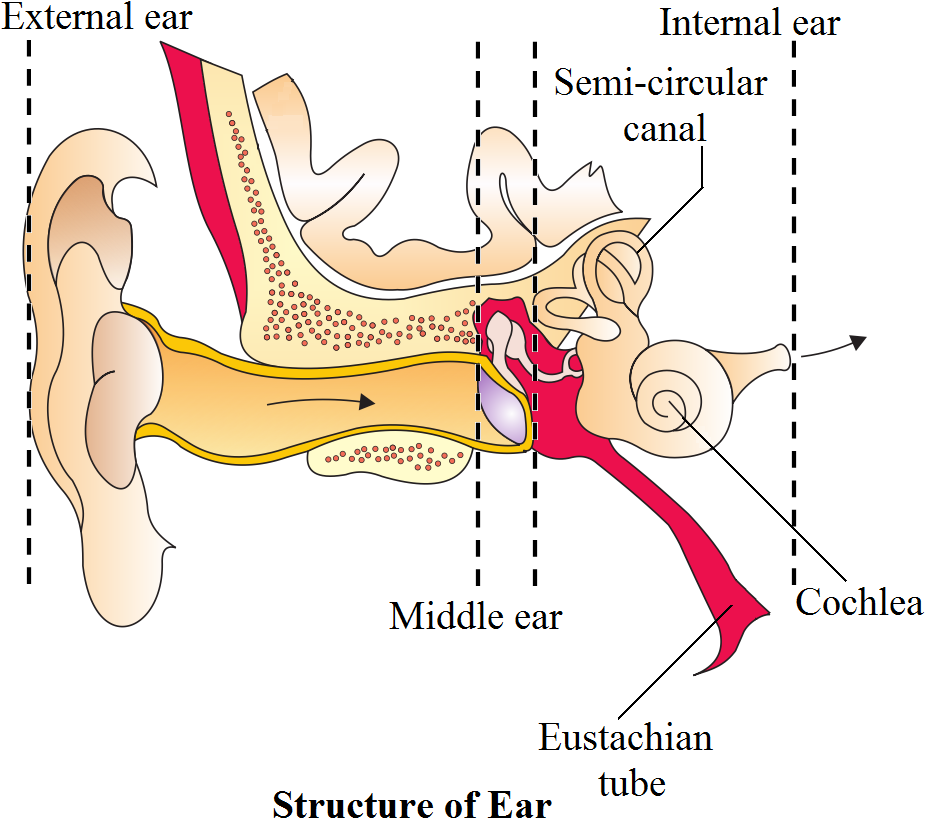
Ear: Ear is the sense organ for hearing and equilibrium. It consists of three portions – external ear, middle ear, and internal ear.
  1. External ear:
It consists of pinna, external auditory meatus, and a tympanic membrane.
  1. Pinna is a sensitive structure that collects and directs the vibrations into the ear to produce sound.
  2. External auditory meatus is a tubular passage supported by cartilage in external ear.
  3. Tympanic membrane is a thin membrane that lies close to the auditory canal. It separates the middle ear from external ear.
  1. Middle ear:
It is an air-filled tympanic cavity that is connected with pharynx through eustachian tube. Eustachian tube helps to equalize air pressure in both sides of tympanic membrane. The middle ear contains a flexible chain of three middle bones called ear ossicles. The three ear ossicles are malleus, incus, and stapes that are attached to each other.
  1. Internal ear:
It is also known as labyrinth. Labyrinth is divided into bony labyrinth and a membranous labyrinth. Bony labyrinth is filled with perilymph while membranous labyrinth is filled with endolymph. Membranous labyrinth is divided into 2 parts.
  1. Vestibular apparatus:
    Vestibular apparatus is a central sac-like part that is divided into utriculus and sacculus. A special group of sensory cells called macula are present in sacculus and utriculus.
    Vestibular apparatus also contains three semi-circular canals. The lower end of each semi-circular canal contains a projecting ridge called crista ampularis. Each ampulla has a group of sensory cells called crista. Crista and macula are responsible for maintaining the balance of body and posture.
  2. Cochlea:
    Cochlea is a long and coiled outgrowth of sacculus. It is the main hearing organ. Cochlea consists of three membranes. The organ of corti, a hearing organ, is located on the basilar membrane that has hair cells.
View full question & answer
Question 185 Marks
Give a brief account of mechanism of hearing.
Answer
The pinna of the external region collects the sound waves and directs it towards ear drum or external auditory canal. These waves strike the tympanic membrane and vibrations are created. Then, these vibrations are transmitted to the oval window, fenestra ovalis, through three ear ossicles, named as malleus, incus, and stapes. These ear ossicles act as lever and transmit the sound waves to internal ear. These vibrations from fenestra ovalis are transmitted into cochlear fluid. This generates sound waves in the lymph. The formation of waves generates a ripple in the basilar membrane. This movement bends the sensory hair cells present on the organ of corti against tectorial membrane. As a result of this, sound waves are converted into nerve impulses. These impulses are then carried to auditory cortex of brain via auditory nerves. In cerebral cortex of brain, the impulses are analysed and sound is recognized.
View full question & answer
Question 195 Marks
Briefly describe the structure of brain.
Answer
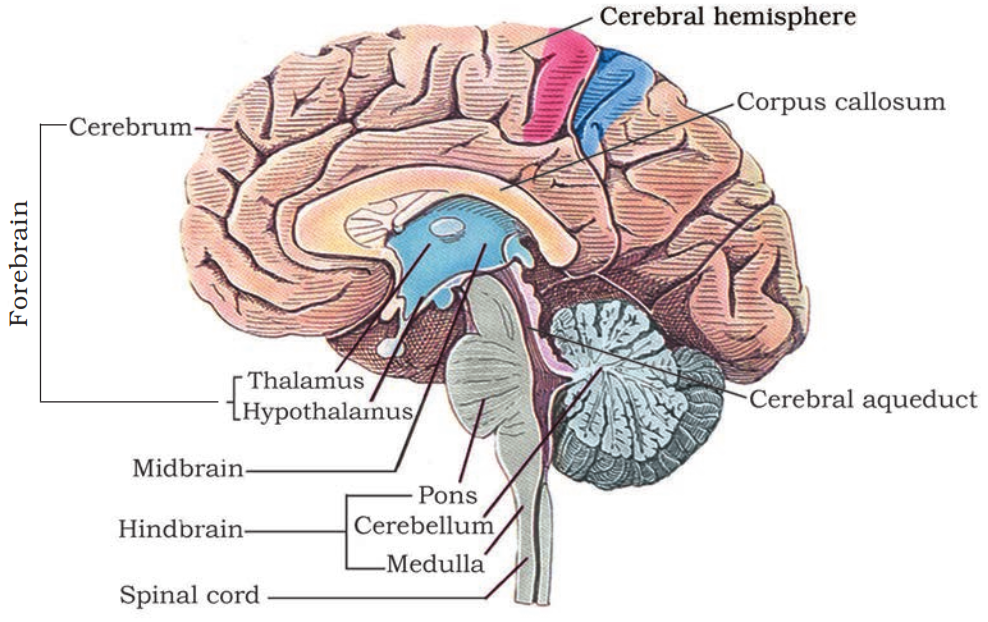
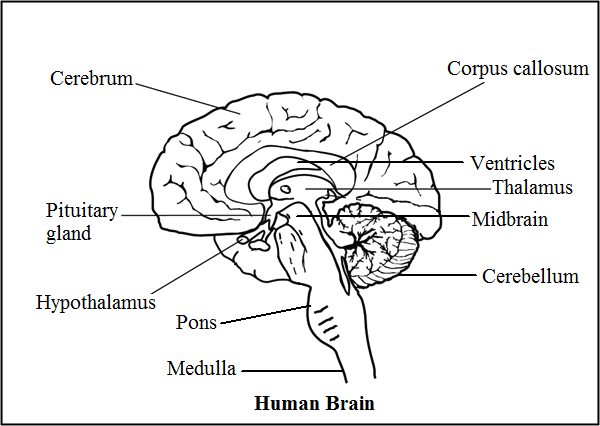
Brain: Brain is the main coordinating centre of the body. It is a part of nervous system that controls and monitors every organ of the body. It is well protected by cranial meninges that are made up of an outer layer called dura mater, a thin middle layer called arachnoid, and an inner layer called pia mater. It is divided into three regions − forebrain, midbrain, and hindbrain.Forebrain: It is the main thinking part of the brain. It consists of cerebrum, thalamus, and hypothalamus.
  1. Cerebrum:
Cerebrum is the largest part of the brain and constitutes about four-fifth of its weight. Cerebrum is divided into two cerebral hemispheres by a deep longitudinal cerebral fissure. These hemispheres are joined by a tract of nerve fibre known as corpus callosum. The cerebral hemispheres are covered by a layer of cells known as cerebral cortex or grey matter. Cerebrum has sensory regions known as association areas that receive sensory impulses from various receptors as well as from motor regions that control the movement of various muscles. The innermost part of cerebrum gives an opaque white appearance to the layer and is known as the white matter.
  1. Thalamus:
Thalamus is the main centre of coordination for sensory and motor signalling. It is wrapped by cerebrum.
  1. Hypothalamus:
It lies at the base of thalamus and contains a number of centres that regulate body temperature and the urge for eating and drinking. Some regions of cerebrum, along with hypothalamus, are involved in the regulation of sexual behaviour and expression of emotional reactions such as excitement, pleasure, fear, etc.
Midbrain:
It is located between the thalamus region of the forebrain and pons region of hindbrain. The dorsal surface of midbrain consists of superior and inferior corpora bigemina and four round lobes called corpora quadrigemina. A canal known as cerebral aqueduct passes through the midbrain. Midbrain is concerned with the sense of sight and hearing.
Hindbrain:
It consists of three regions − pons, cerebellum, and medulla oblongata.
  1. Pons is a band of nerve fibre that lies between medulla oblongata and midbrain. It connects the lateral parts of cerebellar hemisphere together.
  2. Cerebellum is a large and well developed part of hindbrain. It is located below the posterior sides of cerebral hemispheres and above medulla oblongata. It is responsible for maintaining posture and equilibrium of the body.
  3. Medulla oblongata is the posterior and simplest part of the brain. It is located beneath the cerebellum. Its lower end extends in the form of spinal cord and leaves the skull through foramen magnum.
View full question & answer
Question 205 Marks
Write short note on forebrain.
Answer
Forebrain It is the main thinking part of the brain. It consists of cerebrum, thalamus, and hypothalamus.
  1. Cerebrum:
Cerebrum is the largest part of the brain and constitutes about four-fifth of its weight. Cerebrum is divided into two cerebral hemispheres by a deep longitudinal cerebral fissure. These hemispheres are joined by a tract of nerve fibres known as corpus callosum. The cerebral hemispheres are covered by a layer of cells known as cerebral cortex or grey matter. Cerebrum has sensory regions known as association areas that receive sensory impulses from various receptors as well as from motor regions that control the movement of various muscles. The innermost part of cerebrum gives an opaque white appearance to the layer and is known as the white matter.
  1. Thalamus:
Thalamus is the main centre of coordination for sensory and motor signalling. It is wrapped by cerebrum.
  1. Hypothalamus:
It lies at the base of thalamus and contains a number of centres that regulate body temperature and the urge for eating and drinking. Some regions of cerebrum, along with hypothalamus, are involved in the regulation of sexual behaviour and expression of emotional reactions such as excitement, pleasure, fear, etc.
View full question & answer
Question 215 Marks
Write short note on cochlea.
Answer
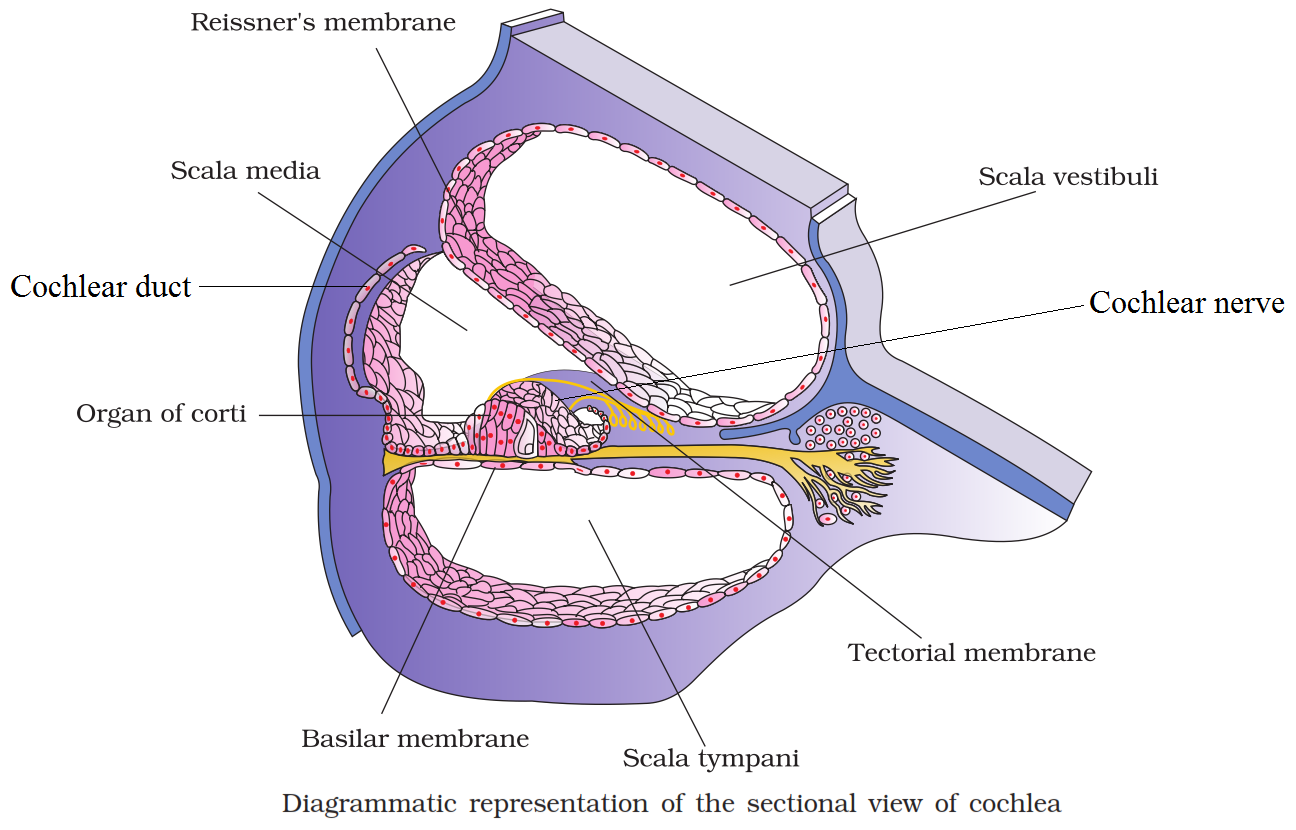
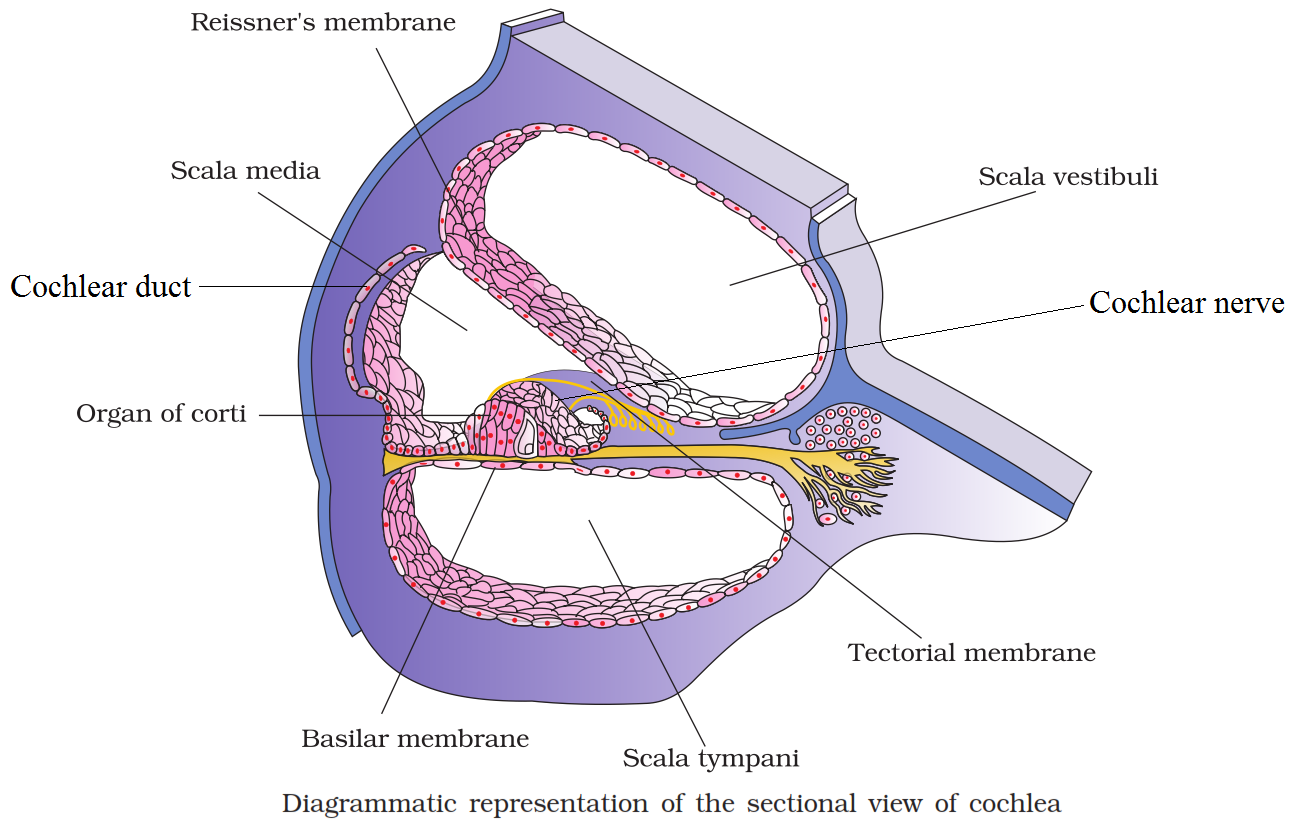
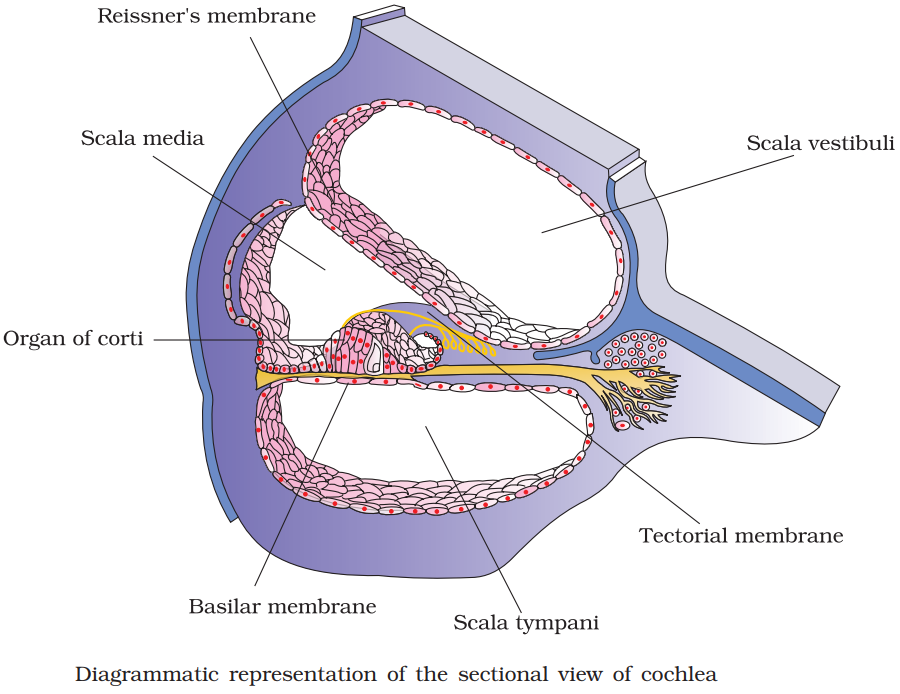
Cochlea is a long, coiled outgrowth of sacculus. It is the main hearing organ. The cochlea forms three chambers.
  1. Upper − scala vestibule
  2. Middle − scala media
  3. Lower − scale tympani
The floor of the scala media is basilar membrane while its roof is Reissner’s membrane. Reissner’s membrane gives out a projection called tectorial membrane. The organ of corti, a hearing organ, is located on the basilar membrane. Organ of corti contains receptor hair cells. The upper scala vestibule and lower scala tympani contain perilymph.
View full question & answer
Question 225 Marks
Briefly describe the structure of eye.
Answer
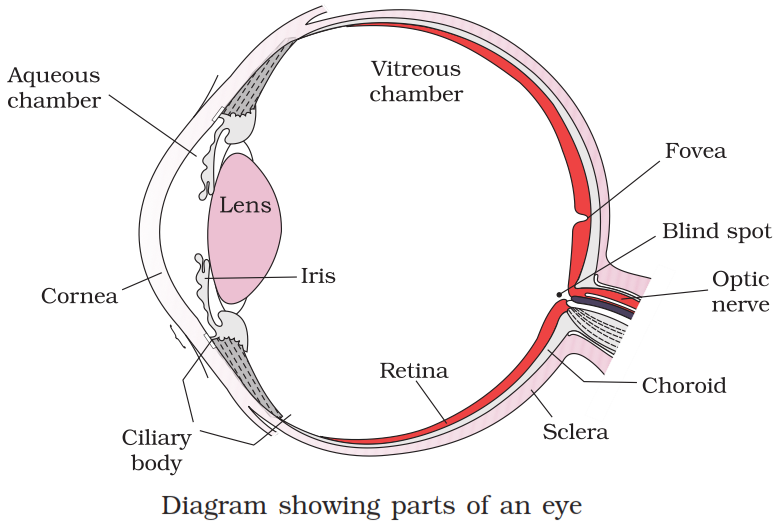
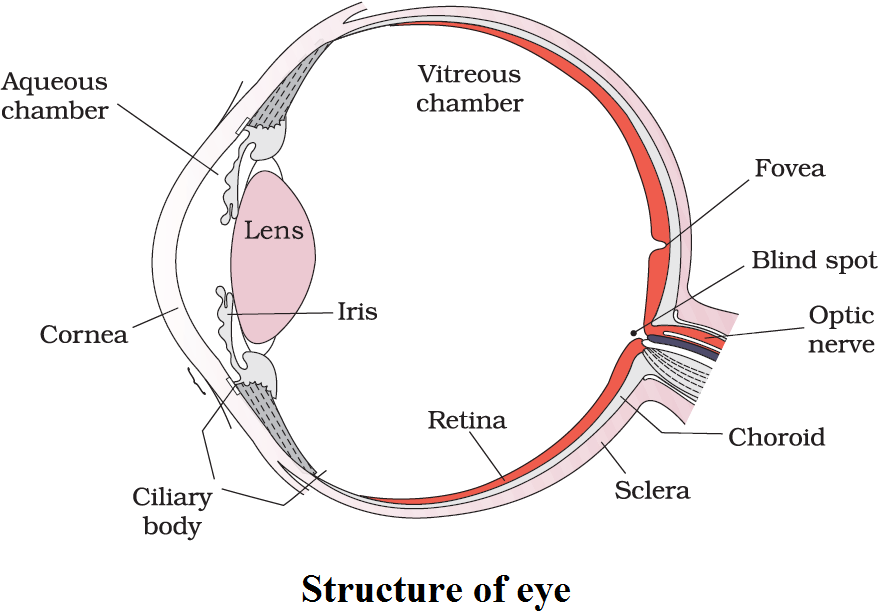
Eye: Eyes are spherical structures that consist of three layers.
  1. The outer layer is composed of sclera and cornea.
  1. Sclera is an opaque tissue that is usually known as white of the eye. It is composed of a dense connective tissue.
  2. Cornea is a transparent anterior portion of eye that lacks blood vessels and is nourished by lymph from the nearby area. It is slightly bulged forward and helps in focusing light rays with the help of lens.
  1. The middle layer of eye is vascular in nature and contains choroid, ciliary body, and iris.
  1. Choroid lies next to the sclera and contains numerous blood vessels that provide nutrients and oxygen to the retina and other tissues.
  2. Ciliary body: The choroid layer is thin over posterior region and gets thickened in the anterior portion to form ciliary body. It contains blood vessels, ciliary muscles, and ciliary processes.
  3. Iris: At the junction of sclera and cornea, the ciliary body continues forward to form thin coloured partition called iris. It is the visible coloured portion of eye.
    The eye contains a transparent, biconvex, and elastic structure just behind the iris. It is known as lens. The lens is held in position by suspensory ligaments attached to the ciliary body. The lens divides the eye ball into two chambers – an anterior aqueous and posterior vitreous chamber.
  1. The innermost nervous coat of eye contains retina. Retina is the innermost layer. It contains three layers of cells – inner ganglion cells, middle bipolar cells, and outermost photoreceptor cells. The receptor cells present in the retina are of two types – rod cells and cone cells.
  1. Rod cells –The rods contain the rhodopsin pigment (visual purple) that is highly sensitive to dim light. It is responsible for twilight vision.
  2. Cone cells –The cones contain the iodopsin pigment (visual violet) and are highly sensitive to high intensity light. They are responsible for daylight and colour visions.
    The innermost ganglionic cells give rise to optic nerve fibre that forms optic nerve in each eye and is connected with the brain.
View full question & answer
Question 235 Marks
Explain the following processes: Transmission of a nerve impulse across a chemical synapse.
Answer
Transmission of a nerve impulse across a chemical synapse: Synapse is a small gap that occurs between the last portion of the axon of one neuron and the dendrite of next neuron. When an impulse reaches at the end plate of axon, vesicles consisting of chemical substance or neurotransmitter, such as acetylcholine, fuse with the plasma membrane. This chemical moves across the cleft and attaches to chemo-receptors present on the membrane of the dendrite of next neuron. This binding of chemical with chemo-receptors leads to the depolarization of membrane and generates a nerve impulse across nerve fibre. The chemical, acetylcholine, is inactivated by enzyme acetylcholinestrase. The enzyme is present in the post synaptic membrane of the dendrite. It hydrolyses acetylcholine and this allows the membrane to repolarise.
View full question & answer
Question 245 Marks
Differentiate between myelinated and non-myelinated axons.
Answer
Myelinated and non-myelinated axons:
  Myelinated axons   Non-myelinated axons
1. Transmission of nerve impulse is faster. 1. Transmission of nerve impulse is slower.
2. Myelinated axon has a myelin sheath. 2. Myelin sheath is absent.
3. Node of Ranvier is present between adjacent myelin sheaths. 3. Node of Ranvier is absent.
4. Found in the brain, the spinal cord, the cranial and spinal nerves. 4. Found in autonomous and somatic neural systems.
5. Schwann cells are observed inside the myelin sheath. 5. Schwann cells are not observed inside the myelin sheath.
View full question & answer
Question 255 Marks
Complete the statement by choosing appropriate match among the following-
A.
Resting potential
i.
Chemicals involved in the transmission of impulses at synapses.
B.
Nerve impulse
ii.
Gap between the pre synaptic and post synaptic neurons.
C.
Synaptic cleft
iii.
Electrical potential difference across the resting neural membrane.
D.
Neurotransmitters
iv.
An electrical wave like response of a neuron to a stimulation.
Answer
A.
Resting potential
iii.
Electrical potential difference across the resting neural membrane.
B.
Nerve impulse
iv.
An electrical wave like response of a neuron to a stimulation.
C.
Synaptic cleft
ii.
Gap between the pre synaptic and post synaptic neurons.
D.
Neurotransmitters
i.
Chemicals involved in the transmission of impulses at synapses.
View full question & answer
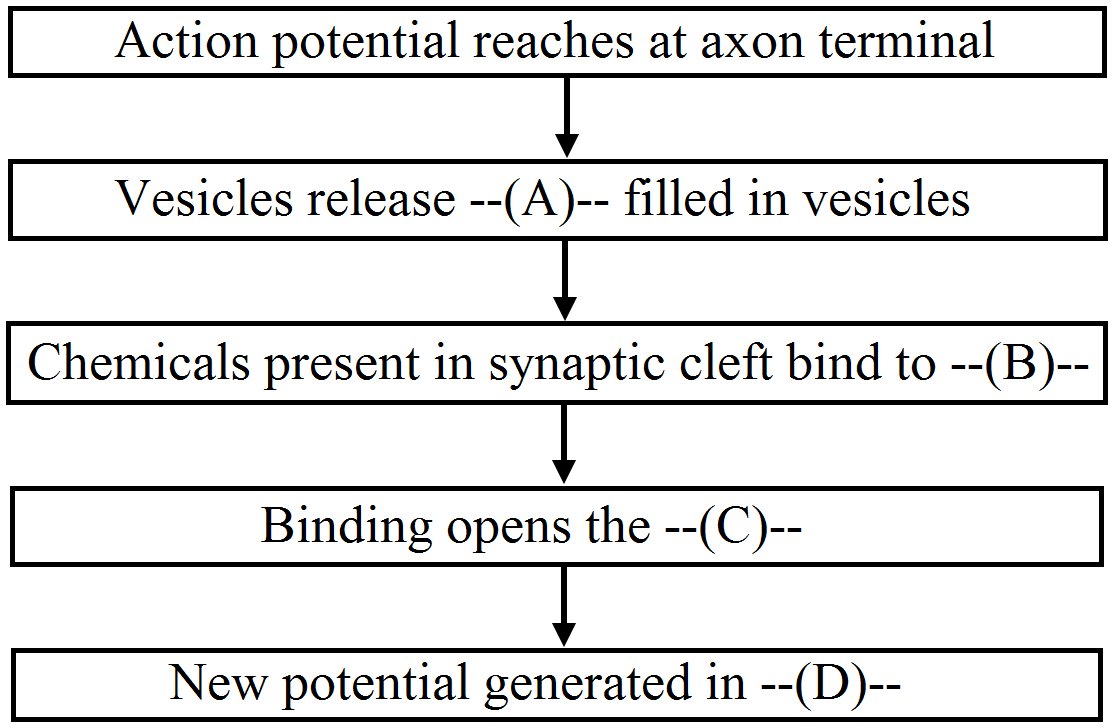
Question 265 Marks

Fill in the blanks at (A), (B),(C) and (D).
Answer
A – Neurotransmitter B - specific receptors C - ion channels D - post-synaptic neuron.
View full question & answer
Question 275 Marks
Neural system and computers share certain common features. Comment in five lines. (Hint: CPU, input-output devices).
Answer
Neural system and computers share certain common features. The neural system has brain as command and control centre similar to the computer that has CPU (Central processing unit). Sensory organs are input devices of neural system like the mouse and keyboard of the computer. Responses of the body are the output of the neural system. Like the data analysis and typed material of the computer. Nerves are comparable to the wires of the computers.
View full question & answer
Question 285 Marks
Name and differentiate between the two types of synapses.
Answer
S. No.
Electrical Synapses
Chemical Synapses
1.
The membranes of the pre-synaptic and post synaptic neurons are in close proximity and there is no synaptic cleft.
The membranes of the pre-synaptic and post-synaptic neurons are separated by a fluid-filled space, the synaptic cleft.
2.
Electrical current can flow directly from one neuron to the other.
Transmission involves chemicals, called neurotransmitters.
3.
Impulse conduction is faster.
Impulse conduction is relatively slower.
4.
Electrical synapses are rare in our system.
Chemical synapses are the most common type of synapses.
View full question & answer
Question 295 Marks
Name the parts of human forebrain indicating their respective functions.
Answer
The forebrain consists of cerebrum, thalamus and hypothalamus. The cerebrum contains motor areas, sensory areas and large regions that are neither clearly sensorv nor motor in function. These regions known as the association areas are responsible for complex functions like intersensory associations, memory and communication. Thalamus is a major coordinating centre for sensory and motor signaling. The hypothalamus contains a number of centers which control body temperature, urge for eating and drinking’s It also contains neurosecretory cells which secrete hypothalamic hormones. The inner parts of cerebral hemisphere and a group of associated deep structures like amygdale, hippocampus etc. form a complex structure called the limbic system. Hypothalamus and limbic system are involved in the regulation of sexual behavior, expression of emotional reactions and motivation.
View full question & answer
Question 305 Marks
Explain the structure of middle and internal ear with the help of diagram.
Answer
The middle ear contains three ossicles called malleus, incus and stapes which are attached to one another in a chainlike fashion. The malleus is attached to the tympanic membrane and the stapes is attached to the oval window of the cochlea. The ear ossicles increase the efficiency of transmission of sound waves to the inner ear. A Eustachian tube connects the middle ear cavity with the pharynx. The Eustachian tube helps in equalising the pressures on either sides of the ear drum.
The fluid-filled inner ear called labyrinth consists of two parts, the bony and the membranous labyrinths. The bony labyrinth is a series of channels. Inside these channels lies the membranous labyrinth, which is surrounded by a fluid called perilymph. The membranous labyrinth is filled with a fluid called endolymph. The coiled portion of the labyrinth is called cochlea. The membranes constituting cochlea, the Reissner’s and basilar, divide the surrounding perilymph filled bony labyrinth into an upper scala vestibuli and a lower scala tympani. The space within cochlea called scala media is filled with endolymph. At the base of the cochlea, the scala vestibuli ends at the oval window, while the scala tympani terminates at the round window which opens to the middle ear. The organ of Corti is a structure located on the basilar membrane which contains hair cells that act as auditory receptors. The hair cells are present in rows on the internal side of the organ of Corti. The basal end of the hair cell is in close contact with the afferent nerve fibres. A large number of processes called stereo cilia are projected from the apical part of each hair cell. Above the rows of the hair cells is a thin elastic membrane called tectorial membrane. The inner ear also contains a complex system called vestibular apparatus, located above the cochlea. The vestibular apparatus is composed of three semi-circular canals and the otolith (macula is the sensory part of saccule and utricle). Each semi-circular canal lies in a different plane at right angles to each other. The membranous canals are suspended in the perilymph of the bony canals. The base of canals is swollen and is called ampulla, which contains a projecting ridge called crista ampullaris which has hair cells. The saccule and utricle contain a projecting ridge called macula. The crista and macula are the specific receptors of the vestibular apparatus responsible for maintenance of balance of the body and posture.
View full question & answer
Question 315 Marks
Explain the process of the transport and release of a neurotransmitter with the help of a labelled diagram showing a complete neuron, axon terminal and synapse.
Answer
A nerve impulse is transmitted from one neuron to another through junctions called synapses. A synapse is formed by the membranes of a presynaptic neuron and a postsynaptic neuron, which may or may not be separated by a gap called synaptic cleft. At a chemical synapse, the membranes of the pre- and post-synaptic neurons are separated by a fluid-filled space called synaptic cleft. Chemicals called neurotransmitters are involved in the transmission of impulses at these synapses. The axon terminals contain vesicles filled with these neurotransmitters. When an impulse (action potential) arrives at the axon terminal, it stimulates the movement of the synaptic vesicles towards the membrane where they fuse with the plasma membrane and release their neurotransmitters in the synaptic cleft. The released neurotransmitters bind to their specific receptors, present on the postsynaptic membrane. This binding opens ion channels allowing the entry of ions which can generate a new potential in the postsynaptic neuron. The new potential developed may be either excitatory or inhibitory.
View full question & answer
Question 325 Marks
With the help of suitable diagrams describe the structure of the human brain.
Answer
  1. Structure of Brain: The human brain is well protected by the skull. Inside the skull, the brain is covered by cranial meninges consisting of an outer layer called dura mater, a very thin middle layer called arachnoid and an inner layer (which is in contact with the brain tissue) called pia mater. The brain can be divided into three major parts.
  • Forebrain: The forebrain consists of cerebrum, thalamus and hypothalamus Cerebrum forms the major part of the human brain. A deep cleft divides the cerebrum longitudinally into two halves, which are termed as the left and right cerebral hemispheres. The hemispheres are connected by a tract of nerve fibres called corpus callosum. The cerebral cortex contains motor areas, sensory areas and large regions that are neither clearly sensory nor motor in function. These regions called as the association areas are responsible for complex functions like intersensory associations, memory and communication. The cerebrum wraps around a structure called thalamus, which is a major coordinating centre for sensory and motor signaling. Another very important part of the brain called hypothalamus lies at the base of the thalamus. The hypothalamus contains a number of centres which control body temperature, urge for eating and drinking. It also contains several groups of neurosecretory cells, which secrete hormones called hypothalamic hormones. The inner parts of cerebral hemispheres and a group of associated deep structures like amygdala, hippocampus, etc., form a complex structure called the limbic lobe or limbic system. Along with the hypothalamus, it is involved in the regulation of sexual behaviour, expression of emotional reactions (e.g.. excitement, pleasure, rage and fear), and motivation.
  • Midbrain: The midbrain is located between the thalamus/hypothalamus of the forebrain and pons of the hindbrain. A canal called the cerebral aqueduct possess through the midbrain. The dorsal portion of the midbrain consists mainly of four round swellings (lobes) called corpora quadrigemina, idbrain and hindbrain form the brainstem.
  • Hindbrain: The hindbrain comprises pons, cerebellum and medulla (also called the medulla oblongata). Pons consists of fibre tracts that interconnect different regions of the brain. Cerebellum has very convoluted surface in order to provide the additional space for many more neurons. The medulla of the brain is connected to the spinal cord. The medulla contains centres which control respiration, cardiovascular reflexes and gastric secretions.
View full question & answer
Question 335 Marks
What is the difference between electrical transmission and chemical transmission?
Answer
Differences between electrical transmission and chemical transmission are:
 
Electrical transmission
Chemical transmission
i.
Electrical synapse is present.
Chemical synapase is present.
ii.
Membranes of pre-and post-synaptic neurons are in very close proximity provided by the gap junction.
The membranes of pre-and post-synaptic neurons are separated by a fluid-filled space called synaptic cleft.
iii.
Impulse transmission across an electrical synapse is fast.
Impulse transmission across a chemical synapse is slow.
iv.
No neurptransmitter is involved.
Neurotransmitter is involved.
v.
Electrical synapase are relatively rare.
Chemical synapses are relatively more.
View full question & answer
Question 345 Marks
Describe the detail structure of the human ear.
Answer
Structure of Ear: Anatomically, the ear can be divided into three major sections called the outer ear, the middle ear and the inner ear. Outer Ear. The outer ear consists of the pinna and external auditory meatus (canal). The pinna collects the vibrations in the air which produce sound. The external auditory meatus leads inwards and extends up to the tympanie membrane (the ear drum). There are very fine hairs and wax-secreting sebaceous glands in the skin of the pinna and the meatus. The tympanie membrane is composed of connective tissues covered with skin outside and with mucus membrane inside. Middle Ear. The middle ear contains three ossicles called malleus, incus and stapes which are attached to one another in a chain-like fashion. The malleus is attached to the tympanic membrane and the stapes is attached to the oval window of the cochlea. The car ossicles increase the efficiency of transmission of sound waves to the inner car. An Eustachian tube connects the middle ear cavity with the pharynx. The Eustachian tube helps in equalising the pressures on either sides of the ear drum. Inner Ear: The fluid-filled inner ear called labyrinth consists of two parts, the bony and the membranous labyrinths. The bony labyrinth is a series of channels Inside these channels lies the membranous labyrinth, which is surrounded by a fluid called perilymph. The membranous labyrinth is filled with a fluid called endolymph. The coiled portion of the labyrinth is called cochlea. The membranes constituting cochlea, the issner's and basilar, divide the surounding perilymph filled bony labyrinth into an upper scala vestibuli and a lower scala tympani. The space within cochlea called scala media is filled with endolymph. At the base of the cochlea, the scala vestibuli ends at the oval window, while the scala tympani terminates at the round window which opens to the middle ear. The organ of corti is a structure located on the basilar membrane which contains hair cells that act as auditory receptors. The hair cells are present in rows on the internal side of the organ of corti. The basal end of the hair cell is in close contact with the afferent nerve fibres. A large number of processes called stereo cilia are projected from the apical part of each hair cell. Above the rows of the hair cells is a thin elastic membrane called tectorial membrane. The inner car also contains a complex system called vestibular apparatus, located above the cochlea. The vestibular apparatus is composed of three semi-circular canals and the otolith organ consisting of the saccule and utricle. Each semicircular canal lies in a different plane at right angles to each other. The membranous canals are suspended in the perilymph of the bony canals. The base of canals is swollen and is called ampulla, which contains a projecting ridge called crista ampullaris which has hair cells. The saccule and utricle contain a projecting ridge called macula. The crista and macula are the specifice receptors of the vestibular apparatus responsible for maintenance of balance of the body and posture.
View full question & answer
Question 355 Marks
Describe the structure of the human eye with a well labeled diagram.
Answer
Structure of Eye: The adult human eye ball is nearly a spherical structure. The wall of the eye ball is composed of three layers. The external layer is composed of a dense connective tissue and is called the selera. The anterior portion of this layer is called the cornea. The middle layer, choroid, contains many blood vessels and looks bluish in colour The choroid layer is thin over the posterior two-thirds of the eye ball, but it becomes thick in the anterior part to form the ciliary body. The ciliary body itself continues forward to form a pigmented and opaque structure called the iris which is the visible coloured portion of the eye. The eye ball contains a transparent crystalline lens which is held in place by ligaments attached to the ciliary body. In front of the lens, the aperture surrounded by the iris is called the pupil. The diameter of the pupil is regulated by the muscle fibres of iris. The inner layer is the retina and it contains three layers of cells from inside to outside - ganglion cells, bipolar cells and photoreceptor cells. There are two types of photoreceptor cells, namely, rods and cones. These cells contain the light-sensitive proteins called the photopigments. The daylight (photopic) vision and colour vision are functions of cones and the twilight (scotopic) vision is the function of the rods. The rods contain a purplish-red protein called the rhodopsin or visual purple, which contains a derivative of Vitamin A. In the human eye, there are three types of cones which possess their own characteristic photopigments that respond to red, green and blue lights. The sensations of different colours are produced by various combinations of these cones and their photopigments. When these cones are stimulated equally, a sensation of white light is produced. The optic nerves leave the eye and the retinal blood vessels enter it at a point medial to and slightly above the posterior pole of the eye ball. Photoreceptor cells are not present in that region and hence it is called the blind spot. At the posterior pole of the eye lateral to the blind spot, here is a yellowish pigmented spot called macula lutea with a central pit called the fovea. The fovea is a thinned-out portion of the retina where only the cones are densely packed. It is the point where the visual acuity resolution) is the greatest. The space between the cornea and the lens is called the aqueous chamber and contains a thin watery fluid called aqueous humor. The pace between the lens and the retina is called the vitreous chamber and is filled with a transparent gel called vitreous humor.
View full question & answer