Questions

3 Marks Question

Take a timed test

10 questions · self-marked practice — reveal the answer and mark yourself.

Question 13 Marks
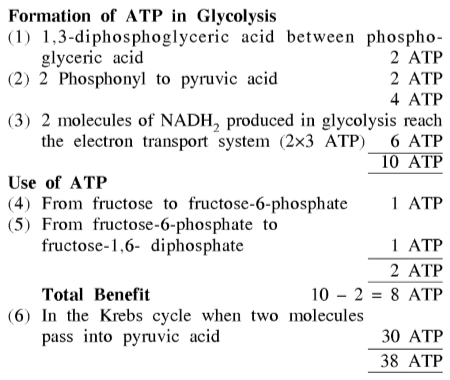
What are the assumptions made during the calculation of net gain of ATP?
Answer
Assumptions for obtaining ATP molecules:
(i) This process starts from glycolysis and ends with Krebs' cycle and ETS. Therefore, it is a sequential, well-organised functional path in which one substrate is formed from another.
(ii) NADH produced during the glycolysis process enters the mitochondria, where it is phosphorylated.
(iii) Only glucose is used in respiration. No other alternative substrate enters any intermediate step in respiration.
(iv) None of the intermediates in the respiratory tract are used in the formation of other compounds.
In fact, all the paths work together. The substrate keeps coming in and out of the path as per requirement. ATP can be used as per requirement. The rate of action of enzymes is controlled by various factors. Respiration is a useful activity for life. Energy is stored and extracted continuously in the living system.
View full question & answer
Question 23 Marks
Distinguish between the following:
Glycolysis and Fermentation
Answer
Difference between Glycolysis and Fermentation
GlycolysisFermentation
(i) This process occurs in both Aerobic respiration and Anaerobic respiration.(i) Partial disintegration of glucose occurs in this.
(ii) It occurs in the cytoplasm. In this, when pyruvic acid is formed from glucose molecule, pure 2 molecules of ATP are formed.(ii) This process also takes place in the cytoplasm and during the formation of pyruvic acid from glucose, pure 2 molecules of ATP are formed.
(iii) Sugar gets partially oxidised to form two molecules of pyruvic acid.(iii) In fermentation, the oxidation of NADH to NAD+ is slow.
View full question & answer
Question 43 Marks
What are the main steps in aerobic respiration? Where does it take place?
View full question & answer
Question 53 Marks
What is the significance of step-wise release of energy in respiration?
Answer
During the oxidation process inside the cell, the entire energy present in the respiratory substrate is not released simultaneously in the cell. It is released in the form of slow stepwise reactions controlled by enzymes, which store chemical energy in the form of ATP. It is worth noting that the energy released by oxidation in Biology-Class 11 respiration is not directly used but it is used in the synthesis of ATP and whenever this energy is needed, it gets broken down and provides energy. For this reason, ATP acts as energy currency for the cell. The energy stored in ATP is used in various energy-essential processes of living organisms. The organic substances produced during respiration serve as precursors for the synthesis of other molecules in the cell.
View full question & answer
Question 63 Marks
How many ATP molecules are produced by the complete oxidation of one molecule of glucose and where?
View full question & answer
Question 73 Marks
What is called amphibolic path? Write any four differences between Respiration and Photo-synthesis.
Answer
Amphibolic path : Because the respiratory pathway is involved in both anabolism and catabolism it is called amphibolic path.
Difference between Respiration and Photosynthesis
RespirationPhotosynthesis
1. This is a disruptive action.1. It is a creative activity.
2. It is present in every cell of living beings.2. Occurs only in chlorophyll cells.
3. It happens continuously in both light and darkness.3. Occurs only in the presence of light.
4. In this, O2 is absorbed and CO2 is released.4. When CO2 is taken in, O2 is released.
5. Weight decreases.5. Weight increases.
6. Food disintegrates.6. Food is manufactured.
View full question & answer
Question 83 Marks
Explain the difference between Oxidative Phosphorylation and Photophosphorylation.
Answer
Difference between Oxidative Phosphorylation and Photophosphorylation
Oxidative PhosphorylationPhotophosphorylation
1. It occurs during respiration.1. This happens in the process of photosynthesis.
2. This process takes place in mitochondria2. This process takes place in chloroplast.
3. This process takes place in the F1 particle of Cristi present in the inner membrane of mitochondria.3. This process takes place in the thylakoid of chloroplast.
4. It is related to ETS found in mitochondria. It is only one type.4. This is an electron transport system found in chloroplast in which two types of pigments are found.
5. O2 molecules are required in this process.5. O2 is not required.
6. Photolysis of water does not occur in this process.6. Photolytic decomposition of water occurs.
View full question & answer
Question 93 Marks
(i) In aerobic respiration the respiratory coefficient is infinite. Please explain.
(ii) Define the following: (a) Floating respiration (b) Protoplasmic respiration (c) External respiration (d) Internal respiration.
Answer
(i) In anaerobic respiration, CO2 is released but O2 is not absorbed. Therefore, the respiration coefficient is infinite.
C6H12O6 → 2C2H2OH + 2CO2 + Energy
R.Q. $\frac{2 CO _2}{\text { Zero }{ }_2}=$ Infinity $(\infty)$
(ii) (a) Floating respiration: The respiration in
which carbohydrates and fats are used as respiratory substances, called floating respiration.
(b) Protoplasmic respiration: When protein is used as a respiratory substance, then it is called protoplasmic respiration.
(c) External respiration : It involves an organism and its environment. Exchange of respiratory gases (O2 and CO2) takes place between them.
(d) Internal respiration : This is also called tissue respiration. In this exchange of respiratory gases between the tissue and the extracellular environment takes place.
View full question & answer
Question 103 Marks
Write the names of the products formed on incomplete oxidation of glucose molecule and write any four importance of respiration.
Answer
Alcohol, CO2 and energy C6H12O6 → 2C2H5OH + 2CO2 + 28 Kcal Energy
Importance of respiration : Respiration plays an important role in the life of plants which are as follows:
1. This releases energy which is used in metabolic activities necessary for plant life.
2. Regulation of energy is produced as per the requirement of all activities.
3. Due to this, insoluble food substances are converted into soluble forms.
4. This releases CO2 which is used in photosynthesis.
5. The Krebs cycle is a general pathway for the oxidative breakdown of carbohydrates, fatty acids, and amino acids.
6. It activates various meristematic tissues of plants.
View full question & answer