Questions

Assertion (A) & Reason (B) MCQ

Take a timed test

4 questions · auto-graded multiple-choice test.

MCQ 11 Mark
In the following questions a statement of assertion $(A)$ followed by a statement of reason $(R)$ is given. Choose the correct option out of the choices given below each question.
Assertion $(A)$ : Toluene on Friedal Crafts methylation gives $o–$ and $p–$ xylene.
Reason $(R)$ : $\text{CH}_3-$ group bonded to benzene ring increases electron density at $o–$ and $p–$ position.
  • Both $A$ and $R$ are correct and $R$ is the correct explanation of $A$.
  • B
    Both $A$ and $R$ are correct but $R$ is not the correct explanation of $A$.
  • C
    Both $A$ and $R$ are not correct.
  • D
    $A$ is not correct but $R$ is correct.
Answer
Correct option: A.
Both $A$ and $R$ are correct and $R$ is the correct explanation of $A$.
Toluene has $ -\text{CH}_3$ group attached to benzene ring. $\text{CH}_3$ group is electron withdrawing group which activates benzene ring due to hyperconjugation effect, and increases electron density on ortho and para position for the attack of electrophiles.
View full question & answer
MCQ 21 Mark
In the following questions a statement of assertion $(A)$ followed by a statement of reason $(R)$ is given. Choose the correct option out of the choices given below each question.
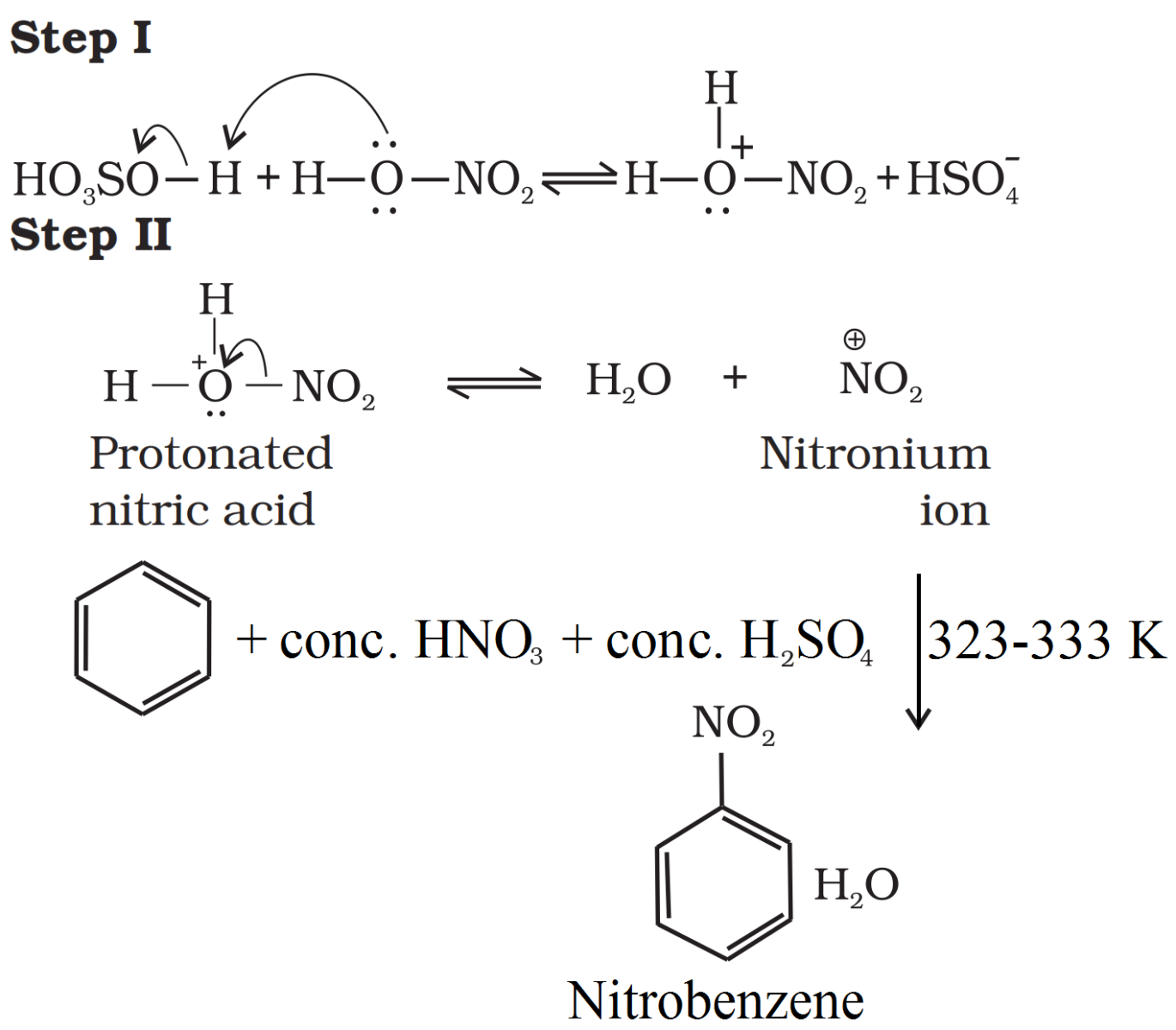
Assertion $(A)$ : Nitration of benzene with nitric acid requires the use of concentrated sulphuric acid.
Reason $(R)$ : The mixture of concentrated sulphuric acid and concentrated nitric acid produces the electrophile, $\text{NO}_2^+$.
  • Both $A$ and $R$ are correct and $R$ is the correct explanation of $A.$
  • B
    Both $A$ and $R$ are correct but $R$ is not the correct explanation of $A.$
  • C
    Both $A$ and $R$ are not correct.
  • D
    $A$ is not correct but $R$ is correct.
Answer
Correct option: A.
Both $A$ and $R$ are correct and $R$ is the correct explanation of $A.$
In nitration, benzene is treating with nitrating mixture, i.e. conc. $\mathrm{HNO}_3$ and $\mathrm{H}_2 \mathrm{SO}_4$ and $\mathrm{H}_2 \mathrm{SO}^4$ helps in furishing $\mathrm{N}_2^{+} ($Electrophile$).$​​​​​​​
View full question & answer
MCQ 31 Mark
In the following questions a statement of assertion $(A)$ followed by a statement of reason $(R)$ is given. Choose the correct option out of the choices given below each question.
Assertion $(A)$ : Among isomeric pentanes, $2, 2-$ dimethylpentane has highest boiling point.
Reason $(R)$ : Branching does not affect the boiling point.
  • A
    $A$ and $R$ both are correct, and $R$ is the correct explanation of $A.$
  • B
    $A$ and $R$ both are correct, but $R$ is not the correct explanation of $A$.
  • $A$ is true but $R$ is false.
  • D
    $A$ and $R$ both are false.
Answer
Correct option: C.
$A$ is true but $R$ is false.
Among isomeric pentanes $2, 2-$ dimethylpentane has lowest boiling point and on branching boiling point decreases.
View full question & answer
MCQ 41 Mark
In the following questions a statement of assertion $(A)$ followed by a statement of reason $(R)$ is given. Choose the correct option out of the choices given below each question.
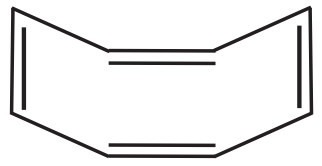
Assertion $(A)$ : The compound cyclooctane has the following structural formula:

It is cyclic and has conjugated $8\pi-$ electron system but it is not an aromatic compound.
Reason $(R) : (4n + 2) \pi-$ electrons rule does not hold good and ring is not planar.
  • $A$ and $R$ both are correct, and $R$ is the correct explanation of $A.$
  • B
    $A$ and $R$ both are correct, but $R$ is not the correct explanation of $A$.
  • C
    $A$ is true but $R$ is false.
  • D
    $A$ and $R$ both are false.
Answer
Correct option: A.
$A$ and $R$ both are correct, and $R$ is the correct explanation of $A.$
Both $A $ and $R$ are Correct, and $R$ is correct explanation of $A$.
Aromaticity is shown by compounds possessing following characteristics:
Planarity. Complete delocalization of the $\pi$ electrons in the ring.
Presence of $(4n + 2)\pi$ electrons in the ring where n is an integer $(4 = 0, 1, 2, .....)$.
This is often referred to as Huckel Rule.
View full question & answer