Question 14 Marks
Read the passage given below and answer the following questions from 1 to 5.
Alkynes– Like alkenes, alkynes are also unsaturated hydrocarbons. They contain at least one triple bond between two carbon atoms. The number of hydrogen atoms is still less in alkynes as compared to alkenes or alkanes. Their general formula is $C_nH_{2n–2}.$ The first stable member of alkyne series is ethyne which is popularly known as acetylene. Acetylene is used for arc welding purposes in the form of oxyacetylene flame obtained by mixing acetylene with oxygen gas. Alkynes are starting materials for a large number of organic compounds. Hence, it is interesting to study this class of organic compounds.
Structure of Triple Bond Ethyne is the simplest molecule of alkyne series. Structure of ethyne is shown in Figure. Each carbon atom of ethyne has two sp hybridised orbitals. Carbon-carbon sigma $(\sigma)$ bond is obtained by the head-on overlapping of the two sp hybridised orbitals of the two carbon atoms. The remaining sp hybridised orbital of each carbon atom undergoes overlapping along the internuclear axis with the 1s orbital of each of the two hydrogen atoms forming two C-H sigma bonds. H-C-C bond angle is of $180^\circ .$
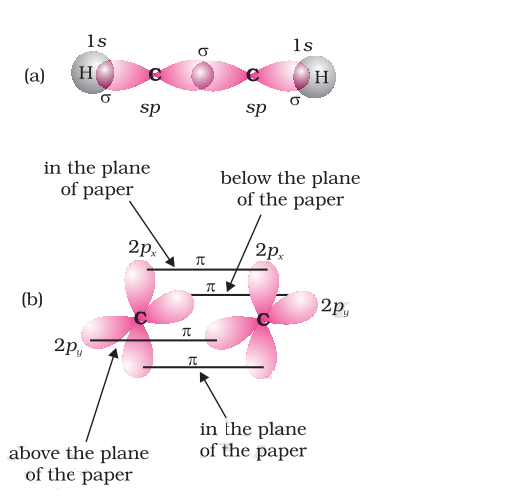
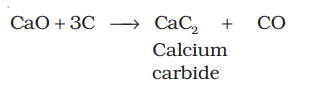
Each carbon has two unhybridised p orbitals which are perpendicular to each other as well as to the plane of the C C sigma bond. The $2 p$ orbitals of one carbon atom are parallel to the $2 p$ orbitals of the other carbon atom, which undergo lateral or sideways overlapping to form two pi ( $\pi$ ) bonds between two carbon atoms. Thus ethyne molecule consists of one $C - C \sigma$ bond, two $C - H \sigma$ bonds and two $C - C \pi$ bonds. The strength of $C \equiv C$ bond (bond enthalpy $823 kJ mol ^{-1}$ ) is more than those of $C = C$ bond (bond enthalpy $681 kJ mol ^{-1}$ ) and $C - C$ bond (bond enthalpy 348 kJ $mol ^{-1}$ ). The $C \equiv C$ bond length is shorter $(120 pm )$ than those of $C = C (133 pm )$ and $C - C (154 pm )$. Electron cloud between two carbon atoms is cylindrically symmetrical about the internuclear axis. Thus, ethyne is a linear molecule. Preparation - From calcium carbide: On industrial scale, ethyne is prepared by treating calcium carbide with water. Calcium carbide is prepared by heating quick lime with coke. Quick lime can be obtained by heating limestone as shown in the following reactions:
$\text{C}\text{aC}_2+2\text{H}_2\text{O}\rightarrow\text{Ca}(\text{OH})_2+\text{C}_2\text{H}_2$
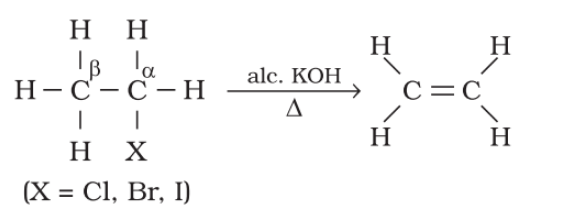
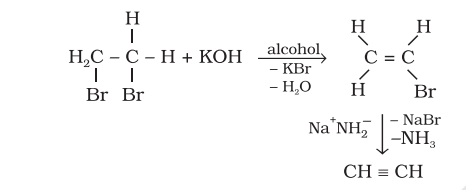
From vicinal dihalides: Vicinal dihalides on treatment with alcoholic potassium hydroxide undergo dehydrohalogenation. One molecule of hydrogen halide is eliminated to form alkenyl halide which on treatment with sodamide gives alkyne.
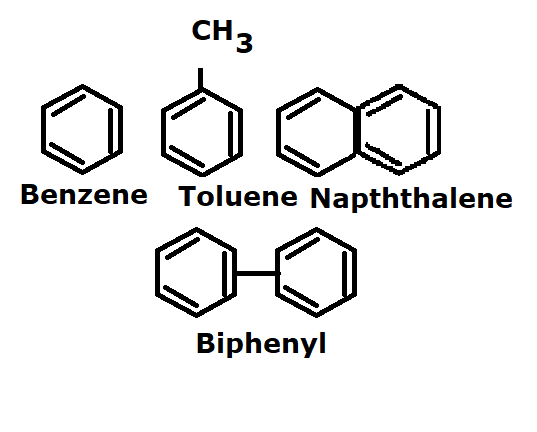
Aromatic hydrocarbon- These hydrocarbons are also known as ‘arenes’. Since most of them possess pleasant odour, the class of compounds was named as ‘aromatic compounds’. Most of such compounds were found to contain benzene ring. Benzene ring is highly unsaturated but in a majority of reactions of aromatic compounds, the unsaturation of benzene ring is retained. However, there are examples of aromatic hydrocarbons which do not contain a benzene ring but instead contain other highly unsaturated ring. Aromatic compounds containing benzene ring are known as benzenoids and those not containing a benzene ring are known as non-benzenoids. Some examples of arenes are given below:
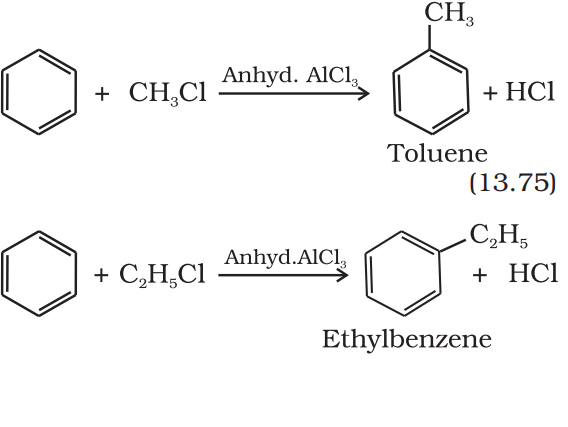
Friedel-Crafts alkylation reaction: When benzene is treated with an alkyl halide in the presence of anhydrous aluminium chloride, alkylbenene is formed.
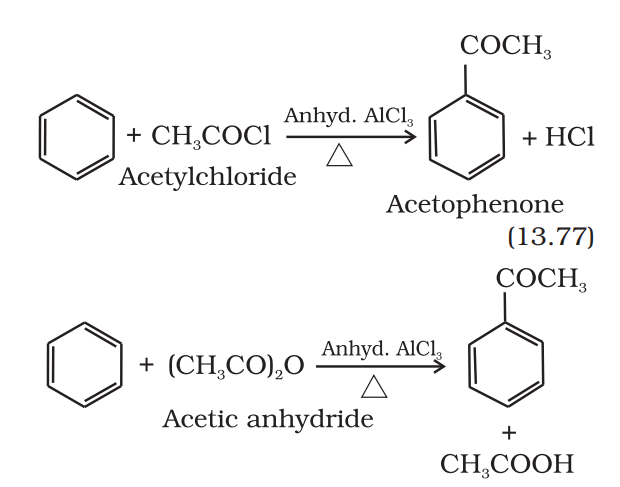
Friedel-Crafts acylation reaction: The reaction of benzene with an acyl halide or acid anhydride in the presence of Lewis acids ($AlCl_3$) yields acyl benzene.
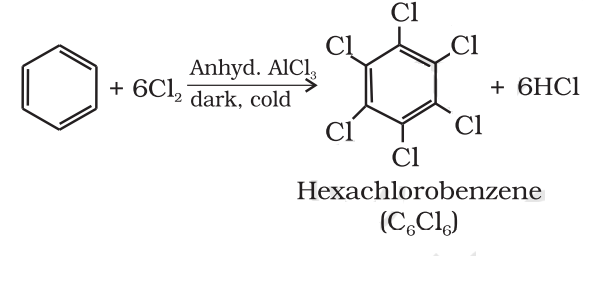
If excess of electrophilic reagent is used, further substitution reaction may take place in which other hydrogen atoms of benzene ring may also be successively replaced by the electrophile. For example, benzene on treatment with excess of chlorine in the presence of anhydrous $AlCl_3$ can be chlorinated to hexachlorobenzene $(C_6Cl_6)$
Alkynes– Like alkenes, alkynes are also unsaturated hydrocarbons. They contain at least one triple bond between two carbon atoms. The number of hydrogen atoms is still less in alkynes as compared to alkenes or alkanes. Their general formula is $C_nH_{2n–2}.$ The first stable member of alkyne series is ethyne which is popularly known as acetylene. Acetylene is used for arc welding purposes in the form of oxyacetylene flame obtained by mixing acetylene with oxygen gas. Alkynes are starting materials for a large number of organic compounds. Hence, it is interesting to study this class of organic compounds.
Structure of Triple Bond Ethyne is the simplest molecule of alkyne series. Structure of ethyne is shown in Figure. Each carbon atom of ethyne has two sp hybridised orbitals. Carbon-carbon sigma $(\sigma)$ bond is obtained by the head-on overlapping of the two sp hybridised orbitals of the two carbon atoms. The remaining sp hybridised orbital of each carbon atom undergoes overlapping along the internuclear axis with the 1s orbital of each of the two hydrogen atoms forming two C-H sigma bonds. H-C-C bond angle is of $180^\circ .$
Each carbon has two unhybridised p orbitals which are perpendicular to each other as well as to the plane of the C C sigma bond. The $2 p$ orbitals of one carbon atom are parallel to the $2 p$ orbitals of the other carbon atom, which undergo lateral or sideways overlapping to form two pi ( $\pi$ ) bonds between two carbon atoms. Thus ethyne molecule consists of one $C - C \sigma$ bond, two $C - H \sigma$ bonds and two $C - C \pi$ bonds. The strength of $C \equiv C$ bond (bond enthalpy $823 kJ mol ^{-1}$ ) is more than those of $C = C$ bond (bond enthalpy $681 kJ mol ^{-1}$ ) and $C - C$ bond (bond enthalpy 348 kJ $mol ^{-1}$ ). The $C \equiv C$ bond length is shorter $(120 pm )$ than those of $C = C (133 pm )$ and $C - C (154 pm )$. Electron cloud between two carbon atoms is cylindrically symmetrical about the internuclear axis. Thus, ethyne is a linear molecule. Preparation - From calcium carbide: On industrial scale, ethyne is prepared by treating calcium carbide with water. Calcium carbide is prepared by heating quick lime with coke. Quick lime can be obtained by heating limestone as shown in the following reactions:
$\text{C}\text{aC}_2+2\text{H}_2\text{O}\rightarrow\text{Ca}(\text{OH})_2+\text{C}_2\text{H}_2$
From vicinal dihalides: Vicinal dihalides on treatment with alcoholic potassium hydroxide undergo dehydrohalogenation. One molecule of hydrogen halide is eliminated to form alkenyl halide which on treatment with sodamide gives alkyne.
Aromatic hydrocarbon- These hydrocarbons are also known as ‘arenes’. Since most of them possess pleasant odour, the class of compounds was named as ‘aromatic compounds’. Most of such compounds were found to contain benzene ring. Benzene ring is highly unsaturated but in a majority of reactions of aromatic compounds, the unsaturation of benzene ring is retained. However, there are examples of aromatic hydrocarbons which do not contain a benzene ring but instead contain other highly unsaturated ring. Aromatic compounds containing benzene ring are known as benzenoids and those not containing a benzene ring are known as non-benzenoids. Some examples of arenes are given below:
Friedel-Crafts alkylation reaction: When benzene is treated with an alkyl halide in the presence of anhydrous aluminium chloride, alkylbenene is formed.
Friedel-Crafts acylation reaction: The reaction of benzene with an acyl halide or acid anhydride in the presence of Lewis acids ($AlCl_3$) yields acyl benzene.
If excess of electrophilic reagent is used, further substitution reaction may take place in which other hydrogen atoms of benzene ring may also be successively replaced by the electrophile. For example, benzene on treatment with excess of chlorine in the presence of anhydrous $AlCl_3$ can be chlorinated to hexachlorobenzene $(C_6Cl_6)$
- The general formula of Alkynes is …?
- $C_nH_{2n–2}$
- $C_nH_{2n–2}$
- $C_nH_{2n–2}$
- $C_nH_{2n–2}$
- Calcium carbide is prepared by heating quick lime with …?
- Backing soda
- Coke
- Carbide
- Salt
- Vicinal dihalides on treatment with alcoholic potassium hydroxide undergo …?
- Dehydrogenation.
- Hydrohalogenation.
- Dehydrohalogenation
- Dehalogenation.
- The bond enthalpy of C ≡ C is …?
- 523 kJ mol
- 623 kJ mol
- 723 kJ mol
- 823 kJ mol
- The C ≡ C bond length is …?
- 1200 pm
- 620 pm
- 240 pm
- 120 pm
Answer
View full question & answer→- (a) $C_nH_{2n–2}$
- (b)Coke
- (c) Dehydrohalogenation.
- (d) 823 kJ mol
- (d) 120 pm