An alkene (molecular weight $=56$ ) on reaction with trioxygen followed by zinc/ $CH _3 COOH$ gave only ethanal. Identify the Structure of the alkene.
Answer
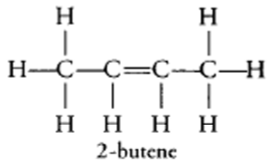
Let the molecular formula of given alkene is $C _{ n } H _{2 n }$ $ 12 n+2 n=56 $ or $14 n =56$ $ \therefore n=4 $ Thus, the molecular formula of alkene is $C _4 H _8$. As, $C _4 H _8$ is giving only ethanal during ozonolysis followed by reduction, Thus, given alkene is symmetrical and its structure is :
Oxygen is prepared by the catalytic decomposition of potassium chlorate $\left( KCIO _3\right)$. Decomposition of potassium chlorate gives potassium chloride (KCI) and oxygen $\left( O _2\right)$. If 2.4 moles of oxygen is needed for an experiment, how many grams of potassium chlorate must be decomposed?
Answer
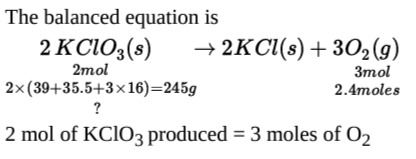
3 moles of $O _2$ is produced by decomposition of 245 g of $KClO _3$ 2.4 moles of $O _2$ will be produced by the decomposition of $KClO _3=\frac{245 \times 2.4}{3}=196.0 g$
Lead chloride has a solubility product of $1.7 \times 10^{-5}$ at 298 K . Calculate its solubility at this temperature.
Answer
According to the question, the solubility product of lead chloride at 298 K is $1.7 \times 10^{-5}$. Reaction: $ PbCl_2(s) \rightleftharpoons Pb^{2+}(a q)+2 Cl^{-}(a q) $ Let the solubility of $PbCl _2$ be $S mol / L$. Then the solution will contain S moles of $Pb ^{2+}$ ions and 2 S moles of $Cl ^{-}$ions respectively per litre. $ \begin{aligned} & \therefore K_{sp}=\left[Pb^{2+}\right]\left[Cl^{-}\right]^2 \\ & =S \times(2 S)^2 \\ & =4 S^3 \\ & \Rightarrow 4 S^3=1.7 \times 10^{-5} \\ & \Rightarrow S^3=\frac{1.7 \times 10^{-5}}{4}=0.425 \times 10^{-5} \end{aligned} $ Therefore, $S =1.620 \times 10^{-2} mol L ^{-1}$.
In each of the following pairs of salts, which one is more stable? 1. Ferrous and ferric salts 2. Cuprous and cupric salts
Answer
1. Ferrous and ferric salts In ferrous salts $Fe ^{2+}$, the configuration is $1 s^2 2 s^2, 2 p ^6, 3 s^2, 3 p ^6, 3 d^6$. In ferric salts $Fe ^{3+}$, the configuration is $1 s^2 2 s^2, 2 p^6, 3 s^2, 3 p^6, 3 d^5$. As half-filled $3 d^5$ configuration is more stable therefore ferric salts are more stable than ferrous salts. 2. Cuprous and cupric salts In cuprous salts, the configuration of $Cu ^{+}$is $1 s^2 2 s^2 2 p ^6 3 s^2 3 p ^6 3 d^{10}$. In cupric salts, the configuration of $Cu ^{2+}$ is $1 s^2 2 s^2, 2 p^6, 3 s^2, 3 p^6, 3 d^9$. Although $Cu ^{+}$has completely filled d-orbital, yet cuprous salts are less stable. This is because the nuclear charge is not sufficient enough to hold 18 electrons of $Cu ^{+}$ion present in the outermost shell.