Sample QuestionsModel Paper 10 questions
One sample from each question group in this chapter. Select any group above to see the full set with answer keys.
The enthalpy of combustion of methane, graphite and dihydrogen at 298 K are, $-890.3 kJ mol ^{-1},-393.5 kJ mol ^{-1}$ and $-285.8 kJ mol ^{-1}$ respectively. Enthalpy of formation of $CH _4(g)$ will be
- A
$+74.8 kJ mol ^{-1}$
- B
$+52.26 kJ mol ^{-1}$
- C
$-74.8 kJ mol ^{-1}$
- D
$-52.27 kJ mol ^{-1}$
View full solution →Boiling point of alkanes are:
- A
is independent of branching.
- B
decreases with increase in molecular mass.
- C
is independent of molecular mass.
- ✓
increases with increase in molecular mass.
Answer: D.
View full solution →Standard enthalpy of fusion or molar enthalpy of fusion is:
- A
the enthalpy change that accompanies melting of one kg of a solid substance in the standard state.
- B
the enthalpy change that accompanies vaporization of one kg of a solid substance in the standard state.
- ✓
the enthalpy change that accompanies melting of one mole of a solid substance in the standard state.
- D
the enthalpy change that accompanies vaporization of one mole of a solid substance in the standard state.
Answer: C.
View full solution →Which conformation of ethane has the lowest potential energy?
Answer: C.
View full solution →Write the state of hybridisation of carbon in $H _2 C = O$ and mention the molecular geometry also.
- A
sp hybridised carbon, linear
- ✓
$sp ^2$ hybridised carbon, trigonal planar
- C
$sp ^3$ hybridised carbon, tetrahedral
- D
$sp ^3$ hybridised carbon, trigonal pyramidal
Answer: B.
View full solution →How will you convert benzene into
i. p - nitrobromobenzene
ii. m - nitrobromobenzene
An alkene (molecular weight $=56$ ) on reaction with trioxygen followed by zinc/ $CH _3 COOH$ gave only ethanal. Identify the Structure of the alkene.
View full solution →Oxygen is prepared by the catalytic decomposition of potassium chlorate $\left( KCIO _3\right)$. Decomposition of potassium chlorate gives potassium chloride (KCI) and oxygen $\left( O _2\right)$. If 2.4 moles of oxygen is needed for an experiment, how many grams of potassium chlorate must be decomposed?
View full solution →Which element do you think would have been named by:
1. Lawrence Berkeley Laboratory
2. Seaborg's group?
Lead chloride has a solubility product of $1.7 \times 10^{-5}$ at 298 K . Calculate its solubility at this temperature.
View full solution →1. Give the mathematical expression of enthalpy.
2. Neither q nor W is a state function but $q + W$ is a state function. Explain why?
3. The standard heat of formation of $Fe _2 O _3$ (s) is $824.2 kJ mol ^{-1}$ Calculate heat change for the reaction.
$
4 Fe(s)+3 O_2(g) \rightarrow 2 Fe_2 O_3(s)
$
View full solution →The reactant which is entirely consumed in reaction is known as limiting reagent. In the reaction $2 A+4 B \rightarrow 3 C+4 D$ , when 5 moles of A react with 6 moles of $B$, then
i. Which is the limiting reagent?
ii. Calculate the amount of C formed?
View full solution →The electronic configuration of some elements are given below:
a. $1 s^2, 2 s^2, 2 p^6, 3 s^2$
b. $1 s^2, 2 s^2, 2 p^6$
c. $1 s^2, 2 s^2, 2 p ^2$
d. $1 s^2, 2 s^2, 2 p ^6, 3 s^1$
e. $1 s^2, 2 s^2, 2 p^5$
Answer the following questions:
i. Name the elements.
ii. Which of these have the lowest Ionization enthalpy?
iii. Which is a halogen?
iv. Which is an alkali metal?
v. Which is an inert gas?
View full solution →What transition in a hydrogen spectrum would have the same wavelength Balmer transition $n =4$ to $n =2$ of $\overline{ v }=\frac{1}{\lambda}= R _{ H } Z^2\left(\frac{1}{ n _1^2}-\frac{1}{ n _2^2}\right)$ spectrum?
View full solution →Identify the type of redox reaction taking place in the following.
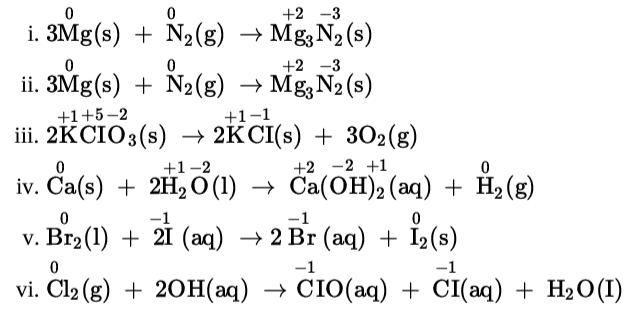
Write a relation between $\triangle G$ and Q and define the meaning of each term and answer the following:
a. Why a reaction proceeds forward when $Q < K$ and no net reaction occurs when $Q = K$.
b. Explain the effect of an increase in pressure in terms of reaction quotient Q for the reaction:
$
CO(g)+3 H_2(g) \rightleftharpoons CH_4(g)+H_2 O(g)
$
View full solution →Attempt any five of the following:
1. Can a catalyst change the position of equilibrium in a reaction?
2. To which category of compounds does cyclohexane belong?
3.

4. What is hydrogenation?
5. What are conformations?
6. The intermediate carbocation formed in the reactions of $HI , HBr$ and HCl with propene is the same and the bond energy of $HCl , HBr$ and HI is $430.5 kJ mol ^{-1}, 363.7 kJ mol ^{-1}$ and $296.8 kJ mol ^{-1}$ respectively. What will be the order of reactivity of these halogen acids?
7. State Le chatelier's principle. View full solution →1. Suggest a method to purify
i. a liquid which decomposes at its boiling point.
ii. kerosene oil containing water.
iii. camphor containing traces of common salt.
2. Differentiate between the principle of estimation of nitrogen in an organic compound
i. Dumas method
ii. Kjeldahl's method.
1. Why is nitric acid added to sodium extract before adding silver nitrate for testing halogens?
2. How does
i. an electron withdrawing group (EWG) and
ii. an electron donating group (EDG) influence the acid strength of carboxylic end?
Calculate the degree of ionization of 0.05 M acetic acid if its $pK _{ a }$ value is 4.74 . How is the degree of dissociation affected when its solution also contains
a. 0.01 M
b. 0.1 M HCl ?
View full solution →Assertion (A): Atomic mass has no unit but is expressed in amu.
Reason (R): It is the average mass of an atom taking care of the relative abundance of all its possible isotopes.
Assertion (A): The nuclear isomers are the atoms with the same atomic number and same mass number, but with different radioactive properties.
Reason (R): The nucleus in the excited state will evidently have a different half-life as compared to that in the ground state.
Assertion (A): Simple distillation can help in separating a mixture of propan-1-ol (boiling point $97^{\circ} C$ ) and propanone (boiling point $56^{\circ} C$ ).
Reason (R): Liquids with a difference of more than $20^{\circ} C$ in their boiling points can be separated by simple distillation.
- ✓
Both A and R are true and R is the correct explanation of A.
- B
Both A and R are true but R is not the correct explanation of A.
- C
A is true but R is false.
- D
A is false but R is true.
Answer: A.
View full solution →The molecular orbital theory is based on the principle of a linear combination of atomic orbitals. According to this approach when atomic orbitals of the atoms come closer, they undergo constructive interference as well as destructive interference giving molecular orbitals, i.e., two atomic orbitals overlap to form two molecular orbitals, one of which lies at a lower energy level (bonding molecular orbital). Each molecular orbital can hold one or two electrons in accordance with Pauli's exclusion principle and Hund's rule of maximum multiplicity. For molecules up to $N _2$, the order of filling of orbitals is:

Bond order $=\frac{1}{2}$ [bonding electrons - antibonding electrons]
Bond order gives the following information:
i. If bond order is greater than zero, the molecule/ion exists otherwise not.
ii. Higher the bond order, higher is the bond dissociation energy.
iii. Higher the bond order, greater is the bond stability.
iv. Higher the bond order, shorter is the bond length.
1. Arrange the following negative stabilities of $CN , CN ^{+}$and $CN ^{-}$in increasing order of bond.
2. The molecular orbital theory is preferred over valence bond theory. Why?
3. Ethyne is acidic in nature in comparison to ethene and ethane. Why is it so?
OR
Bonding molecular orbital is lowered by a greater amount of energy than the amount by which antibonding molecular orbital is raised. Is this statement correct? View full solution →The existing large number of organic compounds and their ever-increasing numbers has made it necessary to classify them on the basis of their structures. Organic compounds are broadly classified as open-chain compounds which are also called aliphatic compounds. Aliphatic compounds further classified as homocyclic and heterocyclic compounds. Aromatic compounds are special types of compounds. Alicyclic compounds, aromatic compounds may also have heteroatom in the ring. Such compounds are called heterocyclic aromatic compounds. Organic compounds can also be classified on the basis of functional groups, into families or homologous series. The members of a homologous series can be represented by general molecular formula and the successive members differ from each other in a molecular formula by a $- CH _2$ unit.
1. The successive members of a homologous series differ by which mass of amu?
OR
Is tetrahydrofuran is aromatic compounds?
2. Does Pyridine, pyrrole, thiophene are all heteroaromatic compounds
3. Difference between heterocyclic and homocyclic compound.
View full solution →