Question 14 Marks
Chromatography is an important technique extensively used to separate mixtures into their components, purify compounds and also test the purity of compounds. Based on the principle involved, chromatography is classified into different categories. Two of these are Adsorption chromatography and Partition chromatography. Two main types of chromatographic techniques are based on the principle of differential adsorption column chromatography, and thin-layer chromatography. Adsorption chromatography is based on the fact that different compounds are adsorbed on an adsorbent to different degrees. Column chromatography involves the separation of a mixture over a column of adsorbent (stationary phase) packed in a glass tube. Thin-layer chromatography (TLC) is another type of adsorption chromatography, which involves the separation of substances of a mixture over a thin layer of an adsorbent coated on a glass plate. Partition chromatography is based on the continuous differential partitioning of components of a mixture between stationary and mobile phases.
1. Which adsorbent is used in adsorption chromatography?
2. How do you visualize colourless compounds after separation in Paper Chromatography?
3. Why paper chromatography is a type of partition chromatography?
OR
Which chromatography is shown in following image?
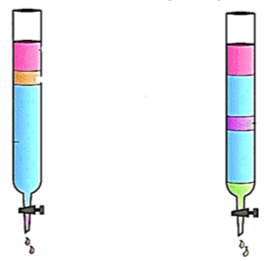
1. Which adsorbent is used in adsorption chromatography?
2. How do you visualize colourless compounds after separation in Paper Chromatography?
3. Why paper chromatography is a type of partition chromatography?
OR
Which chromatography is shown in following image?
Answer
View full question & answer→1. In column chromatography adsorbent is silica gel or alumina while in paper chromatography adsorbent is cellulose.
2. In paper chromatography the spots of the separated colourless components may be observed either under ultra-violet light or by the use of an appropriate spraying agent.
3. Partition chromatography is based on continuous differential partitioning of components of a mixture between stationary and mobile phases as doner in paper chromatography.
OR
Column chromatography.
2. In paper chromatography the spots of the separated colourless components may be observed either under ultra-violet light or by the use of an appropriate spraying agent.
3. Partition chromatography is based on continuous differential partitioning of components of a mixture between stationary and mobile phases as doner in paper chromatography.
OR
Column chromatography.