Question
Chromatography is an important technique extensively used to separate mixtures into their components, purify compounds and also test the purity of compounds. Based on the principle involved, chromatography is classified into different categories. Two of these are Adsorption chromatography and Partition chromatography. Two main types of chromatographic techniques are based on the principle of differential adsorption column chromatography, and thin-layer chromatography. Adsorption chromatography is based on the fact that different compounds are adsorbed on an adsorbent to different degrees. Column chromatography involves the separation of a mixture over a column of adsorbent (stationary phase) packed in a glass tube. Thin-layer chromatography (TLC) is another type of adsorption chromatography, which involves the separation of substances of a mixture over a thin layer of an adsorbent coated on a glass plate. Partition chromatography is based on the continuous differential partitioning of components of a mixture between stationary and mobile phases.

1. Which adsorbent is used in adsorption chromatography?
2. How do you visualize colourless compounds after separation in Paper Chromatography?
3. Why paper chromatography is a type of partition chromatography?
OR
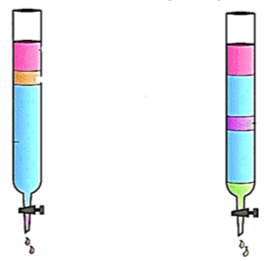
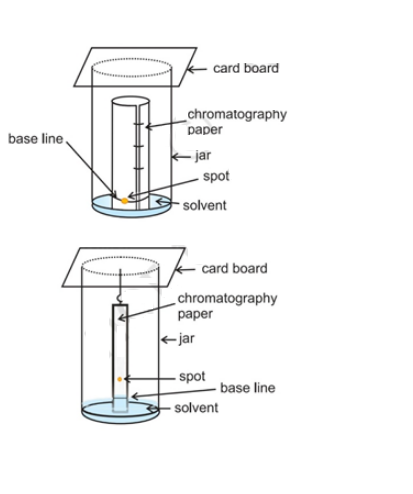
Which chromatography is shown in following image?
Image

Answer

1. In column chromatography adsorbent is silica gel or alumina while in paper chromatography adsorbent is cellulose.
2. In paper chromatography the spots of the separated colourless components may be observed either under ultra-violet light or by the use of an appropriate spraying agent.
3. Partition chromatography is based on continuous differential partitioning of components of a mixture between stationary and mobile phases as doner in paper chromatography.
OR
Column chromatography.

Need a full question paper?

Generate a complete, print-ready paper with questions like this in minutes — across 16+ boards, with answer keys.

Start Generating Free

Similar questions

Read the passage given below and answer the following questions from 1 to 5.
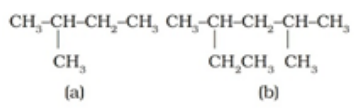
Branched chain hydrocarbons: In a branched chain compound small chains of carbon atoms are attached at one or more carbon atoms of the parent chain. The small carbon chains (branches) are called alkyl groups. For example:

In order to name such compounds, the names of alkyl groups are prefixed to the name of parent alkane. An alkyl group is derived from a saturated hydrocarbon by removing a hydrogen atom from carbon. Thus, CH4 becomes – CH3 and is called methyl group. An alkyl group is named by substituting ‘yl’ for ‘ane’ in the corresponding alkane. Some alkyl groups are listed in Table

AlkaneAlkyl Group
Molecular formulaName of alkaneStructural formulaName of alkyl group
CH4Methane-CH3Methyl
C2H6Ethane-CH2CH3Ethyl
C3H8Propane-CH2CH2CH3Propyl
C4H10Butane-CH2CH2CH2CH3Butyl
C10H22Decane-CH2(CH2)8CH3Decyl

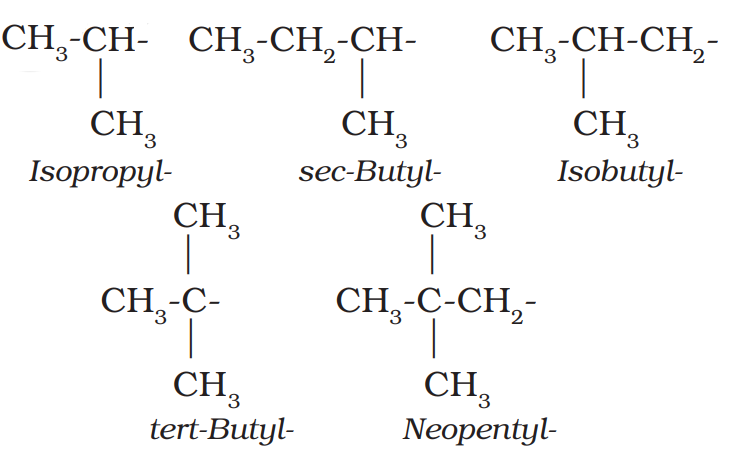
Abbreviations are used for some alkyl groups. For example, methyl is abbreviated as Me, ethyl as Et, propyl as Pr and butyl as Bu. The alkyl groups can be branched also. Thus, propyl and butyl groups can have branched structures as shown below .

Common branched groups have specific trivial names. For example, the propyl groups can either be n-propyl group or isopropyl group. The branched butyl groups are called sec- butyl, isobutyl and tert-butyl group. We also encounter the structural unit, – CH2C(CH3)3, which is called neopentyl group.

For Nomenclature of branched chain alkanes ,longest carbon chain in the molecule is identified. The numbering is done in such a way that the branched carbon atoms get the lowest possible numbers. lower number is given to the one coming first in the alphabetical listing. Carbon atom of  the branch that attaches to the root  alkane. in alphabetical order, the prefixes iso- and neo- are considered to be the part of the fundamental name of alkyl group. The prefixes sec- and tert- are not considered to be the part of the fundamental name.

Cyclic Compounds: A saturated monocyclic compound is named by prefixing ‘cyclo’ to the corresponding straight chain alkane. If side chains are present, then the rules given above are applied. Names of some cyclic compounds are given below.

The phenomenon of existence of two or more compounds possessing the same molecular formula but different properties is known as isomerism. Such compounds are called as isomers. The following flow chart shows different types of isomerism.

Structural Isomerism Compounds having the same molecular formula but different structures (manners in which atoms are linked) are classified as structural isomers. Some typical examples of different types of structural isomerism are given below:

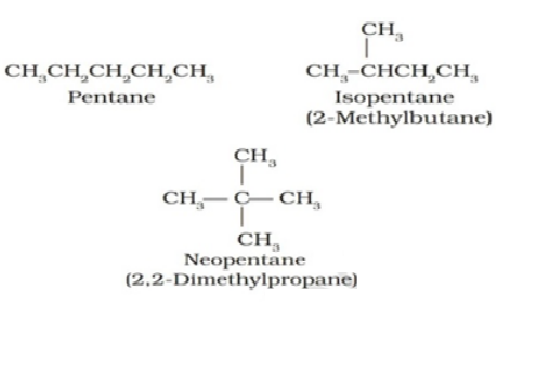
(i) Chain isomerism: When two or more compounds have similar molecular formula but different carbon skeletons, these are referred to as chain isomers and the phenomenon is termed as chain isomerism. For example, C5H12 represents three compounds:

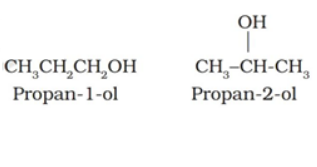
(ii) Position isomerism: When two or more compounds differ in the position of substituent atom or functional group on the carbon skeleton, they are called position isomers and this phenomenon is termed as position isomerism. For example, the molecular formula C3H8O represents two alcohols:

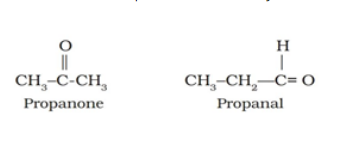
(iii) Functional group isomerism: Two or more compounds having the same molecular formula but different functional groups are called functional isomers and this phenomenon is termed as functional group isomerism. For example, the molecular formula C3H6O represents an aldehyde and a ketone:

(iv) Metamerism: It arises due to different alkyl chains on either side of the functional group in the molecule. For example, C4H10O represents methoxy propane (CH3OC3H7) and ethoxyethane (C2H5OC2H5).

Stereoisomerism The compounds that have the same constitution and sequence of covalent bonds but differ in relative positions of their atoms or groups in space are called stereoisomers. This special type of isomerism is called as stereoisomerism and can be classified as geometrical and optical isomerism.

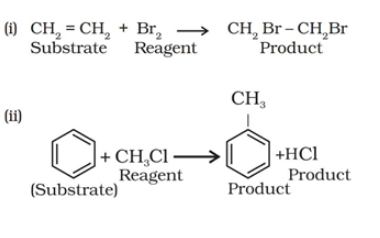
Substrate and Reagent Ions are generally not formed in the reactions of organic compounds. Molecules as such participate in the reaction. It is convenient to name one reagent as substrate and other as reagent. In general, a molecule whose carbon is involved in new bond formation is called substrate and the other one is called reagent. When carbon-carbon bond is formed, the choice of naming the reactants as substrate and reagent is arbitrary and depends on molecule under observation. Example:

  1. CH4 becomes – CH3,  is called … group.
  1. methyl
  2. ethyl
  3. propyl
  4. butyl
  1. For the Nomenclature of branched chain alkanes  …. carbon chain in the molecule is identified.
  1. shortest
  2. longest
  3. smallest
  4. none of above
  1. when two or more compounds possessing the same molecular formula but different properties is known as ….
  1. Allotrops
  2. Isotops
  3. Isomers
  4. Isobars
  1. For the Nomenclature of branched chain alkanes, the numbering is done in such a way that the branched carbon atoms get the … possible numbers.
  1. biggest
  2. Lower
  3. Highest
  4. lowest
  1. Which of the following is not an example of isomerisim?
  1. Functional
  2. Positional
  3. Chain
  4. Preconditional
Once an organic compound is extracted from a natural source or synthesised in the laboratory, it is essential to purify it. Various methods used for the purification of organic compounds are based on the nature of the compound and the impurity present in it. Finally, the purity of a compound is ascertained by determining its melting or boiling point. This is one of the most commonly used techniques for the purification of solid organic compounds. In crystallisation Impurities, which impart colour to the solution are removed by adsorbing over activated charcoal. In distillation Liquids having different boiling points vaporise at different temperatures. The vapours are cooled and the liquids so formed are collected separately. Steam Distillation is applied to separate substances which are steam volatile and are immiscible with water. Distillation under reduced pressure: This method is used to purify liquids having very high boiling points.

1. Which method can be used to separate two compounds with different solubilities in a solvent?
OR
Why chloroform and aniline are easily separated by the technique of distillation?
2. Distillation method is used to separate which type of substance?
3. Which technique is used to separate aniline from aniline water mixture?
The phenomenon of the existence of two or more compounds possessing the same molecular formula but different properties is known as isomerism. Such compounds are called isomers. Compounds having the same molecular formula but different structures (manners in which atoms are linked) are classified as structural isomers. Structural isomers are classified as chain isomer, position isomer, functional group isomer. Meristematic arises due to different alkyl chains on either side of the functional group in the molecule and stereoisomerism and can be classified as geometrical and optical isomerism. Hyperconjugation is a general stabilising interaction. It involves delocalisation of $\sigma$ electrons of the C-H bond of an alkyl group directly attached to an atom of an unsaturated system or to an atom with an unshared p orbital. This type of overlap stabilises the carbocation because electron density from the adjacent $\sigma$ bond helps in dispersing the positive charge.

1. Why Isopentane, pentane and Neopentane are chain isomers?
OR
Why hyperconjugation is a permanent effect?
2. The molecular formula $C _3 H _8 O$ represents which isomer?
3. What type of isomerism is shown by Methoxypropane and ethoxyethane?
We must bear in mind that when Mendeleev developed his Periodic Table, chemists knew nothing about the internal structure of atom. However, the beginning of the 20th century witnessed profound developments in theories about sub-atomic particles. In 1913, the English physicist, Henry Moseley observed regularities in the characteristic X-ray spectra of the elements. A plot of ν (whereν is frequency of X-rays emitted) against atomic number (Z ) gave a straight line and not the plot of ν vs atomic mass. He thereby showed that the atomic number is a more fundamental property of an element than its atomic mass. Mendeleev’s Periodic Law was, therefore, accordingly modified. This is known as the Modern Periodic Law and can be stated as : The physical and chemical properties of the elements are periodic functions of their atomic numbers.Numerous forms of Periodic Table have been devised from time to time. Some forms emphasise chemical reactions and valence, whereas others stress the electronic configuration of elements. A modern version, the so-called “long form” of the Periodic Table of the elements , is the most convenient and widely used. The horizontal rows (which Mendeleev called series) are called periods and the vertical columns, groups. Elements having similar outer electronic configurations in their atoms are arranged in vertical columns, referred to as groups or families. According to the recommendation of International Union of Pure and Applied Chemistry (IUPAC), the groups are numbered from 1 to 18 replacing the older notation of groups IA … VIIA, VIII, IB … VIIB and 0. There are altogether seven periods. The period number corresponds to the highest principal quantum number (n) of the elements in the period. The first period contains 2 elements. The subsequent periods consists of 8, 8, 18, 18 and 32 elements, respectively. The seventh period is incomplete and like the sixth period would have a theoretical maximum (on the basis of quantum numbers) of 32 elements. In this form of the Periodic Table, 14 elements of both sixth and seventh periods (lanthanoids and actinoids, respectively) are placed in separate panels at the bottom. the IUPAC has made recommendation that until a new element’s discovery is proved, and its name is officially recognised, a systematic nomenclature be derived directly from the atomic number of the element using the numerical roots for 0 and numbers 1-9. The roots are put together in order of digits which make up the atomic number and “ium” is added at the end.Groupwise Electronic Configurations Elements in the same vertical column or group have similar valence shell electronic configurations, the same number of electrons in the outer orbitals, and similar properties. theoretical foundation for the periodic classification. The elements in a vertical column of the Periodic Table constitute a group or family and exhibit similar chemical behaviour. This similarity arises because these elements have the same number and same distribution of electrons in their outermost orbitals. We can classify the elements into four blocks viz., s-block, p-block, d-block and f-block depending on the type of atomic orbitals that are being filled with electrons. Two exceptions to this categorisation. Strictly, helium belongs to the s-block but its positioning in the p-block along with other group 18 elements is justified because it has a completely filled valence shell (1s) and as a result, exhibits properties characteristic of other noble gases. The other exception is hydrogen. It has only one s-electron and hence can be placed in group 1 (alkali metals). It can also gain an electron to achieve a noble gas arrangement and hence it can behave similar to a group 17 (halogen family) elements. Because it is a special case, we shall place hydrogen separately at the top of the Periodic Table.
  1. In 1913, the English physicist, ….observed regularities in the characteristic X-ray spectra of the elements.
  1. Johann Dobereiner
  2. John Alexander Newlands
  3. Demitri Mendeleev
  4. Henry Moseley
  1. Horizontal row in periodic table called:
  1. Group
  2. Period
  3. Triad
  4. Octave
  1. Vertical Column in periodic table called:
  1. Group
  2. Period
  3. Triad
  4. Octave
  1. According to Modern Periodic Law the physical and chemical properties of the elements are periodic functions of their ….
  1. Atomic mass
  2. Atomic numbers
  3. Atomic structure
  4. Atomic size
  1. What is IUPAC name of element having atomic number 107.
  1. Unnilpentium
  2. Unnilhexium
  3. Unnilseptium
  4. Unniloctium

Read the passage given below and answer the following questions from 1 to 5.

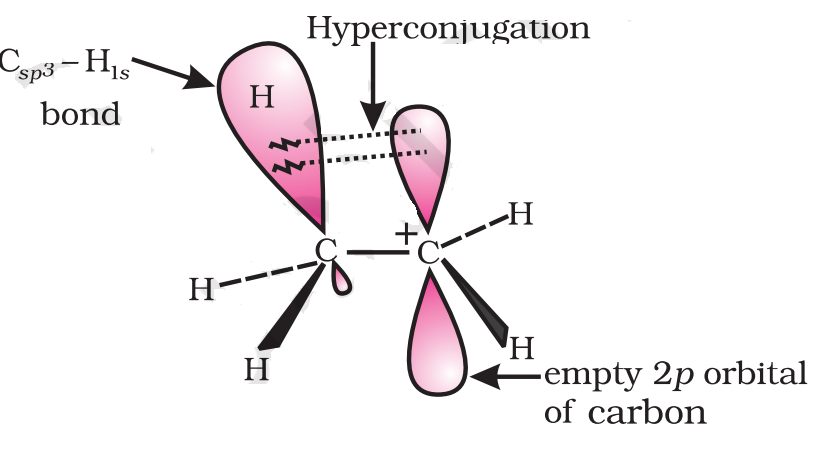
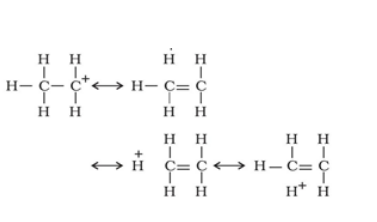
Hyperconjugation is a general stabilising interaction. It involves delocalisation of σ electrons of C—H bond of an alkyl group directly attached to an atom of unsaturated system or to an atom with an unshared p orbital. The σ electrons of C—H bond of the alkyl group enter into partial conjugation with the attached unsaturated system or with the unshared p orbital. Hyperconjugation is a permanent effect. To understand hyperconjugation effect, let us take an example of CH 32 + (ethyl cation) in which the positively charged carbon atom has an empty p orbital. One of the C-H bonds of the methyl group can align in the plane of this empty p orbital and the electrons constituting the C-H bond in plane with this p orbital can then be delocalised into the empty p orbital as depicted in Figure.

This type of overlap stabilises the carbocation because electron density from the adjacent σ bond helps in dispersing the positive charge.

In general, greater the number of alkyl groups attached to a positively charged carbon atom, the greater is the hyperconjugation interaction and stabilisation of the cation. Thus, we have the following relative stability of carbocations:

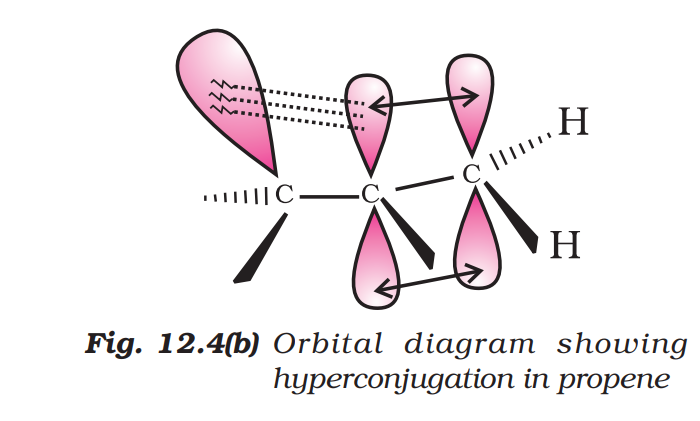
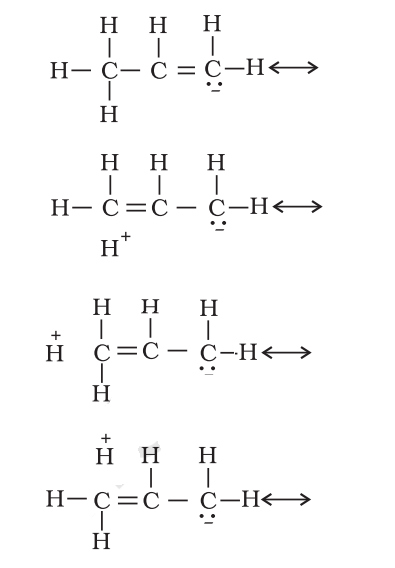
Hyperconjugation is also possible in alkenes and alkylarenes. Delocalisation of electrons by hyperconjugation in the case of alkene can be depicted as in Figure.

There are various ways of looking at the hyperconjugative effect. One of the way is to regard C—H bond as possessing partial ionic character due to resonance.

The hyperconjugation may also be regarded as no bond resonance.

The hyperconjugation may also be regarded as no bond resonance.

Methods of purification of organic compounds Once an organic compound is extracted from a natural source or synthesised in the laboratory, it is essential to purify it. Various methods used for the purification of organic compounds are based on the nature of the compound and the impurity present in it. The common techniques used for purification are as follows :

i) Sublimation

ii) Crystallisation

iii) Distillation

iv) Differential extraction and

v) Chromatography

Finally, the purity of a compound is ascertained by determining its melting or boiling point. Most of the pure compounds have sharp melting points and boiling points. New methods of checking the purity of an organic compound are based on different types of chromatographic and spectroscopic techniques.

Sublimation  On heating, some solid substances change from solid to vapour state without passing through liquid state. The purification technique based on the above principle is known as sublimation and is used to separate sublimable compounds from non- sublimable impurities.

Crystallisation This is one of the most commonly used techniques for the purification of solid organic compounds. It is based on the difference in the solubilities of the compound and the impurities in a suitable solvent. The impure compound is dissolved in a solvent in which it is sparingly soluble at room temperature but appreciably soluble at higher temperature. The solution is concentrated to get a nearly saturated solution. On cooling the solution, pure compound crystallises out and is removed by filtration. The filtrate (mother liquor) contains impurities and small quantity of the compound. If the compound is highly soluble in one solvent and very little soluble in another solvent, crystallisation can be satisfactorily carried out in a mixture of these solvents. Impurities, which impart colour to the solution are removed by adsorbing over activated charcoal. Repeated crystallisation becomes necessary for the purification of compounds containing impurities of comparable solubilities.


Distillation This important method is used to separate

i) volatile liquids from nonvolatile impurities and

ii) the liquids having sufficient difference in their boiling points.

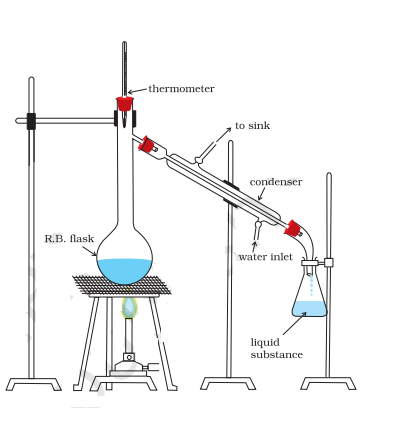
Liquids having different boiling points vaporise at different temperatures. The vapours are cooled and the liquids so formed are collected separately. Chloroform (b.p 334 K) and aniline (b.p. 457 K) are easily separated by the technique of distillation (Fig 12.5). The liquid mixture is taken in a round bottom flask and heated carefully. On boiling, the vapours of lower boiling component are formed first. The vapours are condensed by using a condenser and the liquid is collected in a receiver. The vapours of higher boiling component form later and the liquid can be collected separately.

Partition Chromatography: Partition chromatography is based on continuous differential partitioning of components of a mixture between stationary and mobile phases. Paper chromatography is a type of partition chromatography. In paper chromatography, a special quality paper known as chromatography paper is used. Chromatography paper contains water trapped in it, which acts as the stationary phase. A strip of chromatography paper spotted at the base with the solution of the mixture is suspended in a suitable solvent or a mixture of solvents (Fig. 12.13). This solvent acts as the mobile phase. The solvent rises up the paper by capillary action and flows over the spot. The paper selectively retains different components according to their differing partition in the two phases. The paper strip so developed is known as a chromatogram. The spots of the separated coloured compounds are visible at different heights from the position of initial spot on the chromatogram. The spots of the separated colourless compounds may be observed either under ultraviolet light or by the use of an appropriate spray reagent as discussed under thin layer chromatography.

  1. Hyperconjunction  involves delocalisation of … electrons of C—H bond of an alkyl group directly attached to an atom of unsaturated system or to an atom with an unshared p orbital.
  1. $\sigma$
  2. $\pi$
  3. $\delta$
  4. $\eta$
  1. Which of the is an example of technique used for purification.
  1. Distillation
  2. Differential extraction
  3. Chromatography
  4. All the above
  1. On heating, some solid substances change from solid to vapour state without passing through liquid state is known as …
  1. Melting
  2. Boiling
  3. Sublimation
  4. Condensation
  1. The hyperconjugation may also be regarded as ….
  1. bonding resonance
  2. no bond resonance
  3. no bond induction
  4. bonding induction
  1. Chromatography paper contains water trapped in it, which acts as the … phase.
  1. mobile
  2. stationery
  3. Secondary
  4. quaternary
When anions and cations approach each other, the valence shell of anions are pulled towards the cation nucleus and thus, the shape of the anion is deformed. The phenomenon of deformation of anion by a cation is known as polarization and the ability of the cation to polarize the anion is called as polarizing power of cation. Due to polarization, sharing of electrons occurs between two ions to some extent and the bond shows some covalent character.
The magnitude of polarization depends upon a number of factors.

1. Out of $AlCl _3$ and $AlI _3$ which halides show maximum polarization?
2. Out of $AlCl _3$ and $CaCl _2$ which one is more covalent in nature?
3. The non-aqueous solvent like ether is added to the mixture of $LiCl , NaCl$ and KCl . Which will be extracted into the ether?
OR
Out of $CaF _2$ and $CaI _2$ which one has a minimum melting point?
Read the passage given below and answer the following questions from 1 to 5.

Chemistry deals with varieties of matter and change of one kind of matter into the other. Transformation of matter from one kind into another occurs through the various types of reactions. One important category of such reactions is Redox Reactions. Originally, the term oxidation was used to describe the addition of oxygen to an element or a compound. Because of the presence of dioxygen in the atmosphere (~20%), many elements combine with it and this is the principal reason why they commonly occur on the earth in the form of their oxides. The following reactions represent oxidation processes:

$2\text{Mg}(\text{s})\rightarrow2\text{MgO}\text{ (S)}$

$\text{S}(\text{s})+\text{O}_2(\text{g})\rightarrow\text{SO}_2\text{ g}$

the term “oxidation” is defined as the addition of oxygen/electronegative element to a substance or removal of hydrogen/ electropositive element from a substance. In the beginning, reduction was considered as removal of oxygen from a compound. However, the term reduction has been broadened these days to include removal of oxygen/electronegative element from a substance or addition of hydrogen/ electropositive element to a substance. According to the definition given above, the following are the examples of reduction processes:

$2\text{HgO}\text{S}\xrightarrow{\triangle}2\text{ Hg}(1)+\text{O}_2(\text{g})$

$2\text{HgCl}_2(\text{aq})+\text{SnCl}_2(\text{aq})\rightarrow\text{Hg}_2\text{Cl}_2(\text{s})+\text{SnCl}_4(\text{aq})$

In reaction simultaneous oxidation of stannous chloride to stannic chloride is also occurring because of the addition of electronegative element chlorine to it. It was soon realised that oxidation and reduction always occur simultaneously (as will be apparent by re-examining all the equations given above), hence, the word “redox” was coined for this class of chemical reactions.

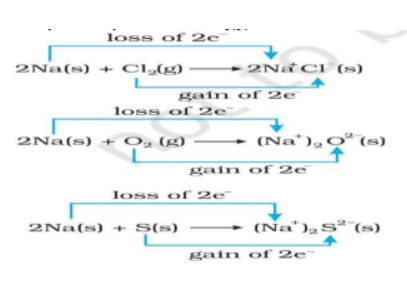
The reactions:

$2\text{Na}(\text{s})+\text{Cl2}\text{g}\rightarrow2\text{NaCl}(\text{s})$

$4\text{Na}(\text{s})+\text{O}_2\text{g}\rightarrow2\text{Na}_2\text{o}(\text{s})$

$2\text{Na}(\text{s})+\text{S}\text{(s)}\rightarrow2\text{Na}_2\text{S}(\text{s})$

are redox reactions because in each of these reactions sodium is oxidised due to the addition of either oxygen or more electronegative element to sodium. Simultaneously, chlorine, oxygen and sulphur are reduced because to each of these, the electropositive element sodium has been added. From our knowledge of chemical bonding we also know that sodium chloride, sodium oxide and sodium sulphide are ionic compounds and perhaps better written as Na+ Cl–(s), (Na+)2 O2–(s), and (Na+)2 S2 (s). Development of charges on the species produced suggests us to rewrite the reactions in the following manner:

For convenience, each of the above processes can be considered as two separate steps, one involving the loss of electrons and the other the gain of electrons. As an illustration, we may further elaborate one of these, say, the formation of sodium chloride.

$2\text{Na}(\text{s})\rightarrow2\text{Na}^+\text{g}+2\bar{\text{e}}$

$\text{Cl}_2\text{g}+2\bar{\text{e}}\rightarrow2\text{C}\bar{\text{I}}\text{ (g)}$

Each of the above steps is called a half reaction, which explicitly shows involvement of electrons. Sum of the half reactions gives the overall reaction

$2\text{Na}(\text{s})+\text{Cl}_2\text{(g)}\rightarrow2\text{Na}^+\text{CI}(\text{s})\text{ or } 2\text{NaCI}(\text{s})$

Above Reactions suggest that half reactions that involve loss of electrons are called oxidation reactions. Similarly, the half reactions that involve gain of electrons are called reduction reactions. To summarise, we may mention that

Oxidation: Loss of electron(s) by any species.

Reduction: Gain of electron(s) by any species.

Oxidising agent: Acceptor of electron(s).

Reducing agent: Donor of electron(s).

  1. Addition of electronegative element to a substance is known as..
  1. Oxidation
  2. Reduction
  3. Redox reaction
  4. All the above
  1. Removal of electronegative element to a substance is known as ..
  1. Oxidation
  2. Reduction
  3. Redox reaction
  4. All the above
  1. Acceptor of electrons is …
  1. Reducing Agent
  2. Catalytic Agent
  3. Oxidising Agent
  4. None of above
  1. Donor of electrons is…
  1. Organic Agent
  2. Catalytic Agent
  3. Oxidising Agent
  4. Reducing Agent
  1. Oxidation and Reduction occurs simultaneously is known as …
  1. Exothermic reaction
  2. Endothermic reaction
  3. Redox reaction
  4. Neutralization reaction


Lewis dot structures, in general, do notrepresent the actual shapes of the molecules.In case of polyatomic ions, the net charge ispossessed by the ion as a whole and not by aparticular atom. It is, however, feasible toassign a formal charge on each atom. Theformal charge of an atom in a polyatomicmolecule or ion may be defined as thedifference between the number of valenceelectrons of that atom in an isolated or freestate and the number of electrons assignedto that atom in the Lewis structure. It isexpressed as :Generally the lowest energystructure is the one with the smallestformal charges on the atoms. The formalcharge is a factor based on a pure covalentview of bonding in which electron pairsare shared equally by neighbouring atoms. The octet rule, though useful, is not universal.It is quite useful for understanding thestructures of most of the organic compoundsand it applies mainly to the second periodelements of the periodic table. There are threetypes of exceptions to the octet rule.

  • The incomplete octet of the central atom
  • Odd-electron molecules
  • The expanded octetFrom the Kössel and Lewis treatment of theformation of an ionic bond, it follows that theformation of ionic compounds wouldprimarily depend upon:
  • The ease of formation of the positive andnegative ions from the respective neutralatoms;
  • The arrangement of the positive andnegative ions in the solid, that is, thelattice of the crystalline compound.

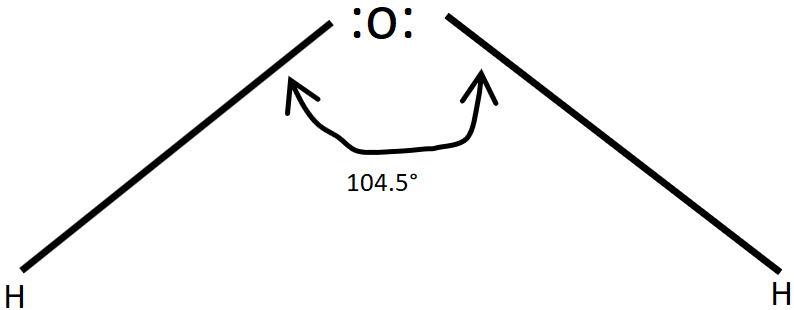
The Lattice Enthalpy of an ionic solid is defined as the energy required to completely separate one mole of a solid ionic compound into gaseous constituent ions. For example, the lattice enthalpy of NaCl is 788 kJ mol–1. This means that 788 kJ of energy is required to separate one mole of solid NaCl into one mole of Na+  (g) and one mole of Cl– (g) to an infinite distance.Bond length is defined as the equilibriumdistance between the nuclei of two bondedatoms in a molecule. Bond lengths aremeasured by spectroscopic, X-ray diffractionand electron-diffraction techniques . The covalent radius is measuredapproximately as the radius of an atom’score which is in contact with the core ofan adjacent atom in a bonded situation.  The vander Waals radius represents the overall sizeof the atom which includes its valence shellin a nonbonded situation.  Bond Angle is defined as the angle between the orbitalscontaining bonding electron pairs around thecentral atom in a molecule/complex ion. Bondangle is expressed in degree which can beexperimentally determined by spectroscopicmethods. It gives some idea regarding thedistribution of orbitals around the centralatom in a molecule/complex ion and hence ithelps us in determining its shape. Forexample H–O–H bond angle in water can berepresented as under:

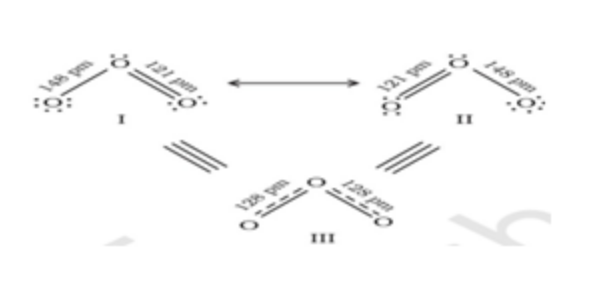
Bond Enthalpy It is defined as the amount of energy required to break one mole of bonds of a particular type between two atoms in a gaseous state. The unit of bond enthalpy is kJ mol–1. For example, the H–H bond enthalpy in hydrogen molecule is 435.8 kJ mol–1 . H2 (g) → H(g) + H(g); ∆aH  = 435.8 kJ mol–1. Bond OrderIn the Lewis description of covalent bond,the Bond Order is given by the number ofbonds between the two atoms in amolecule. The bond order, for example in H2(with a single shared electron pair), in O2(with two shared electron pairs) and in N2(with three shared electron pairs) is 1,2,3respectively. A general correlation useful forunderstanding the stablities of moleculesis that: with increase in bond order, bondenthalpy increases and bond lengthdecreases. The concept of resonance was introducedto deal with the type of difficulty experiencedin the depiction of accurate structures ofmolecules like O3. According to the conceptof resonance, whenever a single Lewis structure cannot describe a moleculeaccurately, a number of structures with similar energy, positions of nuclei, bonding and non-bonding pairs of electrons are taken as the canonical structures of the hybrid which describes the molecule accurately.

Thus for O3, the two structures shown above constitute the canonical structures or resonance structures and their hybrid i.e., theIII structure represents the structure of O3more accurately. This is also called resonance hybrid. Resonance is represented by a double headed arrow. In general, it may be stated that

  • Resonance stabilizes the molecule as the energy of the resonance hybrid is lessthan the energy of any single cannonical structure; and,
  • Resonance averages the bond characteristics as a whole. Thus the energy of theO3resonancehybrid is lower than either of the two cannonical froms I and II.
  1. Which of the following techniques used to measure bond length?
  1. Spectroscopic techniques
  2. X-ray diffraction
  3. Electron-diffraction techniques
  4. All the above
  1. The unit of bond enthalpy is …
  1. kJ mol–1
  2. Cal mol-1
  3. Cal mol
  4.  kJ mol
  1. With increase in bond order, bond enthalpy… and bond length ….
  1. Decreases, decreases
  2. Increases, decreases
  3. Increases, increases
  4. Decreases, increases
  1. The …. is measured approximately as the radius of an atom’s core which is in contact with the core of an adjacent atom in a bonded situation.
  1. Ionic radius
  2. Metallic radius
  3. Covalent radius
  4. None of above
  1. … is given by the number of bonds between the two atoms in a molecule.
  1. Bond Order
  2. Bond size
  3. Bond enthalpy
  4. Bond angle
The phenomenon of the existence of two or more compounds possessing the same molecular formula but different properties is known as isomerism. Such compounds are called isomers. Compounds having the same molecular formula but different structures (manners in which atoms are linked) are classified as structural isomers. Structural isomers are classified as chain isomer, position isomer, functional group isomer. Meristematic arises due to different alkyl chains on either side of the functional group in the molecule and stereoisomerism and can be classified as geometrical and optical isomerism. Hyperconjugation is a general stabilising interaction. It involves delocalisation of $\sigma$ electrons of the C-H bond of an alkyl group directly attached to an atom of an unsaturated system or to an atom with an unshared p orbital. This type of overlap stabilises the carbocation because electron density from the adjacent $\sigma$ bond helps in dispersing the positive charge.

1. Why Isopentane, pentane and Neopentane are chain isomers?
2. The molecular formula $C _3 H _8 O$ represents which isomer?
3. What type of isomerism is shown by Methoxypropane and ethoxyethane?
OR
Why hyperconjugation is a permanent effect?

Read the passage given below and answer the following questions from 1 to 5.

Alkanes are generally inert towards acids, bases, oxidising and reducing agents. However, they undergo the following reactions under certain conditions.

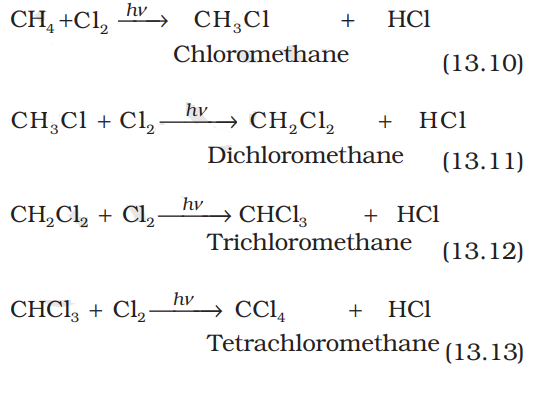
1) Substitution reactions One or more hydrogen atoms of alkanes can be replaced by halogens, nitro group and sulphonic acid group. Halogenation takes place either at higher temperature (573-773K) or in the presence of diffused sunlight or ultraviolet light. Lower alkanes do not undergo nitration and sulphonation reactions. These reactions in which hydrogen atoms of alkanes are substituted are known as substitution reactions. As an example, chlorination of methane is given below: Halogenation

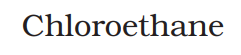
$\text{CH}_3-\text{CH}_3+\text{CL}_2\xrightarrow{\text{hv}}\text{CH}_3-\text{CH}_2\text{Cl}+\text{HCl}$
It is found that the rate of reaction of alkanes with halogens is F2 > Cl2 > Br2 > I2. Rate of replacement of hydrogens of alkanes is: 3° > 2° > 1°. Fluorination is too violent to be controlled. Iodination is very slow and a reversible reaction. It can be carried out in the presence of oxidizing agents like HIO3 or HNO3.

$\text{CH}_4+\text{I}_2\rightleftharpoons\text{CH}_3\text{I}+\text{HI}$

$\text{HIO}_3+5\text{HI}\rightarrow3\text{I}_2+3\text{H}_2\text{O}$

Halogenation is supposed to proceed via free radical chain mechanism involving three steps namely initiation, propagation and termination.
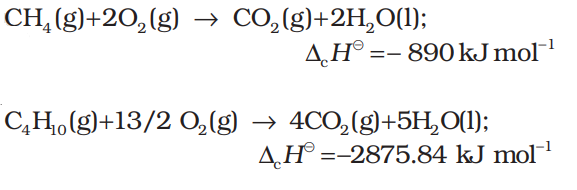
The General combustion equation for any alkane is:

$\text{C}_\text{n}\text{H}_{2\text{n}+2}+\Bigg(\frac{3\text{n}+1}{2}\Bigg)\text{O}_2\rightarrow\text{nCO}_2+(\text{n}+1)\text{H}_2\text{O}$

Combustion
Alkanes on heating in the presence of air or dioxygen are completely oxidized to carbon dioxide and water with the evolution of large amount of heat.

Due to the evolution of large amount of heat during combustion, alkanes are used as fuels. During incomplete combustion of alkanes with insufficient amount of air or dioxygen, carbon black is formed which is used in the manufacture of ink, printer ink, black pigments and as filters.
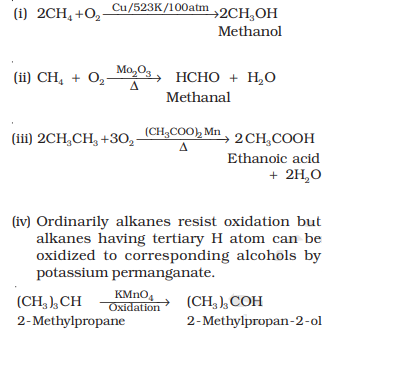
Controlled oxidation Alkanes on heating with a regulated supply of dioxygen or air at high pressure and in the presence of suitable catalysts give a variety of oxidation products.

Ordinarily alkanes resist oxidation but alkanes having tertiary H atom can be oxidized to corresponding alcohols by potassium permanganate .

Pyrolysis Higher alkanes on heating to higher temperature decompose into lower alkanes, alkenes etc. Such a decomposition reaction into smaller fragments by the application of heat is called pyrolysis or cracking.
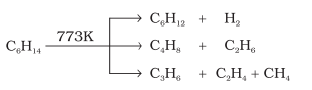
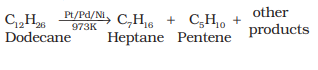
Pyrolysis of alkanes is believed to be a free radical reaction. Preparation of oil gas or petrol gas from kerosene oil or petrol involves the principle of pyrolysis. For example, dodecane, a constituent of kerosene oil on heating to 973K in the presence of platinum, palladium or nickel gives a mixture of heptane and pentene.
Conformations- Alkanes contain carbon-carbon sigma $(\sigma)$bonds. Electron distribution of the sigma molecular orbital is symmetrical around the internuclear axis of the C–C bond which is not disturbed due to rotation about its axis. This permits free rotation about C–C single bond. This rotation results into different spatial arrangements of atoms in space which can change into one another. Such spatial arrangements of atoms which can be converted into one another by rotation around a C-C single bond are called conformations or conformers or rotamers. Alkanes can thus have infinite number of conformations by rotation around C-C single bonds. However, it may be remembered that rotation around a C-C single bond is not completely free. It is hindered by a small energy barrier of 1-20 kJ mol–1 due to weak repulsive interaction between the adjacent bonds. Such a type of repulsive interaction is called torsional strain. Conformations of ethane : Ethane molecule (C2H6) contains a carbon – carbon single bond with each carbon atom attached to three hydrogen atoms. Considering the ball and stick model of ethane, keep one carbon atom stationary and rotate the other carbon atom around the C-C axis. This rotation results into infinite number of spatial arrangements of hydrogen atoms attached to one carbon atom with respect to the hydrogen atoms attached to the other carbon atom. These are called conformational isomers (conformers). Thus there are infinite number of conformations of ethane. However, there are two extreme cases. One such conformation in which hydrogen atoms attached to two carbons are as closed together as possible is called eclipsed conformation and the other in which hydrogens are as far apart as possible is known as the staggered conformation. Any other intermediate conformation is called a skew conformation. It may be remembered that in all the conformations, the bond angles and the bond lengths remain the same. Eclipsed and the staggered conformations can be represented by Sawhorse and Newman projections.

  1. Alkanes contain carbon-carbon … bonds.
  1. sigma $\sigma$
  2. pi bond$\pi$
  3. delta$\delta$
  4. eta $\eta$
  1. C-C single bond is hindered by a small energy barrier of…. kJ mol–1
  1. 10 - 200
  2. 1 - 20
  3. 100 - 427
  4. 342 - 786
  1. A decomposition reaction into smaller fragments by the application of heat is called as ….
  1. pyrolysis
  2. cracking
  3. both (a) & (b)
  4. combustion
  1. Which of the following steps are involving in free radical chain mechanism
  1. initiation
  2. propagation
  3. termination
  4. All the above
  1. The … reaction in which alkanes on heating in the presence of air or dioxygen are completely oxidized to carbon dioxide and water with the evolution of large amount of heat.
  1. pyrolysis
  2. cracking
  3. both (a) & (b)
  4. combustion