Questions

2 Marks Questions

Take a timed test

6 questions · self-marked practice — reveal the answer and mark yourself.

Question 12 Marks
The uncertainty in the position of a moving bullet of mass 10 g is $\Delta x m \Delta v =\frac{ h }{4 \pi}$. Calculate the uncertainty in its velocity?
Answer
According to the uncertainty principle,
$\Delta x . m \Delta v =\frac{ h }{4 \pi}$ or $\Delta v =\frac{h}{4 \pi m \Delta x} h=6.625 \times 10^{-34} kg m ^2 s^{-1} m=10 g=10^{-2} K$
$
\Delta x=10^{-5} m ; \Delta v=\frac{\left(6.626 \times 10^{-34} kgm^2 s^{-1}\right)}{4 \times 3.143 \times\left(10^{-2} kg\right) \times\left(10^{-5} m\right)}=5.27 \times 10^{-28} mv
$
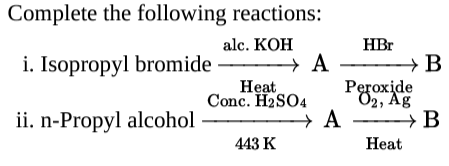
View full question & answer
Question 22 Marks
Define resonance energy. What is resonance energy of benzene?
Answer
Resonance energy is the difference in energy between actual structure of compound and most stable resonating structure. The resonance energy of benzene is $150.325 j mol ^{-1}$
View full question & answer
Question 42 Marks
Calculate: Mass of 2.5 gram atoms of magnesium,
Answer
Since one gram atom of Mg represents a quantity = Atomic mass of Mg (ie. 24 gms.)
1 gram atom of $Mg =24 g$
2.5-gram atoms of $Mg =24 \times 2.5=60 g$
View full question & answer
Question 52 Marks
How does the reactivity of non–metals changes in a period and group?
Answer
The reactivity of non - metals is measured in terms of its tendency to gain electrons to form an ion. The reactivity of non - metals increases from left to right in a period because of increase in nuclear charge due to succesive addition of electron in same shell whereas reactivity decreases in a group as we go down the group because of increase in atomic size and decrease in nuclear charge. Therefore, the tendency to accept electrons decreases down the group.
View full question & answer
Question 62 Marks
Classify the following species into Lewis acids and Lewis bases and show how these act as Lewis acid/base:
a. $OH ^{-}$
b. $F ^{-}$
c. $H ^{+}$
d. $BCl _3$
Answer
a. Hydroxyl ion $\left( OH ^{-}\right)$acts as a Lewis base as it can donate an electron lone pair.
b. Fluoride ion $\left( F ^{-}\right)$acts as a Lewis base as it can donate any one of its four electron lone pairs.
c. A proton $\left( H ^{+}\right)$acts as a Lewis acid as it can accept a lone pair of electrons from bases like hydroxyl ion and fluoride ion.
d. $BCl _3$ acts as a Lewis acid as it can accept a lone pair of electrons from species like ammonia or amine molecules.
View full question & answer