Questions

5 Marks Questions

Take a timed test

5 questions · self-marked practice — reveal the answer and mark yourself.

Question 15 Marks
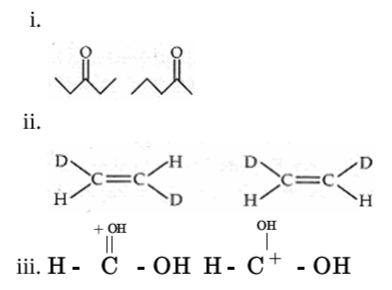
1. What is the relationship between the members of following pairs of structures? Are they structural or geometrical isomers or resonance contributors?
Image
2. A sample of 0.50 g of an organic compound was treated according to Kjeldahl's method. The ammonia evolved was absorbed in 50 mL of $0.5 M H _2 SO _4$. The residual acid required 60 mL of 0.5 M solution of NaOH for neutralisation. Find the percentage composition of nitrogen in the compound.
Answer
1. i. Structural isomers (actually position isomers as well as metamers)
ii. Geometrical isomers
iii. Resonance contributors because they differ in the position of electrons but not atoms
$\begin{aligned} & \text { 2. Volume of the acid taken }=50 mL \text { of } 0.5 M H _2 SO _4 \\ & =25 mL \text { of } 1.0 M H _2 SO _4 \\ & \text { Volume of alkali used for neutralisation of excess acid } \\ & =60 mL \text { of } 0.5 M NaOH \\ & =30 mL \text { of } 1.0 M NaOH \\ & H _2 SO _4+2 NaOH \longrightarrow Na _2 SO _4+2 H _2 O \\ & 1 \text { mole of } H _2 SO _4=2 moles \text { of } NaOH \\ & \text { Hence, } 30 mL \text { of } 1.0 M NaOH =15 mL \text { of } 1.0 M H _2 SO _4 \\ & \therefore \text { Volume of acid used by ammonia }=25-15=10 mL \\ & \% \text { of nitrogen }=\frac{1.4 \times N_1 \times \text { vol. of acidused }}{w} \\ & \text { (where, } N _1=\text { normally of acid and w }=\text { mass of the organic compound taken) } \\ & \% \text { of nitrogen }=\frac{1.4 \times 2 \times 10}{0.5}=56.0\end{aligned}$

View full question & answer
Question 25 Marks
1. An organic liquid decomposes below its boiling point. How will you purify it?
2. Name three types of chromatography?
Answer
1. By distillation under reduced pressure.
2. Column chromatography, paper chromatography and thin layer chromatography.
View full question & answer
Question 35 Marks
On the basis of Le Chatelier principle explain how temperature and pressure can be adjusted to increase the yield of ammonia in the following reaction:
$
\begin{aligned}
& N_2(g)+3 H_2(g) \rightleftharpoons 2 NH_3(g) \\
& \Delta H=-92.38 kJmol^{-1}
\end{aligned}
$
What will be the effect of the addition of argon to the above reaction mixture at constant volume?
Answer
We have $N _2(g)+3 H _2(g) \rightleftharpoons 2 NH _3(g), \Delta H =-92.38 kJ mol ^{-1}$.
Hence in accordance with Le Chatelier's principle, raising the temperature will shift the equilibrium to the backward direction and decreases the equilibrium concentration of ammonia. Similarly, an increase in pressure shifts the equilibrium in the forward direction. In other words, low temperature and high pressure are favorable for high yield of ammonia. Hence for better yield of ammonia, an optimum condition of temperature and pressure of $500^{\circ} C$ and 200 atm respectively is used in the presence of suitable catalysts.
There will be no change in equilibria on the addition of argon ( Ar ) at constant volume to the above mixture at equilibrium because the addition of Ar at constant volume doesn't change the partial pressure of the substances involved in the reaction.
View full question & answer
Question 45 Marks
Determine the degree of ionization and pH of a 0.05 M of ammonia solution. The ionization constant of ammonia can be taken from table given below.
Base$K _{ b }$
Dimethylamine, $\left( CH _3\right)_2 NH$$5.4 \times 10^{-4}$
Triethylamine, $\left( C _2 H _5\right)_3 N$$6.45 \times 10^{-5}$
Ammonia, $NH _3$ or $NH _4 OH$$1.77 \times 10^{-5}$
Quinine, (A plant product)$1.10 \times 10^{-6}$
Pyridine, $C _5 H _5 N$$1.77 \times 10^{-9}$
Aniline, $C _6 H _5 NH _2$$4.27 \times 10^{-10}$
Urea, $CO \left( NH _2\right)_2$$1.3 \times 10^{-14}$
Also, calculate the ionization constant of the conjugate acid of ammonia.
Answer
The ionization of $NH _3$ in water is represented by the equation:
$
NH^3+H_2 ONH_4^{+}+OH^{-}
$
We use equation (7.33) to calculate hydroxyl ion concentration,
$
\begin{aligned}
& {\left[OH^{-}\right]=c \alpha=0.05 \alpha} \\
& K_{b}=0.05 \alpha^2 /(1-\alpha)
\end{aligned}
$
The value of $\alpha$ is small, therefore the quadratic equation can be simplified by neglecting $\alpha$ in comparison to 1 in the denominator on right-hand side of the equation,
Thus,
$
\begin{aligned}
& K_{b}=c \alpha^2 \text { or } \alpha=\sqrt{ }\left(1.77 \times 10^{-5} / 0.05\right) \\
& =0.018
\end{aligned}
$
$\begin{aligned} & {\left[ OH ^{-}\right]= c \alpha=0.05 \times 0.018=9.4 \times 10^{-4} M } \\ & {\left[ H ^{+}\right]= K _{ w } /\left[ OH ^{-}\right]=10^{-14} /\left(9.4 \times 10^{-4}\right)} \\ & =1.06 \times 10^{-11}\end{aligned}$
$
pH=-\log \left(1.06 \times 10^{-11}\right)=10.97
$
Now, using the relation for conjugate acid-base pair,
$
K_{a} \times K_{b}=K_{w}
$
using the value of $K _{ b }$ of $NH _3$ from table.
We can determine the concentration of conjugate acid $NH _4^{+}$
$
\begin{aligned}
& K_{a}=K_{w} / K_{b}=10^{-14} / 1.77 \times 10^{-5} \\
& =5.64 \times 10^{-10}
\end{aligned}
$
View full question & answer
Question 55 Marks
Attempt any five of the following:
i. What is hydrogenation?
ii. Why do the $C - C$ bonds rather than $C - H$ bonds break during cracking of alkanes?
iii. Which conformation of ethane is more stable?
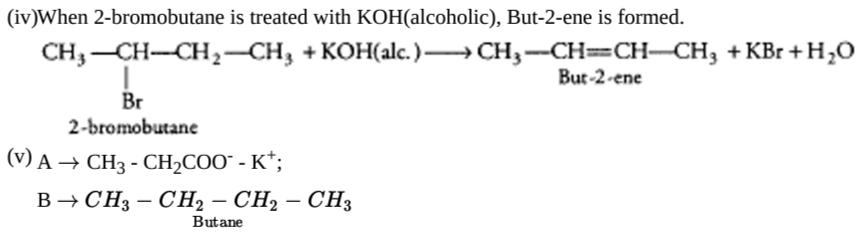
iv. What happens when 2-bromobutane is being treated with KOH (alcoholic)?
v. Identify the structure of A and B;
Image
vi. How will you separate propene from propyne?
vii. Why is t-butyl bromide more reactive towards $S _{ N } 1$ reaction as compared to n-butyl bromide?
Answer
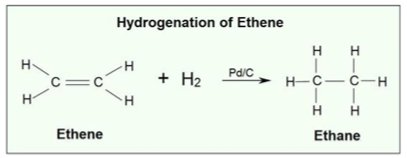
(i) Hydrogenation: Addition of hydrogen to alkenes and alkenes in the presence of finely divided catalysts like Pt, Pd or Ni to form alkanes is known as hydrogenation.
Example:
Image
(ii) Bond dissociation energy of $C - C$ bonds is $348 kJ mol ^{-1}$.
Bond dissociation energy of $C - H$ bonds is $414 kJ mol ^{-1}$.
Clearly, bond dissociation energy of $C - C$ bonds is lower than bond dissociation energy of $C - H$ bonds.
Therefore, during cracking of alkanes, $C - C$ bonds break more easily than $C - H$ bonds.
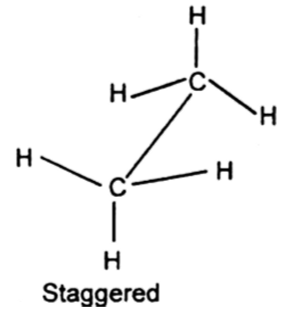
(iii) Staggered conformation of ethane is more stable.
Structure:
Image
Image
(vi) We can separate, propene from propyne by passing the mixture through ammonical $AgNO _3$ solution or ammoniacal CuCl solution. Propyne reacts with ammonical $AgNO _3$ due to presence of acidic terminal hydrogen while propene passes over.
(vii) Due to higher stability of $3^{\circ} /$ tertiary carbocation
View full question & answer