Questions

M.C.Q (1 Marks)

🎯

Test yourself on this topic

12 questions · timed · auto-graded

MCQ 11 Mark
Calculate the enthalpy change on freezing of 1.0 mol of water at $10.0^{\circ} C$ to the ice at $-10.0^{\circ} C . \Delta_{\text {fus }} H =6.03 kJ$ $\operatorname{mol}^{-1}$ at $0^{\circ} C$.
a. $C _{ P }\left[ H _2 O ( l )\right]=75.3 Jmol ^{-1} K^{-1}$
b. $C _{ P }\left[ H _2 O ( s )\right]=36.8 Jmol ^{-1} K^{-1}$
  • A
    $\Delta H =-5.231 kJmol ^{-1}$
  • $\Delta H =-7.151 kJ mol ^{-1}$
  • C
    $\Delta H =-6.114 kJmol ^{-1}$
  • D
    $\Delta H =-7.415 kJ mol ^{-1}$
Answer
Correct option: B.
$\Delta H =-7.151 kJ mol ^{-1}$
(b) $\Delta H =-7.151 kJ mol ^{-1}$
Explanation: Water $\left(10.0^{\circ} C \right) \rightarrow$ ice $\left(-10.0^{\circ} C \right) \Delta H=$ ?
The enthalpy change for the conversion of 1 mole liquid water at $10.0^{\circ} C$ into 1 mole liquid water $0^{\circ} C$, water $\left(10.0^{\circ} C \right)$ $\rightleftharpoons \operatorname{water}\left(0^{\circ} C \right)$.
$
\Delta H_1=C_p \times H_2 O(l) \times \Delta T=-75.3 Jmol^{-1} K^{-1}=-753 J mol^{-1}
$
Enthalpy of fusion, water $\left(0^{\circ} C \right) \rightleftharpoons \operatorname{ice}\left(0^{\circ} C \right), \Delta H_2=\Delta_{\text {fus }} H$
$
l \triangle H_2=\triangle H_{\text {freezing }}=-\triangle H_{\text {fusion }}=-6.06 kJ mol^{-1}
$
Enthalpy change for conversion of 1 mole of ice at $0^{\circ} C$ to 1 mole of ice at $10^{\circ} C$, Ice $\left(0^{\circ} C \right) \rightleftharpoons$ ice $\left(10.0^{\circ} C \right)$;
$
\begin{aligned}
& \Delta H_3=C_p\left[H_2 O(s)\right] \Delta T=-36.8 Jmol^{-1} K^{-1} \times 10 K=-368 J mol^{-1} \\
& \Delta H=\Delta H_1+\Delta H_2+\Delta H_3=-(0.753+6.03+0.368) kJ mol^{-1}=-7.151 kJml^{-1}
\end{aligned}
$
View full question & answer
MCQ 21 Mark
In the following sequence of reactions, the alkene is converted to compound $B$ $CH _3 CH = CHCH _3 \xrightarrow{ O _3} A \xrightarrow{ H _2 O , Zn } B$
The compound $B$ ________________ is?
  • A
    $CH _3 CH _2 CHO$
  • $CH _3 CHO$
  • C
    $CH _3 COCH _3$
  • D
    $CH _3 CH _2 COCH _3$
Answer
Correct option: B.
$CH _3 CHO$
(b) $CH _3 CHO$
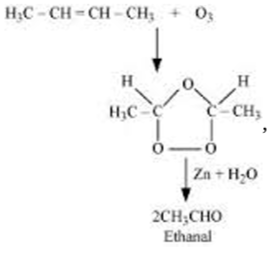
Explanation: The given sequence of conversion steps represent Ozonolysis of 2-Butene, which follows the following path,
i. Formation of an unstable intermediate/ozonide $(A)$
ii. Cleavage of the intermediate/ozonide by $\left( Zn + H _2 O \right)$ to smaller molecules, giving out the compound $B$, which is $C H _3 C H O$ (Ethanal)
The reaction is well depicted as below,
Image
View full question & answer
MCQ 31 Mark
Given $N _2(g)+3 H _2(g) \rightarrow NH _3(g) ; \Delta_r H ^{\circ}=-92.4 kJ mol ^{-1}$. What is the standard enthalpy of formation of $NH _3$ gas?
  • A
    $-41.3 kJ mol ^{-1}$
  • $-46.2 kJ mol ^{-1}$
  • C
    $-56.5 kJ mol ^{-1}$
  • D
    $-36.9 kJ mol ^{-1}$
Answer
Correct option: B.
$-46.2 kJ mol ^{-1}$
(b) $-46.2 kJ mol ^{-1}$
Explanation: Given, $N _2(g)+3 H _2(g) \rightarrow 2 NH _3(g) ; \Delta_r H ^{\circ}=-92.4 kJ mol ^{-1}$.
Chemical reaction for the enthalpy of formation of $NH _3(g)$ is as follows:
$
\frac{1}{2} N_2(g)+\frac{3}{2} H_2(g) \rightarrow N H_3(g)
$
Therefore, $\Delta_f H^{\circ}=\frac{-92.4}{2}=-46.2 kJ / mol$
View full question & answer
MCQ 41 Mark
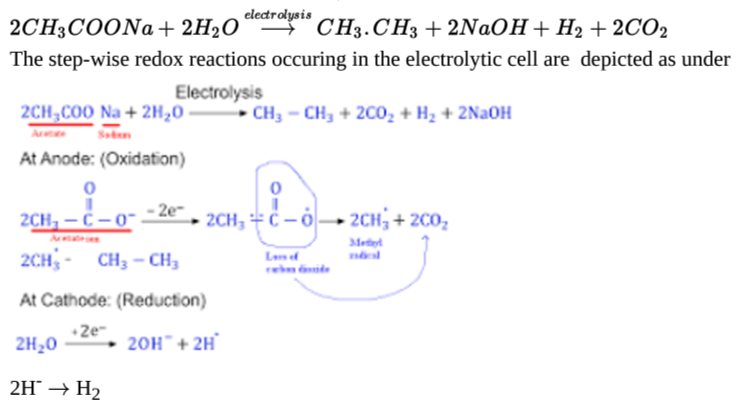
An aqeous solution of compound A gives ethane on electrolysis. The compound A is _________________ ?
  • A
    Sodium propionate
  • Sodium acetate
  • C
    Sodium ethoxide
  • D
    Ethyl acetate
Answer
Correct option: B.
Sodium acetate
(b) Sodium acetate
Explanation: This is an example of Kolbe's electrolysis method. The reaction is:
Image
View full question & answer
MCQ 51 Mark
The elements charecterised by the filling of 4 f-orbitals, are:
  • A
    Alkali metals
  • B
    Alkaline earth metals
  • Lanthanoids
  • D
    Transition elements
Answer
Correct option: C.
Lanthanoids
(c) Lanthanoids
Explanation: The two rows of elements at the bottom of the Periodic Table, called the Lanthanoids, $Ce ( Z =58)- Lu ( Z =71)$ and Actinoids, $\operatorname{Th}( Z =90)- Lr ( Z =103)$ are characterized by the outer electronic configuration $( n -2) f ^{1-14}( n -1) d ^{0-1} ns^2$. The last electron added to each element is filled in f- orbital. These two series of elements are hence called the Inner-Transition Elements (f-Block Elements).
View full question & answer
MCQ 61 Mark
Which solution is used for the separation of a mixture of phenol and aromatic carboxylic acid?
  • A
    $Na _2 CO _3$
  • $NaHCO _3$
  • C
    NaOH
  • D
    CaO
Answer
Correct option: B.
$NaHCO _3$
(b) $NaHCO _3$
Explanation: $NaHCO _3$ solution is used for the separation of a mixture of phenol and aromatic carboxylic acid.
View full question & answer
MCQ 71 Mark
Lines in the hydrogen spectrum which appear in the infrared region of the electromagnetic Spectrum, then they are called as
  • A
    Balmer series
  • B
    Hydrogen line series
  • C
    Hydrogen series
  • Paschen series
Answer
Correct option: D.
Paschen series
(d) Paschen series
Explanation: The Lyman series lies in the ultraviolet, whereas the Paschen, Brackett, and Pfund series lies in the infrared.
View full question & answer
MCQ 81 Mark
Dalda is prepared from oils by __________.
  • A
    hydrolysis
  • reduction
  • C
    distillation
  • D
    oxidation
Answer
Correct option: B.
reduction
(b) reduction
Explanation: Oils are esters of unsaturated fatty acids whereas Dalda is an ester of saturated fatty acids. The former is converted into the latter by catalytic hydrogenation i.e., reduction.
View full question & answer
MCQ 91 Mark
What will be the value of logarithm of equilibrium constant $K_p$ if the standard free energy change of a reaction is
$\Delta G^o=-115 kJ$ at 298 K will be
  • A
    13.83
  • B
    2.015
  • 20.15
  • D
    2.303
Answer
Correct option: C.
20.15
(c) 20.15
Explanation: $\Delta G^o=-115 \times 10^3 J$
$
\begin{aligned}
& T=298 K, R=8.314 JK^{-1} mol^{-1} \\
& -\Delta G^o=2.303 RT \log _{10} K_{p} \\
& -\left(-115 \times 10^3\right)=2.303 \times 8.314 \times 298 \log _{10} K_{p} \\
& \log _{10} K_{p}=\frac{115000}{2.303 \times 8.314 \times 298}=20.15
\end{aligned}
$
View full question & answer
MCQ 101 Mark
Find the energy of the photons which correspond to light of frequency $3 \times 10^{15} Hz$ (Hint: $h =$ Planck's constant$
\left.=6.626 \times 10^{-34} Js\right) ?
$
  • A
    $2.988 \times 10^{-18} J$
  • B
    $0.988 \times 10^{-18} J$
  • C
    $1.308 \times 10^{-18} J$
  • $1.988 \times 10^{-18} J$
Answer
Correct option: D.
$1.988 \times 10^{-18} J$
(d) $1.988 \times 10^{-18} J$
Explanation: We know Planck's equation is
$
E=hv
$
where E is energy, h is Planck's constant and v is frequency.
$
E=6.626 \times 10^{-34} \times 3 \times 10^{15}=1.988 \times 10^{-18} J
$
View full question & answer
MCQ 111 Mark
Photoelectric effect established that light
  • behaves like particles
  • B
    behaves like magnetic fields
  • C
    behaves like waves
  • D
    behaves like rays
Answer
Correct option: A.
behaves like particles
(a) behaves like particles
Explanation: The emission of free electrons from a metal surface when light is shone on it is called the photoemission or the photoelectric effect. This effect led to the conclusion that light is made up of packets or quantum of energy. Einstein already associated the light quantum with momentum. This strongly supported the particle nature of light and these particles were named photons. Thus, the wave-particle duality of light came into the picture. Einstein won the Nobel Prize for Physics not for his work on relativity, but for explaining the photoelectric effect.
View full question & answer
MCQ 121 Mark
The number of moles of solute present in 1 kg of a solvent is called __________.
  • A
    Molarity (M)
  • B
    ppm
  • C
    Normality( N )
  • Molality (m)
Answer
Correct option: D.
Molality (m)
(d) Molality (m)
Explanation: Molality is defined as no. of moles of solute present per kg of solvent. It is denoted as " m ". Mathematically, Molality $( m )=$ [number of moles of the solute] $/ kg$ of solvent
Since this mode of expressing the strength of a solution involves (weight/weight) relationship of solute and solvent, the molality of the solution is not affected by variation in temperatures of the solution.
View full question & answer
M.C.Q (1 Marks) - Chemistry STD 11 Science Questions - Vidyadip