Questions

M.C.Q (1 Marks)

Take a timed test

12 questions · auto-graded multiple-choice test.

MCQ 11 Mark
On the basis of thermochemical equations (A), (B) and (C), find out which of the algebraic relationships given in options (i) to (iv) is correct:
A. C(graphite) $+ O _2(g) \rightarrow CO _2$ (g); $\triangle_r H= x KJ mol ^{-1}$
B. C(graphite) $+\frac{1}{2} O_2(g) \rightarrow C O(g) ; \Delta_r H= y KJ mol ^{-1}$
C. $C O(g)+\frac{1}{2} O_2(g) \rightarrow C O_2(g) ; \Delta_r H=z k J m o l=1$
  • $x=y+z$
  • B
    $y=2 z-x$
  • C
    $z=x+y$
  • D
    $x=y-z$
Answer
Correct option: A.
$x=y+z$
(a) $x=y+z$
Explanation: We have, C (graphite) $+ O _2(g) \rightarrow CO _2(g) ; \triangle_r H= x KJ mol ^{-1} \ldots .(1)$
C (graphite) $+\frac{1}{2} O _2(g) \rightarrow CO ( g ) ; \Delta_r H=y kJmol ^{-1} \ldots(2)$
Subtacting (1) and (2), we get;
$
\begin{aligned}
& CO(g)+\frac{1}{2} O_2(g) \rightarrow CO_2(g) ; \triangle_r H=(x-y) kJmol^{-1} \\
& \therefore z=x-y \Rightarrow x=y+z
\end{aligned}
$
View full question & answer
MCQ 21 Mark
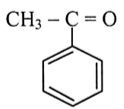
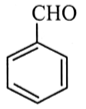
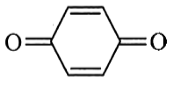
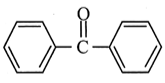
The following compounds do not show ketoenol tautomerism, except:
  • A

    Image

  • Image
  • C

    Image
  • D

    Image
Answer
Correct option: B.

Image
(b)
Image

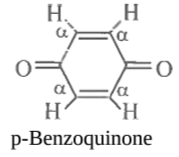
Explanation: For keto-enol tautomerism, a compound must have at least one acidic $\alpha$-hydrogen. So acetophenone (A) shows tautomerism. Benzaldehyde (B) and benzophenone (C) do not show tautomerism due to lack of $\alpha$-hydrogen. p-Benzoquinone (D) contains $\alpha$-hydrogens but they are not acidic because they are present on a double bond. Therefore, it does not show ketoenol tautomerism.
Image
View full question & answer
MCQ 31 Mark
In an atom, the maximum number of electrons in an orbit / principal energy level n is
  • $2 n^2$
  • B
    $2 n$
  • C
    $2 n -1$
  • D
    $n^2$
Answer
Correct option: A.
$2 n^2$
(a) $2 n^2$
Explanation: Since the maximum number of electrons in each orbital is 2, the maximum number of electrons in an entire quantum level is $2 n ^2$.
View full question & answer
MCQ 41 Mark
A person is suffering with fever with a high temperature of $104^{\circ} F$. What will be his body temperature in ${ }^{\circ} C$ ?
  • A
    $32.38{ }^{\circ} C$
  • B
    $28.10^{\circ} C$
  • C
    $18.68^{\circ} C$
  • $40^{\circ} C$
Answer
Correct option: D.
$40^{\circ} C$
(d) $40^{\circ} C$
Explanation: $\left.104^{\circ} F -32\right) \times 5 / 9=40^{\circ} C$
View full question & answer
MCQ 51 Mark
The hydrocarbon which can react with sodium in liquid ammonia is ____________________ .
  • A
    $CH _3 CH = CHCH _3$
  • $CH _3 CH _2 C \equiv CH$
  • C
    $CH _3 CH _2 CH _2 C \equiv CCH _2 CH _2 CH _3$
  • D
    $CH _3 CH _2 C \equiv CCH _2 CH _3$
Answer
Correct option: B.
$CH _3 CH _2 C \equiv CH$
(b) $CH _3 CH _2 C \equiv CH$
Explanation: Terminal alkynes react with Na in the presence of liquid $NH _3$ to form higher alkynes. The alkyne contains acidic H at the end (i.e. the H bonded to $C _1$ of the chain). Therefore, it is easily replaced with highly electropositive metals such as Na in liquid ammonia, to form sodium alkaline ion which can react further in the presence of a suitable catalyst to yield higher alkynes/hydrocarbons.
View full question & answer
MCQ 61 Mark
The correct order for the decrease in atomic radii is
  • $Li < Be < B < C$
  • B
    $Li > Be > B > C$
  • C
    $C < Li < Be < B$
  • D
    $Be < B > C < Li$
Answer
Correct option: A.
$Li < Be < B < C$
(a) $Li < Be < B < C$
Explanation: In a period moving from left to right, the effective nuclear charge increases because the next electron fills in the same shell. So the atomic size decreases.
View full question & answer
MCQ 71 Mark
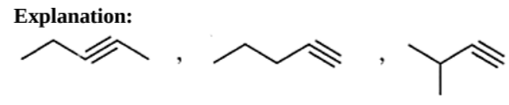
The number of alkynes possible with molecular formula $C _5 H _8$ is:
  • A
    5
  • B
    4
  • C
    2
  • 3
Answer
Correct option: D.
3
(d) 3
Image
View full question & answer
MCQ 81 Mark
Chlorine, bromine, and iodine when combined with oxygen, have oxidation numbers:
  • +1 or any positive number
  • B
    -1 or any negative number
  • C
    -2
  • D
    -1
Answer
Correct option: A.
+1 or any positive number
(a) +1 or any positive number
Explanation: This is according to the rules of assigning oxidation numbers i.e., Chlorine, Bromine, Iodine have positive oxidation numbers when combined with oxygen, for example in oxoacids and oxoanions.
View full question & answer
MCQ 91 Mark
An atom of an element contains 29 electrons and 35 neutrons. The number of protons are:
  • A
    35
  • B
    32
  • C
    30
  • 29
Answer
Correct option: D.
29
(d) 29
Explanation: In an atom no. of protons = no. of electrons i.e. $P = E$ while this is not true in case of ions. So the number of protons in the given atom is 29 .
View full question & answer
MCQ 101 Mark
Suppose that 1.00 kJ of heat is transferred to 2.00 mol argon (at $298 K, 1 atm$ ). What will the final temperature $T _{ f }$ be if the heat is transferred at constant pressure?
  • A
    301 K
  • B
    335 K
  • 322 K
  • D
    376 K
Answer
Correct option: C.
322 K
(c) 322 K
Explanation: Argon is monoatomic, Here, $C_p=\frac{5}{2} R=\frac{5}{2} \times 8.314 JK ^{-1} mol^{-1}=20.79 JK ^{-1} mol^{-1}$
As pressure is kept constant, $q_p=n C_p \Delta T$
$
\begin{aligned}
& \Rightarrow 1000 J=(2.00 mol) \times\left(20.79 JK^{-1} mol^{-1}\right) \times \Delta T \\
& \Rightarrow \Delta T=24.05 K \\
& \Rightarrow T_f=298+24.05=322.05 K
\end{aligned}
$
View full question & answer
MCQ 111 Mark
Cathode rays or cathode ray particles are:
  • A
    neutrons
  • B
    protons
  • electrons
  • D
    muons
Answer
Correct option: C.
electrons
(c) electrons
Explanation: Cathode rays - In 1897, British physicist J. J. Thomson showed the rays were composed of a previously unknown negatively charged particle, which was later named the electron.
View full question & answer
MCQ 121 Mark
What is the change in the energy of system if 500 cal of heat energy are added to a system and system does 350 cal of work on the surroundings?
  • A
    +850 cal
  • B
    -150 cal
  • +150 cal
  • D
    -850 cal
Answer
Correct option: C.
+150 cal
(c) +150 cal
Explanation: According to the first law of thermodynamics, $\Delta E = q + W =500+(-350)=+150 cal$
View full question & answer