Question types

Model Paper 9 question types

36 questions across 6 question groups — pick any mix to generate a Chemistry paper with step-by-step answer keys.

36
Questions
6
Question groups
5
Question types
Sample Questions

Model Paper 9 questions

One sample from each question group in this chapter. Select any group above to see the full set with answer keys.

When two hydrogen atoms in benzene are replaced by two similar or different monovalent atoms or groups, how many different position isomers are possible?
  • A
    6
  • B
    5
  • C
    2
  • 3

Answer: D.

View full solution
The molar specific heat capacity of a substance is the quantity of heat needed to raise the temperature of one
  • A
    kilogram by one degree Fahrenheit.
  • mole by one degree celsius or one kelvin.
  • C
    mole by one degree Fahrenheit.
  • D
    gram by one degree celsius.

Answer: B.

View full solution
A dibromo derivative of an alkane reacts with sodium metal to form an alicyclic hydrocarbon.
The derivative is ___________ .
  • 1, 4-dibromobutane
  • B
    1, 1-dibromopropane
  • C
    2, 2-dibromobutane
  • D
    dibromoethane

Answer: A.

View full solution
On the basis of standard electrode potential values, suggest which of the following reactions would take place? (Consult the book for $E^{\ominus}$ value).
  • $Mg + Fe ^{2+} \rightarrow Mg ^{2+}+ Fe$
  • B
    $Fe + Cd ^{2+} \rightarrow Cd + Fe ^{2+}$
  • C
    $Cu + Zn ^{2+} \rightarrow Cu ^{2+}+ Zn$
  • D
    $Br _2+2 Cl ^{-} \rightarrow Cl _2+2 Br ^{-}$

Answer: A.

View full solution
According to the recommendation of the International Union of Pure and Applied Chemistry (IUPAC), the groups in the modern periodic table are numbered from:
  • 1 to 18
  • B
    1 to 10
  • C
    1 to 12
  • D
    1 to 8

Answer: A.

View full solution
Write the electronic configuration of ${ }_9 F^{19},{ }_{16} S^{32}$ and ${ }_{18} Ar ^{38}$ and then point out the element with
i. maximum nuclear charge.
ii. minimum number of neutrons.
iii. maximum number of unpaired electrons.
View full solution
For the equilibrium,
$
2 NOCl(g) \rightleftharpoons 2 NO(g)+Cl_2(g)
$
the value of the equilibrium constant, $K _{ c }$ is $3.75 \times 10^{-6}$ at 1069 K . Calculate the $K _{ p }$ for the reaction at this temperature?
View full solution
Q 113 Marks Question3 Marks
Commercially available concentrated hydrochloric acid $( HCl )$ contains $38 \% HCI$ by mass.
1. What is the molarity $( M )$ of the solution (density of solution $=1.19 g mL ^{-1}$ )
2. What volume required of concentrated HCI is required to make 1.0 L of an 0.10 M HCI ?
View full solution
Q 133 Marks Question3 Marks
According to de Broglie, matter should exhibit dual behaviour, that is both particle and wave like properties. However, a cricket ball of mass 100 g does not move like a wave when it is thrown by a bowler at a speed of 100 $km / h$. Calculate the wavelength of the ball and explain why it does not show wave nature.
View full solution
Q 153 Marks Question3 Marks
1. The fact that the enthalpy is a state function forms the basis of a very useful law. Name the law.
2. If the combustion of 1 g of graphite produces 20.7 kJ of heat, what will be molar enthalpy change? Give the significance of the sign also.
3. Consider the same expansion, but this time against a constant external pressure of 1 atm.
View full solution
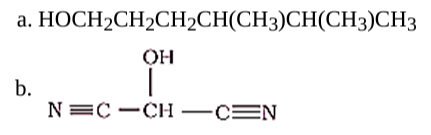
1. For each of the following compounds, write a condensed formula and also their bond-line formula.
Image
2. How does
i. an electron withdrawing group (EWG) and
ii. an electron donating group (EDG) influence the acid strength of carboxylic end?
View full solution
At 1127 K and 1 atmosphere pressure, a gaseous mixture of CO and $CO _2$ in equilibrium with solid carbon has 90.55\% CO by mass.
$
C(s)+CO_2(g) \rightleftharpoons 2 CO(g)
$
Calculate $K _{ c }$ for the reaction at the above temperature.
View full solution
1. Give condensed and bond line structural formulas and identify the functional groups present, if any, for:
a. 2, 2, 4-Trimethylpentane
b. 2-Hydroxy-1, 2, 3-propanetricarboxylic acid
c. Hexanedial?
2. Give three points of differences between inductive effect and resonance effect.
View full solution
A sparingly soluble salt gets precipitated only when the product of the concentration of its ions in the solution $\left( Q _{ sp }\right)$ becomes greater than its solubility product. If the solubility of $BaSO _4$ in water is $8 \times 10^{-4} mol dm ^{-3}$, calculate its solubility in $0.01 mol dm ^{-3}$ of $H _2 SO _4$.
View full solution
Attempt any five of the following:
1. Why are Alkenes called olefins?
2. Convert 1-bromopropane to 2-bromopropane.
3. If Qc < Kc, when we continuously remove the product, what would be the direction of the reaction?
4. Convert methane into ethane.
5. What are cycloalkanes?
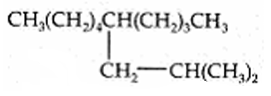
6. Write IUPAC name of following:
Image
7. How will you convert ethanoic acid into ethene?
View full solution
Assertion (A): 22-carat gold is a compound.
Reason (R): A compound has fixed composition of the elements present in it.
  • A
    Both A and R are true and R is the correct explanation of A.
  • B
    Both A and R are true but R is not the correct explanation of A.
  • C
    A is true but R is false.
  • A is false but R is true.

Answer: D.

View full solution
Assertion (A): Splitting of the spectral lines in the presence of a magnetic field is known as the Stark effect.
Reason (R): The line spectrum is simplest for the hydrogen atoms.
  • A
    Both A and R are true and R is the correct explanation of A.
  • B
    Both A and R are true but R is not the correct explanation of A.
  • C
    A is true but R is false.
  • A is false but R is true.

Answer: D.

View full solution
Assertion (A): Sulphur present in an organic compound can be estimated quantitatively by Carius method.
Reason (R): Sulphur can be separated easily from other atoms in the molecule, by lassiagn's test, but the yellow precipitate cannot be obtained.
  • A
    A is correct and R is not correct.
  • B
    Both A and R are correct and R is the correct explanation of A.
  • C
    Both A and R are correct but R is not the correct explanation of A.
  • A is not correct but R is correct.

Answer: D.

View full solution
Assertion (A): Trans-2-butene on reaction with $Br _2$ gives a meso-2,3-dibromobutane.
Reason (R): The reaction involves the syn-addition of bromine.
  • A
    Both A and R are true and R is the correct explanation of A.
  • B
    Both A and R are true but R is not the correct explanation of A.
  • A is true but R is false.
  • D
    A is false but R is true.

Answer: C.

View full solution
Once an organic compound is extracted from a natural source or synthesised in the laboratory, it is essential to purify it. Various methods used for the purification of organic compounds are based on the nature of the compound and the impurity present in it. Finally, the purity of a compound is ascertained by determining its melting or boiling point. This is one of the most commonly used techniques for the purification of solid organic compounds. In crystallisation Impurities, which impart colour to the solution are removed by adsorbing over activated charcoal. In distillation Liquids having different boiling points vaporise at different temperatures. The vapours are cooled and the liquids so formed are collected separately. Steam Distillation is applied to separate substances which are steam volatile and are immiscible with water. Distillation under reduced pressure: This method is used to purify liquids having very high boiling points.

1. Which method can be used to separate two compounds with different solubilities in a solvent?
OR
Why chloroform and aniline are easily separated by the technique of distillation?
2. Distillation method is used to separate which type of substance?
3. Which technique is used to separate aniline from aniline water mixture?
View full solution
The ionic character of metallic halides tends toward covalent nature as per Fajan's rule. Such covalent halides behave as non-metal in their higher oxidation states. The property to hydrolyse to give oxy-acids of the element and corresponding hydro halogen acid for most non-metallic elements proceeds exceptionally in the way, keeping oxidation number of element and halide sam in oxo-acids.
Non-polar halides are immiscible in water, as they do not show hydrolysis, but halides of some elements with empty d-orbital undergo hydrolysis. Stability of halides of the higher state is governed by the inert-pair effect.

1. How does halide undergo hydrolysis to give oxy-acids of underlined element $PCl _3$ ?
2. Out of $NCl _3$ and $BCl _3$ undergoes hydrolysis to form oxy-acids? Write the chemical reaction for the correct answer.
3. Out of $PbCl _4, PbF _4, PbI _4$ and $PbBr _4$ which one doesn't exist?
OR
Non-Polar halides are immiscible in water. Why?
View full solution

Generate a Model Paper 9 paper free

Pick question groups from the list above, set marks and difficulty, and export a branded PDF with step-by-step answer keys. First 3 chapters free — no signup.

Download App