Questions

M.C.Q (1 Marks)

Take a timed test

12 questions · auto-graded multiple-choice test.

MCQ 11 Mark
When two hydrogen atoms in benzene are replaced by two similar or different monovalent atoms or groups, how many different position isomers are possible?
  • A
    6
  • B
    5
  • C
    2
  • 3
Answer
Correct option: D.
3
(d) 3
Explanation: The three isomers will be ortho(i.e.1,2- or 1,4-disubstituted), meta(i.e.1,3- or 1,5-disubstituted) and para (1,4disubstituted).
View full question & answer
MCQ 21 Mark
The molar specific heat capacity of a substance is the quantity of heat needed to raise the temperature of one
  • A
    kilogram by one degree Fahrenheit.
  • mole by one degree celsius or one kelvin.
  • C
    mole by one degree Fahrenheit.
  • D
    gram by one degree celsius.
Answer
Correct option: B.
mole by one degree celsius or one kelvin.
(b) mole by one degree celsius or one kelvin.
Explanation: Molar specific heat capacity can be defined as the amount of heat energy required to raise the temperature of 1 mole of a substance by $1^{\circ} C$.
View full question & answer
MCQ 31 Mark
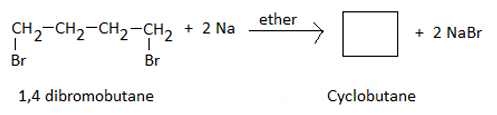
A dibromo derivative of an alkane reacts with sodium metal to form an alicyclic hydrocarbon.
The derivative is ___________ .
  • 1, 4-dibromobutane
  • B
    1, 1-dibromopropane
  • C
    2, 2-dibromobutane
  • D
    dibromoethane
Answer
Correct option: A.
1, 4-dibromobutane
(a) 1, 4-dibromobutane
Explanation: 1,4-dibromobutane ( ie. a dibromo derivative of an alkane, butane) when reacted within ( $N a-m e t a l)$ ethereal solution produces alicyclic hydrocarbon, Cyclobutane as per the following reaction. 
Image
Therefore, the dibromo-derivative of an alkane is identified as 1, 4-dibromobutane.
View full question & answer
MCQ 41 Mark
On the basis of standard electrode potential values, suggest which of the following reactions would take place? (Consult the book for $E^{\ominus}$ value).
  • $Mg + Fe ^{2+} \rightarrow Mg ^{2+}+ Fe$
  • B
    $Fe + Cd ^{2+} \rightarrow Cd + Fe ^{2+}$
  • C
    $Cu + Zn ^{2+} \rightarrow Cu ^{2+}+ Zn$
  • D
    $Br _2+2 Cl ^{-} \rightarrow Cl _2+2 Br ^{-}$
Answer
Correct option: A.
$Mg + Fe ^{2+} \rightarrow Mg ^{2+}+ Fe$
(a) $Mg + Fe ^{2+} \rightarrow Mg ^{2+}+ Fe$
Explanation: On the basis of standard reduction potential suggested in the reactivity, this series reaction can take place as Mg has a more negative value of the cell. Thus, Mg will be oxidized by losing an electron, and iron will be reduced by gaining an electron.
View full question & answer
MCQ 51 Mark
According to the recommendation of the International Union of Pure and Applied Chemistry (IUPAC), the groups in the modern periodic table are numbered from:
  • 1 to 18
  • B
    1 to 10
  • C
    1 to 12
  • D
    1 to 8
Answer
Correct option: A.
1 to 18
(a) 1 to 18
Explanation: The groups are numbered from 1 to 18 ; where group 1 is alkali metal group and group 18 is for the noble gases.
View full question & answer
MCQ 61 Mark
For estimation of which element Kjeldahl method is used?
  • Nitrogen
  • B
    Halogen
  • C
    Sulphur
  • D
    Oxygen
Answer
Correct option: A.
Nitrogen
(a) Nitrogen
Explanation: Nitrogen
View full question & answer
MCQ 71 Mark
de-Broglie equation is
  • A
    $\lambda=\frac{h v}{m}$
  • B
    $\lambda=\frac{m v}{h}$
  • C
    $\lambda= hmv$
  • $\lambda=\frac{h}{m v}$
Answer
Correct option: D.
$\lambda=\frac{h}{m v}$
(d) $\lambda=\frac{h}{m v}$
Explanation: Louis de-Broglie proposed that matter, like light, has a dual character.It exhibits wave as well as particle nature. The wavelength of the wave associated with a particle of mass m moving with velocity v is given by $\lambda=\frac{h}{m v}$
View full question & answer
MCQ 81 Mark
Values of $\frac{e}{m}\left[\frac{\text { charge }}{\text { mass }}\right]$ in the categories alpha particle $(\alpha)$, electron (e) and protons (p) increase in the order:
  • A
    $p < e <\alpha$
  • $\alpha< p < e$
  • C
    $e <\alpha< p$
  • D
    $\alpha< e < p$
Answer
Correct option: B.
$\alpha< p < e$
(b) $\alpha<$ p $<$ e
Explanation: $\alpha$-particle $\left( He ^{2+}\right)$ has a very high mass compared to proton and electron, therefore a very small $\frac{e}{m}$ ratio. Proton and electron have the same charge (magnitude) but former is heavier, hence has a smaller value of $\frac{e}{m}$.
View full question & answer
MCQ 91 Mark
Select the incorrect expression from the following.
  • $\Delta S_{\text {total }}<0$ (spontaneous process)
  • B
    $\Delta G=\Delta H-T \Delta S$
  • C
    $\Delta S_{\text {total }}=\Delta S_{\text {system }}+\Delta S_{\text {surr }}$
  • D
    $\Delta S_{\text {surr }}=\frac{\Delta H_{\text {surr }}}{T}=-\frac{\Delta H_{\text {sys }}}{T}$
Answer
Correct option: A.
$\Delta S_{\text {total }}<0$ (spontaneous process)
(a) $\Delta S_{\text {total }}<0$ (spontaneous process)
Explanation: For spontaneous process, $\Delta S_{\text {total }}>0$
$
T \Delta S_{\text {system }}-\Delta H_{\text {system }}>0-\left(\Delta H_{\text {system }}-T \Delta S_{\text {system }}\right)>0
$
View full question & answer
MCQ 101 Mark
In an atom, an electron is moving with a speed of $600 m / s$ with an accuracy of $0.005 \%$. Certainty with which the position of the electron can be located is $\left( h =6.6 \times 10^{-34} Js \right)$ ?
  • A
    $3.84 \times 10^{-3} m$
  • B
    $5.10 \times 10^{-3} m$
  • C
    $1.52 \times 10^{-4} m$
  • $1.92 \times 10^{-3} m$
Answer
Correct option: D.
$1.92 \times 10^{-3} m$
(d) $1.92 \times 10^{-3} m$
Explanation: Velocity $=600 m / s$
Accuracy $=0.005 \%$
so, uncertainty in the velocity $=\frac{600 \times 5}{1000}=\frac{3000}{1000}=3 m / s$ $\Delta x=$ ?
Using the Heisenberg uncertainty equation, we have
$
\begin{aligned}
& \Delta x \times \Delta p=\frac{h}{h \pi} \\
& \Rightarrow \Delta x=\frac{h}{4 \pi m \Delta v}=\frac{6.634 \times 10^{-34}}{4 \times 3.14 \times 9.1 \times 10^{-31} \times 3}=1.92 \times 10^{-3} m
\end{aligned}
$
View full question & answer
MCQ 111 Mark
The bond dissociation energies of $H _2, Cl _2$ and HCl are 104,58 and $103 kcal mol ^{-1}$ respectively. The enthalpy of formation of HCl would be
  • A
    $+22 kcal mol ^{-1}$
  • B
    $-44 kcal mol ^{-1}$
  • C
    $+44 kcal mol ^{-1}$
  • $-22 kcal mol ^{-1}$
Answer
Correct option: D.
$-22 kcal mol ^{-1}$
(d) $-22 kcal mol ^{-1}$
Explanation: - $22 kcal mol ^{-1}$
View full question & answer
MCQ 121 Mark
In a homogeneous mixture,
  • A
    the components do not mix with each other and its composition is uniform throughout.
  • the components completely mix with each other and its composition is uniform throughout.
  • C
    the components completely mix with each other and its composition is not uniform throughout.
  • D
    the components do not mix with each other and its composition is not uniform throughout.
Answer
Correct option: B.
the components completely mix with each other and its composition is uniform throughout.
(b) the components completely mix with each other and its composition is uniform throughout.
Explanation: Its a basic criteria of a homogeneous mixture.
i. The components get mixed up uniformly throughout the mixture.
ii. Its individual parts are not easily identifiable.
iii. It has same proportions of its components through out the sample.
View full question & answer