Question 11 Mark
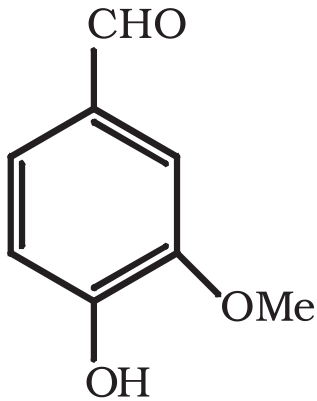
Identify the functional groups in the following compounds:
Question 21 Mark
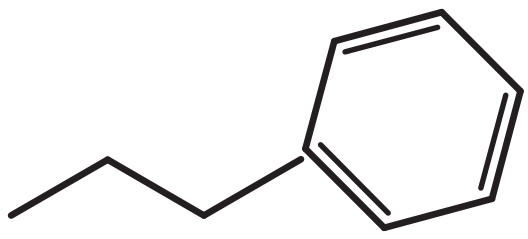
Give the IUPAC names of the following compounds:
Question 31 Mark
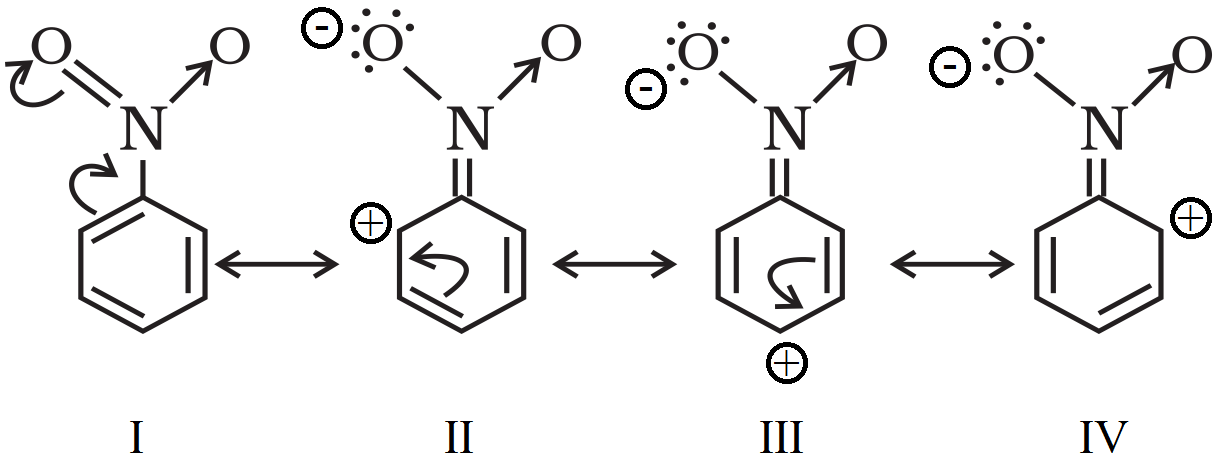
Draw the resonance structures for the following compounds. Show the electron shift using curved-arrow notation. $\mathrm{C}_6 \mathrm{H}_5 \mathrm{NO}_2$.
Answer
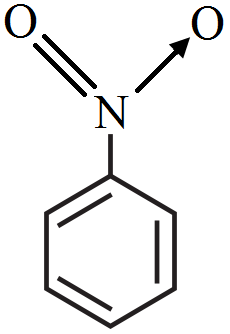
The structure of $\mathrm{C}_6 \mathrm{H}_5 \mathrm{NO}_2$ is:
The resonating structures of nitro benzene are represented as:
View full question & answer→Question 41 Mark
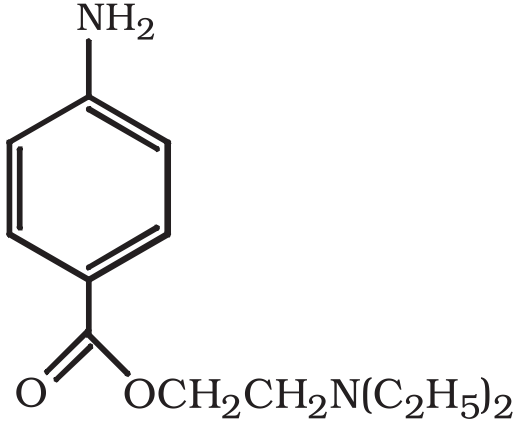
Identify the functional groups in the following compounds:
Question 51 Mark
Draw the resonance structures for the following compounds. Show the electron shift using curved-arrow notation. $\ \ \ \ \ \ \ \ \ \ \ \ \ \ \ \ \ \ \ \ \ + \\ \text{CH}_3\text{H}=\text{CHCH}_2$
Answer
$\ \ \ \ \ \ \ \ \ \ \ \ \ \ \ \ \ \ \ \ \ + \\ \text{CH}_3\text{H}=\text{CHCH}_2$
The resonating structures of the given compound are:

View full question & answer→Question 61 Mark
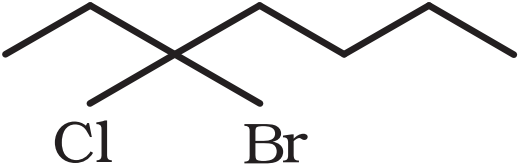
Give the IUPAC names of the following compounds:
Question 71 Mark
Give the IUPAC names of the following compounds:
$\mathrm{Cl}_2 \mathrm{CHCH}_2 \mathrm{OH} \text {. }$
View full question & answer→Question 81 Mark
Identify the reagents shown in bold in the following equations as nucleophiles or electrophiles:
$ \ \ \ \ \ \ \ \ \ \ \ \ \ \ \ \ \ \ \ \ \ \ \ \ \ \ - \\ \text{CH}_3\text{COOH}_3+\text{CN}\rightarrow (\text{CH}_3)_2\text{C(CN)(OH)}$
AnswerElectrophiles are electron-deficient species and can receive an electron pair. On the other hand, nucleophiles are electron-rich species and can donate their electrons.
$ \ \ \ \ \ \ \ \ \ \ \ \ \ \ \ \ \ \ \ \ \ \ \ \ \ \ - \\ \text{CH}_3\text{COOH}_3+\text{CN}\rightarrow (\text{CH}_3)_2\text{C(CN)(OH)}$
Here, ${}^-\text{CN}$ acts as a nucleophiles as it is an electron-rich species, i.e., it is a nucleus-seeking species.
View full question & answer→Question 91 Mark
Identify the reagents shown in bold in the following equations as nucleophiles or electrophiles:
$ \ \ \ \ \ \ \ \ \ \ \ \ \ \ \ \ \ \ \ \ \ \ + \\ \text{C}_6\text{H}_6+ \text{CH}_3\text{ CO}\rightarrow \text{C}_6\text{H}_5\text{COCH}_3$
AnswerElectrophiles are electron-deficient species and can receive an electron pair. On the other hand, nucleophiles are electron-rich species and can donate their electrons. $ \ \ \ \ \ \ \ \ \ \ \ \ \ \ \ \ \ \ \ \ \ \ + \\ \text{C}_6\text{H}_6+ \text{CH}_3\text{ CO}\rightarrow \text{C}_6\text{H}_5\text{COCH}_3$Here, $\ \ \ \ \ \ \ + \\ \text{CH}_3\text{CO}$ acts as an electrophile as it is an electron-deficient species.
View full question & answer→MCQ 101 Mark
In the organic compound $\mathrm{CH}_2=\mathrm{CH}-\mathrm{CH}_2-\mathrm{CH}_2-\mathrm{C} \equiv \mathrm{CH}$, the pair of hydridised orbitals involved in the formation of: $\mathrm{C}_2$ $\mathrm{C}_3$ bond is:
- A
$\mathrm{sp}-\mathrm{sp}_2$.
- B
$\mathrm{sp}-\mathrm{sp}_3$.
- ✓
$\mathrm{sp}_2-\mathrm{sp}_3$
- D
$\mathrm{sp}_3-\mathrm{sp}_3$.
AnswerCorrect option: C. $\mathrm{sp}_2-\mathrm{sp}_3$
The carbon atom in the given compound may be numbered as:
$ \ \ \ \ \ 1 \ \ \ \ \ \ 2 \ \ \ \ \ \ \ \ \ 3 \ \ \ \ \ \ \ \ \ \ \ 4 \ \ \ \ \ \ \ \ \ \ \ 5 \ \ \ \ \ \ \ \ \ 6 \\ \text{H}_2\text{C}=\text{CH}-\text{CH}_2-\text{CH}_2-\text{CH}\equiv\text{CH}$
Thus, $\mathrm{C}^2-\mathrm{C}^3$ are bonded by $\mathrm{sp}^2-\mathrm{sp}^3$ hybrid orbitals.
View full question & answer→Question 111 Mark
Identify the reagents shown in bold in the following equations as nucleophiles or electrophiles:
$\mathrm{CH}_3 \mathrm{COOH}+\mathrm{HO}^{-} \rightarrow \mathrm{CH}_3 \mathrm{COO}^{-}+\mathrm{H}_2 \mathrm{O}$
AnswerElectrophiles are electron-deficient species and can receive an electron pair. On the other hand, nucleophiles are electron-rich species and can donate their electrons.
$\mathrm{CH}_3 \mathrm{COOH}+\mathrm{HO}^{-} \rightarrow \mathrm{CH}_3 \mathrm{COO}^{-}+\mathrm{H}_2 \mathrm{O}$
Here, $\mathrm{HO}^{-}$acts as a nucleophiles as it is an electron-rich species, i.e., it is a nucleus-seeking species.
View full question & answer→Question 121 Mark
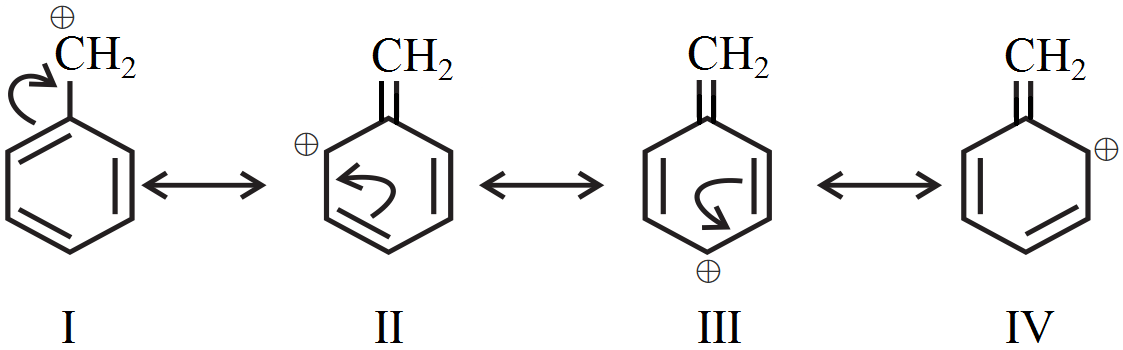
Draw the resonance structures for the following compounds. Show the electron shift using curved-arrow notation. $\ \ \ \ \ \ \ \ \ \ \ \ \ + \\ \text{C}_6\text{H}_5-\text{CH}_2$
Answer
$\ \ \ \ \ \ \ \ \ \ \ \ \ + \\ \text{C}_6\text{H}_5-\text{CH}_2$
The resonating structures of the given compound are:
View full question & answer→MCQ 131 Mark
The best and latest technique for isolation, purification and separation of organic compounds is :
AnswerChromatography is the most useful and the latest technique of separation and purification of organic compounds. It was first used to separate a mixture of coloured substances.
View full question & answer→Question 141 Mark
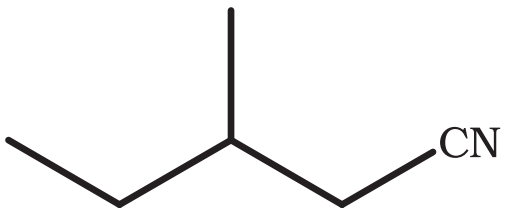
Give the IUPAC names of the following compounds:
Question 151 Mark
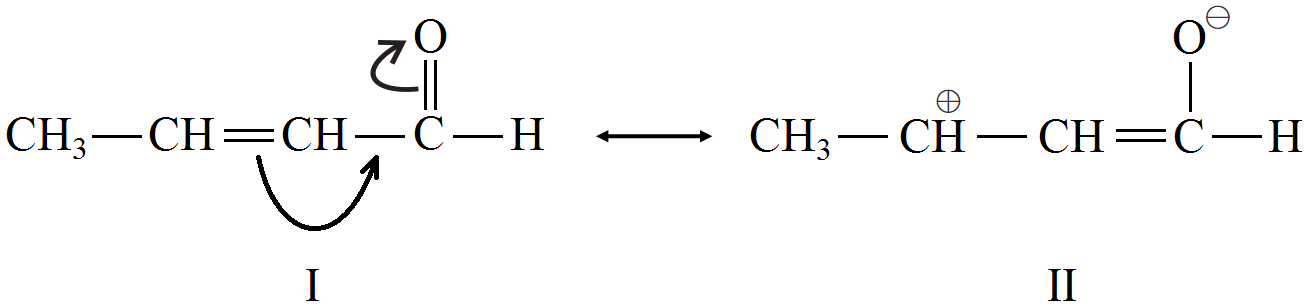
Draw the resonance structures for the following compounds. Show the electron shift using curved-arrow notation. $\mathrm{CH}_3 \mathrm{CH}=\mathrm{CH}\mathrm{CHO}$.
Answer$\mathrm{CH}_3 \mathrm{CH}=\mathrm{CH}-\mathrm{CHO}$
The resonating structures of the given compound are represented as:
View full question & answer→Question 161 Mark
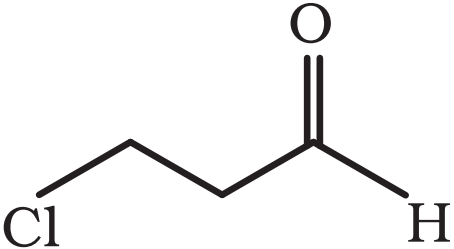
Give the IUPAC names of the following compounds:
Question 171 Mark
Give the IUPAC names of the following compounds:
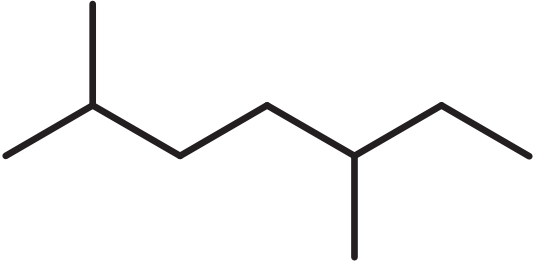
Question 181 Mark
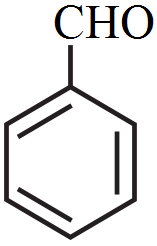
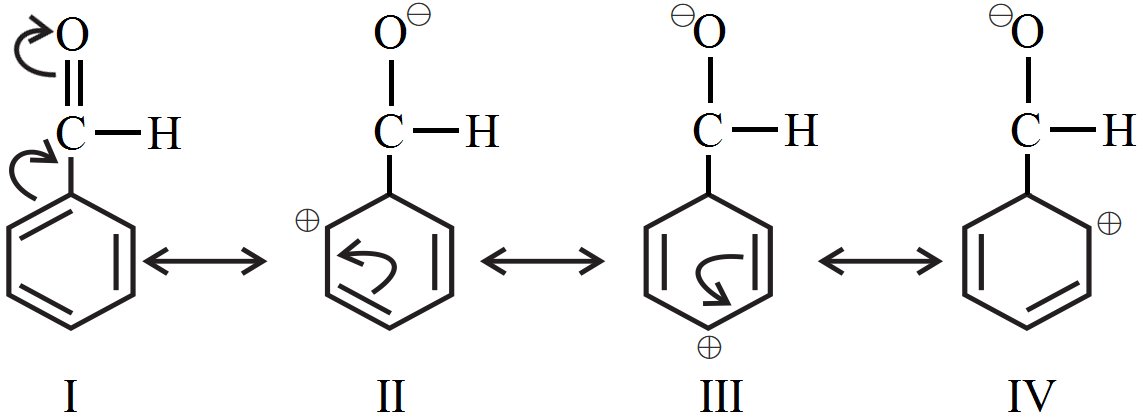
Draw the resonance structures for the following compounds. Show the electron shift using curved-arrow notation. $\mathrm{C}_6 \mathrm{H}_5-\mathrm{CHO}$.
Answer
The structure of $\mathrm{C}_6 \mathrm{H}_5\mathrm{CHO}$ is:
The resonating structures of benzaldehyde are represented as:
View full question & answer→MCQ 191 Mark
Which of the following carbocation is most stable?
- A
$\ \ \ \ \ \ \ \ \ \ \ \ \ \ \ \ + \\ (\text{CH}_3)_3\text{C}.\text{CH}_2$
- ✓
$\ \ \ \ \ \ \ \ \ \ \ + \\ (\text{CH}_3)_3\text{C}$
- C
$\ \ \ \ \ \ \ \ \ \ \ \ \ \ + \\ \text{CH}_3\text{CH}_2\text{CH}_2$
- D
$\ \ \ \ \ \ \ + \\ \text{CH}_3 \text{CH CH}_2\text{CH}3$
AnswerCorrect option: B. $\ \ \ \ \ \ \ \ \ \ \ + \\ (\text{CH}_3)_3\text{C}$
$\ \ \ \ \ \ \ \ \ \ \ + \\ (\text{CH}_3)_3\text{C}$ is a tertiary carbocation. A tertiary carbocation is the most stable carbocation due to the electron releasing effect of three methyl groups. An increased $+\ I$ effect by three methyl groups stabilizes the positive charge on the carbocation.
View full question & answer→Question 201 Mark
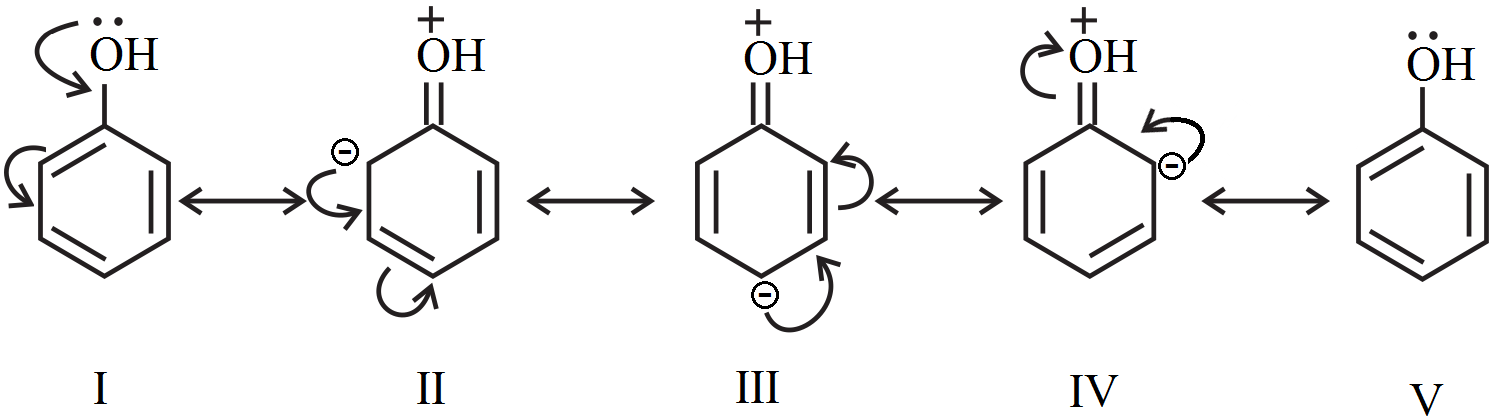
Draw the resonance structures for the following compounds. Show the electron shift using curved-arrow notation. $\mathrm{C}_6 \mathrm{H}_5\mathrm{OH}$.
Answer
The structure of $\mathrm{C}_6 \mathrm{H}_5\mathrm{OH}$ is:
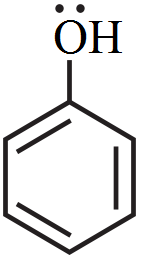
The resonating structures of phenol are represented as:
View full question & answer→MCQ 211 Mark
The reaction : $\mathrm{CH}_3 \mathrm{CH}_2 \mathrm{I}+\mathrm{KOH}(\mathrm{aq}) \rightarrow \mathrm{CH}_3 \mathrm{CH}_2 \mathrm{OH}+\mathrm{KI}$ is classified as :
- A
Electrophilic substitution.
- ✓
Nucleophilic substitution.
- C
- D
AnswerCorrect option: B. Nucleophilic substitution.
$\mathrm{CH}_3 \mathrm{CH}_2 \mathrm{I}+\mathrm{KOH}(\mathrm{aq}) \rightarrow \mathrm{CH}_3 \mathrm{CH}_2 \mathrm{OH}+\mathrm{Kl}$
In the given reaction, the $\mathrm{I}^{-}$from the alkyl iodide is replaced by the $\mathrm{OH}^{-}$ ion. Thus, it is substitution reaction.
The substitution is brought about by the $\mathrm{OH}^{-}$ ion which is a nucleophile.
$\because$ The reaction is a nucleophilic substitution reaction.
View full question & answer→MCQ 221 Mark
In the Lassaigne's test for nitrogen in an organic compound, the Prussian blue colour is obtained due to the formation of :
- A
$\mathrm{Na}_4\left[\mathrm{Fe}(\mathrm{CN})_6\right]$.
- ✓
$\mathrm{Fe}_4\left[\mathrm{Fe}(\mathrm{CN})_6\right]_3$.
- C
$\mathrm{Fe}_2\left[\mathrm{Fe}(\mathrm{CN})_6\right]$.
- D
$\mathrm{Fe}_3\left[\mathrm{Fe}(\mathrm{CN})_6\right]_4$.
AnswerCorrect option: B. $\mathrm{Fe}_4\left[\mathrm{Fe}(\mathrm{CN})_6\right]_3$.
In the Lassaigne's test for nitrogen in an organic compound, the sodium fusion extract is boiled with iron $\text{(II)}$ sulphate and then acidified with sulphuric acid. In the process, sodium cyanide first reacts with iron $\text{(II)}$ sulphate and forms sodium hexacyanoferrate $\text{(II)}.$ Then, on heating with sulphuric acid, some iron $\text{(II)}$ gets oxidised to form iron $\text{(III)}$ hexacyanoferrate $\text{(II)},$ which is Prussian blue in colour. The chemical equations involved in the reaction can be represented as
$6 \mathrm{CN}^{-}+\mathrm{Fe}^{2+} \rightarrow\left[\mathrm{Fe}(\mathrm{CN})_6\right]^{4-}$
$3\left[\mathrm{Fe}(\mathrm{CN})_6\right]^{4-}+4 \mathrm{Fe}^{3+} \xrightarrow{3 \mathrm{H}_2 \mathrm{O}} \mathrm{Fe}_4\left[\mathrm{Fe}(\mathrm{CN})_6\right]_3 \cdot \mathrm{xH}_2 \mathrm{O}$
Hence, the Prussian blue colour is due to the formation of $\mathrm{Fe}_4\left[\mathrm{Fe}(\mathrm{CN})_6\right]_3$.
View full question & answer→Question 231 Mark
Arrange the following in increasing order of $\mathrm{C}-\mathrm{C}$ bond length: $\mathrm{C}_2 \mathrm{H}_6, \mathrm{C}_2 \mathrm{H}_4, \mathrm{C}_2 \mathrm{H}_2$.
Answer$\mathrm{C}_2 \mathrm{H}_2(120 \mathrm{pm})<\mathrm{C}_2 \mathrm{H}_4(134 \mathrm{pm})<\mathrm{C}_2 \mathrm{H}_6(154 \mathrm{pm})$.
View full question & answer→Question 241 Mark
How will you separate a mixture of iodine and sodium chloride?
Question 251 Mark
What is the suitable adsorbent in the process of column chromatography?
Answer$\mathrm{Al}_2, \mathrm{O}_3$, (alumina) is most suitable adsorbent for column chromatography.
View full question & answer→Question 261 Mark
Which method is used to extract a organic compound in aqueous solution?
AnswerDifferential extraction is used to extract organic compound by adding organic solvent in which organic compound is more soluble. Organic layer is separated and on evaporation we get organic compound.
View full question & answer→Question 271 Mark
Give an example of metamerism.
AnswerDiethyl ether $\left(\mathrm{C}_2 \mathrm{H}_3 \mathrm{OC}_3 \mathrm{H}_7\right)$ and methyl propyl ether $\left(\mathrm{CH}_3 \mathrm{OC}_3 \mathrm{H}_7\right)$ are related to each other by metamerism.
View full question & answer→Question 281 Mark
In which of the following compounds will Kjeldahl's method be suitable for nitrogen estimation? Give reason.
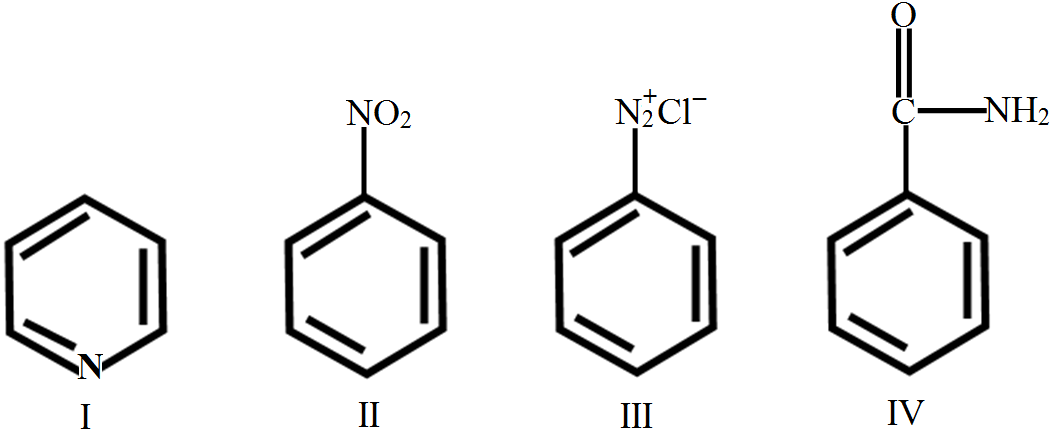
AnswerIt is suitable only for Benzamide (IV) because it can form ammonia on reaction with $\mathrm{H}_2 \mathrm{SO}_4$.
View full question & answer→Question 291 Mark
Which of the following compounds will not exist as resonance hybrid. Give reason for your answer:
$\mathrm{R}-\mathrm{CONH}_2$
Answer$\mathrm{R}-\mathrm{CONH}_2$: it shows resonance due to the presence of lone pair on N atom and $\pi$ electrons on C =0 bond,Hence amide can be represented by three resonating structures.
View full question & answer→Question 301 Mark
What is the basic principle of chromatography?
AnswerChromatography is based on the principle of differential adsorption due to difference in solubility. The substance which is less adsorbed will move faster and will get separated.
View full question & answer→Question 311 Mark
What are primary and secondary suffixes as applied to IUPAC nomenclature?
AnswerThe primary suffix indicates whether the carbon chain is saturated or unsaturated while the secondary suffix indicates the functional group present in the molecule.
View full question & answer→Question 321 Mark
Using curved arrow notation, show the formation of reactive intermediates when the following covalent bonds undergo heterolytic cleavage.
- $\text{CH}_3-\text{SCH}_3$
- $\text{CH}_3-\text{CN}$
- $\text{CH}_3-\text{Cu}$
Answer
- $\text{CH}_3-\text{SCH}_3\leftrightarrow\text{C}^-\text{H}_3+\stackrel{+}{\text{SCH}_3}$
- $\text{CH}_3-\text{CN}\leftrightarrow\stackrel{+ \ \ \ \ \ }{\text{CH}_3}+\text{CN}^-\\ \ \ \ \ \ \ \ \ \ \ \ \ \ \ \ \ \ \ \ \ \ \ \ \ _{\text{Carbocation}}$
- $\text{CH}_3-\text{Cu}\leftrightarrow\text{C}^-\text{H}_3+\text{Cu}^+\\ \ \ \ \ \ \ \ \ \ \ \ \ \ \ \ \ \ \ \ \ \ \ \ \ \ \ _{\text{Carbonion}}$
View full question & answer→Question 331 Mark
Name the process of separating benzoic acid and naphthalene.
AnswerFractional crystallisation using benzene as a solvent because both are soluble in benzene but to different extent. Naphthalene is more soluble, whereas benzoic acid is less soluble which will crystallise out first and after separating benzoic acid on further crystallization naphthalene will be obtained.
View full question & answer→Question 341 Mark
What is the state of hybridisation of carbon atoms in $\text{CH}_3-\text{CH}=\text{CH}_2?$
Answer$\text{CH}_3-\text{CH}=\text{CH}_2\\\ \ ^{\text{sp}^3}\ \ \ \ \ \ \ \ ^{\text{sp}^2}\ \ \ \ \ \ \ ^{\text{sp}^2}$
View full question & answer→Question 351 Mark
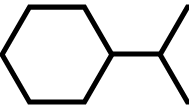
Write the $\text{IUPAC}$ name of Following?
-
- $\ \ \ \ \ \ \ \ \ \ \ \ \text{CH}_3\\\ _6\ \ \ \ \ \ \ \ \ \ _5|\ \ \ \ \ \ _4\ \ \ \ \ \ \ \ \ _3\ \ \ \ \ \ \ \ \ _2\ \ \ \ \ \ \ \ \ \ \ _1\\\text{CH}_3-\text{C}-\text{CH}=\text{CH}-\text{CH}_2-\text{COOH}\\\ \ \ \ \ \ \ \ \ \ \ \ \ \ |\ \ \ \ \ \\\ \ \ \ \ \ \ \ \ \ \ \ \text{CH}_3$
Answer
- $1-$Methyl ethyl cyclohexane.
- $5, 5-$dimethyl hex$-3-$enoic acid.
View full question & answer→Question 361 Mark
If we get blood red colouration on adding $\mathrm{FeSO}_4$ and dil. $\mathrm{H}_2 \mathrm{SO}_4$ to the sodium extract, what do you infer about the elements present in organic compound?
AnswerThe organic compound contains nitrogen and sulphur.
$\because\text{Na}+\text{S}+\text{C}+\text{N}\xrightarrow{\ \ \ \ \ \ \ }\text{NaSCN}$
$\text{Fe}^{3+}\text{NaSCN}\xrightarrow{\ \ \ \ \ }\text{Fe}(\text{SCN})_3+3\text{Na}^+\\\ \ \ \ \ \ \ \ \ \ \ \ \ \ \ \ \ \ \ \ \ \ \ \ \ \ \ \ \ \ _{\text{Ferric thiocyanate}}\\\ \ \ \ \ \ \ \ \ \ \ \ \ \ \ \ \ \ \ \ \ \ \ \ \ \ \ _{(\text{Blood red colouration)}}$
View full question & answer→Question 371 Mark
How many $\sigma\text{ and }\pi$ bonds are present in
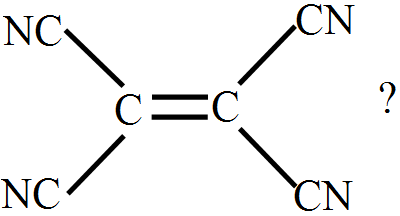
AnswerThere are $9\sigma\text{ and }9\pi$ bonds.
View full question & answer→Question 381 Mark
$\left(\mathrm{CH}_3\right)_3 \mathrm{C}^{+}$ is more stable than $(\text{CH}_3)_2\stackrel{{+}}{\hbox{C}}\text{H}.$ Explain why.
AnswerIt is due to more +1 effect (positive inductive effect) of three alkyl groups which are electron releasing groups, make it more stable than $2^{\circ}$ carbocation which has two electron releasing alkyl groups. Secondly, $\left(\mathrm{CH}_3\right)_3 \mathrm{C}^{+}$ is most stable due to hyperconjugation.
View full question & answer→Question 391 Mark
How many $\sigma$ and $\pi$ bonds gre there in,
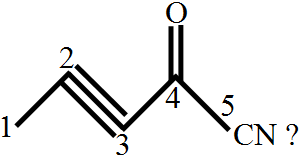
Answer$\ \ \ \ \ \ \ \ \text{H}\ \ \ \ \ \ \ \ \ \ \ \ \ \ \ \ \ \ \ \ \ \text{O}\\\ \ \ \ \ \ \ \ _1|\ \ \ \ \ \ _2\ \ \ \ \ \ _3\ \ \ \ \ _4||\ \ \ \ \ _5\\\text{H}-\text{C}-\text{C}\equiv\text{C}-\text{C}-\text{C}\equiv\text{N}\\ \ \ \ \ \ \ \ \ \ |\\ \ \ \ \ \ \ \ \ \text{H}$
There are $9\sigma$ bonds. $5\pi$ bonds [All single bonds are $\sigma$ bonds, double bonds have $1\sigma$ and $1\pi,$ Triple bonds have $1\sigma$ and $2\pi$ bonds].
View full question & answer→Question 401 Mark
Complete the following:$(\text{CH}_3\text{COO})_2\text{Pb}+\text{Na}_2\text{S}\xrightarrow{\ \ \ \ \ \ }$
Answer$(\text{CH}_3\text{COO})_2\text{Pb}+\text{Na}_2\text{S}\xrightarrow{\ \ \ \ \ \ }\text{PbS}+2\text{CH}_3\text{COONa}\\\ \ \ \ \ \ \ \ \ \ \ \ \ \ \ \ \ \ \ \ \ \ \ \ \ \ \ \ \ \ \ \ \ \ \ \ \ \ \ \ \ \ \ \ \ \ \ \ _{(\text{black ppt.)}}$
View full question & answer→Question 411 Mark
Write IUPAC name of the following organic compound:
$\text{CH}_3-\text{C}(\text{CH}_3)_2-\text{CH}=\text{CH}_2$
Answer$\ \ \ \ \ \ \ \ \ \ \ \ \text{CH}_3\\\ _4\ \ \ \ \ \ \ \ \ \ _3|\ \ \ \ \ \ _2\ \ \ \ \ \ \ \ \ _1\\\text{CH}_3-\text{C}-\text{CH}=\text{CH}_2\\ \ \ \ \ \ \ \ \ \ \ \ \ \ \ |\\\ \ \ \ \ \ \ \ \ \ \ \ \text{CH}_3\\\ \ \ \ _{3,3\text{Dimethylbut-1-ene}}$
View full question & answer→Question 421 Mark
Arrange the following in decreasing order of -I effect:
$-\text{Br},-\text{Cl},-\text{F}$
Answer$\text{F}>\text{Cl}>\text{Br}.$
View full question & answer→Question 431 Mark
Name the stationary and mobile phases in paper chromatography.
AnswerLiquid on paper is stationary phase and the solution of substance to be separated is mobile phase in paper chromatography.
View full question & answer→Question 441 Mark
Draw all position isomers of an alcohol with molecular formula, $\mathrm{C}_3\mathrm{H}_8\mathrm{O}$.
Answer$\text{CH}_3\text{CH}_2\text{CH}_2\text{OH}\\ \ \ \ \ \ \ _{\text{Propan-1-ol}}$ and $\text{CH}_3\text{CH(OH)CH}_3\\ \ \ \ \ \ \ \ \ _{\text{Propan-2-ol}}$
View full question & answer→Question 451 Mark
Identify the tertiary (3°) and quarternary (4°) carbon in,
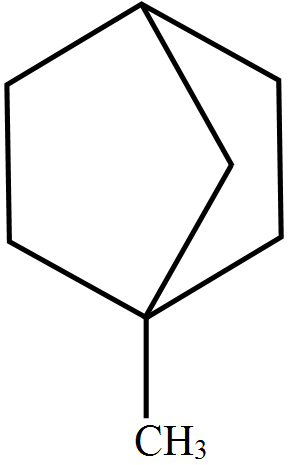
Answer
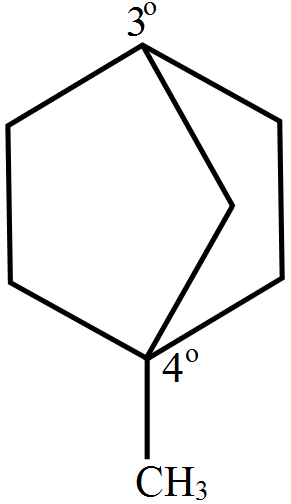
Tertiary 'C' is carbon attached to three more carbon atoms. 4° carbon is attached to four carbon atoms.
View full question & answer→Question 461 Mark
Write the correct stability order for the following carbocations.
$(\text{CH}_3)_3\stackrel{+ }{\text{CCH}}_2,(\text{CH}_3)_3\stackrel{+}{\text{C}},\text{CH}_3\text{CH}_2\stackrel{+ \ \ \ \ }{\text{CH}}_2$
AnswerThe order of stability of carbocation is 3° > 2° >1°.
$(\text{CH}_3)_3\stackrel{+}{\text{C}}>(\text{CH}_3)_3\stackrel{+ }{\text{CCH}}_2>\text{CH}_3\text{CH}_2\stackrel{+ \ \ \ \ }{\text{CH}}_2$
3° carbocation, i.e.$(\text{CH}_3)_3\stackrel{+}{\text{C}}$ is the most stable carbocation.
View full question & answer→Question 471 Mark
Lassaigne's test is not shown by diazonium salts, though they contain nitrogen. Why?
AnswerDiazonium salts $(\text{C}_{6}\text{H}_{5}\text{N}^{+}_{2}\text{X}^{-})$ readily lose $\mathrm{N}_2$ on heating before reacting with fused sodium metal. Therefore, these do not give positive Lassaigne's test for nitrogen.
View full question & answer→Question 481 Mark
Which of the following compounds will not exist as resonance hybrid. Give reason for your answer:
$\mathrm{CH}_3 \mathrm{CH}=\mathrm{CHCH}_2 \mathrm{NH}_2$
Answer$\mathrm{CH}_3 \mathrm{CH}=\mathrm{CHCH}_2 \mathrm{NH}_2$: As the lone pair of electrons on N atom, is not conjugated with the $\pi$ electrons of double bond.
Hence, it does not show resonance.
View full question & answer→Question 491 Mark
How will you separate a mixture of o-nitro phenol and p-nitrophenol?
AnswerA mixture of o-nitrophenol and p-nitrophenol can be separated by steam distillation, o-nitrophenol being less volatile distils over along with water while p-nitrophenol being non-volatile remains in the flask.
View full question & answer→Question 501 Mark
How are liquids with high boiling point or liquids which decompose at or below their normal boiling points, purified?
AnswerThey are purified by distillation under reduced pressure so that their boiling point is reduced and they do not decompose but get purified at lower boiling point.
View full question & answer→Question 511 Mark
Write the IUPAC name of:
$\ \ \ \ \ \ \ \ \ \ \ \ \ _4\ \ \ \ \ \ \ \ \ _3\ \ \ \ \ \ \ \ \ \ \ _2\ \ \ \ \ \ \ \ \ _1\\\text{CH}_3-\text{CH}-\text{CH}_2-\text{CH}-\text{COOH}\\\ \ \ \ \ \ \ \ \ \ \ \ _5|\ \ \ \ \ \ \ \ \ \ \ \ \ \ \ \ \ \ \ \ \ \ |\\\ \ \ \ \ \ \ \ \ \ \ \ \text{CHO}\ \ \ \ \ \ \ \ \ \ \ \ \ \ \ \text{CH}_3$
Answer2, 4-Dimethyl-5-oxopentanoic acid.
View full question & answer→Question 521 Mark
In the organic compound $\text{CH}_2=\text{CH}-\text{CH}_2-\text{CH}_2-\text{C}\equiv\text{CH}$, the pair of hybridised orbitals involved in the formation of $\mathrm{C}_2-\mathrm{C}_3$ bond is
AnswerWhen double and triple bonds are present at equivalent positions, then preference is given to double bond while numbering the carbon chain. Thus
$\stackrel{{1}}{\hbox{CH}_2}=\stackrel{{2}}{\hbox{CH}}-\stackrel{{3}}{\hbox{CH}_2}-\stackrel{{4}}{\hbox{CH}_2}-\stackrel{{5}}{\hbox{C}}\equiv\stackrel{{6}}{\hbox{CH}}\\ \text{sp}^2\ \ \ \ \ \ \text{sp}^2\ \ \ \ \ \ \ \text{sp}^3\ \ \ \ \ \ \ \text{sp}^3\ \ \ \ \ \ \ \text{sp}\ \ \ \text{sp}$
$\therefore \mathrm{C}_2-\mathrm{C}_3$ bond is formed by overlap of $\mathrm{sp}^2$ and $\mathrm{sp}^3$ orbitals.
View full question & answer→Question 531 Mark
Give $\text{IUPAC}$ name of following bond line formula:
-
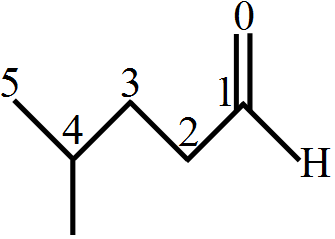
-
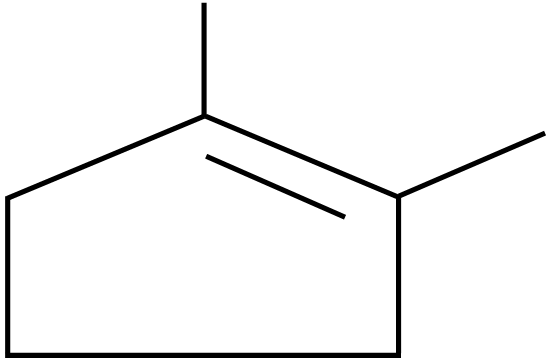
Answer
- $4-$methyl pentanal.
- $1, 2-$dimethyl cyclopentene.
View full question & answer→Question 541 Mark
Which of the following compounds will not exist as resonance hybrid. Give reason for your answer: $\mathrm{CH}_3 \mathrm{OH}$
Answer$\mathrm{CH}_3 \mathrm{OH}$: it dose not show resonance because of $\pi$ electrons.
View full question & answer→Question 551 Mark
What is the general molecular formula of saturated monohydric alcohols?
AnswerMonohydric alcohols are the compounds derived from alkane by replacing one hydrogen by -OH group. Therefore, the general molecular formula is $\text{C}_\text{n}\text{H}_\text{2n+1}\text{OH}$
$\text{C}_\text{n}\text{H}_\text{2n+2}\text{O}$ e.g.
$\text{CH}_4\xrightarrow[\text{-H}]{ +(-\text{OH})}\text{CH}_3-\text{OH}\\ \text{Methane}\ \ \ \ \ \ \ \ \ \text{Methanol}$
View full question & answer→Question 561 Mark
Arrange ethyne, ethene and ethane in the order of increasing acidity.
AnswerIn alkynes, due to higher electonegativity of 'sp' hybridised carbon, which is due to $50 \% \mathrm{~s}$-character, the hydrogen atom is less tightly held by the carbon and hence $\left(\mathrm{H}^{+}\right)$can be removed by a strong base. Therefore, alkynes are most acidic and alkanes are least.
$\text{CH}_3-\text{CH}_3<\text{CH}_2=\text{CH}_2<\text{HC}\equiv\text{CH}$ is increasing order of acidity.
View full question & answer→Question 571 Mark
Name the type of organic reaction involved in the following reaction.
$\mathrm{CH}_3 \mathrm{CH}_2 \mathrm{I}+\mathrm{KOH}(\mathrm{aq}) \rightarrow \mathrm{CH}_3 \mathrm{CH}_2 \mathrm{OH}+\mathrm{KI}$
AnswerThis is an example of nucleophilic substitution reaction because the nucleophile $\mathrm{I}^{-}$is replaced by the nucleophile $\mathrm{OH}^{-}$.
View full question & answer→Question 581 Mark
Identify electrophilic centre in the following compounds $\mathrm{CH}_3 \mathrm{CH}=\mathrm{O}, \mathrm{CH}_3 \mathrm{CN}, \mathrm{CH}_3 \mathrm{I}$.
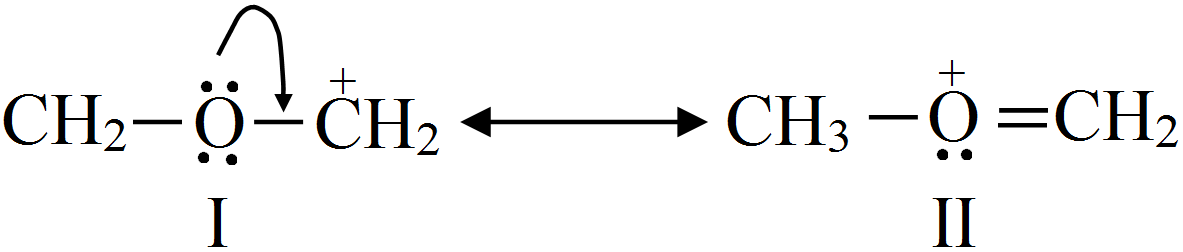
Answer$\text{CH}_3\underline{\text{C}}\text{H}=\text{O},\ \text{H}_3\text{C}\underline{\text{C}}\equiv\equiv\text{N},$ and $\text{H}_3\underline{\text{C}}-\text{I},$ the underlined carbon atoms are electrophilic centres as they will have partial positive charge due to polarity of the C-O or C-N or C-I bonds.
View full question & answer→Question 591 Mark
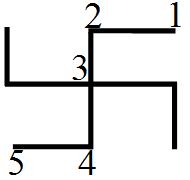
Write IUPAC name of the following compound.
Question 601 Mark
Why is fusion of an organic compound with sodium required?
AnswerIt is done so as to convert organic compound into inorganic compound which ionises in water and can be easily detected by suitable tests.
View full question & answer→Question 611 Mark
Which type of compounds are purified by steam distillation?
AnswerSteam volatile and insoluble in water.
View full question & answer→Question 621 Mark
Explain, why Lassaigne's solution is boiled with conc. $\mathrm{HNO}_3$ before testing for halogens?
AnswerIt is done so as to decompose NaCN to HCN and $\mathrm{Na}_2 \mathrm{S}$ to $\mathrm{H}_2 \mathrm{S}$ which are removed as gases otherwise they will interfere with the tests for halogens.
View full question & answer→Question 631 Mark
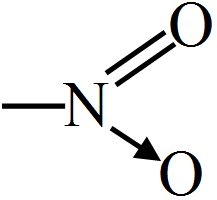
What is functional group of:
- Aldehyde,
- Nitro compound?
Answer
- $\ \ \ \ \text{O}\\\ \ \ \ ||\\-\text{C}-\text{H}$
-
View full question & answer→Question 641 Mark
Calculate number of sigma and pi bonds in 1,3-butadiene.
Answer$\text{CH}_1=\text{CH}-\text{CH}=\text{CH}_2$ There are $9\sigma$ and $2\pi$ bonds present in 1,3-butadiene.
View full question & answer→Question 651 Mark
How will you separate a mixture of o-nitrophenol and p-nitrophenol?
AnswerSteam distillation because o-nitrophenol is steam volatile due to weaker intramolecular H-bonding while p-nitrophenol is not steam volatile due to stronger inter molecular H-bonding.
View full question & answer→Question 661 Mark
Write the structure of compound that contains both 1° and 2° alcohol.
Answer$\text{CH}_2\text{OH}(1^\circ)\\ \ |\\\text{CHOH}(2^\circ)\\ \ |\\\text{CH}_2\text{OH}(1^\circ)$
View full question & answer→Question 671 Mark
What type of solids are separated by fractional crystallisation?
AnswerThose solids which are soluble in same solvent but to different extent, i.e. differ in their solubility. Less soluble component will crystallise out first which can be separated. On further crystallization, more soluble component will get crystallised.
View full question & answer→Question 681 Mark
Draw the resonance structures of the following compounds;

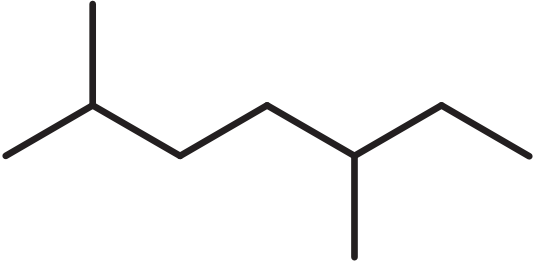
Question 691 Mark
Give the IUPAC names of the following compounds:
Question 701 Mark
Name two classes of compounds in which Kjeldahl's method cannot be used for estimation of nitrogen.
AnswerNitro compounds, azo compounds and compounds containing nitrogen in ring, e.g. pyridine, quinoline.
View full question & answer→Question 711 Mark
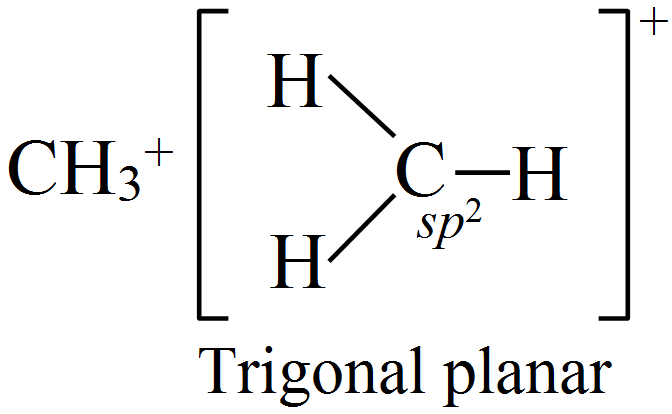
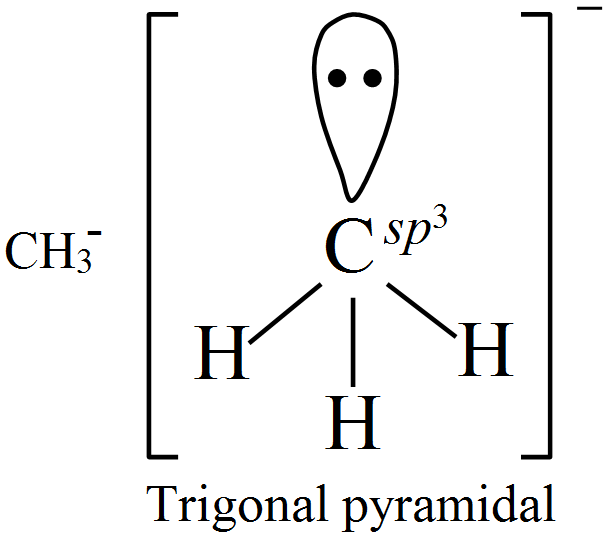
Give the structure and hybridisation of:
- $\text{CH}_3^+$
- $\text{CH}_3^-$
View full question & answer→Question 721 Mark
Explain, why an organic liquid vapourises at a temperature below its boiling point in its steam distillation?
AnswerIn steam distillation, the mixture consisting of the organic liquid and water boils when the sum of the vapour pressures of the organic liquid $\left(p_1\right)$ and that of water $\left(p_2\right)$ becomes equal to the atmospheric pressure $\left(p_1\right)$, i.e. $p=p_1+p_2$.
Since, $p_1$ is lower than $p$, the orgainc liquid vaporises at lower temperature than its boiling point.
View full question & answer→Question 731 Mark
Write structural formula of 3, 4, 4, 5-tetramethylheptane.
Answer$\ \ \ \ \ \ \ \ \ \ \ \ \ \ \ \ \ \ \ \ \ \ \ \ \ \ \ \ \ \ \ \ \ \ \ \text{CH}_3\\\ \ _1\ \ \ \ \ \ \ \ \ \ _2\ \ \ \ \ \ \ \ \ \ \ _3\ \ \ \ \ \ \ _4|\ \ \ \ \ \ \ _5\ \ \ \ \ \ \ \ \ _6\ \ \ \ \ \ \ \ \ \ _7\\\text{CH}_3-\text{CH}_2-\text{CH}-\text{C}-\text{CH}-\text{CH}_2-\text{CH}_3\\\ \ \ \ \ \ \ \ \ \ \ \ \ \ \ \ \ \ \ \ \ \ \ \ \ \ |\ \ \ \ \ \ \ \ \ \ |\ \ \ \ \ \ \ |\\\ \ \ \ \ \ \ \ \ \ \ \ \ \ \ \ \ \ \ \ \ \ \ \ \ \text{CH}_3\ \ \ \text{CH}_3\ \ \text{CH}_3\\\ \ \ \ \ \ \ \ \ \ \ \ \ \ \ \ \ \ \ \ \ _{3,4,4,5-\text{Tetramethylheptane}}$
View full question & answer→Question 741 Mark
How many o bonds and bonds are present in the second member of the alkene series?
AnswerThe second member of the alkene series is propene. The structural formula of the propene is
$ \ \ \ \ \ \ \ \ {\text{H}\ \ \ \ \ \text{H}\ \ \ \ \ \text{H}}\\\ \ \ \ \ \ \ \ \ |\ \ \ \ \ \ \ |\ \ \ \ \ \ \ |\\ \text{H}-\text{C}-\text{C}=\text{C}=\text{H}\\\ \ \ \ \ \ \ \ |\\\ \ \ \ \ \ \ \text{H}$
Number of $\sigma$ bond = 8
Number of $\pi$ bond = 1
View full question & answer→Question 751 Mark
What is the state of hybridisation of each carbon atom in $\text{C}_6\text{H}_6$?
View full question & answer→Question 761 Mark
The $R_f$ value of A and B in a mixture determined by TLC in a solvent mixture are 0.65 and 0.42 respectively. If the mixture is separated by column chromatography using the same solvent mixture on a mobile phase, which of the two components A or B will elute first? Explain.
Answer$R_f$ value of $A$ is 0.65 , therefore, it is less strongly adsorbed as compared to compound $B$ which has $R_f$ value of 0.42 .
Therefore, A will be eluted first.
View full question & answer→Question 771 Mark
Nitrogen present in nitrobenzene, azo compounds, 'N' present in ring cannot be estimated by _________.
AnswerNitrogen present in nitrobenzene, azo compounds, 'N' present in ring cannot be estimated by Kjeldahl's method.
View full question & answer→Question 781 Mark
Give the IUPAC name of the following compound:
$\text{CH}_3-\text{CH}_2-\text{CH}-\text{C}-\text{H}\\\ \ \ \ \ \ \ \ \ \ \ \ \ \ \ \ \ \ \ \ \ \ \ \ \ \ |\ \ \ \ \ \ \ \ \ ||\\ \ \ \ \ \ \ \ \ \ \ \ \ \ \ \ \ \ \ \ \ \ \ \ \ \ \text{CH}_3\ \ \ \text{O}$
Answer$\ _4\ \ \ \ \ \ \ \ \ \ \ _3\ \ \ \ \ \ \ \ \ \ _2\ \ \ \ \ \ \ \ \ _1\\\text{CH}_3-\text{CH}_2-\text{CH}-\text{C}-\text{H}\\\ \ \ \ \ \ \ \ \ \ \ \ \ \ \ \ \ \ \ \ \ \ \ \ \ \ |\ \ \ \ \ \ \ \ \ ||\\ \ \ \ \ \ \ \ \ \ \ \ \ \ \ \ \ \ \ \ \ \ \ \ \ \ \text{CH}_3\ \ \ \text{O}\\\ \ \ \ \ \ \ \ \ \ \ \ \ _{2-\text{Methylbutanal}}$
View full question & answer→Question 791 Mark
Give the IUPAC name of the following compound $\text{CH}_3-\text{CH}-\text{C}-\text{CH}-\text{CH}_3\\ \ \ \ \ \ \ \ \ \ \ \ \ \ \ | \ \ \ \ \ \ \ \ \ \| \ \ \ \ \ \ |\\ \ \ \ \ \ \ \ \ \ \ \ \ \ \text{Br} \ \ \ \ \ \ \text{O} \ \ \ \ \ \text{CH}_3$
Answer$\stackrel{{1} \ \ \ \ }{\hbox{CH}_3}-\stackrel{{2} \ \ \ }{\hbox{CH}}-\stackrel{{3} }{\hbox{C}}-\stackrel{{4} \ \ \ }{\hbox{CH}}-\stackrel{{5} \ \ \ \ }{\hbox{CH}_3}\\\ \ \ \ \ \ \ \ \ \ \ \ \ \ \ | \ \ \ \ \ \ \ \ \| \ \ \ \ \ \ |\\ \ \ \ \ \ \ \ \ \ \ \ \ \ \ \text{Br} \ \ \ \ \ \ \text{O} \ \ \ \ \ \text{CH}_3\\ _{2-\text{bromo-4-methyl pentan-3-one}}$
View full question & answer→Question 801 Mark
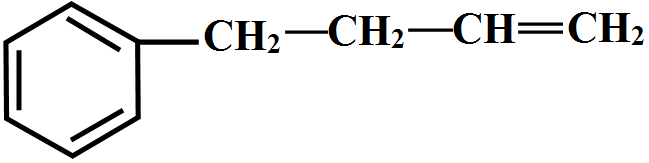
Write IUPAC name of the organic compound.
Question 811 Mark
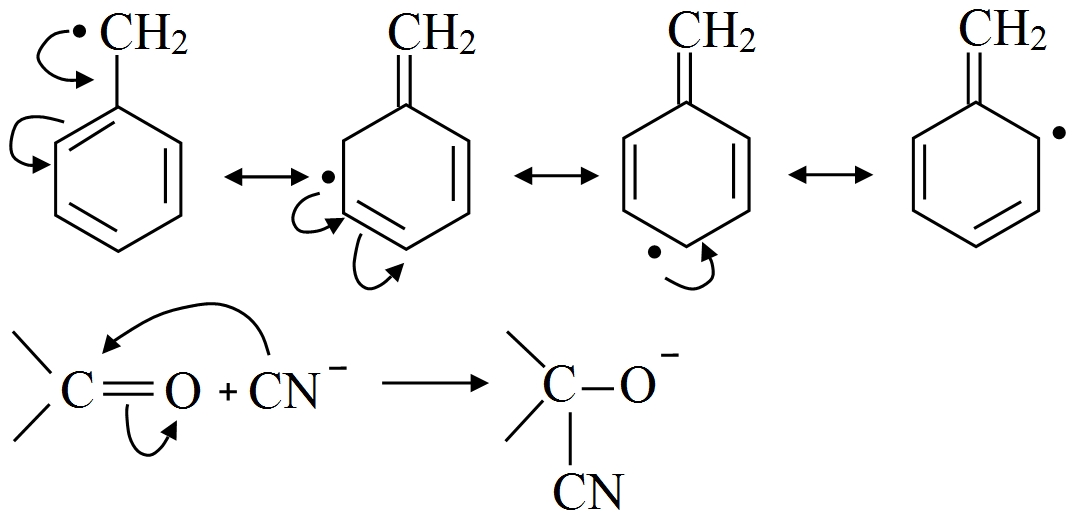
Why is benzylic free radical more stable than allylic free radical?
AnswerThis is due to more resonance of benzylic free radical.
View full question & answer→Question 821 Mark
Name the method used to purify aniline.
AnswerSteam distillation because it is steam volatile and immiscible with water.
View full question & answer→Question 831 Mark
$\text{CH}_2=\stackrel{- \ \ \ }{\text{CH}}$ is more basic than $\text{HC}\equiv\text{C}^-.$ Explain why?
Answer$\text{CH}_2=\stackrel{\text{sp}^2}{\text{CH}^-}$ $\text{HC}\equiv\stackrel{\text{sp}}{\text{C}^-}$
Since, sp-carbon is more electronegative than $\text{sp}^2$-carbon, therefore, $\text{CH}\equiv\text{C}^-$ is less willing to donate a pair of electrons than $\text{H}_2\text{C}=\text{CH}^-.$ In other words, $\text{H}_2\text{C}=\text{CH}^-$ is more basic than $\text{HC}\equiv\text{C}^-.$
View full question & answer→Question 841 Mark
Identify the most electronegative element in $\mathrm{CH}_2 \mathrm{FCl}$.
Answer'F' (fluorine) is most electronegative element.
View full question & answer→Question 851 Mark
How can you separate a mixture of three immiscible liquids having different boiling points?
AnswerWe can separate with the help of separating funnel due to difference in densities. As they differ in boiling points, the forces of attraction between molecules will be different, therefore, they will have different densities, hence they can be separated by differential extraction using separating funnel as these are immiscible.
View full question & answer→