Questions

3 Marks Question

Take a timed test

12 questions · self-marked practice — reveal the answer and mark yourself.

Question 13 Marks
A photon of wavelength $4 \times 10^{-7} m$ strikes on metal surface, the work function of the metal being 2.13 eV . Calculate (i) the energy of the photon (eV), (ii) the kinetic energy of the emission, and (iii) the velocity of the photoelectron ( $1 eV =1.6020 \times$ $\left.10^{-19} J\right)$.
Answer
(i) Energy of photons $E =h \nu=\frac{h c}{\lambda}$
$=\frac{6.626 \times 10^{-34} Js \times 3 \times 10^8 ms^{-1}}{4 \times 10^{-7} m}$
$=4.969 \times 10^{-19} J$
$=4.97 \times 10^{-19} J$
$E =\frac{4.97 \times 10^{-19}}{1.6020 \times 10^{-19}}=3.10 eV$
(ii) Energy $( E )=$ K.E. (Kinetic energy) + Work Function
K.E. $=$ E - Work Function
$=3.10-2.13=0.97 eV$
(iii) Kinetic Energy K.E. $=\frac{1}{2} m v ^2$
Velocity of $e ^{-}( v )=\sqrt{\frac{2 \cdot K E}{m}}$
K.E. $=0.97 eV =0.97 \times 1.602 \times 10^{-19} J$
$=0.97 \times 1.602 \times 10^{-19} kg m ^2 s^{-2}$
$v =\sqrt{\frac{2 \times 0.97 \times 1.602 \times 10^{-19} kg m ^2 s^{-2}}{9.1 \times 10^{-31} kg}}$
$v =5.84 \times 10^5 ms^{-1}$
View full question & answer
Question 23 Marks
Indicate the number of unpaired electrons in : (a) P (b) Si , (c) Cr (d) Fe and (e) Kr .
Answer
(a) ${ }_{15} P =1 s^2, 2 s^2, 2 p^6, 3 s^2, 3 p_x{ }^1, 3 p_y{ }^1$,$3 p_z^1($ unpaired electron $=3)$
(b) ${ }_{14} Si =1 s^2, 2 s^2, 2 p^6, 3 s^2, 3 p_x{ }^1$,$3 p_y^1($ unpaired electron $=2)$
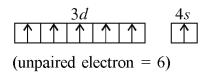
(c) ${ }_{24} Cr =1 s^2, 2 s^2, 2 p^6, 3 s^2, 3 p^6, 3 d^6, 4 s^1$
Image
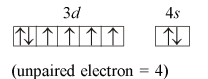
(d) ${ }_{26} Fe =1 s^2, 2 s^2, 2 p^6, 3 s^2, 3 p^6, 3 d^6, 4 s^2$
Image
(e) ${ }_{36} Kr =1 s^2, 2 s^2, 2 p^6, 3 s^2, 3 p^6, 3 d^{10}, 4 s^2, 4 p^6$$($ unpaired electron $=0)$
View full question & answer
Question 33 Marks
If the position of the electron is measured within an accuracy of $\pm 0.002 nm$, calculate the uncertainty in the momentum of the electron. Suppose the momentum of the electron is $\frac{h}{4 \pi_m \times 0.05 nm}$, is there any problem in defining this value.
Answer
Uncertainty in position, $\Delta x=0.002 nm=2 \times 10^{-3}$ $nm =2 \times 10^{-12} m$ and $h =6.626 \times 10^{-34} kg m ^2 s^{-1}$
According to Heisenberg's uncertainty principle
$\Delta x \times \Delta p=\frac{h}{4 \pi}$
Uncertainty in momentum $\Delta p=\frac{h}{4 \pi \Delta x}$
$\begin{array}{l}=\frac{6.626 \times 10^{-34} kg m ^2 s^{-1}}{4 \times 3.14 \times 2 \times 10^{-12} m} \\ =2.6377 \times 10^{-23} kg ms ^{-1} \\ =2.638 \times 10^{-23} kg ms ^{-1}\end{array}$
$\begin{aligned} \text { Actual momentum } & =\frac{h}{4 \pi \times 0.05 nm} \\ & =\frac{6.626 \times 10^{-34} kg m ^2 s^{-1}}{4 \times 3.14 \times 5 \times 10^{-11} m}\end{aligned}$
$
\left(0.05 nm=5 \times 10^{-11} m\right)=1.055 \times 10^{-24} kg ms^{-1}
$
This will not real momentum. Hence we can't define it because real value of momentum is very less than uncertainty.
View full question & answer
Question 43 Marks
Calculate the wavelength for the emission transition if it starts from the orbit having radius 1.3225 nm and ends at 211.6 pm . Name the series to which this transition belongs and the region of the spectrum.
Answer
Radius of $n ^{\text {th }}$ orbital $=\frac{52.9 n^2}{Z} Pm$
$\begin{array}{r}r_2=1.3225 nm=1322.5 Pm =52.9 n_2^2 Pm \\ ( Z =1)\end{array}$
$n _2^2=\frac{1322.5}{52.9}=25$
$n _2=5$
$r _1=211.5 Pm =52.9 n _1^2 Pm$
$n_1^2=\frac{211.6}{52.9}=4$
$n _1=2$
as $n _1=2, n _2=5$
Therefore this transition is related to Balmer series and is in visible region.
$\bar{v}=1.097 \times 10^7 m^{-1}\left(\frac{1}{n_1^2}-\frac{1}{n_2^2}\right)$
$\bar{v}=1.097 \times 10^7\left(\frac{1}{2^2}-\frac{1}{5^2}\right)$
$\bar{v}=1.097 \times \frac{21}{100} \times 10^7 m^{-1}$
$\lambda=\frac{1}{\bar{v}}=\frac{100}{1.097 \times 10^7 \times 21} m$
$=434 \times 10^{-9} m=434 nm$
View full question & answer
Question 53 Marks
The ejection of the photoelectron from the silver metal in the photoelectric effect experiment can be stopped by applying the voltage of 0.35 V when the radiation 256.7 nm is used. Calculate the work function for silver metal.
Answer
By 0.35 V , voltage we can stop the emission of photoelectrons. Hence kinetic energy of photoelectrons is equal to 0.35 V .
$\begin{aligned} \text { K.E. }=0.35 V & =0.35 \times 1.6 \times 10^{-19} J \\ & =0.56 \times 10^{-19} J\end{aligned}$
$E =h v=\frac{h c}{\lambda}, \lambda=256.7 nm=256.7 \times 10^{-9} m$
$\begin{array}{l}=\frac{6.626 \times 10^{-34} Js \times 3 \times 10^8 ms^{-1}}{256.7 \times 10^{-9} m} \\ =7.74 \times 10^{-19} J\end{array}$
$\begin{array}{r}\text { Energy of radiation }=\text { Work function }+ \text { K.E. of } \\ \text { photoelectron }\end{array}$
$h v= W _0+ K . E$.
Work function $W _0=h v- K$.E.
Work function $=7.74 \times 10^{-19} J-0.56 \times 10^{-19} J$
$\begin{array}{l}=7.74-0.56\left(10^{-19}\right) J \\ =7.18 \times 10^{-19} J\end{array}$
Work function $=\frac{7.18 \times 10^{-19}}{1.6 \times 10^{-19}} eV$
Work function $=4.48 eV$
View full question & answer
Question 63 Marks
Neon gas is generally used in the sign boards. If it emits strongly at 616 nm , calculate (a) the frequency of emission, (b) distance travelled by this radiation in 30 s , (c) energy of quantum and (d) number of quanta present if it produces 2 J of energy.
Answer
(a) Wavelength $(\lambda)=616 nm=616 \times 10^{-9} m$, velocity of light $c =3 \times 10^8 ms^{-1}$
Hence frequency $(v)=\frac{ c }{\lambda}=\frac{3 \times 10^8 ms^{-1}}{616 \times 10^{-9} m}$
$=4.87 \times 10^{14} s^{-1}$
$\begin{array}{l}\text { (b) Distance covered by radiation } \\ =\text { velocity } \times \text { time }\end{array}$
$\begin{array}{l}c=3 \times 10^8 ms^{-1}, t=30 s \\ =c \times t \\ =3 \times 10^8 ms^{-1} \times 30 s \\ =9 \times 10^9 m\end{array}$
(c) Energy of quantum $E =h v$
$
\begin{aligned}
h & =6.626 \times 10^{-34} Js, \quad v=4.87 \times 10^{14} s^{-1} \\
E & =6.626 \times 10^{-34} Js \times 4.87 \times 10^{14} s^{-1} \\
& =32.268 \times 10^{-20} J \\
& =32.27 \times 10^{-20} J
\end{aligned}
$
(d) Quantum no. $=\frac{\text { Total energy }}{\text { Energy of } 1 \text { quantum }}$
$\begin{array}{l}=\frac{2 J}{32.27 \times 10^{-20} J} \\ =6.19 \times 10^{18} \\ =6.2 \times 10^{18}\end{array}$
View full question & answer
Question 73 Marks
An ion with mass number 37 possess one unit of negative charge. If the ion contains $11.1 \%$ more neutrons than the electrons, find the symbol of the ion.
Answer
On ion there is one unit negative charge that is in ions number of electrons is one more than number of protons. Hence total number of electrons and neutrons $=37+1=38$.
Let number of electrons in this ion $=x$
$
\text { No. of neutrons in ion }=\frac{x+11.1 x}{100}=1.111 x
$
Total no. of electrons and neutrons in ion
$\begin{aligned}(38) & =x+1.111 x \\ 2.111 & =38\end{aligned}$
$\begin{array}{l}x=\frac{38}{2.111} \\ x=18\end{array}$
Hence no. of ions in electron $=18$
No. of protons $=18-1=17$
Atomic no. of element $=17$ and this element is chlorine.
Symbol of ion $={ }_{17}^{37} Cl ^{-}$
View full question & answer
Question 83 Marks
What transition in the hydrogen spectrum would have the same wavelength as the Balmer transition $n=4$ to $n=2$ of $He ^{+}$spectrum?
Answer
For any atom $=$ wavenumber $=\bar{v}$
$= R _{ H } Z ^2\left(\frac{1}{n_1^2}-\frac{1}{n_2^2}\right)$
For $He ^{+}$spectrum : $\frac{1}{\lambda}=v= R _{ H } \times 2^2$
$\left(\frac{1}{2^2}-\frac{1}{4^2}\right),\left( Z =2, n_1=2, n_2=4\right)$
$\begin{array}{l}\frac{1}{\lambda}= R _{ H } \times 4\left(\frac{1}{4}-\frac{1}{16}\right) \\ \frac{1}{\lambda}=4 R _{ H }\left(\frac{3}{16}\right)=\frac{3 R _{ H }}{4}\end{array}$
For hydrogen spectrum $\frac{1}{\lambda}=\frac{3 R_H}{4} \quad(Z=1)$
$\begin{array}{l}\frac{3 R _{ H }}{4}= R _{ H } \times 1\left(\frac{1}{n_1^2}-\frac{1}{n_2^2}\right) \\ \frac{3 R _{ H }}{4}= R _{ H } \times\left(\frac{1}{1^2}-\frac{1}{2^2}\right)\end{array}$
Hence $n_1=1$ and $n_2=2$
Therefore in hydrogen spectrum this transition will be similar to $n=2$ to $n=1$.
View full question & answer
Question 93 Marks
(i) An atomic orbital has $n=3$. What are the possible values of $l$ and $m_l$ ?
(ii) List the quantum number ( $m_l$ and $l$ ) of electrons for $3 d$ orbital.
(iii) Which of the following orbitals are possible? $1 p, 2 s, 2 p$ and $3 f$
Answer
(i) When $n =3$ then $l=0,1,2$ because $l=0$ to $(n-1)$
\begin{array}{ll}
\text { For } & l=0 ; m_{L}=0 \\
\text { For } & l=1 ; m_{L}=-1,0,+1 \\
\text { For } & l=2 ; m_{L}=-2,-1,0,+1,+2 \\
\text { (because } & m_{L}=-l \text { to } 0 \text { to }+l \text { ) }
\end{array}
(ii) For 3d orbital $l=2, m_{ L }=-2,-1,0,+1,+2$
(iii) 2 s and 2 p are possible because for $2 s, n =2$,$l=0$ (possible) and for $2 p , n =2, l=1$ (possible) but 1 p and 3f are not possible because for $1 p , n =1$ and $l=$ 1 which is not possible. Similarly for 3f, $n =3$ and $l= e$ will be there which is not possible because value of $n$ and $l$ can't be same.
View full question & answer
Question 103 Marks
(i) Write the electronic configurations of the following ions : (a) $H ^{-}$(b) $Na ^{+}$(c) $O ^{2-}$ (d) $F ^{-}$
(ii) What are the atomic numbers of elements whose outermost electrons are represented by (a) $3 s^1$ (b) $2 p^3$ and (c) $3 p^5$ ?
(iii) Which atoms are indicated by the following configurations?
(a) $[ He ] 2 s^1$
(b) $[ Ne ] 3 s^2 3 p ^3$
(c) $[ Ar ] 4 s^2 3 d^1$.
Answer
(i) (a) $H ^{-}(1+1=2$ electron $)=1 s^2$
(b) $Na ^{+}(11-1=10$ electron $)$
$
=1 s^2 2 s^2 2 p^6
$
(c) $O ^{2-}(8+2=10$ electron $)$
$
=1 s^2 2 s^2 2 p^6
$
(d) $F ^{-}(9+1=10$ electron $)$
$
=1 s^2 2 s^2 2 p^6
$
(ii) (a) $1 s^2 2 s^2 2 p^6 3 s^1=11$ electron<br>hence atomic number $=11$
(b) $1 s^2 2 s^2 2 p^3=7$ electron<br>hence atomic number $=7$
(c) $1 s^2 2 s^2 2 p^6 3 s^2 3 p^5=17$ electron
hence atomic number $=17$
(iii) (a) $[ He ] 2 s^1=3$ electron $= Li$ (Lithium)
(b) $[ Ne ] 3 s^2 3 p^3=15$ electron $= P$ (Phosphorus)
(c) $[ Ar ] 4 s^2 3 d^1=21$ electron $= Sc$ (Scandium)
View full question & answer
Question 113 Marks
What is the energy in joules, required to shift the electron of the hydrogen atom from the first Bohr orbit to the fifth Bohr orbit and what is the wavelength of the light emitted when the electron returns to the ground state? The ground state electron energy is $-2.18 \times 10^{-11}$ ergs.
View full question & answer
Question 123 Marks
How much energy is required to ionise a $H$ atom if the electron occupies $n = 5$ orbit? Compare your answer with the ionization enthalpy of H atom (energy required to remove the electron from $n=1$ orbit).
Answer
Energy of electron in first orbital of hydrogen
$
E_1=-2.18 \times 10^{-18} J / \text { atom }
$
$E _n=-\frac{2.18 \times 10^{-18}}{n^2} J /$ atom
$n=5$
Hence, $E_5=-\frac{2.18 \times 10^{-18}}{(5)^2} J /$ atom
$=8.72 \times 10^{-20} J /$ atom
Energy required to remove an electron from 5th orbital
$IE _5= E _{\infty}- E _5, \quad\left( E _{\infty}=0\right)$
$IE _5=0-\left(-8.72 \times 10^{-20} J\right)$
$IE _5=8.72 \times 10^{-20} J$
Hence energy required to remove an electron from $n =1$ orbital
$IE _1= E _{\infty}- E _1$
$=0-\left(-2.18 \times 10^{-18} J\right)$
$=2.18 \times 10^{-18} J$
Comparison of both ionisation enthalpy
$=\frac{ IE _5}{ IE _1}=\frac{8.72 \times 10^{-20} J}{2.18 \times 10^{-18} J}$
$=4 \times 10^{-2}$
View full question & answer