Questions

5 Marks Questions

🎯

Test yourself on this topic

8 questions · timed · auto-graded

Question 15 Marks
Solve for x, the inequalities Exercises.
$\frac{1}{|\text{x}|-3}\leq\frac{1}{2}$
Answer
Given that $\frac{1}{|\text{x}|-3}\leq\frac{1}{2}$
$\Rightarrow|\text{x}|-3\geq2$
$\Rightarrow|\text{x}|\geq5$ 
So, $\text{x}\in(-\infty, -5)\cup(5, \infty)\ ...(\text{i})$
Here $|\text{x}|-3\neq0$ 
$|\text{x}|-3<0$ or $|\text{x}|-3>0$ 
$|\text{x}|<3$ or $|\text{x}|>3$ 
$-3<\text{x}<3, \text{x}<-3, \text{x}>3\ ...(\text{ii})$ 
From in eq. (i) and (ii) we get
$\text{x}\in(-\infty, -5)\cup(-3, 3)\cup(5, \infty)$
View full question & answer
Question 25 Marks
The water acidity in a pool is considerd normal when the average pH reading of three daily measurements is between 8.2 and 8.5. If the first two pH readings are 8.48 and 8.35, find the range of pH value for the third reading that will result in the acidity level being normal.
Answer
Let the third pH value be x.
Given that first pH value = 8.48
Second pH value = 8.35
Average value of pH $=\frac{8.48+8.35+\text{x}}{3}$
But average value pf pH lies batween 8.2 and 8.5
⇒ 24.6 < 16.83 + x < 25.5
⇒ 24.6 - 16.83 < x < 25.5 - 16.83
⇒ 7.77 < x < 8.67
Hence, the thrid pH value lies between 7.77 and 8.67.
View full question & answer
Question 35 Marks
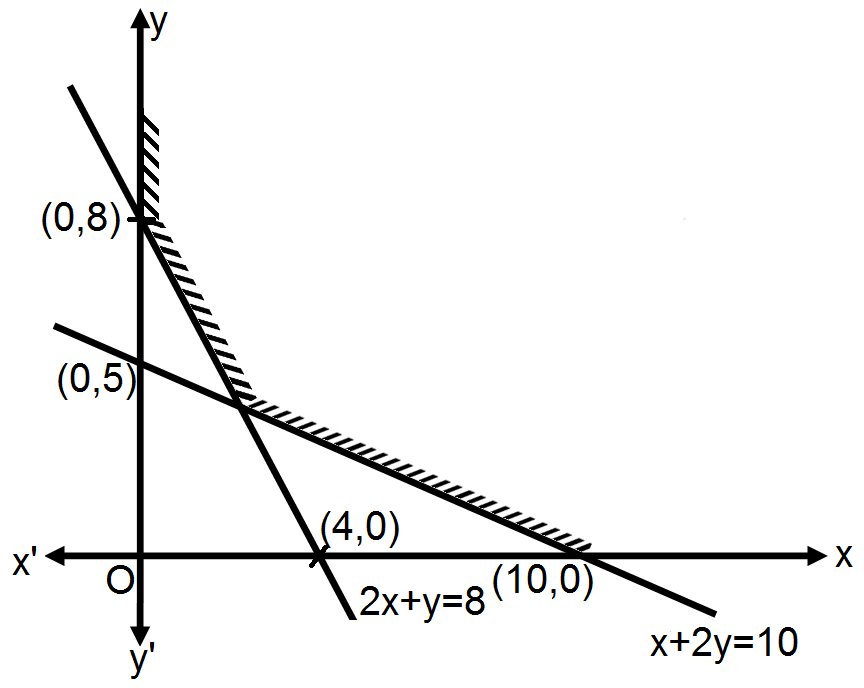
Show that the solution set of the following system of linear inequalities is an unbounded region: 2x + y > 8, x + 2y > 10, x > 0, y > 0.
Answer
We have 2x + y > 8, x + 2y > 10, x > 0, y > 0.
Line 2x + y = 8 passes through the points (0, 8) and (4, 0).
Line x + 2y = 10 passes through points (10, 0) and (0, 5).
For (0, 0), 2(0) + (0) – 8 < 0.
Therefore, the region satisfying the inequality 2x + y > 8 and (0, 0) lie on the opposite side of the line 2x + y = 8.
For (0, 0), (0) + 2(0) - 10 < 0.
Therefore, the region satisfying the inequality x + 2y > 10 and (0, 0) lie on the opposite side of the line x + 2y = 10.
Also, for x > 0, y > 0, region lies in the first quadrant.
The common region is plotted as shown in the following figure.
View full question & answer
Question 45 Marks
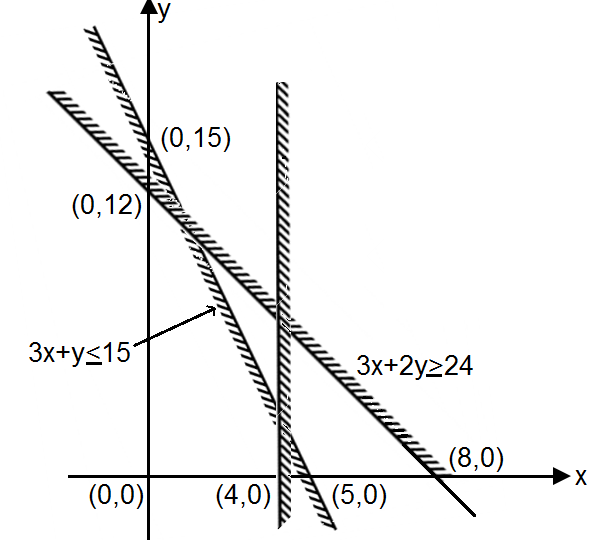
Solve the following system of linear inequalities: $3\text{x}+2\text{y}\geq24, 3\text{x}+\text{y}\leq15, \text{x}\geq4$ 
Answer
We have, $3\text{x}+2\text{y}\geq24, 3\text{x}+\text{y}\leq15, \text{x}\geq4$
Now let’s plot lines 3x + 2y = 24, 3x + y = 15 and x = 4 on the coordinate plane.
Line 3x + 2y = 24 passes through the points (0, 12) and (8, 0).
Line 3x + y = 15 passes through points (5, 0) and (0, 15).
Also line x = 4 is passing through the point (4, 0) and vertical.
For $ (0, 0), 3(0) + 2(0) – 24 \leq 0.$
Therefore, the region satisfying the inequality 3x + 2y > 24 and (0, 0) lie on the opposite of the line
3x + 2y = 24
For $(0), 3(0) + (0) – 15 \leq 0.$
Therefore, the region satisfying the inequality 3x + y = 15 and (0, 0) lie on th e same side of the line 3x + y = 15.
The region satisfying $\text{x}\geq4$ lies to the right hand side of the line x = 4.
These regions are plotted as shown in the following figure.
It is clear from the graph that there is no common region corresponding to these inequalities.
View full question & answer
Question 55 Marks
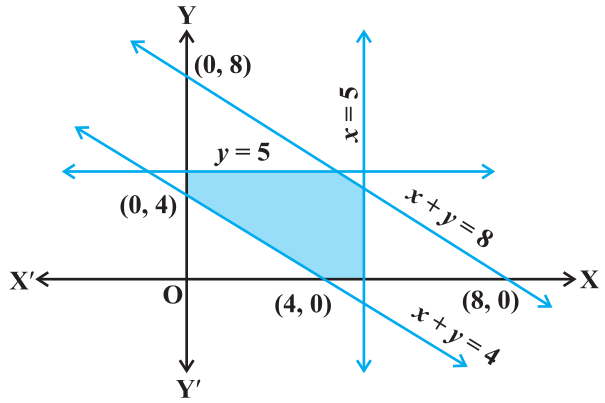
Find the linear inequalities for which the shaded region in the given figure is the solution set.
Answer
We observe that the shaded region and the origin are on the same side of the x + y = 8.
For (0, 0), we have 0 + 0 - 8 < 0. So, the shaded region satisfies the inquality x + 2 < 8.
The shaded region and the orign are on the opposite side of the line x + y = 4.
For (0, 0), we have 0 + 0 - 4 < 0. So, the shaded region satisfies the inequality x + 2 > 4.
Further, the shaded region and the origin are on the same side of the lines x = 5 and y = 5.
So, it satisfies the inequality x < 5 and y < 5.
Also, the shaded region lies in the first quadrant. So, x > 0, y > 0.
Thus, the liner in equation comprising the giver solution set are x + y > 4; x + y < 8; x < 5; y < 5 and y < 0.
View full question & answer
Question 65 Marks
A solution of 9% acid is to be diluted by adding 3% acid solution to it. The resulting mixture is to be more than 5% but less than 7% acid. If there is 460 litres of the 9% solution, how many litres of 3% solution will have to be added?
Answer
Let Off 3% solution be added 460 L of 9% solution of acid.
Then, total quantity of mixture = (460 + x) L
Total acid content in the (460 + x) L of maxture $=\Big(460\times\frac{9}{100}+\text{x}\times\frac{3}{100}\Big)$ 
It is given that acid content in the resulting mixture must be more than 5% but less than 7% acid.
$\Rightarrow5\%(460+\text{x})<460\times\frac{9}{100}+\frac{3\text{x}}{100}<7\%(460+\text{x})$ 
$\Rightarrow\frac{5}{100}\times(460+\text{x})<460\times\frac{9}{100}+\frac{3\text{x}}{100}<\frac{7}{100}\times(460+\text{x})$
 $\Rightarrow5\times(460+\text{x})<460\times9+3\text{x}<7\times(460+\text{x})$ 
$\Rightarrow2300+5\text{x}<4140+3\text{x}<3220+7\text{x}$ 
$\Rightarrow5\text{x}<1840+3\text{x}<920+7\text{x}$ 
$\Rightarrow2\text{x}<1840<920+4\text{x}$ 
$\Rightarrow\text{x}<920+4\text{x}$ 
$\Rightarrow\text{x}<920<230<\text{x}$ 
$\Rightarrow230<\text{x}<920$ 
Hence, the number of litres of the 3% solution of acid must be more than 230 and less than 920.
View full question & answer
Question 75 Marks
Solve the following system of inequalities.
$\frac{2\text{x}+1}{7\text{x}-1}>5, \frac{\text{x}+7}{\text{x}-8}>2$
Answer
We have$\frac{2\text{x}+1}{7\text{x}-1}>5, \frac{\text{x}+7}{\text{x}-8}>2$
Now,
$\frac{2\text{x}+1}{7\text{x}-1}-5>0$ 
$\Rightarrow\frac{(2\text{x}+1)-5(7\text{x}-1)}{7\text{x}-1}>0$
$\Rightarrow\frac{2\text{x}+1-35\text{x}+5}{7\text{x}-1}>0$
$\Rightarrow\frac{-33\text{x}+6}{7\text{x}+1}>0$ 
$\Rightarrow\frac{11\text{x}-2}{7\text{x}+1}<0$ 
$\Rightarrow11\text{x}-2<0$ and $7\text{x}-1>0$ or $11\text{x}-2>0$ and $7\text{x}-1<0$
$\Rightarrow\text{x}<\frac{2}{11}$ and $\text{x}>\frac{1}{7}$ or $\text{x}>\frac{2}{11}$ and $\text{x}<\frac{1}{7}$
Also,
$\Rightarrow\frac{\text{x}+2}{\text{x}-8}>2$ 
$\Rightarrow\frac{\text{x}+2}{\text{x}-8}-2>0$ 
$\Rightarrow\frac{\text{x}+7-(\text{x}+8)}{\text{x}-8}>0$ 
$\Rightarrow\frac{\text{x}+7-2\text{x}+16}{\text{x}-8}>0$ 
$\Rightarrow\frac{-\text{x}+23}{\text{x}-8}>0$ 
$\Rightarrow\frac{\text{x}-23}{\text{x}-8}<0$ 
$\Rightarrow\text{x}<23$ and $\text{x}>8$ or $\text{x}-23>0$ and $\text{x}-8<0$ 
$\Rightarrow\text{x}\in(8,23)$ 
we can find that there is no common set of values of x.
So, that given system of equation has no solution.
View full question & answer
Question 85 Marks
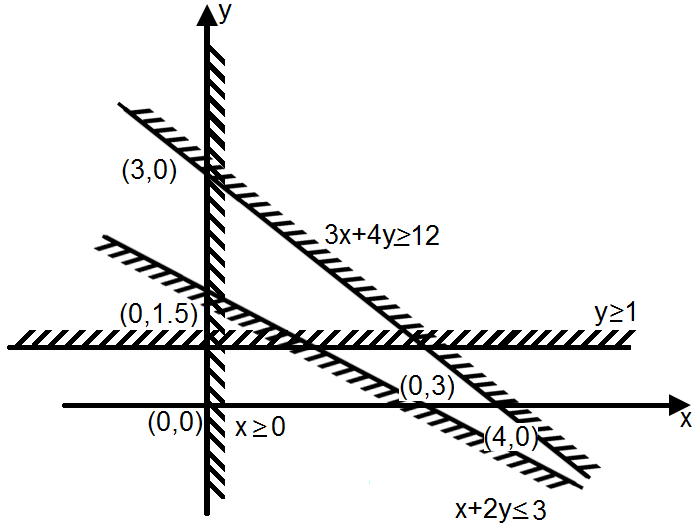
Show that the following system of linear inequalities has no solution: x + 2y < 3, 3x + 4y > 12, x > 0, y > 1.
Answer
We have x + 2y < 3, 3x + 4y > 12, x > 0, y > 1
Now let's plot lines x + 2y = 3, 3x + 4y = 12, x = 0 and y = 1 in coordinate plan.
Line x + 2y = 3 passes through the points $(0, \frac{3}{2})$ and (3, 0).
Line 3jc + 4y = 12 passes through points (4, 0) and (0, 3).
For (0, 0), 0 + 2(0) - 3 < 0.
Therefore, the region satisfying the inequality x + 2y < 3 and (0, 0) lie on the same of the line x + 2y = 3.
For (0, 0), 3(0) + 4(0) - 12 < 0.
Therefore, the region satisfying the inequality 3x + 4y > 12 and (0, 0) lie on the opposite side of the line 3x + 4y = 12.
The region satisfying x > 0 lies to the right hand side of the y-axis.
The region satisfying y > 1 lies above the line y = 1.
These regions are plotted as shown in the following figure.
It is clear from the graph thet the shaded portions do not have common region. So, solution set is null set.
View full question & answer
5 Marks Questions - MATHS STD 11 Science Questions - Vidyadip