Questions

3 Marks Question

🎯

Test yourself on this topic

9 questions · timed · auto-graded

Question 13 Marks
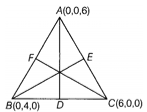
Find the lengths of the medians of the triangle with vertices A (0, 0, 6), B (0, 4, 0) and C (6, 0, 0).
View full question & answer
Question 23 Marks
There are 200 individuals with a skin disorder, 120 had been exposed to the chemical $C_1, 50$ to chemical $C_2$ and 30 to both the chemicals $C _1$ and $C _2$. Find the number of individuals exposed to (i) chemical $C _1$ but not chemical $C _2$ (ii) Chemical $C _2$ but not chemical $C _1$ (iii) Chemical $C _2$ or chemical $C _1$.
Answer
Let S denote the universal set consisting of individuals suffering from the skin disorder, A denote the set of individuals exposed to chemical $C _1$ and B denote the set of individuals exposed to chemical $C _2$.
Now,
n(S) = 200
n(A) = 120
n(B) = 50 
and $n(A \cap B)=30$
i. Chemical $C _1$ but not chemical $C _2$
Number of individuals exposed to chemical $C _1$ but not chemical $C _2$ is
$\begin{array}{l}=n\left(A \cap B^{\prime}\right) \\ 
= n ( A )-n(A \cap B) \\ 
=120-30=90\end{array}$
ii. Number of individuals exposed to chemical $C _2$ but not chemical $C _1$
$\begin{array}{l}=n\left(A^{\prime} \cap B\right) \\ 
= n ( B )- n ( A \cap B ) \\ 
=50-30=20\end{array}$
iii. Number of individuals exposed to chemical $C_1$ or chemical $C_2$
$\begin{array}{l}=n(A \cup B) \\ 
= n ( A )+ n ( B )- n ( A \cap B ) \\ 
=120+50-30 \\ 
=140\end{array}$
View full question & answer
Question 33 Marks
Express the complex number $\left(-2-\frac{1}{3} i\right)^3$ in the form of $a+i b$.
Answer

$\begin{array}{l}\left(-2-\frac{1}{3} i\right)^3=-\left(2+\frac{1}{3} i\right)^3 \\ 
=-\left[(2)^3+\left(\frac{1}{3} i\right)^3+3 \times(2)^2 \times \frac{1}{3} i+3 \times 2 \times\left(\frac{1}{3} i\right)^2\right]\end{array}$
$\begin{array}{l}=-\left[8+\frac{1}{27} i^3+4 i+\frac{2}{3} i^2\right]=-\left[8-\frac{1}{27} i+4 i-\frac{2}{3}\right]\left[\begin{array}{c}\because i^3=-i \\ i^2=-1\end{array}\right] \\
=\left[\left(8-\frac{2}{3}\right)+\left(4-\frac{1}{27}\right) i\right. \\ 
=-\left[\frac{22}{3}+\frac{107}{27} i\right]=\frac{-22}{3}-\frac{107}{27} i\end{array}$
View full question & answer
Question 43 Marks
Find $(a+b)^4-(a-b)^4$. Hence, evaluate $(\sqrt{3}+\sqrt{2})^4-(\sqrt{3}-\sqrt{2})^4$
Answer

$\begin{array}{l}( a + b )^4=\left[{ }^4 C_0 a^4+{ }^4 C_1 a^3 b+{ }^4 C_2 a^2 b^2+{ }^4 C_3 a b^3+{ }^4 C_4 b^4\right] \\ 
\text { and }(a-b)^4=\left[{ }^4 C_0 a^4-{ }^4 C_1 a^3 b+{ }^4 C_2 a^2 b^2-{ }^4 C_3 a b^3+{ }^4 C_4 b^4\right] \\ 
\therefore(a+b)^4-(a-b)^4=2\left[{ }^4 C_1 a^3 b+{ }^4 C_3 a b^3\right] \\ 
=2\left[4 a^3 b+4 a b^3\right]=8 a b\left[a^2+b^2\right] \\ 
\therefore(\sqrt{3}+\sqrt{2})^4-(\sqrt{3}-\sqrt{2})^4=8 \cdot \sqrt{3} \cdot \sqrt{2}\left[(\sqrt{3})^2+(\sqrt{2})^2\right] \\ 
=8 \cdot \sqrt{3} \cdot \sqrt{2}[3+2]=40 \cdot \sqrt{3} \cdot \sqrt{2}=40 \sqrt{6}\end{array}$
View full question & answer
Question 53 Marks
Find the square root of 3 - 4i
Answer
Let $x + yi =\sqrt{3-4 i}$
Squaring both sides, we get
$x^2-y^2+2 x y i=3-4 i$
Equating the real and imaginary parts
$x^2-y^2=3 \ldots . \text { (i) }$
and $2 x y=-4 \Rightarrow x y=-2$
Now from the identity, we know
$\begin{array}{l}\left(x^2+y^2\right)=\left(x^2-y^2\right)^2+4 x^2 y^2 \\ 
\left(x^2+y^2\right)^2=(3)^2+4(-2)^2 \\ 
=9+16=25\end{array}$
$\therefore x^2+y^2=5 \ldots$ (ii) [Neglecting (-) sign as $\left.x^2+y^2>0\right]$
Solving (i) and (ii) we get 
$\begin{array}{l} x ^2=4 \text { and } y ^2=1 \\ 
x= \pm 2 \text { and } y= \pm 1\end{array}$
Since the sign of xy is negative 
$\begin{array}{l}\therefore \text { if, } x =2, y =-1 \\ 
\text { and if } x =-2, y =1 \\ 
\therefore \sqrt{-5+12 i}= \pm(2-i)\end{array}$
View full question & answer
Question 63 Marks
Using binomial theorem, expand: $\left(\frac{2 x}{3}-\frac{3}{2 x}\right)^6$
Answer
To find: Expansion of $\left(\frac{2 x}{3}-\frac{3}{2 x}\right)^6$ by means of binomial theorem 
Formula used: ${ }^n C_r=\frac{n!}{(n-r)(r)!}$
$(a+b)^{n}={ }^n C_0 a^n+{ }^n C_1 a^{n-1} b+{ }^n C_2 a^{n-2} b^2+\ldots \ldots+{ }^n C_{n-1} a b^{n-1}+n C_n b^n$
Now here We have, $\left(\frac{2 x}{3}-\frac{3}{2 x}\right)^6$
$\begin{array}{l}=\left[6 c_0\left(\frac{2 x}{3}\right)^{6-0}\right]+\left[6 c_1\left(\frac{2 x}{3}\right)^{6-1}\left(-\frac{3}{2 x}\right)^1\right]+\left[6 c_2\left(\frac{2 x}{3}\right)^{6-2}\left(-\frac{3}{2 x}\right)^2\right] \\ +\left[6 c_3\left(\frac{2 x}{3}\right)^{6-3}\left(-\frac{3}{2 x}\right)^3\right]+\left[6 C _4\left(\frac{2 x}{3}\right)^{6-4}\left(-\frac{3}{2 x}\right)^4\right] \\ +\left[6 c_5\left(\frac{2 x}{3}\right)^{6-5}\left(-\frac{3}{2 x}\right)^5\right]+\left[6 c_6\left(-\frac{3}{2 x}\right)^6\right] \\ =\left[\frac{6!}{01(6-0)!}\left(\frac{2 x}{3}\right)^6\right]-\left[\frac{6!}{11(6-1)!}\left(\frac{2 x}{3}\right)^5\left(\frac{3}{2 x}\right)\right]+\left[\frac{6!}{2!(6-2)!}\left(\frac{2 x}{3}\right)^4\left(\frac{9}{4 x^2}\right)\right]-\left[\frac{6!}{3!(6-3)!}\left(\frac{2 x}{3}\right)^3\left(\frac{27}{8 x^3}\right)\right] \\ +\left[\frac{6!}{4!(6-4)!}\left(\frac{2 x}{3}\right)^2\left(\frac{81}{16 x^4}\right)\right]-\left[\frac{6!}{5!(6-5)!}\left(\frac{2 x}{3}\right)^1\left(\frac{243}{32 x^5}\right)\right]+\left[\frac{6!}{6!(6-6)!}\left(\frac{729}{64 x^6}\right)\right] \\ =\left[1\left(\frac{64 x^5}{729}\right)\right]-\left[6\left(\frac{32 x^5}{243}\right)\left(\frac{3}{2 x}\right)\right]+\left[15\left(\frac{16 x^4}{81}\right)\left(\frac{9}{4 x^2}\right)\right]-\left[20\left(\frac{8 x^3}{27}\right)\right] \\ \left.\left(\frac{27}{8 x^3}\right)\right]+\left[15\left(\frac{4 x^2}{9}\right)\left(\frac{81}{16 x^4}\right)\right]-\left[6\left(\frac{2 x}{3}\right)\left(\frac{243}{32 x^5}\right)\right]+\left[1\left(\frac{729}{64 x^6}\right)\right] \\ =\frac{64}{729} x^6-\frac{32}{27} x^4+\frac{20}{3} x^2-20+\frac{135}{4} \frac{1}{x^2}-\frac{243}{8} \frac{1}{x^4}+\frac{729}{64} \frac{1}{x^6}\end{array}$

View full question & answer
Question 73 Marks
Find the point on the y-axis which is equidistant from the points A(3, 1, 2) and B(5, 5, 2).
Answer
Consider, C(0, y, 0) point which lies on the y-axis and is equidistant from points A(3, 1, 2) and B(5, 5, 2). 
$\begin{array}{l}\therefore AC = BC \\
\sqrt{(0-3)^2+(y-1)^2+(0-2)^2}=\sqrt{(0-5)^2+(y-5)^2+(0-2)^2}\end{array}$
Squaring both sides, 
$\begin{array}{l}\Rightarrow(0-3)^2+(y-1)^2+(0-2)^2=(0-5)^2+(y-5)^2+(0-2)^2 \\ \Rightarrow 9+y^2-2 y+1+4=25+y^2-10 y+25+4 \\ 
\Rightarrow 8 y=40 \\
\Rightarrow y=5\end{array}$
The coordinate of C is (0, 5, 0).
View full question & answer
Question 83 Marks
To receive Grade A, in a mathematics course, one must obtain an average of 90 marks or more in five examinations (each of 100 marks). If Ragini's marks in first four examinations are 87, 92, 94 and 95, find minimum marks that Ragini must obtain in fifth examination to get Grade A in the course.
Answer
Let the marks obtained by Ragini in fifth examination be x.
Then average of five examinations $=\frac{87+92+94+95+x}{5}$ 
Now $\frac{87+92+94+95+x}{5} \geq 90 \Rightarrow \frac{368+x}{5} \geq 90$
Multiplying both sides by 5, we have 
$\begin{array}{l}368+x \geq 450 \\ 
\Rightarrow x \geq 450-368 \\
\Rightarrow x \geq 82\end{array}$
Thus the minimum marks needed to be obtained by Ragini = 82.
View full question & answer
3 Marks Question - MATHS STD 11 Science Questions - Vidyadip