Questions

5 Marks Questions

🎯

Test yourself on this topic

6 questions · timed · auto-graded

Question 15 Marks
Show that the equation $x^2-2 y^2-2 x+8 y-1=0$ represents a hyperbola. Find the coordinates of the centre, lengths of the axes, eccentricity, latusrectum, coordinates of foci and vertices and equations of directrices of the hyperbola.
Answer
We have, 
$x^2-2 y^2-2 x+8 y-1=0$
$\begin{array}{l}\Rightarrow\left(x^2-2 x\right)-2\left(y^2-4 y\right)=1 \\ \Rightarrow\left(x^2-2 x+1\right)-2\left(y^2-4 y+4\right)=-6 \\ \Rightarrow(1-x)^2-2(y-2)^2=-6 \\ \Rightarrow \frac{(x-1)^2}{(\sqrt{6})^2}-\frac{(y-2)^2}{(\sqrt{3})}=-1 \ldots \text { (i) }\end{array}$
Shifting the origin at (1, 2) without rotating the coordinate axes and denoting the new coordinates with respect to these axes by X
and Y, we obtain 
x = X + 1 and y = Y + 2 ... (ii)
Using these relations, equation (i) reduces to  
$\frac{X^2}{(\sqrt{6})^2}-\frac{Y^2}{(\sqrt{3})^2}=-1 \ldots$ (iii)
Comparing equation (iii) with standard form $\frac{x^2}{a^2}-\frac{y^2}{b^2}=-1$, we get
$\begin{array}{l}a^2=(\sqrt{6})^2 \text { and } b^2=(\sqrt{3})^2 \\ a=(\sqrt{6}) \text { and } b=(\sqrt{3})\end{array}$
Centre
The coordinates of the centre with respect to the new axes are (X = 0, Y = 0).
So, the coordinates of the centre with respect to the old axes are 
$(1,2)[$ Putting $X =0, Y =0$ in (ii)]
Lengths of the axes: 
$\therefore$ Transverse axis $=2 b=2 \sqrt{3}$ and, Conjugate axis $=2 a =2 \sqrt{6}$.
Eccentricity:  
$e=\sqrt{1+\frac{a^2}{b^2}}=\sqrt{1+\frac{6}{3}}=\sqrt{3}$
Latusrectum: 
Foci: 
The coordinates of foci with respect to the new axes are ( $X=0, Y= \pm$ be) i.e. $(X=0, y= \pm 3$ ). So, the coordinates of foci with respect to the old axes are
$(1,2 \pm 3)$ i.e. $(1,5)$ and $(1,-1)[$ Putting $X=0, y= \pm 3$ in (ii)]
Directrices: 
The coordinates of the vertices with respect to the new axes are $X=0, Y= \pm b)$ i.e. $(x=0, y= \pm \sqrt{3})$ So, the coordinates of the vertices with respect to the old axes are $(1,2 \pm \sqrt{3})$ i.e. $(1,2+\sqrt{3})$ and $(1,2-\sqrt{3})$ [Putting $X=0, Y= \pm \sqrt{3}$ in (ii)]
Directrices:
The equations of the directrices with respect to the new axes are $Y = \pm \frac{b}{e}$ i.e. $y = \pm 1$.
So, the equations of the directrices with respect to the old axes are $y=2 \pm 1$ i.e. $y=1$ and $y=3[$ Putting $Y= \pm 2$ in (ii) $]$
View full question & answer
Question 25 Marks
From the frequency distribution consisting of 18 observations, the mean and the standard deviation were found to be 7 and 4, respectively. But on comparison with the original data, it was found that a figure 12 was miscopied as 21 in calculations. Calculate the correct mean and standard deviation.
Answer
Mean = 7
$\begin{array}{l}\therefore \frac{\sum x_i}{18}=7[\because n =18] \\ \Rightarrow \sum x_i=18 \times 7=126\end{array}$
Since, an observation 12 was miscopied as 21. 
$\therefore$ Correct $\sum x_i=126-21+12=117$
Hence, true mean $=\frac{\operatorname{Correct} \sum x_i}{18}=\frac{117}{18}=6.5$
Also, given variance $=4^2=16$
$\begin{array}{l}\therefore \frac{\sum x_i^2}{18}-(\text { Mean })^2=16 \\ \Rightarrow \frac{\sum x_i^2}{18}=16+(\text { Mean })^2=16+(7)^2 \\ \Rightarrow \frac{\sum x_i^2}{18}=16+49 \\ \Rightarrow \sum x_i^2=18 \times 65=1170\end{array}$
But one observation 12 was miscopied as 21. 
Correct $\sum x_i^2=1170-21^2+12^2=1170-441+144=873$
Hence, correct variance $=\frac{\text { Carrect } \sum x_i^2}{18}-(\text { Correct mean })^2$
$=\frac{873}{18}-(6.5)^2=48.5-42.25=6.25$
$\begin{array}{l}\therefore \text { Correct standard deviation }=\sqrt{\text { Correct variance }} \\ =\sqrt{6.25}=2.5\end{array}$
View full question & answer
Question 35 Marks
Prove that: $\sin 5 x=5 \sin x-20 \sin ^3 x+16 \sin ^5 x$.
Answer
We have to prove that $\sin 5 x=5 \sin x-20 \sin ^3 x+16 \sin ^5 x$.
Let us consider LHS = sin 5x 
sin 5x = sin(3x + 2x) 
But we know, 
sin(x + y) = sin x cos y + cos x sin y ... (i) 
$\begin{array}{l}\Rightarrow \sin 5 x=\sin 3 x \cos 2 x+\cos 3 x \sin 2 x \\ \Rightarrow \sin 5 x=\sin (2 x+x) \cos 2 x+\cos (2 x+x) \sin 2 x \ldots \text { (ii) }\end{array}$
and
cos (x + y) = cos(x)cos(y) - sin(x)sin(y) ... (iii)
Now substituting equation (i) and (iii) in equation (ii), we get 
$\begin{array}{l}\Rightarrow \sin 5 x=(\sin 2 x \cos x +\cos 2 x \sin x ) \cos 2 x +(\cos 2 x \cos x -\sin 2 x \sin x ) \sin 2 x \\ \Rightarrow \sin 5 x =\sin 2 x c cop text \\ \Rightarrow \sin 5 x +\left(\sin 2 x \cos 2 x \cos x -\sin ^2 2 x \sin 2 x \right) \\ \text { Now } \sin 2 x =2 x \sin x \cos x +\cos ^2 2 x \sin x -\sin ^2 2 x \sin x \ldots \text { (iv) } \\ \text { And } \cos 2 x =\cos ^2 x -\sin ^2 x \ldots \text { (vi) }\end{array}$
Substituting equation (v) and (vi) in equation (iv), we get 
$\begin{array}{l}\Rightarrow \sin 5 x=2(2 \sin x \cos x)\left(\cos ^2 x-\sin ^2 x\right) \cos x+\left(\cos ^2 x-\sin ^2 x\right)^2 \sin x-(2 \sin x \cos x)^2 \sin x \\ \Rightarrow \sin 5 x=4\left(\sin x \cos ^2 x\right)\left(\left[1-\sin ^2 x\right]-\sin ^2 x\right)+\left(\left[1-\sin ^2 x\right]-\sin ^2 x\right)^2 \sin _x x \\ -\left(4 \sin ^2 x \cos ^2 x\right) \sin _x\left(\operatorname{as} \cos ^2 x+\sin ^2 x=1 \Rightarrow \cos ^2 x=\right. \ \left.1-\sin ^2 x\right) \\ \Rightarrow \sin 5 x=4\left(\sin x\left[1-\sin ^2 x\right]\right)\left(1-2 \sin ^2 x\right)+\left(1-2 \sin ^2 x\right)^2 \sin x-4 \sin ^3 x\left[1-\sin ^2 x\right] \\ \Rightarrow \sin 5 x=4 \sin x\left(1-\sin ^2 x\right)\left(1-2 \sin ^2 x\right)+\left(1-4 \sin ^2 x+4 \sin ^4 x\right) \sin x-4 \sin ^3 x+4 \sin ^5 x \\ \Rightarrow \sin 5 x=\left(4 \sin x-4 \sin ^3 x\right)\left(1-2 \sin ^2 x\right)+\sin x-4 \sin ^3 x+4 \sin ^5 x-4 \sin ^3 x+4 \sin ^5 x \\ \Rightarrow \sin 5 x=4 \sin x-8 \sin ^3 x-4 \sin ^3 x+8 \sin ^5 x+\sin x-8 \sin ^3 x+8 \sin ^5 x \\ \Rightarrow \sin 5 x=5 \sin x-20 \sin ^3 x+16 \sin ^5 x\end{array}$
Hence LHS = RHS
Hence proved.

View full question & answer
Question 45 Marks
Prove that $\cos 12^{\circ}+\cos 60^{\circ}+\cos 84^{\circ}=\cos 24^{\circ}+\cos 48^{\circ}$
Answer

$\begin{array}{l}\text { LHS }=\cos 12^{\circ}+\cos 60^{\circ}+\cos 84^{\circ} \\ =\cos 12^{\circ}+\left(\cos 84^{\circ}+\cos 60^{\circ}\right) \\ =\cos 12^{\circ}+\left[2 \cos \left(\frac{84^{\circ}+60^{\circ}}{2}\right) \times \cos \left(\frac{84^{\circ}-60^{\circ}}{2}\right)\right]\end{array}$
$\left[\because \cos x+\cos y=2 \cos \left(\frac{x+y}{2}\right) \cos \left(\frac{x-y}{2}\right)\right]$
$\begin{array}{l}=\cos 12^{\circ}+\left[2 \cos \frac{144^{\circ}}{2} \times \cos \frac{24^{\circ}}{2}\right] \\ =\cos 12^{\circ}+\left[2 \cos 72^{\circ} \times \cos 12^{\circ}\right]=\cos 12^{\circ}\left[1+2 \cos 72^{\circ}\right] \\ =\cos 12^{\circ}\left[1+2 \cos \left(90^{\circ}-18^{\circ}\right)\right] \\ =\cos 12^{\circ}\left[1+2 \sin 18^{\circ}\right]\left[\because \cos \left(90^{\circ}-\theta\right)=\sin \theta\right] \\ =\cos 12^{\circ}\left[1+2\left(\frac{\sqrt{5}-1}{4}\right)\right]\left[\because \sin 18^{\circ}=\frac{\sqrt{5}-1}{4}\right] \\ =\left(1+\frac{\sqrt{5}-1}{2}\right) \cos 12^{\circ}=\left(\frac{\sqrt{5}+1}{2}\right) \cos 12^{\circ}\end{array}$
$\begin{array}{l}\text { RHS }=\cos 24^{\circ}+\cos 48^{\circ} \\ =2 \cos \left(\frac{24^{\circ}+48^{\circ}}{2}\right) \cos \left(\frac{24^{\circ}-48^{\circ}}{2}\right)\left[\because \cos x+\cos y=2 \cos \left(\frac{x+y}{2}\right) \cos \left(\frac{x-y}{2}\right)\right] \\ =2 \cos 36^{\circ} \cos \left(-12^{\circ}\right)\end{array}$
$\begin{array}{l}=2 \cos 36^{\circ} \times \cos 12^{\circ}[\because \cos (-\theta)=\cos \theta] \\ =2 \times \frac{\sqrt{5}+1}{4} \times \cos 12^{\circ}=\frac{\sqrt{5}+1}{2} \times \cos 12^{\circ}\left[\because \cos 36^{\circ}=\frac{\sqrt{5}+1}{4}\right] \\ \therefore \text { LHS }=\text { RHS }\end{array}$
Hence proved.
View full question & answer
Question 55 Marks
Solve for $x , \frac{|x+3|+x}{x+2}>1$zZ
Answer

$\begin{array}{l}\text { We have, } \frac{|x+3|+x}{x+2}>1 \\ \Rightarrow \frac{|x+3|+x}{x+2}-1>0 \\ \Rightarrow \frac{|x+3|+x-x-2}{x+2}>0 \\ \Rightarrow \frac{|x+3|-2}{x+2}>0\end{array}$
$\begin{array}{l}\Rightarrow x =-3 \\ \therefore x =-3 \text { is a critical point. }\end{array}$
So, here we have two intervals $(-\infty,-3)$ and $[-3, \infty)$
Case I: When - $3 \leq x<\infty$, then $|x+3|=(x+3)$
$\begin{array}{l}\therefore \frac{|x+3|-2}{x+2}>0 \\ \Rightarrow \frac{x+3-2}{x+2}>0 \\ \Rightarrow \frac{x+1}{x+2}>0 \\ \Rightarrow \frac{(x+1)(x+2)^2}{(x+2)}>0 \times(x+2)^2 \\ \Rightarrow(x+1)(x+2)>0\end{array}$
Product of (x + 1) and (x + 2) will be positive, if both are of same sign.
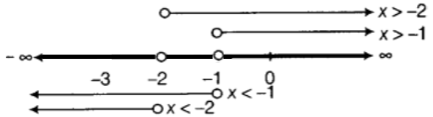
$\begin{array}{l}\therefore(x+1)>0 \text { and }(x+2)>0 \\ \text { or }(x+1)<0 \text { and }(x+2)<0 \\ \Rightarrow x>-1 \text { and } x>-2 \\ \text { or } x<-1 \text { and } x<-2\end{array}$
On number line, these inequalities can be represented as,
Image
Thus, $-1< x< \infty$ or $-\infty< x< -2$
But, here - $3 \leq x <\infty$
$\therefore-1< x <\infty$ or $-3 \leq x <-2$
Then, solution set in this case is 
$x \in[-3,-2) \cup(-1, \infty)$
Case II: When $x<-3$, then $|x+3|=-(x+3)$
$\begin{array}{l}\therefore \frac{|x+3|-2}{x+2}>0 \\ \Rightarrow \frac{-x-3-2}{x+2}>0 \\ \Rightarrow \frac{-(x+5)}{x+2}>0 \\ \Rightarrow \frac{x+5}{x+2}<0 \\ \Rightarrow \frac{(x+5)(x+2)^2}{x+2}<0 \times( x +2)^2 \\ \Rightarrow( x +5)( x +2)<0\end{array}$
Product of (x + 5) and (x + 2) will be negative, if both are of opposite sign.
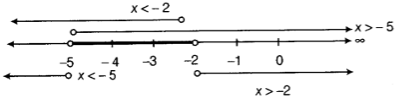
$\begin{array}{l}\therefore(x+5)>0 \text { and }(x+2)<0 \\ \text { or }(x+5)<0 \text { and }(x+2)>0 \\ \Rightarrow x>-5 \text { and } x<-2 \\ \text { or } x<-5 \text { and } x>-2\end{array}$
On number line, these inequalities can be represented as, 
Image

Thus, - 5 < x < - 2 i.e., solution set in the case is  x∈ (- 5, - 2).
On combining cases I and II, we get the required solution set of given inequality, which is 
$x \in(-5,-2) \cup(-1, \infty)$

View full question & answer
Question 65 Marks
Find the (i) lengths of major and minor axes, (ii) coordinate of the vertice, (iii) coordinate of the foci, (iv) eccentricity, and (v) length of the latus rectum of ellipe: $16 x^2+25 y^2=400$.
Answer
Given: $16 x^2+25 y^2=400$
After dividing by 400 to both the sides, we get 
$\begin{array}{l}\frac{16}{400} x^2+\frac{25}{400} y^2=1 \\ \frac{x^2}{25}+\frac{y^2}{16}=1 \ldots \text { (i) }\end{array}$
Now, above equation is of the form, 
$\frac{x^2}{a^2}+\frac{y^2}{b^2}=1 \ldots$ (ii)
Comparing eq. (i) and (ii), we get 
$a^2=25$ and $b^2=16 \Rightarrow a=5$ and $b=4$
i. Length of major axes 
$\therefore$ Length of major axes $=2 a =2 \times 5=10$ units
ii. Coordinates of the Vertices 
$\therefore$ Coordinate of vertices $=(a, 0)$ and $(-a, 0)=(5,0)$ and $(-5,0)$
iii. Coordinates of the foci
As we know that 
Coordinates of foci $=( \pm c , 0)$
Now $c^2=a^2-b^2=25-16$
$\Rightarrow c^2=9 \Rightarrow c=\sqrt{9} \Rightarrow c=3$...(iii)
$\therefore$ Coordinates of foci $=( \pm 3,0)$
iv. Eccentricity 
As we know that, Eccentricity $=\frac{c}{a} \Rightarrow e=\frac{3}{5}$ [from (iii)]
v. Length of the Latus Rectum 
As we know, Length of Latus Rectum $=\frac{2 b^2}{a}=\frac{2 \times(4)^2}{5}=\frac{32}{5}$
View full question & answer
5 Marks Questions - MATHS STD 11 Science Questions - Vidyadip