Questions · Page 1 of 4

M.C.Q (1 Marks)

🎯

Test yourself on this topic

50 questions · timed · auto-graded

MCQ 11 Mark

What can be said regarding a line if its slope is negative?

  • A
    $\theta$ is an acute angle
  • B
    $\theta$ is an obtuse angle
  • C
    Either the line is x-axis or it is parallel to the x-axis
  • D
    None of these
Answer
  1. $\theta$ is an obtuse angle

Solution:

The line with a negative slope makes an obtuse angle with a positive x-axis when measured in the anti-clockwise direction.
View full question & answer
MCQ 21 Mark

The equation $\frac{(2 \text{x})}{2} - \frac{(\text{y}{ 2})}{2} = -3,$ if x = -2, then y is equal to:

  • A
     -2
  • B
    -7
  • C
     8
  • D
     5
Answer
  1.  8
View full question & answer
MCQ 31 Mark

Choose the correct answer.

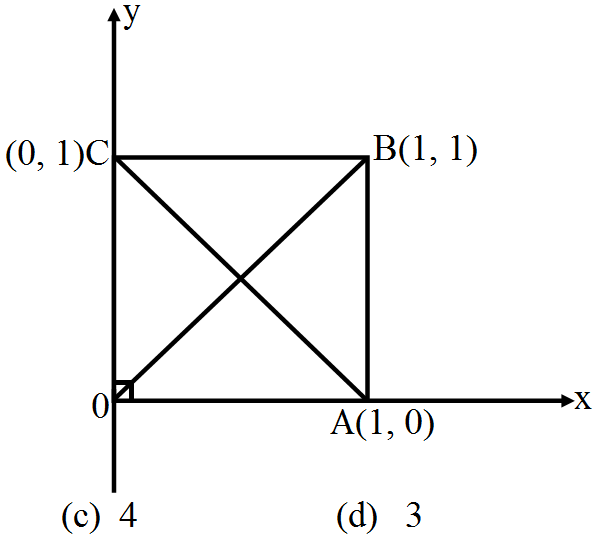
Equations of diagonals of the square formed by the lines x = 0, y = 0, x = 1 and y = 1 are:

Answer
  1. y = x, y + x = 1

Solution:

Given lines are plotted on coordinate plane as shown in the adjacent figure.

From the figure, equation of diagonal OB is y = x.

Equation of the diagonal AC is x + y = 1 (using intercept form).

View full question & answer
MCQ 41 Mark

The points (-a, -b), (0 , 0), (a, b) and (a2, ab) are:

  • A
    Vertices of a square
  • B
    Vertices of a parallelogram
  • C
    Collinear
  • D
    Vertices of a rectangle
Answer
  1. Collinear
View full question & answer
MCQ 51 Mark

The lines x + 2y - 5 = 0, 2x - 3y + 4 = 0, 6x + 4y - 13 = 0:

  • A
    Are concurrent
  • B
    Form a right angled triangle
  • C
    Form an isosceles triangle
  • D
    Form an equilateral triangle
Answer
  1. Form a right angled triangle
View full question & answer
MCQ 61 Mark

If equation of a line is 3x + 2y - 6 = 0 then x-intercept is and y-intercept is:

  • A
    3, 2
  • B
    2, 3
  • C
    2, 6
  • D
    3, 6
Answer
  1. 2, 3

Solution:

Reducing the above equation to intercept form $\frac{\text{x}}{\text{a}} +\frac{\text{y}}{\text{b}} =1,$

we get $\frac{\text{x}}{2} +\frac{\text{y}}{3} =1$

a = 2 which is x-intercept and b = 3 which is y-intercept.

View full question & answer
MCQ 71 Mark

What is the slope of a line which is parallel to y-axis?

  • A
    -1.
  • B
    0.
  • C
    1.
  • D
    Not defined.
Answer
  1. Not defined.

Solution:

If a line is parallel to y-axis then angle formed by it with x-axis is zero. So, its inclination is 90°. $\text{slope} = \tan 90^\circ$ which is not defined.

View full question & answer
MCQ 81 Mark

If line joining (1, 2) and (7, 6) is perpendicular to line joining (3, 4) and (11, x):

  • A
    12
  • B
    16
  • C
    -16
  • D
    -12
Answer
  1. -16

Solution:

We know, slope of line joining two points (x1, y1) and (x2, y2) is given by $\frac{(\text{y}_{2}-\text{y}_{1})}{(\text{x}_{2}-\text{x}_{1})}$

Lines are perpendicular means m× m2 = -1

$\Rightarrow\big(\frac{\text{x}-4}{11-3}\big), \big(\frac{6-2}{7-1}\big) = -1$

⇒ (x - 4) (4) = (-1) (8) (6)

⇒ x - 4 = -12

⇒ x = -16.

View full question & answer
MCQ 91 Mark

Equation of vertical line to the left of y-axis at 5 units from y-axis is:

  • A
    x = 5
  • B
    x = -5
  • C
    y = 5
  • D
    y = -5
Answer
  1. x = -5

Solution:

Equation of y-axis is x = 0. Vertical line is parallel to y-axis and to the left by 5 units so, equation of line is x = -5

View full question & answer
MCQ 101 Mark

What is the distance of (5, 12) from the origin?

  • A
    5 units
  • B
    8 units
  • C
    12 units
  • D
    13 units
Answer
  1. 13 units

Solution:

Let the points be A (0, 0) and B (5, 12).

A (0, 0) = (x1, y1)

B (5, 12) = (x2, y2)

The distance between two points, $\text{AB} = [(\text{x}_{2}-\text{x}_{1})^2+(\text{y}_{2}-\text{y}_{1})^2]$

$\text{AB} = [(5-0)^{2}+(12-0)^2]$

$\text{AB}=\sqrt{(25+144)}$

$\text{AB}=\sqrt{(169)}$

$\text{AB}=13$

The distance of (5, 12) from the origin is 13 units.

View full question & answer
MCQ 111 Mark

If p be the length of the perpendicular from the origin on the straight line x + 2by = 2p, then what is the value of b:

  • A
    $\frac{1}{\text{p}}$
  • B
    $\text{p}$
  • C
    $\frac{1}{2}$
  • D
    $\frac{3}{2}$
Answer
  1. $\frac{3}{2}$
View full question & answer
MCQ 121 Mark

If the lines ax + 12y + 1 = 0, bx + 13y + 1 = 0 and cx + 14y + 1 = 0 are concurrent, then a, b, c are in:

  • A
    H.P.
  • B
    G.P.
  • C
    A.P.
  • D
    None of these.
Answer
  1. A.P.

Solution:

The given lines are

ax + 12y + 1 = 0 ...(1)

bx + 13y + 1 = 0 ...(2)

cx + 14y + 1 = 0 ...(3)

It is given that (1), (2) and (3) are concurrent.

$\begin{vmatrix} \text{a}&12&1\\\text{b}&13&1\\\text{c}&14&1\end{vmatrix}=0$

$\Rightarrow\text{a}(13-14)-12(\text{b}-\text{c})+14\text{b}-13\text{c}=0$

$\Rightarrow-\text{a}-12\text{b}+12\text{c}+14\text{b}-13\text{c}=0$

$\Rightarrow-\text{a}+2\text{b}-\text{c}=0$

$\Rightarrow2\text{b}=\text{a}+\text{c}$

Hence, a, b and c are in AP.

View full question & answer
MCQ 131 Mark

The relation between a, b, a’ and b’ such that the two lines ax + by = c and a’x + b’y = c’ are perpendicular is:

  • A
    aa¢ – bb¢ = 0
  • B
    aa¢ + bb¢ = 0
  • C
    ab + a¢b¢ = 0
  • D
    ab - a¢b¢ = 0
Answer
  1. aa¢ + bb¢ = 0
View full question & answer
MCQ 141 Mark

Given the three straight lines with equations 5x + 4y = 0, x + 2y - 10 = 0 and 2x + y + 5 = 0, then these lines are:

  • A
    None of these
  • B
    The sides of a right angled triangle
  • C
    Concurrent
  • D
    The sides of an equilateral triangle
Answer
  1. Concurrent
View full question & answer
MCQ 151 Mark

Choose the correct answer.

The equations of the lines which pass through the point (3, -2) and are inclined at 60° to the line $\sqrt{3} \text{x} + \text{y} = 1$ is:

  • A
    $\sqrt{3}\text{x}+\text{y}-\sqrt{3}=0,\sqrt{3}\text{x}-\text{y}-\sqrt{3}=0$
  • B
    $\sqrt{3}\text{x}+\text{y}+\sqrt{3}=0,\sqrt{3}\text{x}-\text{y}+\sqrt{3}=0$
  • C
    $\text{x}+\sqrt{3}\text{y}-\sqrt{3}=0,\text{x}-\sqrt{3}\text{y}-\sqrt{3}=0$
  • D
    None of these.
Answer
  1. $\sqrt{3}\text{x}+\text{y}-\sqrt{3}=0,\sqrt{3}\text{x}-\text{y}-\sqrt{3}=0$

Solution:

Slope of the given line $\sqrt{3}\text{x}+\text{y}=1$ is, $\text{m}=-\sqrt{3}.$

Let the slope of the required line which makes an angle of 60° with the above line is m.

$\therefore \tan 60^\circ=\bigg|\frac{-\sqrt{3}-\text{m}}{1-\sqrt{3}\text{m}}\bigg|$

$\Rightarrow \bigg|\frac{-\sqrt{3}-\text{m}}{1-\sqrt{3}\text{m}}\bigg|=\sqrt{3}$

$\Rightarrow -\sqrt{3}-\text{m}=\sqrt{3}-3\text{m}$ or $-\sqrt{3}-\text{m}=-\sqrt{3}+3\text{m}$

$\Rightarrow \text{m}=\sqrt{3}$ or m = 0

Line is passing throught the point (3, -2).

Thus, the equation of the required line is: $\text{y}+2=\sqrt{3}(\text{x}-3)$ or y + 2 = 0

$\Rightarrow \sqrt{3}\text{x}-\text{y}-2-3\sqrt{3}=0$ and y + 2 = 0

View full question & answer
MCQ 161 Mark

The distance between the points (a, b) and (-1, -b) is:

  • A
    0
  • B
    1
  • C
    $\sqrt{\text{ab}}$
  • D
    None of the above
Answer
  1. None of the above

Solution:

Distance between two points $({\text{x}_{1, }}{\text{y}_{1}})$ and $({\text{x}_{2, }}{\text{y}_{2}})$ can be calculated using the formula

$\sqrt{{(\text{x}_{2}-\text{x}_{1})}^2+{(\text{y}_{2}-\text{y}_{1})}^2}$

Distance between the points (a, b) and (-1, -b) 

$(-1-\text{a})^2+(\text{b - b})^2 = \sqrt{1+\text{a}^2+2\text{b}+4\text{b}^2}$

View full question & answer
MCQ 171 Mark
What is the distance of (5, 12) from origin?
  • A
    6 units.
  • B
    8 units.
  • C
    10 units.
  • D
    13 units.
Answer
  1. 13 units.

Solution:

We know, distance between two points (x1, y1) and (x2, y2) is $\sqrt{({\text{x}}_{1}-{\text{x}}_{2})^{2}+({\text{y}}_{1}-{\text{y}}_{2})^{2}}$

So, distance between (5, 12) from origin (0, 0) is $\sqrt{({5-0})^{2}+({12-0})^{2}} = \sqrt{({5})^{2}+({12})^{2}} =13\text{ unit}.$

View full question & answer
MCQ 181 Mark
Three vertices of a parallelogram taken in order are (-1, -6), (2, -5) and (7, 2). The fourth vertex is:
  • A
    (1, 4)
  • B
    (4, 1)
  • C
    (1, 1)
  • D
    (4, 4)
Answer
  1. (4, 1)

Solution:

Let A(-1, -6), B(2, -5) and C(7, 2) be the given vertex. Let D(h, k) be the fourth vertex.

The midpoints of AC and BD are (3, -2) and $\Big(\frac{2+\text{h}}{2},\frac{-5+\text{k}}{2}\Big)$ respectively.

We know that the diagonals of a parallelogram bisect each other.

$\therefore3=\frac{2+\text{h}}{2}$ and $-2=\frac{-5+\text{k}}{2}$

$\Rightarrow\text{h}=4$ and $\text{k}=1$

View full question & answer
MCQ 191 Mark

The angle between the lines 2x - y + 3 = 0 and x + 2y + 3 = 0 is:

Answer
  1. 90°

Solution:

Let m1 and m2 be the slope of the lines 2x - y + 3 = 0 and x + 2y + 3 = 0, respectively.

Let $\theta$ be the angle between them.

Here, m1 = 2 and $\text{m}_2=-\frac{1}{2}$

$\because\text{m}_1\text{m}_2=-1$

Therefore, the angle between the given lines is 90°.

View full question & answer
MCQ 201 Mark

If A (6, 4) and B (2, 12) are the two points, then the slope of a line perpendicular to line AB is:

Answer
  1. $\frac{1}{2}$

Solution:

Given points: A (6, 4) = (x1, y1)

B (2, 12) = (x2, y2)

We know that the slope of a line passing through two points (x1, y1) and (x2, y2) is $\frac{(\text{y}_{2}\text{-y}_{1})}{(\text{x}_{2}-\text{x}_{1})}$

$\text{m} = \frac{(12-4)}{(2-6)} = \frac{8}{-4} = -2.$

We know that the slope of two perpendicular lines m1.m2 = -1.

The slope of a line perpendicular to line AB is $\frac{-1}{\text{m}} = \frac{-1}{-2} = \frac{1}{2}$

View full question & answer
MCQ 211 Mark

Equation of vertical line to the left of y-axis at 5 units from y-axis is:

Answer
  1. x = -5

Solution:

Equation of y-axis is x = 0. Vertical line is parallel to y-axis and to the left by 5 units so, equation of line is x = -5.

View full question & answer
MCQ 221 Mark

Find the equation perpendicular to 2x - y = 4 and pass through (2, 4):

Answer
  1. x + 2y - 10 = 0

Solution:

Line 2x - y = 4 has slope 2. Line perpendicular to given line has slope $\frac{-1}{2}$

equation is $(\text{y}-4) = \big(\frac{-1}{2}\big) (\text{x}-2)$

2y - 8 = -x + 2

⇒ x + 2y - 10 = 0

View full question & answer
MCQ 231 Mark

Which of the following lines is farthest from the origin?

Answer
  1. x + y - 2 = 0
View full question & answer
MCQ 241 Mark

Equation of horizontal line above x-axis at 5 units from x-axis is:

Answer
  1. y = 5

Solution:

Equation of x-axis is y = 0. Horizontal line is parallel to x-axis and above it by 5 units so, equation of line is y = 5.

View full question & answer
MCQ 251 Mark

The inclination of the line x - y + 3 = 0 with the positive direction of x-axis is:

Answer
  1. 45°
View full question & answer
MCQ 261 Mark

What is the inclination of a line which is parallel to y-axis?

Answer
  1. 90°

Solution:

If a line is parallel to y-axis then angle formed by it with x-axis is 90°. So, its inclination is 90°.

View full question & answer
MCQ 271 Mark

Find the equation of line parallel to x-axis and passing through (3, 4):

Answer
  1. y = 4

Solution:

Let general equation of line be y = m × x + c. Since line is parallel to x-axis so, m = 0.

⇒ y = c

⇒ y = 4 by substituting the point (3, 4).

View full question & answer
MCQ 281 Mark

Equation of horizontal line above x-axis at 5 units from x-axis is:

Answer
  1. y = 5

Solution:

Equation of x-axis is y = 0. Horizontal line is parallel to x-axis and above it by 5 units so, equation of line is y = 5

View full question & answer
MCQ 291 Mark

The equations of the sides AB, BC and CA of $\triangle \text{ABC}$ are y - x = 2, x + 2y = 1 and 3x + y + 5 = 0 respectively. The equation of the altitude through B is:

Answer
  1. x - 3y + 4 = 0

Solution:

The equation of the sides AB, BC and CA of $\triangle \text{ABC}$ are y - x = 2, x + 2y = 1 and 3x + y + 5 = 0, respectively.

Solving the equations of AB and BC, i.e. y - x = 2 and x + 2y = 1, we get:

x = -1, y = 1

So, the coordinates of B are (-1, 1).

The altitude through B is perpendicular to AC.

$\therefore$ Slope of AC = -3

Thus, slope of the altitude through B is 13. Thus, slope of the altitude through B is $\frac{1}{3}.$

Equation of the required altitude is given below:

$\text{y}-1+\frac{1}{3}(\text{x}+1)$

$\Rightarrow\text{x}-3\text{y}+4=0$

View full question & answer
MCQ 301 Mark

For specifying a straight line, how many geometrical parameters should be known:

Answer
  1. 2
View full question & answer
MCQ 311 Mark

Two lines are said to be parallel if the difference of their slope is:

Answer
  1. 0

Solution:

We know that two lines are said to be parallel if their slope is equal. If m1 and m2 are the slopes of two parallel lines, then it is represented as m1 = m2.

The difference of their slope should be m- m2 = 0.

View full question & answer
MCQ 321 Mark

The distance between the lines 3x + 4y = 9 and 6x + 8y = 15 is: 

Answer
  1. $\frac{3}{10}$
View full question & answer
MCQ 331 Mark

If equation of line is x + y = 2 then find the angle made by line with x-axis:

Answer
  1. 45°

Solution:

Given, equation is x + y = 2. Reducing the above equation to normal form

$\frac{(\text{x + y})}{\sqrt2} ={\sqrt2}.$

$\text{x} \cos⁡45° + \text{y} \sin 45^\circ = {\sqrt2}$

Angle made with x-axis is 45°.

View full question & answer
MCQ 341 Mark

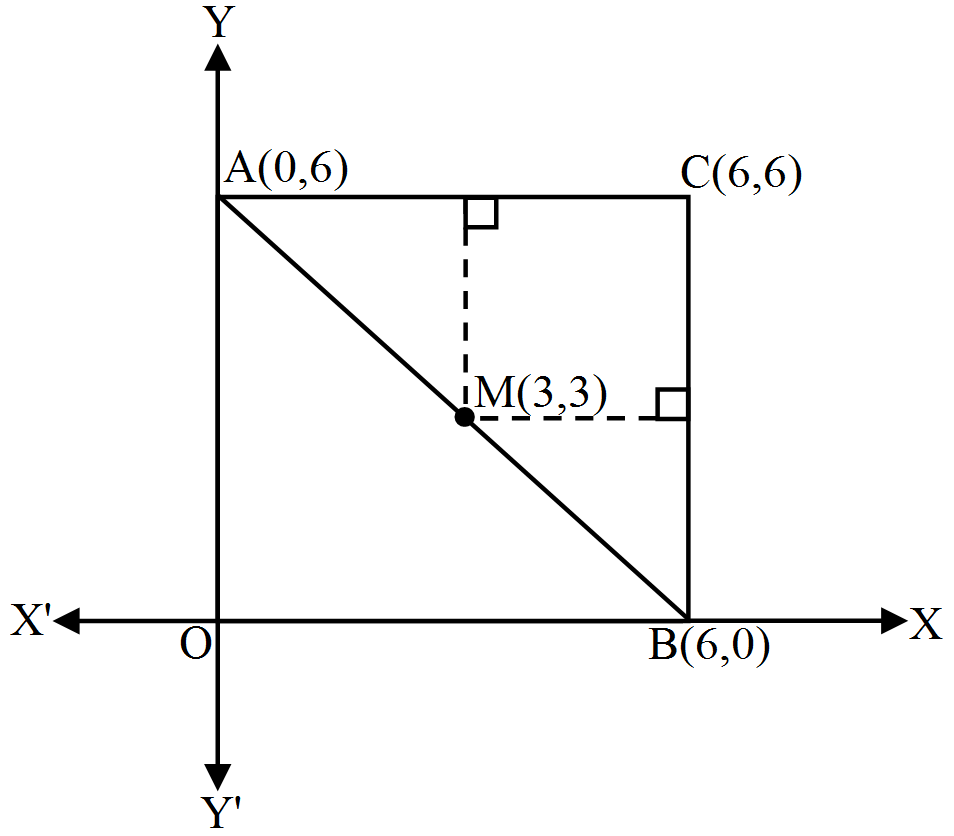
The vertices of a triangle are (6, 0), (0, 6) and (6, 6). The distance between its circumcentre and centroid is:

Answer
  1. $\sqrt{2}$

Solution:

Let A(0, 6), B(6, 0) and C(6, 6) be the vertices of the given triangle.

Centroid of $\triangle\text{ABC}=\Big(\frac{0+6+6}{3},\frac{6+0+6}{3}\Big)$

$=(4,4)$

Coordinates of $\text{N}=\Big(\frac{6+6}{2},\frac{6+0}{2}\Big)$

$=(6,3)$

Coordinates of $\text{P}=\Big(\frac{0+6}{2},\frac{6+6}{2}\Big)$

$=(3,6)$

Equation of MN is y = 3

Equation of MP is x = 3

As, we know that circumcentre of a triangle is the intersection of the perpendicular bisectors of any two sides.

Therefore, coordinates of circumcentre is (3, 3)

Thus, the coordinates of the circumcentre are (3, 3) and the centroid of the triangle is (4, 4).

Let d be the distance between the circumcentre and the centroid.

$\therefore\text{d}\sqrt{(4-3)^2+(4-3)^2}=\sqrt{2}$

View full question & answer
MCQ 351 Mark

What is the distance between (1, 3) and (5, 6)?

Answer
  1. 5 units.

Solution:

We know, distance between two points (x1, y1) and (x2, y2) is $\sqrt{(\text{x}_{1}-\text{x}_{2}) ^{2}+{(\text{y}_{1}-\text{y}_{2})} ^{2}}$

So, distance between (1, 3) and (5, 6) is $\sqrt{{(1-5)}^{2}+(3-6)^{2}} = \sqrt{{(4)}^{2}+(3)^{2}} = 5\text{ units}.$

View full question & answer
MCQ 361 Mark

The reflection of the point (4, -13) about the line 5x + y + 6 = 0 is:

Answer
  1. (-1, -14)

Solution:

Let the reflection point be A(h, k)

Now, the mid point of line joining (h, k) and (4, -13) will lie on the line 5x + y + 6 = 0

$\therefore5\Big(\frac{\text{h}+4}{2}\Big)+\frac{\text{k}-13}{2}+6=0$

$\Rightarrow5\text{h}+20+\text{k}-13+12=0$

$\Rightarrow5\text{h}+\text{k}+19=0 \ ...(1)$

Now, the slope of the line joining points (h, k) and (4, -13) are perpendicular to the line 5x + y + 6 = 0.

slope of the line = -5

slope of line joining by points (h, k) and (4, -13)

$\frac{\text{k}+13}{\text{h}-4}$

$\therefore\frac{\text{k}+13}{\text{h}-4}(-5)=-1$

$\Rightarrow5\text{k}-\text{h}+60=0 \ ...(2)$

Solving (1) and (2), we get

h = -1 and k = -14

View full question & answer
MCQ 371 Mark

The equation of the locus of a point equidistant from the point A (1, 3) and B (-2, 1) is:

Answer
  1. 6x + 4y = 5
View full question & answer
MCQ 381 Mark

The value of $\lambda$ for which the lines $3\text{x} + 4\text{y} = 5, 5\text{x} + 4\text{y} =4$ and $\lambda\text{x} + 4\text{y} = 6$ meet at a point is:

Answer
  1. 1

Solution:

 It is given that the lines $3\text{x} + 4\text{y} = 5, 5\text{x} + 4\text{y} =4$ and $\lambda\text{x} + 4\text{y} = 6$ meet at a point. In other words, the given lines are concurrent.

$\begin{vmatrix}3&4&-5\\5&4&-4\\\lambda&4&-6 \end{vmatrix}=0$

$\Rightarrow3(-24+16)-4(-30+4\lambda)-5(20-4\lambda)=0$

$\Rightarrow-24+120-16\lambda-100+20\lambda=0$

$\Rightarrow4\lambda=4$

$\Rightarrow\lambda=1$ 

View full question & answer
MCQ 391 Mark

The equation of the line passing through (1, 5) and perpendicular to the line 3x - 5y + 7 = 0 is:

Answer
  1. 5x + 3y - 20 = 0

Solution:

A line perpendicular to 3x - 5y + 7 = 0 is given by

$5\text{x}+3\text{y}+\lambda=0$

This line passes through (1, 5)

$5+15+\lambda=0$

$\Rightarrow\lambda=-20$

Therefore, the equation of the required line is 5x + 3y - 20 = 0.

View full question & answer
MCQ 401 Mark

Find the equation of line parallel to y-axis and passing through (3, 4):

Answer
  1. x = 3

Solution:

Let general equation of line be y = m (x - d)

$\Rightarrow\text{x} =\frac{ \text{y}}{\text{m + d}}$ Since line is parallel to y-axis so, $\text{m}=\frac{1}{0} $ or $\frac{1}{\text{m}} =0$

⇒ x = d

⇒ x = 3 by substituting the point (3, 4)

View full question & answer
MCQ 411 Mark

The locus of the point of intersection of lines $\text{x} \cos \text{a} + \text{y} \sin \text{a = a}$ and $\text{x} \sin \text{a - y} \cos \text{a = b}$ (a is a variable):

Answer
  1. x2 + y2 = a2 + b2
View full question & answer
MCQ 421 Mark

The centroid of a triangle is (2, 7) and two of its vertices are (4, 8) and (-2, 6). The third vertex is:

Answer
  1. (4, 7)

Solution:

Let A(4, 8) and B(-2, 6) be the given vertex. Let C(h, k) be the third vertex.

The centroid of $\triangle\text{ABC}$ is $\Big(\frac{4-2+\text{h}}{3},\frac{8+6+\text{k}}{3}\Big)$

It is given that the centroid of triangle ABC is (2, 7).

$\therefore\frac{4-2+\text{h}}{3}=2,\frac{8+6+\text{k}}{3}=7$

$\Rightarrow\text{h}=4,\text{h}=7$

Thus, the third vertex is (4, 7).

View full question & answer
MCQ 431 Mark

Find slope of line joining (1, 2) and (4, 11):

Answer
  1. $3$

Solution:

We know, slope of line joining two points (x1, y1) and (x2, y2) is given by $\frac{{\text{y}}_{2}-{\text{y}}_{1}}{{\text{x}}_{2}-{\text{x}}_{1}}$

So, slope of line joining (1, 2) and (4, 11) is $\frac{11-2}{4-1} = \frac{9}{3} = 3$

View full question & answer
MCQ 441 Mark

Slope of a line which cuts off intercepts of equal lengths on the axes is: 

Answer
  1. -1
View full question & answer
MCQ 451 Mark

The distance between the orthocentre and circumcentre of the triangle with vertices (1, 2), (2, 1) and $\Big(\frac{3+\sqrt{3}}{2},\frac{3+\sqrt{3}}{2}\Big)$ is:

Answer
  1. 0

Solution:

Let A(1, 2), B(2, 1) and C $\Big(\frac{3+\sqrt{3}}{2},\frac{3+\sqrt{3}}{2}\Big)$ be the given points.

$\therefore \ \text{AB}=\sqrt{(2-1)^2+(1-2)^2}$

$=\sqrt{2}$

$\text{BC}=\sqrt{\Big(\frac{3+\sqrt{3}}{2}-2\Big)^2,\Big(\frac{3+\sqrt{3}}{2}-1\Big)^2}$

$=\sqrt{2}$

$\text{AC}=\sqrt{\Big(\frac{3+\sqrt{3}}{2}-1\Big)^2,\Big(\frac{3+\sqrt{3}}{2}-2\Big)^2}$

$=\sqrt{2}$

Thus, ABC is an equilateral triangle.

We know that the orthocentre and the circumcentre of an equilateral triangle are same.

So, the distance between the the orthocentre and the circumcentre of the triangle with vertices (1, 2), (2, 1) and $\Big(\frac{3+\sqrt{3}}{2},\frac{3+\sqrt{3}}{2}\Big)$ is 0.

View full question & answer
MCQ 461 Mark

Choose the correct answer.

A line passes through (2, 2) and is perpendicular to the line 3x + y = 3. Its yintercept is:

Answer
  1. $\frac{4}{3}.$

Solution:

Any line perpendicular to 3x + y = 3

$\text{x}-3\text{y}=\lambda \ (\lambda=\text{constant})$

If is passes through the point (2, 2) then

$2-3(2)=\lambda\Rightarrow \lambda=-4$

$\therefore$ Required equation is x - 3y = -4

$\Rightarrow 3\text{y}=-\text{x}-4$

$\Rightarrow \text{y}=\frac{1}{3}\text{x}+\frac{4}{3}\big[\because \text{y}=\text{mx}+\text{c}\big]$

So, the y-intercept is $\frac{4}{3}.$

Hence, the correct option is (d).

View full question & answer
MCQ 471 Mark

If equation of line is y = 5x + 10 then find the value of x-intercept made by the line:

Answer
  1. $10$

Solution:

Given, equation is y = 5x + 10. Y-intercept means value of y when x is zero. y = 0 + 10

⇒ y = 10

View full question & answer
MCQ 481 Mark

The coordinates of the foot of the perpendicular from the point (2, 3) on the line x + y - 11 = 0 are:

Answer
  1. (5, 6)

Solution:

Let the coordinates of the foot of the perpendicular from the point (2, 3) on the line x + y - 11 = 0 be (x, y)

Now, the slope of the line x + y - 11 = 0 is -1

So, the slope of the perpendicular = 1

The equation of the perpendicular is given by

y - 3 = 1(x - 2)

⇒ x - y + 1 = 0

Solving x + y - 11 = 0 and x - y + 1 = 0, we get

x = 5 and y = 6

View full question & answer
MCQ 491 Mark

Choose the correct answer.

The equation of the straight line passing through the point (3, 2) and perpendicular to the line y = x is:

Answer
  1. x + y = 5

Solution:

Slope of the given line y = x is 1.

Thus, slope of line perpendicular to y = x is -1.

Line passes through the point (3, 2).

So, equation of the required line is:

y - 2 = -1(x - 3)

⇒ x + y = 5

View full question & answer
MCQ 501 Mark

Two lines are given (x - 2y)2 + k (x - 2y) = 0. The value of k, so that the distance between them is 3, is:

Answer
  1. $\text{k} = \underline{+} 3 \sqrt{5}$
View full question & answer
Generate Paper FreeAll Straight Lines topics
M.C.Q (1 Marks) - MATHS STD 11 Science Questions - Vidyadip