Questions

5 Marks Questions

Take a timed test

11 questions · self-marked practice — reveal the answer and mark yourself.

Question 15 Marks
Find the equation of a straight line on which length of perpendicular from the origin is four units and the line makes an angle of 120° with the positive direction of x-axis.
[Hint: Use normal form, here $\omega =30^\circ.$]
Answer
Given that:
OM = 4 units
$\angle \text{BAZ}=120^\circ$
$\therefore \angle \text{BAO}= 180^\circ - 120^\circ$ or $\angle\text{MAO}=60^\circ$
$\angle\text{MOA}+\angle\text{MAO}=90^\circ$
$\therefore \theta=30^\circ$
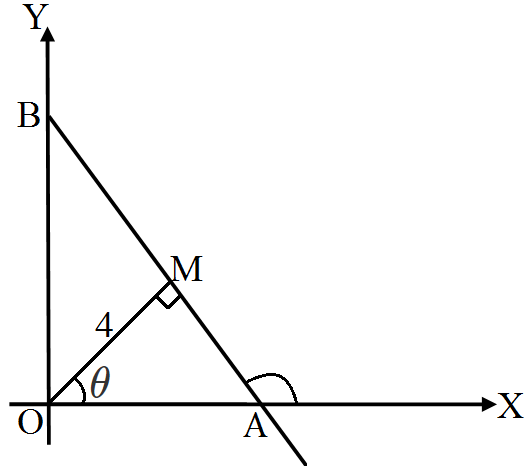
So, equation of AB in its normal form
$\Rightarrow \text{x}\cos\theta+\text{y}\sin\theta=\text{p}$
$\Rightarrow \text{x}\cos30^\circ+\text{y}\sin 30^\circ=4$
$\Rightarrow \text{x}\times\frac{\sqrt{3}}{2}+\text{y}\times\frac{1}{2}=4$
$\Rightarrow \sqrt{3}\text{x}+\text{y}=8$
Hence, the required equation is $\sqrt{3}\text{x}+\text{y}=8.$
View full question & answer
Question 25 Marks
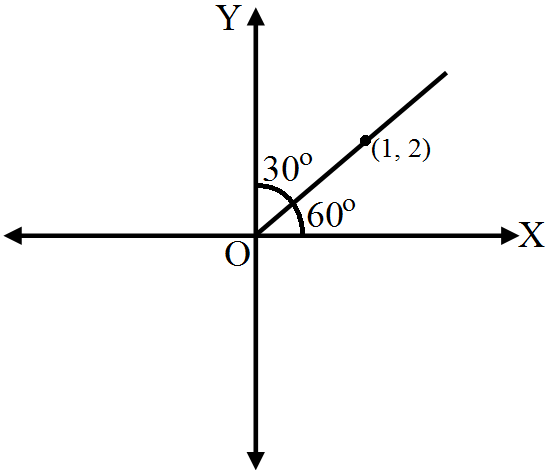
Find the equation of lines passing through (1, 2) and making angle 30° with y-axis.
Answer
Given that the makes angle 30° with y-axis.
$\therefore$ Angle made by the line with x-axis is 60°
$\therefore$ Slope of the line
$\text{M}=\tan60^\circ$
$\Rightarrow \text{m}=\sqrt{3}$

So, the equation of the line passing therought the point (1, 2) and slop $\sqrt{3}$ is
y - y1 = m(x - x1)
$\Rightarrow \text{y}-2=\sqrt{3}(\text{x}-1)$
$\Rightarrow \text{y}-2=\sqrt{3}\text{x}-\sqrt{3}$
$\Rightarrow \text{y}-\sqrt{3}\text{x}+\sqrt{3}-2=0$
Hence, the required equation of line is $\text{y}-\sqrt{3}\text{x}+\sqrt{3}-2=0.$
View full question & answer
Question 35 Marks
Find the equation of the line which passes through the point (-4, 3) and the portion of the line intercepted between the axes is divided internally in the ratio 5 : 3 by this point.
Answer
Let the line through the point P(-A, 3) meets axis at A(h, 0) and 0(0, k)
Now according to the question AP : BP = 5 : 3
$\therefore (-4, 3)\equiv\Big(\frac{3\times\text{h}+5\times}{5+3},\frac{3\times0+5\times\text{k}}{5+3}\Big)\equiv\Big(\frac{3\text{h}}{8},\frac{5\text{h}}{8}\Big)$
$\Rightarrow -4=\frac{3\text{h}}{8}$ and $3=\frac{5\text{k}}{8}$
$\Rightarrow \text{h}=-\frac{32}{3}$ and $\text{k}=\frac{24}{5}$
So, equation of the required line in intercept form is:
$\frac{\text{x}}{-\frac{32}{3}}+\frac{\text{y}}{\frac{24}{5}}=1$
$\Rightarrow 9\text{x}-20\text{y}+96=0$
View full question & answer
Question 45 Marks
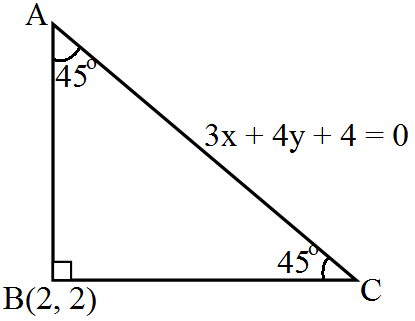
Find the equation of one of the sides of an isosceles right angled triangle whose hypotenuse is given by 3x + 4y = 4 and the opposite vertex of the hypotenuse is (2, 2).
Answer
As shown in the figure, hypotenuse is along the line 3x + 4y + 4 = 0.
$\therefore$ Slope of $\text{AC}=\frac{-3}{4}.$
Since ABC is isosceles righta angled triangle,

Now, let the slope of the line making an angle 45° with AC be m.
$\therefore \tan 45^\circ=\begin{vmatrix}\frac{\text{m}-\Big(-\frac{3}{4}\Big)}{1+\text{m}\Big(-\frac{3}{4}\Big)} \end{vmatrix}$
$\Rightarrow \frac{4\text{m}+3}{4-3\text{m}}=\pm1$
$\Rightarrow 4\text{m}+3=4-3\text{m}$ or $4\text{m}+3=3\text{m}-4$
$\Rightarrow \text{m}=\frac{1}{7}$ or m = -7
So, if the slope of line BC is $\frac{1}{7}$ then the slope of line AB is -7.
So, equation of BC is: $\text{y}-2=\Big(\frac{1}{7}\Big)(\text{x}-2)$
⇒ x - 7y + 12 = 0.
Equation of AB is: y - 2 = -7(x - 2)
⇒ 7x + y - 16 = 0.
View full question & answer
Question 55 Marks
Match the questions given under Column C1 with their appropriate answers given under the Column C2: The value of the λ, if the lines (2x + 3y + 4) + λ (6x - y + 12) = 0 are:
Column C1 Column C2
(a) Parallel to y-axis is (i) $\lambda=-\frac{3}{4}$
(b) Perpendicular to 7x + y - 4 = 0 is (ii) $\lambda=-\frac{1}{3}$
(c) Passes through (1, 2) is (iii) $\lambda=-\frac{17}{41}$
(d) Parallel to x axis is (iv) $\lambda=3$
Answer
Column C1 Column C2
(a) Parallel to y-axis is (i) $\lambda=-\frac{3}{4}$
(b) Perpendicular to 7x + y - 4 = 0 is (ii) $\lambda=-\frac{1}{3}$
(c) Passes through (1, 2) is (iii) $\lambda=-\frac{17}{41}$
(d) Parallel to x axis is (iv) $\lambda=3$
Solution:
  1. Given equcation is
$(2\text{x}+3\text{y}+4)+\lambda(6\text{x}- \text{y}+12)=0$ $\Rightarrow(2+6\lambda)\text{x}+(3-\lambda)\text{y}+4+12\lambda=0\ \ ...\text{(i)}$ If eq.(i) is parallel to y-axis, then $3- \lambda=0\Rightarrow\lambda=3$ Hence, (a) ⇔ (iv)
  1. Given lines are
$(2\text{x}+3\text{y}+4)+\lambda(6\text{x}-\text{y}+12)=0$ ..(i) $\Rightarrow(2+6\lambda)\text{x}+3(3-\lambda)\text{y}+12\lambda=0$ Slope $=-\bigg(\frac{2+6\lambda}{3-\lambda}\bigg)$ Second equation is $7\text{x}+\text{y}-4=0\ \ ...\text{(ii)}$ Slope = -7 If eq. (i) eq. (ii) are perpendilcular to each other $\therefore(-7)\bigg[-\bigg(\frac{2+6\lambda}{3-\lambda}\bigg)\bigg]=1$ $\Rightarrow\frac{14+42\lambda}{3-\lambda} = -1$ $41\lambda=-17$ $\lambda=-\frac{17}{41}$ Hence, (b) ⇔ (iii)
  1. Given equation is $(2\text{x}+3\text{y}+4)+\lambda(6\text{x}- \text{y}+12)=0\ \ ...\text{(i)}$
If eq.(i) passes throgh the given ponit (1, 2) then $(2\times1+3\times2+4) +\lambda(6\times1-0+12)=0$ $\Rightarrow(2+6+4) +\lambda(6-2+12)=0$ $\Rightarrow 12+16\lambda=0$ $\Rightarrow=\frac{-12}{16}=\frac{-3}{4}$ Hence, (c) ⇔ (i)
  1. The equation is $(2\text{x}+3\text{y}+4)+\lambda(6\text{x}- \text{y}+12)=0$
$\Rightarrow(2\text{x}+3\text{y}+4)+\lambda(6\text{x}- \text{y}+12)=0$ If eq. (i) is parallel to x-axis, then $2+6\lambda\Rightarrow\lambda=\frac{-1}{3}$ Hence, (d) ⇔ (ii)
View full question & answer
Question 65 Marks
Find the angle between the lines $\text{y} = (2 - \sqrt{3})(\text{x} + 5)$ and $\text{y} = (2 + \sqrt{3})(\text{x} - 7).$
Answer
The given equation are $\text{y}=(2-\sqrt{3})(\text{x}+5)\ .....(\text{i})$
and $\text{y}=(2+\sqrt{3})(\text{x}-7)$
Slope of eq. (i) m1 (say) $=(2-\sqrt{3})$
and slope of eq. (ii) m2 (say) $=(2+\sqrt{3})$
let $\theta$ be the angle between the two given lines
$\therefore \tan\theta=\Big|\frac{\text{m}_1-\text{m}_2}{1+\text{m}_1\text{m}_2}\Big|=\Big|\frac{2-\sqrt{3}-2-\sqrt{3}}{1+(2-\sqrt{3})(2+\sqrt{3})}\Big|$
$=\Big|\frac{-2\sqrt{3}}{1+4-3}\Big|=\Big|\frac{-2\sqrt{3}}{2}\Big|=|-\sqrt{3}|$
$\Rightarrow \tan\theta=\sqrt{3}\text{ or }-\sqrt{3}$
$\therefore \theta = 60^\circ\text{ or }120^\circ$
Hence, the required angle is 60° or 120°.
View full question & answer
Question 75 Marks
Find the equations of the lines through the point of intersection of the lines x - y + 1 = 0 and 2x - 3y + 5 = 0 and whose distance from the point (3, 2) is $\frac{7}{5}$.
Answer
Given lines are: x - y + 1 = 0 .....(i)
and 2x - 3y + 5 = 0 .....(ii)
Solving these lines, we get point of intersection as (2, 3).
So, equation of line is:
y - 3 = m(x - 2) ⇒ 3m - y + 3 - 2m = 0
Distance of this line from (3, 2) = $\frac{7}{5}$
$\therefore \frac{7}{5}\begin{vmatrix} \frac{3\text{m}-2+3-2\text{m}}{\sqrt{1+\text{m}^2}} \end{vmatrix}\Rightarrow \frac{49}{25}=\frac{(\text{m}+1)^2}{1+\text{m}^2}$
⇒ 49 + 49m2 = 25(m2 + 2m + 1)
⇒ 24m2 - 5m + 24 = 0
⇒ 12m2 - 25m + 12 = 0
⇒ (3m - 4)(4m - 3) = 0
$\therefore \text{m}=\frac{4}{3}$ or $\frac{3}{4}$
So, the equation of the line can be:
$\Rightarrow \text{y}-3=\frac{4}{3}(\text{x}-2)$ or $\text{y}-3=\frac{3}{4}(\text{x}-2)$
⇒ 4x - 3y + 1 = 0 or 3x - 4y + 6 = 0
View full question & answer
Question 85 Marks
P1, P2 are points on either of the two lines $\text{y} - \sqrt{3}|\text{x}| = 2$ at a distance of 5 units from their point of intersection. Find the coordinates of the foot of perpendiculars drawn from P1 , P2 on the bisector of the angle between the given lines.
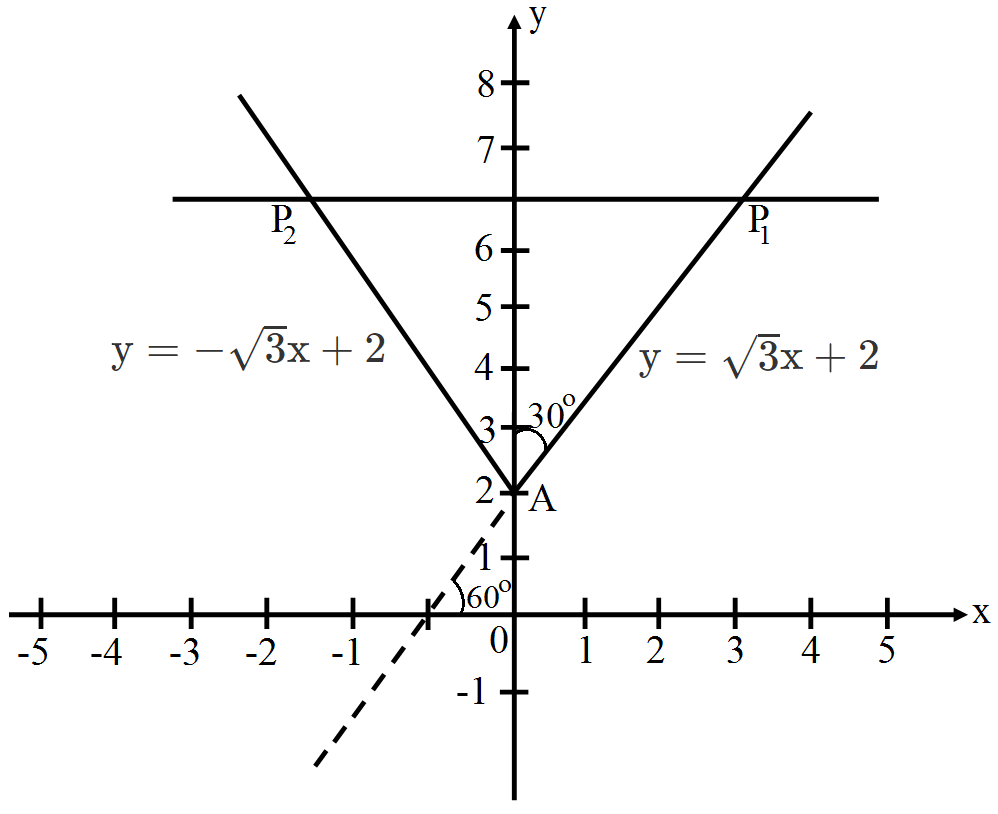
[Hint: Lines are $\text{y} = \sqrt{3}\text{x} + 2$ and $\text{y} = -\sqrt{3}\text{x} + 2$ according as $\text{x} \geq 0$ or x < 0. y-axis is the bisector of the angles between the lines. P1, P2 are the points on these lines at a distance of 5 units from the point of intersection of these lines which have a point on y-axis as common foot of perpendiculars from these points. The y-coordinate of the foot of the perpendicular is given by $2 + 5 \cos30^\circ$.]
Answer
Given lines are: $\text{y}-\sqrt{3}\text{x}=2,$ for $\text{x}\geq0\ .....(\text{i})$
and $\text{y}+\sqrt{3}\text{x}=2,$ for $\text{x}\leq0\ .....(\text{ii})$
Clearly, lines intersect ar A (, 2).
Line (i) is inclined at an angle of 60° with +ve direction of x-axis.
Line (ii) is inclined at an angle of 120° with +ve direction of x-axis.

P1 and P2 are points at distance 5 units from point A on the lines.
Clearly, angle bisector of lines is y-axis.
Foot of perpendicular from P1 and P2 on y-axis is B.
Now, AP1 = 5
$\therefore$ In $\triangle \text{ABP}_1,\frac{\text{AB}}{\text{AP}_1}=\cos30^\circ$
$\therefore \text{AB}=\frac{5\sqrt{3}}{2}$
$\therefore \text{OB}=2+\frac{5\sqrt{3}}{2}$
So, the coordinates of the perpendicular are $\Big(0,2+\frac{5\sqrt{3}}{2}\Big).$
View full question & answer
Question 95 Marks
In what direction should a line be drawn through the point (1, 2) so that its point of intersection with the line x + y = 4 is at a distance $\frac{\sqrt{6}}{3}$ from the given point.
Answer

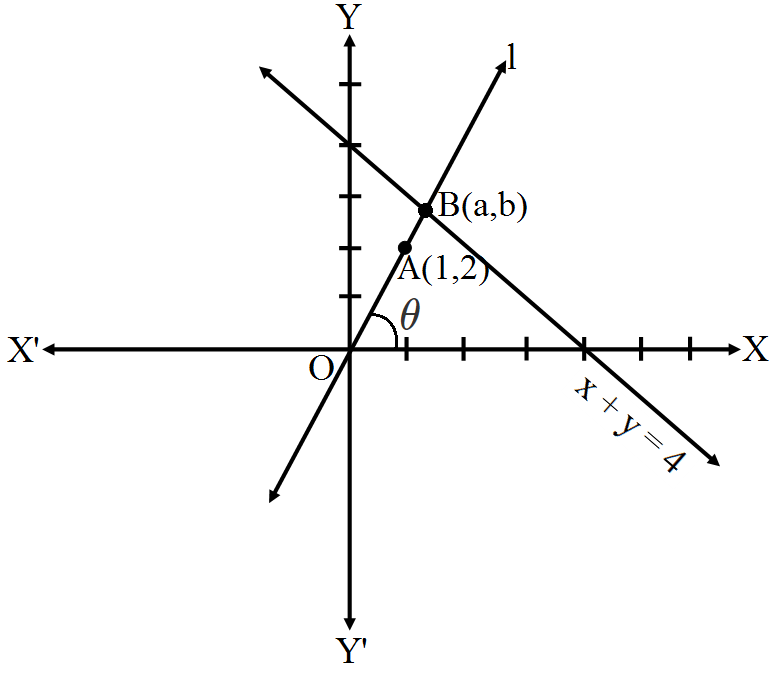
Let the given line x + y = 4 and required line 'l' intersect at B(a, b).
Slope of line 'l' is given by $\text{m}=\frac{\text{b}-2}{\text{a}-1}=\tan\theta\ .....(\text{i})$
Givne that $\text{AB}=\frac{\sqrt{6}}{3}$
So, by distance formula for point A(1, 2) and B(a, b), we get
$\sqrt{(\text{a}-1)^2+(\text{b}-2)^2}=\frac{\sqrt{6}}{3}$
On squaring both the side
$\text{a}^2+ -2\text{a}+\text{b}^2+4-4\text{b}=\frac{6}{9}$
$\text{a}^2\text{b}^2-2\text{a}-4\text{b}+5=\frac{2}{3}\ .....(\text{ii})$
Point B(a, b) also satisfies the eqn. x + y = 4
$\therefore \text{a}+\text{b}\ .....(\text{iii})$
On solving (ii) and (iii), we get $\text{a}=\frac{3\sqrt{3}+1}{2\sqrt{3}},\text{b}=\frac{5\sqrt{3}-1}{2\sqrt{3}}$
Putting values of a and b in eqn. (i), we have
$\tan\theta=\frac{\frac{5\sqrt{3}-1}{2\sqrt{3}}}{\frac{3\sqrt{3}+1}{2\sqrt{3}}}=\frac{5\sqrt{3}-1-4\sqrt{3}}{3\sqrt{3}+1-2\sqrt{3}}=\frac{\sqrt{3}-1}{\sqrt{3}+1}$
$\therefore \tan\theta=\tan15^\circ$
$\Rightarrow \theta = 15^\circ$
View full question & answer
Question 105 Marks
The equation of the line through the intersection of the the lines 2x - 3y = 0 and 4x - 5y = 2 and
column I column II
(a) Throught the point (2, 1) is (a) 2x - y = 4
(b) perpendicular to the line x + 2y + 1 = 0 is (b) x + y - 5 = 0
(c) parpallel to the line 3x + 4y + 5 = 0 (c) x - y - 1
(d) Equally inlined to the axis is (d) 3x - 4y - 1 = 0
Answer
column I column II
(a) Throught the point (2, 1) is (a) 2x - y = 4
(b) perpendicular to the line x + 2y + 1 = 0 is (b) x + y - 5 = 0
(c) parpallel to the line 3x + 4y + 5 = 0 (c) x - y - 1
(d) Equally inlined to the axis is (d) 3x - 4y - 1 = 0
Solution:
  1. Given equcations are 2 - 3y = 0 ...(i)
and 4x - 5y = 2 ...(ii) equation of line passing through eq. (i) and (ii) we get (2x - 3y) + k(4x - 5y - 2) = 0 ...(iii) If eq.(iii)passing through(2, 1) we get (2 × 2 - 3 × 1) + k(4 × 2 - 5 × -2) = 0 ⇒ (4 - 3) + k(8 - 5 - 2) = 0 ⇒ 1 + k(8 - 7)= 0 ⇒ k = -1 So, the required equation is (2x - 3y) -1 (4x - 5y - 2) = 0 ⇒ 2x - 3y - 4x + 5y + 2 = 0 ⇒ - 2x + 2y + 2 = 0 ⇒ x - y - 1 = 0 Hence, (a) ⇔ (iii)
  1. Equation of any line passing through the ponit of intersection of the line 2x - 3y = 0 and 4x - 5y = 2 is
(2x - 3y) + k(4x - 5y - 2) = 0 ...(i) ⇒ (2 + 4k) x + (-3 - 5k) y - 2k = 0 Slope $=\frac{-(2+4\text{k})}{-3-5\text{k}}=\frac{2+4\text{k}}{3+5\text{k}}$ Slope of the given line x + 2y + 1 = 0 is $-\frac{1}{2}$ If they are perpendicular to each other then $\Rightarrow\frac{1}{2}\bigg(\frac{2+4\text{k}}{3+5\text{k}}\bigg)=-1$ $\Rightarrow\frac{2+2\text{k}}{3+5\text{k}}=1$ $\Rightarrow1+2\text{k}=3+5\text{k}$ $ \Rightarrow3\text{k}=-2 \Rightarrow \text{k}\frac{-2}{3}$ $(2\text{x}-3\text{y})-\frac{2}{3}(4\text{x}-5\text{y}-2)=0$ ⇒ 6x - 3y - 8x + 10y + 4 = 0 ⇒ -2x + y + 4 ⇒ 2x - y = 4 Hence , (b ) ⇔ (i)
  1. Given equation are
2x - 3y = 0 ...(i) 4x - 5y = 2 ...(ii) Equation of line pssing through eq. (i) and (ii) we get (2x - 3y) + k(4x - 5y - 2) = 0 ⇒ (2 + 4k) x + (-3 - 5k) y - 2k = 0 Slope $=\frac{-(2+4\text{k})}{-3-5\text{k}}=\frac{2+4\text{k}}{3+5\text{k}}$ slope of the given line 3x - 4y + 5 = 0 is $\frac{3}{4}$ . If the two Equation are parallel , then $\Rightarrow\frac{2+4\text{k}}{3+5\text{k}}=\frac{3}{4}$ ⇒ 8 + 16k = 9 + 15k ⇒ 16k - 15k = 9 - 8 ⇒ k = 1 So, the equation of the requied line is (2x - 3y) + 1(4x - 5y - 2) = 0 2x - 3y + 4x - 5y - 2 = 0 ⇒ 6x - 8y - 2 = 0 ⇒ 3x - 4y - 1 = 0 Hence, (c) ⇔ (iv)
  1. Given equation are
2x - 3y = 0 ...(i) 4x - 5y - 2 = 0...(ii) Equation of the passing through the intersection of eq. (i) and (ii) we get (2x - 3y) + k(4x - 5y - 2) = 0 ⇒ (2 + 4k)x + (-3 - 5k) y - 2k = 0 Slope $=\frac{2+4\text{k}}{3+5\text{k}}$ since the equation is equally inclined with axes $\therefore\ =\tan135^\circ=\tan{(180^\circ-45)}=-\tan45^\circ=-1$ So $\frac{2+4\text{k}}{3+5\text{k}}=-1\Rightarrow2+4\text{k}=-3-5\text{k}$ ⇒ 9k = -5 $\Rightarrow\text{k}=\frac{-5}9{}$ Requied equation is $(2\text{x}-3\text{y})-\frac{5}{9}(4\text{x}-5\text{y}-2)=0$ ⇒ 18x - 27y - 20x + 25y + 10 = 0 ⇒ -2x - 2y + 10 = 0 ⇒ x + y - 5 = 0 Hence, (d ) ⇔ (ii).
View full question & answer
Question 115 Marks
If the equation of the base of an equilateral triangle is x + y = 2 and the vertex is (2, - 1), then find the length of the side of the triangle.
[Hint: Find length of perpendicular (p) from (2, - 1) to the line and use $\text{p}=\text{l}\sin60^\circ$ where l is the length of side of the triangle].
Answer
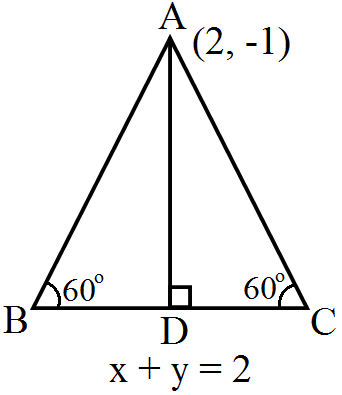
Equation of the base AB of a $\triangle\text{ABC}$ is x + y = 2
In $\triangle\text{ABD},$
$\sin 60^\circ = \frac{\text{AD}}{\text{AB}}$
$\Rightarrow \frac{\sqrt{3}}{2}=\frac{\text{AD}}{\text{AB}}\Rightarrow \text{AD}=\frac{\sqrt{3}}{2}\text{AB}$
Lenght of perpendicular from A(2, -1) to the line x + y = 2 is
$\text{AD}=\bigg|\frac{1\times2+1\times-1-2}{\sqrt{(1)^2+(1)^2}}\bigg|$

$\Rightarrow \frac{\sqrt{3}}{2}\text{AB}=\bigg|\frac{2-1-2}{\sqrt{2}}\bigg|=\bigg|\frac{-1}{\sqrt{2}}\bigg|$
$\Rightarrow \frac{\sqrt{3}}{2}\text{AB}=\frac{1}{\sqrt{2}}$
$\Rightarrow \text{AB}=\frac{\sqrt{2}}{\sqrt{3}}$
Hence, the required length of side $=\frac{\sqrt{2}}{\sqrt{3}}.$
View full question & answer