Question 14 Marks
Rajiv constructs two right angled triangles in the fourth quadrant in such a way that the measure of triangle gives $\cos A=\frac{4}{5}$ and $\cos B=\frac{12}{13}$, where $\frac{3 \pi}{2} < A$ and $B > 2 \pi$.
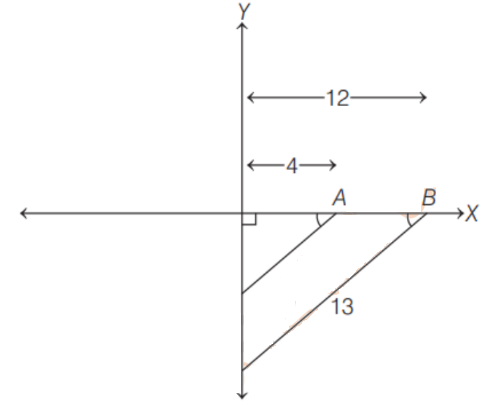
Based on the above information, answer the following questions.
(i) Find the value of $\cos (A+B)$
(ii) Find the value of $\sin (A-B)$
(iii) Find the value of $\tan (\mathbf{A}+\mathbf{B})$
Based on the above information, answer the following questions.
(i) Find the value of $\cos (A+B)$
(ii) Find the value of $\sin (A-B)$
(iii) Find the value of $\tan (\mathbf{A}+\mathbf{B})$
Answer
View full question & answer→Given, $\cos A=\frac{4}{5}$, where $\frac{3 \pi}{2}<A<2 \pi$
$
\therefore \sin A=-\sqrt{1-\cos ^2 A}=-\frac{3}{5}
$
$\left[\because\right.$ A lies in IVth quadrant] and $\cos B=\frac{12}{13}$, where $\frac{3 \pi}{2}<B<2 \pi$
$
\therefore \sin \mathrm{B}=-\sqrt{1-\cos ^2 \mathrm{~B}}=-\frac{5}{13}
$
$[\because$ B lies in IVth quadrant]
(i)
$
\begin{aligned}
\cos (A+B)= & \frac{4}{5} \times \frac{12}{13}-\left(-\frac{3}{5}\right)\left(-\frac{5}{13}\right) \\
& {[\because \cos (A+B)=\cos A \cos B-\sin A \sin B] } \\
= & \frac{48}{65}-\frac{15}{65}=\frac{33}{65}
\end{aligned}
$
(ii)
$
\begin{aligned}
\sin (A-B)= & \left(-\frac{3}{5}\right) \times \frac{12}{13}-\frac{4}{5} \times\left(-\frac{5}{13}\right) \\
& {[\because \sin (A-B)=\sin A \cos B-\cos A \sin B] } \\
= & -\frac{36}{65}+\frac{20}{65}=-\frac{16}{65}
\end{aligned}
$
(iii)
$
\begin{aligned}
\because \sin (A+B)= & \left(-\frac{3}{5}\right) \cdot\left(\frac{12}{13}\right)+\left(\frac{4}{5}\right) \cdot\left(-\frac{5}{13}\right) \\
& {[\because \sin (A+B)=\sin A \cos B+\cos A \sin B] }
\end{aligned}
$
$
\begin{aligned}
&=\frac{-36-20}{5 \times 13}=-\frac{56}{65} \\
& \therefore \tan (A+B)= \frac{-\frac{56}{65}}{\frac{33}{65}}=-\frac{56}{33} \\
& {\left[\because \tan (A+B)=\frac{\sin (A+B)}{\cos (A+B)}\right] }
\end{aligned}
$
$
\therefore \sin A=-\sqrt{1-\cos ^2 A}=-\frac{3}{5}
$
$\left[\because\right.$ A lies in IVth quadrant] and $\cos B=\frac{12}{13}$, where $\frac{3 \pi}{2}<B<2 \pi$
$
\therefore \sin \mathrm{B}=-\sqrt{1-\cos ^2 \mathrm{~B}}=-\frac{5}{13}
$
$[\because$ B lies in IVth quadrant]
(i)
$
\begin{aligned}
\cos (A+B)= & \frac{4}{5} \times \frac{12}{13}-\left(-\frac{3}{5}\right)\left(-\frac{5}{13}\right) \\
& {[\because \cos (A+B)=\cos A \cos B-\sin A \sin B] } \\
= & \frac{48}{65}-\frac{15}{65}=\frac{33}{65}
\end{aligned}
$
(ii)
$
\begin{aligned}
\sin (A-B)= & \left(-\frac{3}{5}\right) \times \frac{12}{13}-\frac{4}{5} \times\left(-\frac{5}{13}\right) \\
& {[\because \sin (A-B)=\sin A \cos B-\cos A \sin B] } \\
= & -\frac{36}{65}+\frac{20}{65}=-\frac{16}{65}
\end{aligned}
$
(iii)
$
\begin{aligned}
\because \sin (A+B)= & \left(-\frac{3}{5}\right) \cdot\left(\frac{12}{13}\right)+\left(\frac{4}{5}\right) \cdot\left(-\frac{5}{13}\right) \\
& {[\because \sin (A+B)=\sin A \cos B+\cos A \sin B] }
\end{aligned}
$
$
\begin{aligned}
&=\frac{-36-20}{5 \times 13}=-\frac{56}{65} \\
& \therefore \tan (A+B)= \frac{-\frac{56}{65}}{\frac{33}{65}}=-\frac{56}{33} \\
& {\left[\because \tan (A+B)=\frac{\sin (A+B)}{\cos (A+B)}\right] }
\end{aligned}
$