MCQ
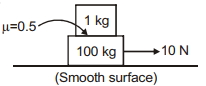
The frictional force acting on $1 \,kg$ block is .................. $N$
  • $0.1$
  • B
    $2$
  • C
    $0.5$
  • D
    $5$

Answer

Correct option: A.
$0.1$
a
(a)

If both move together $a=\frac{10}{101} \simeq 0.1 \,m / s ^2$

Now, $F_{\text {net }}=1(0.1)=0.1 \,N$

$f_L=(0.5)(1)(g)=5 \,N$

So, $f=0.1 \,N$

Need a full question paper?

Generate a complete, print-ready paper with questions like this in minutes — across 16+ boards, with answer keys.
Start Generating Free

Similar questions

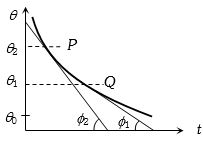
A body cools in a surrounding which is at a constant temperature of ${\theta _0}$. Assume that it obeys Newton's law of cooling. Its temperature $\theta $ is plotted against time $t$ . Tangents are drawn to the curve at the points $P(\theta = {\theta _1})$ and $Q(\theta = {\theta _2})$. These tangents meet the time axis at angles of ${\varphi _2}$and ${\varphi _1}$, as shown
The dimensions of a cone are measured using a scale with a least count of $2 mm$. The diameter of the base and the height are both measured to be $20.0 cm$. The maximum percentage error in the determination of the volume is. . . . .
Inside a closed furnace held at a temperature of $400\,\, K,$ we have a black body. A hole of area $10\,\, cm^2$ is opened in the furnace so that sunlight starts falling on black body. The intensity of sunlight is $2000\, W/m^2.$ In the steady state
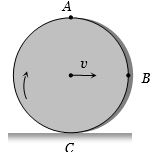
A solid disc rolls clockwise without slipping over a horizontal path with a constant speed $\upsilon $. Then the magnitude of the velocities of points $A, B$ and $C$ (see figure) with respect to a standing
A balloon rises from rest with a constant acceleration $g/8$. A stone is released from it when it has risen to height $h$. The time taken by the stone to reach the ground is
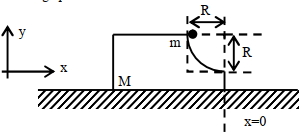
A block of mass $M$ has a circular cut with a frictionless surface as shown. The block rests on the horizontal frictionless surface of a fixed table. Initially the right edge of the block is at $x=0$, in a co-ordinate system fixed to the table. A point mass $m$ is released from rest at the topmost point of the path as shown and it slides down. When the mass loses contact with the block, its position is $\mathrm{x}$ and the velocity is $\mathrm{v}$. At that instant, which of the following options is/are correct?

(image)

$[A]$ The $x$ component of displacement of the center of mass of the block $M$ is : $-\frac{m R}{M+m}$.

[$B$] The position of the point mass is : $x=-\sqrt{2} \frac{\mathrm{mR}}{\mathrm{M}+\mathrm{m}}$.

[$C$] The velocity of the point mass $m$ is : $v=\sqrt{\frac{2 g R}{1+\frac{m}{M}}}$.

[$D$] The velocity of the block $M$ is: $V=-\frac{m}{M} \sqrt{2 g R}$.
A spring of force constant $k$ is cut into lengths of ratio $1:2:3$ . They are connected in series and the new force constant is $k'$ . Then they are connected in parallel and force constant is $k''$ . Then $k':k''$ is
A dip circle is taken to geomagnetic equator. The needle is allowed to move in a vertical plane perpendicular to the magnetic meridian. The needle will stay:
  1. In horizontal direction only.
  2. In vertical direction only.
  3. In any direction except vertical and horizontal.
  4. In the direction it is released.
The net external torque on a system of particles about an axis is zero. Which of the following are compatible with it?
The mass per unit length of a uniform wire is $0.135\, g / cm$. A transverse wave of the form $y =-0.21 \sin ( x +30 t )$ is produced in it, where $x$ is in meter and $t$ is in second. Then, the expected value of tension in the wire is $x \times 10^{-2} N$. Value of $x$ is . (Round-off to the nearest integer)