Question
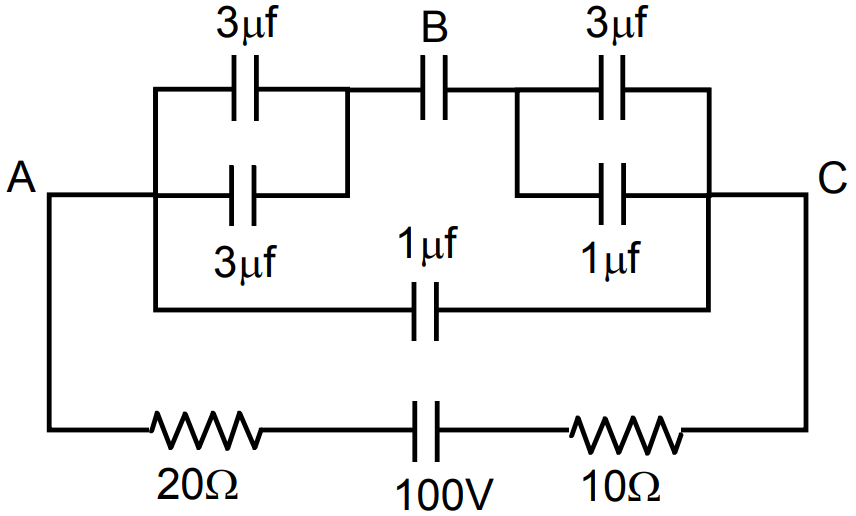
Find the potential difference between the points A and B and between the points B and C of the figure. in steady state.
Answer


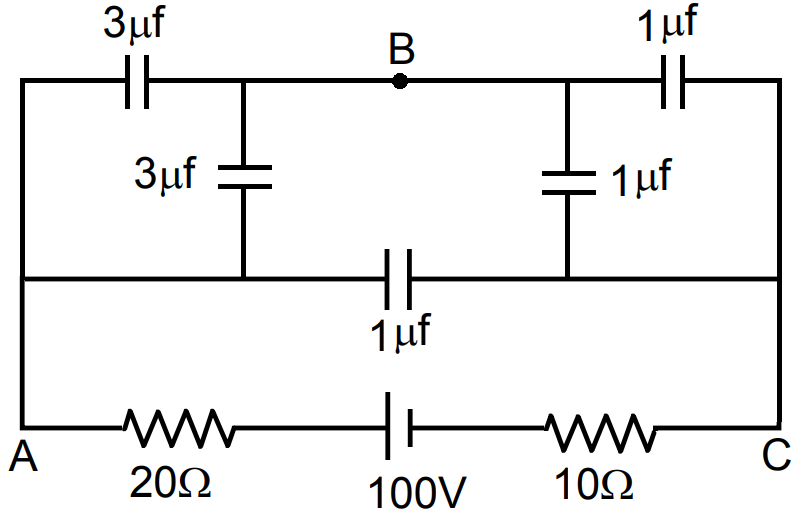
$\text{C}_\text{eq}=\big[(3\mu\text{fp}\ 3\mu\text{f})\text{s}(1\mu\text{f p}1\mu\text{f})\big]\text{p}(1\mu\text{f})$

$=\big[(3+3)\mu\text{f s}(2\mu\text{f})\big]\text{p}1\mu\text{f}$

$=\frac{3}{2}+1=\frac{5}{2}\mu\text{f}$

$\text{V}=100\text{V}$

$\text{Q}=\text{CV}=\frac{5}{2}\times100=250\mu\text{c}$

Charge stored across $1\mu\text{f}$ capacitor $=100\mu\text{C}$

Ceq between A and B is $=6\mu\text{f}=\text{C}$

Potential drop across $\text{AB}=\text{V}=\frac{\text{Q}}{\text{C}}=25\text{V}$

Potential drop across BC = 75V.

Need a full question paper?

Generate a complete, print-ready paper with questions like this in minutes — across 16+ boards, with answer keys.

Start Generating Free

Similar questions

Identical springs of steel and copper are equally stretched. On which, more work will have to be done?
A fighter plane is flying horizontally at an altitude of 1.5 km with a speed of $720 km / h$. At what angle of sight (w.r.t horizontal) when the target is seen, should the pilot drop the bomb in order to attack the target?
Main concept used: $u =720 km / h =720 \times \frac{5}{18} m / s =200 m / s$
Define simple harmonic motion. Derive the differential equation of its motion and find the solution.
A cylindrical piece of cork of density of base area A and height h floats in a liquid of density $\rho_1.$ The cork is depressed slightly and then released. Show that the cork oscillates up and down simple harmonically with a period $\text{T}=2\pi\sqrt{\frac{\text{h}\rho}{\rho_1\text{g}}}$ where $\rho$ is the density of cork. (Ignore damping due to viscosity of the liquid).
Prove that closed argon pipe produced only odd harmonics whereas both odd and even harmonic are produced in an open argon pipe.
Estimate the mean free path and collision frequency of nitrogen molecules in a cylinder of nitrogen gas at 2.0 atm pressure and $17^{\circ} C$ temperature take the radius of nitrogen molecule to be approximately 1.0. Compare the collision time with the time taken by the molecules to move freely between two collisions (Molecular mass of nitrogen $=28.0 u$ ).
Two spherical bodies, each of mass 50kg, are placed at a separation of 20cm. Equal charges are placed on the bodies and it is found that the force of Coulomb repulsion equals the gravitational attraction in magnitude. Find the magnitude of the charge placed on either body.
What is a heat engine? What are its essential parts? Explain its principle and establish the formula for its efficiency.
The equation of a wave travelling on a string stretched along the X-axis is given by-

$\text{y}=\text{A}\text{e}^{-\Big(\frac{\text{x}}{\text{a}}+\frac{\text{t}}{\text{T}}\Big)^2}.$

  1. Write the dimensions of A, a and T.
  2. Find the wave speed.
  3. In which direction is the wave. travelling?
  4. Where is the maximum of the pulse located at t = T? at t = 2T?
A wire of length l is bent in the form of an equilateral triangle and carries an electric currrent i.
  1. Find the magnetic field B at the centre.
  2. If the wire is bent in the form of a square, what would be the value of B at the centre?