Questions · Page 2 of 2

5 Marks Questions

Question 515 Marks
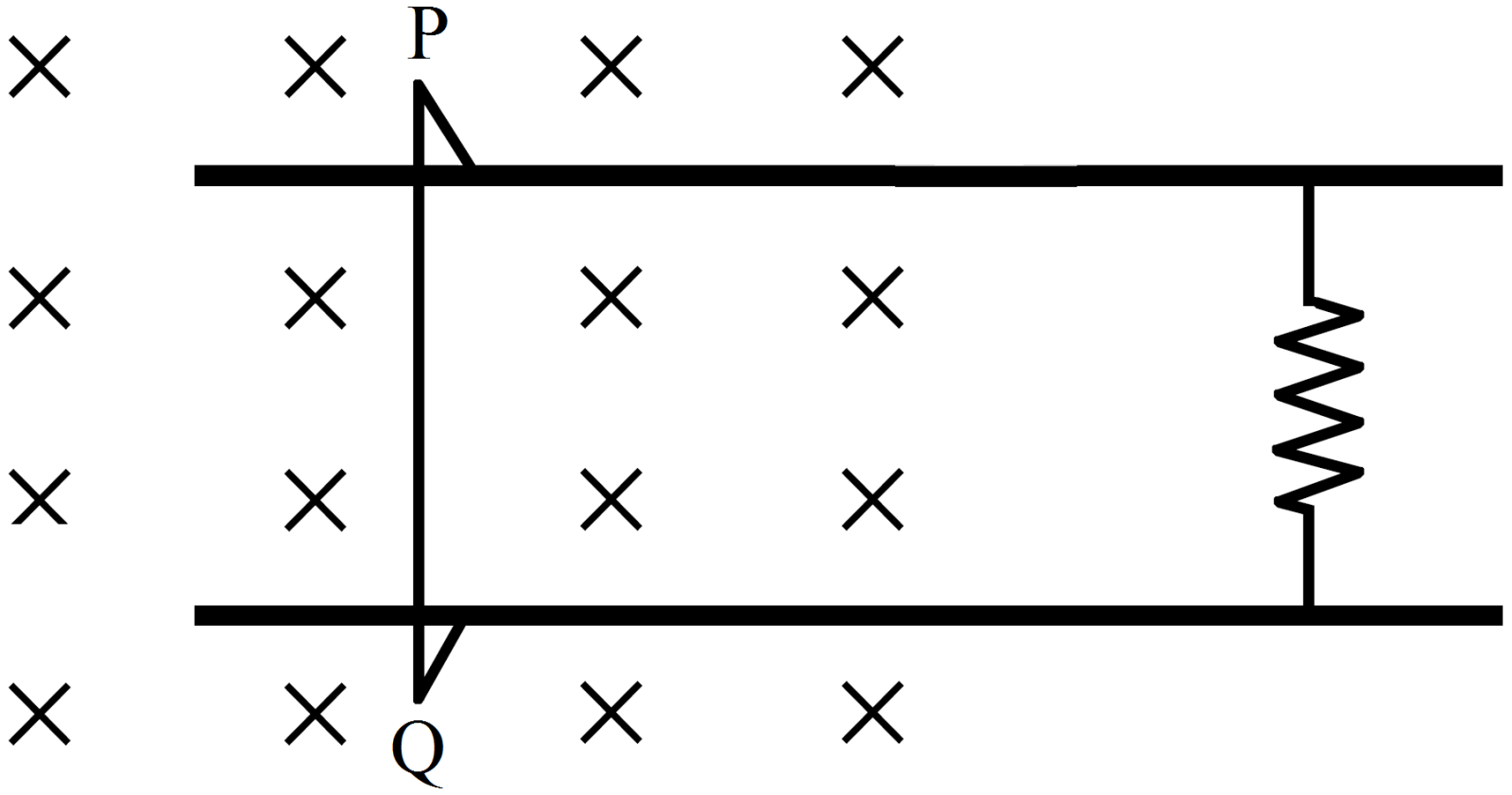
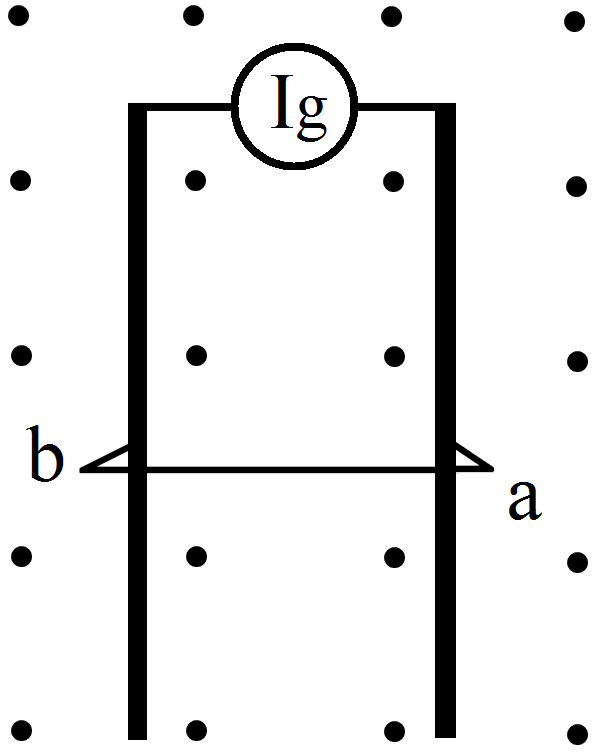
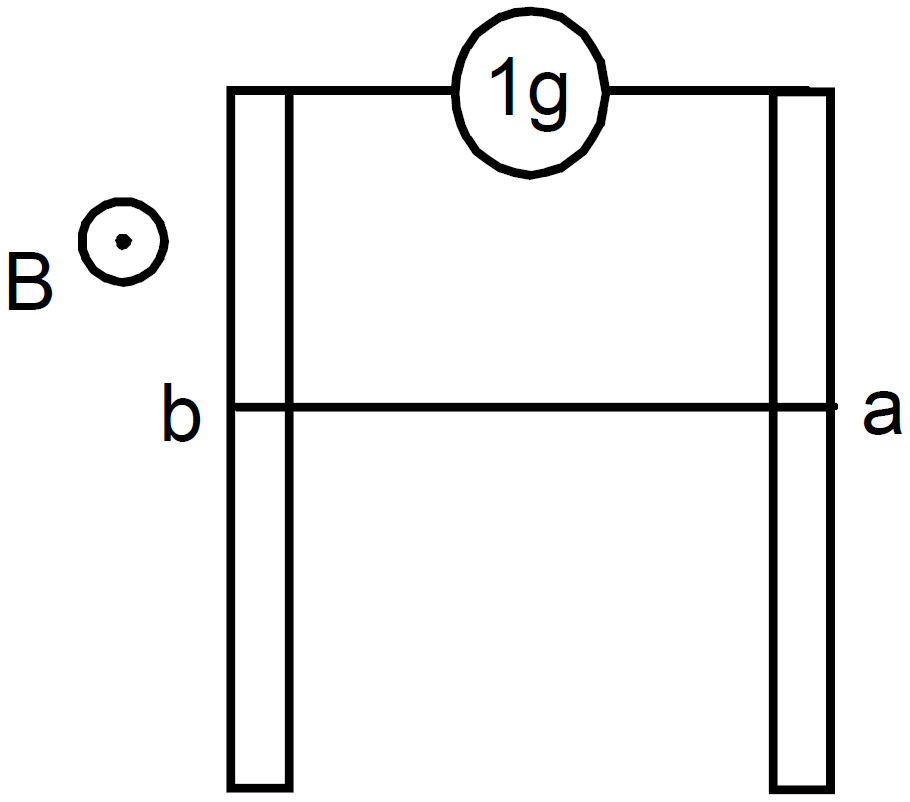
The system containing the rails and the wire of the previous problem is kept vertically in a uniform horizontal magnetic field B that is perpendicular to the plane of the rails (figure). It is found that the wire stays in equilibrium. If the wire ab is replaced by another wire of double its mass, how long will it take in falling through a distance equal to its length?
Answer
Given Blv = mg …(1)

When wire is replaced we have

2mg - Blv = 2ma [where a → acceleration]

$\Rightarrow\text{a}=\frac{2\text{mg}-\text{Blv}}{2\text{m}}$

Now, $\text{s}=\text{ut}+\frac{1}{2}\text{at}^2$

$\Rightarrow\text{l}=\frac{1}{2}\times\frac{2\text{mg}-\text{Blv}}{2\text{m}}\times\text{t}^2 \ \big[\therefore \ \text{s}=\text{l}\big]$

$\Rightarrow\text{t}=\sqrt{\frac{4\text{ml}}{2\text{mg}-\text{Blv}}}=\sqrt{\frac{4\text{ml}}{2\text{mg}-\text{mg}}}=\sqrt{\frac{2\text{l}}{\text{g}}}$ [from (1)]
View full question & answer
Question 525 Marks
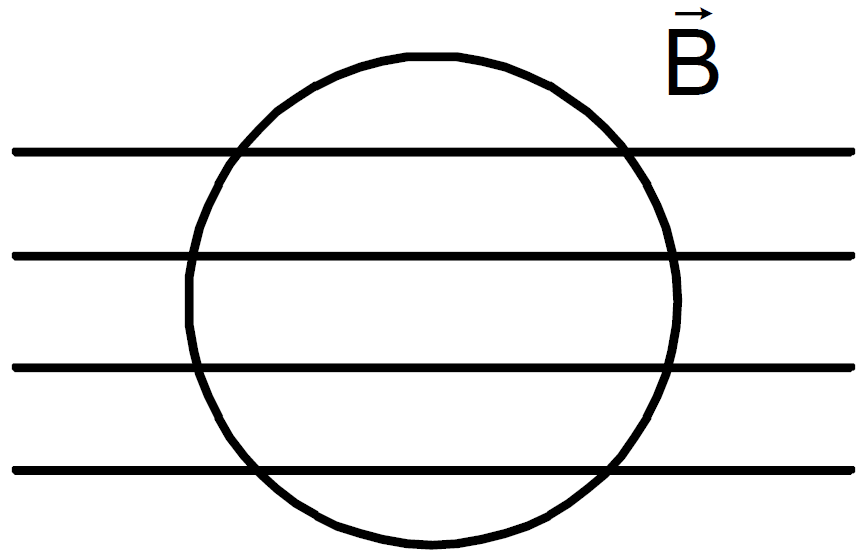
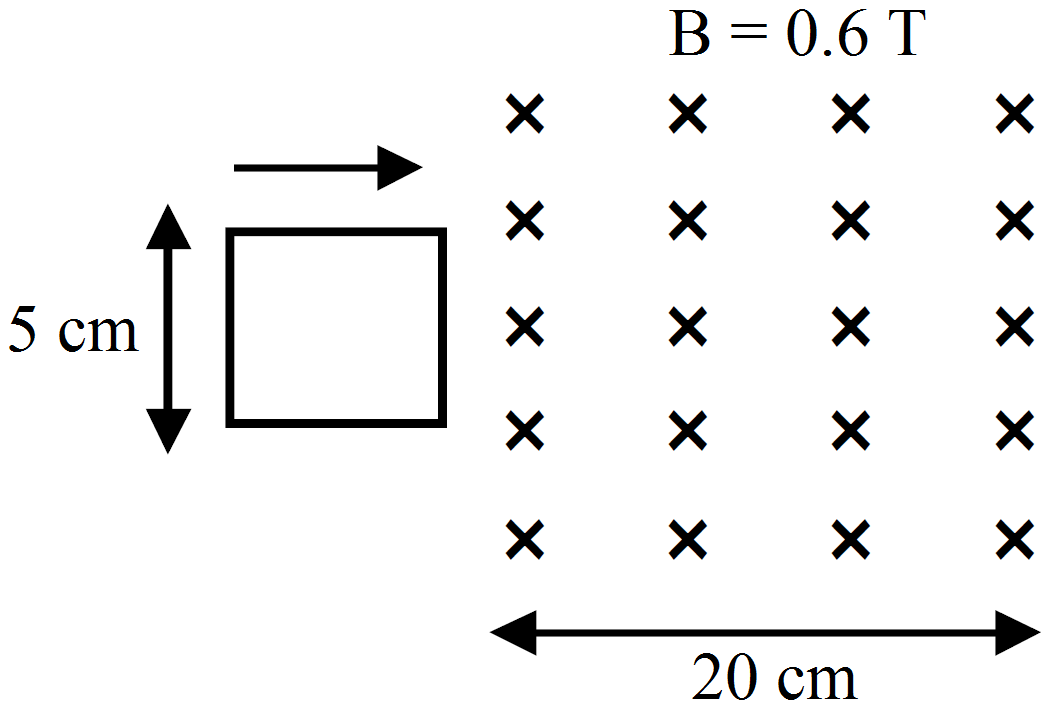
Figure shows a square loop of side 5cm being moved towards right at a constant speed of 1cm/s. The front edge enters the 20cm wide magnetic field at t = 0. Find the emf induced in the loop at:
  1. t = 2s
  2. t = 10s
  3. t = 22s
  4. t = 30s.

Answer
u = 1cm/', B = 0.6T

  1. At t = 2sec, distance moved = 2 × 1cm/s = 2cm

$\text{E}=\frac{\text{d}\phi}{\text{dt}}=\frac{0.6\times(2\times5- 0)\times10^{-4}}{2}=3\times10^{-4}\text{V}$

  1. At t = 10sec

distance moved = 10 × 1 = 10cm

The flux linked does not change with time

$\therefore$ E = 0

  1. At t = 22sec

distance = 22 × 1 = 22cm

The loop is moving out of the field and 2cm outside.

$\text{E}=\frac{\text{d}\phi}{\text{dt}}=\text{B}\times\frac{\text{dA}}{\text{dt}}$

$=\frac{0.6\times(2\times5\times10^{-4})}{2}=3\times10^{-4}\text{V}$

  1. At t = 30sec

The loop is total outside and flux linked = 0

$\therefore$ E = 0.

View full question & answer
Question 535 Marks
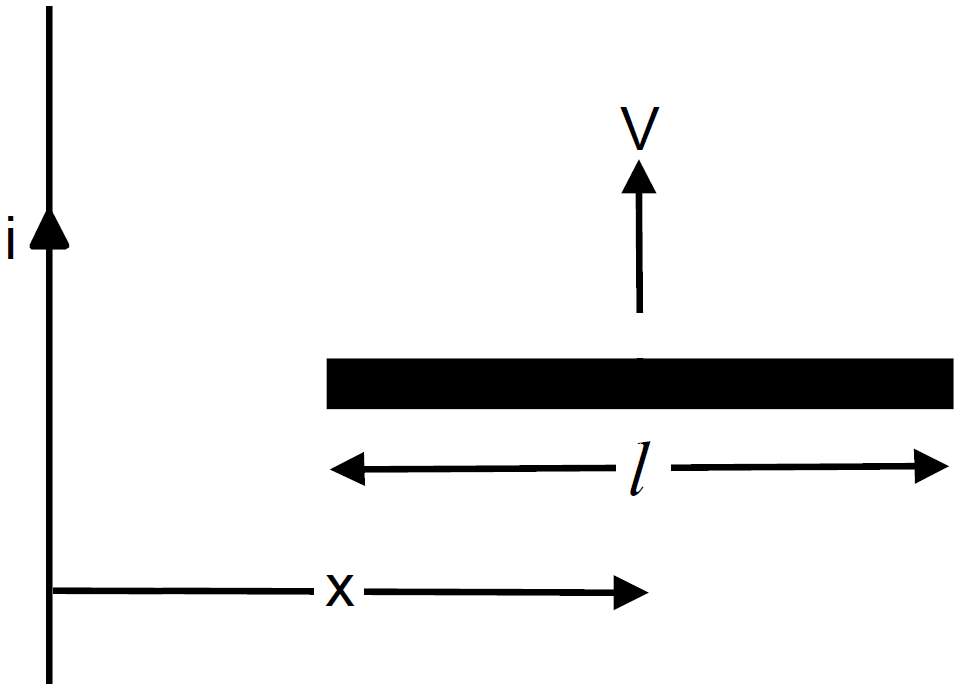
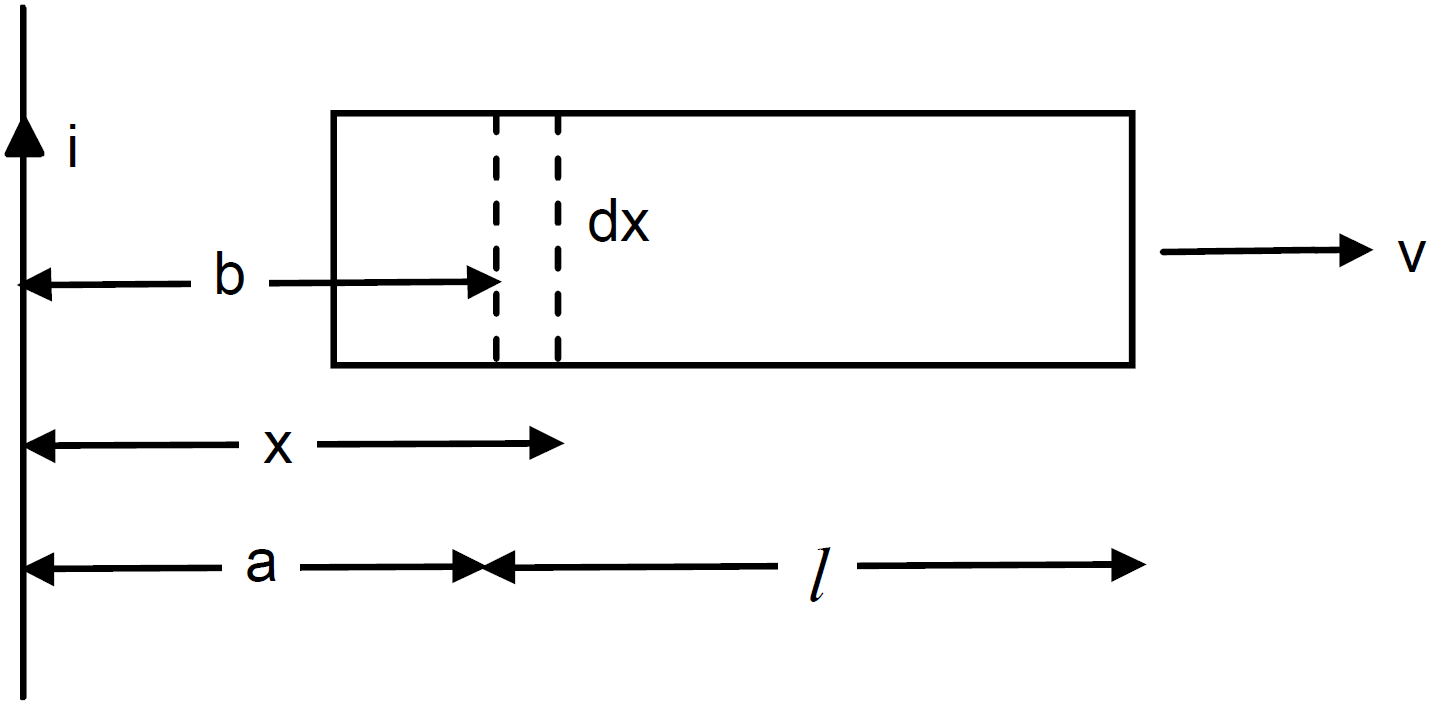
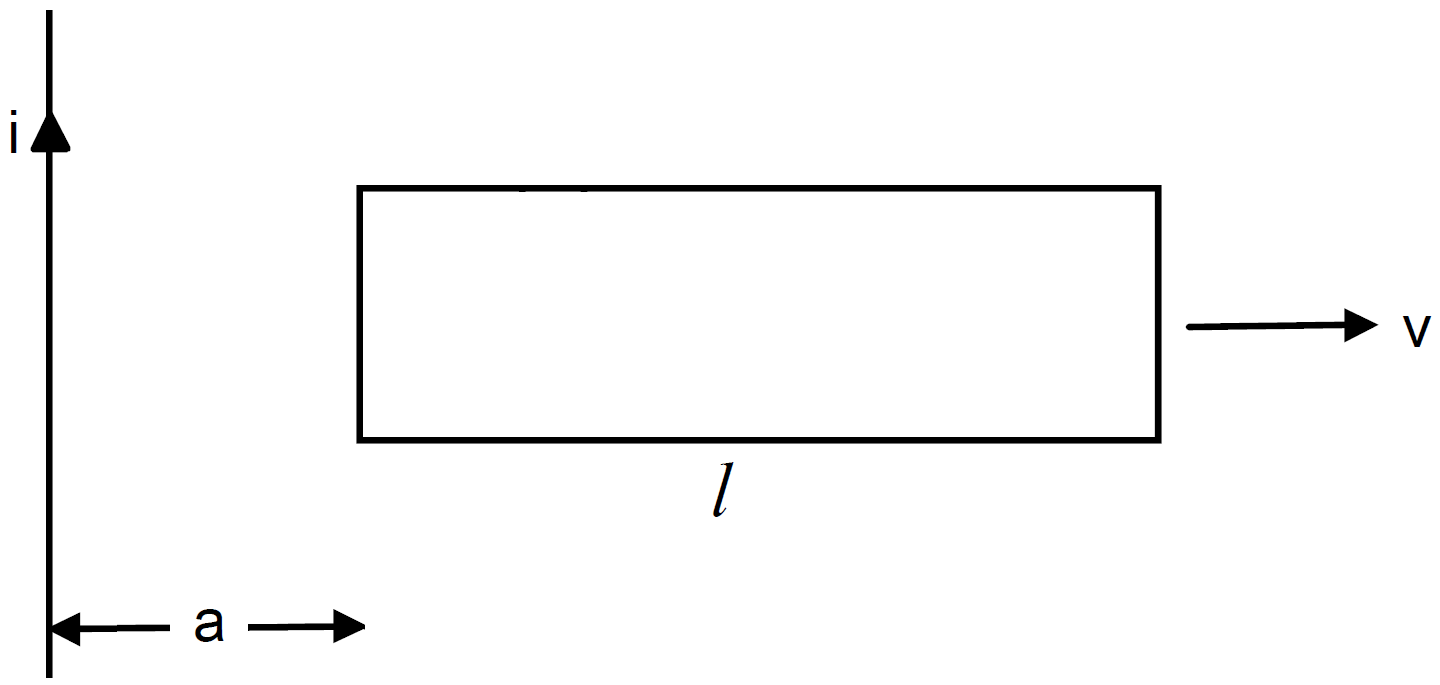
Figure shows a straight, long wire carrying a current i and a rod of length l coplanar with the wire and perpendicular to it. The rod moves with a constant velocity v in a direction parallel to the wire. The distance of the wire from the centre of the rod is x. Find motional emf induced in the rod.

Answer
In this case $\vec{\text{B}}$ varies

Hence considering a small element at centre of rod of length dx at a dist x from the wire.

$\vec{\text{B}}=\frac{\mu_0\text{i}}{2\pi\text{X}}$

so, $\text{de}=\frac{\mu_0\text{i}}{2\pi\text{x}}\times\text{vxdx}$

$\text{e}=\int\limits^\text{e}_0\text{de}=\frac{\mu_0\text{iv}}{2\pi}=\int\limits^{\text{x}+\frac{\text{t}}{2}}_{\text{x}-\frac{\text{t}}{2}}\frac{\text{dx}}{\text{x}}$

$=\frac{\mu_0\text{iv}}{2\pi}\bigg[\text{In}\Big(\text{x}+\frac{\text{l}}{2}\Big)\text{In}-\Big(\text{x}-\frac{\text{l}}{2}\Big)\bigg]$

$\frac{\mu_0\text{iv}}{2\pi}\text{In}\Bigg[\frac{\text{x}+\frac{\text{l}}{2}}{\text{x}-\frac{\text{l}}{2}}\Bigg]=\frac{\mu_0\text{iv}}{2\pi}\text{In}\Big(\frac{2\text{x}+\text{l}}{2\text{x}-\text{l}}\Big)$

View full question & answer
Question 545 Marks
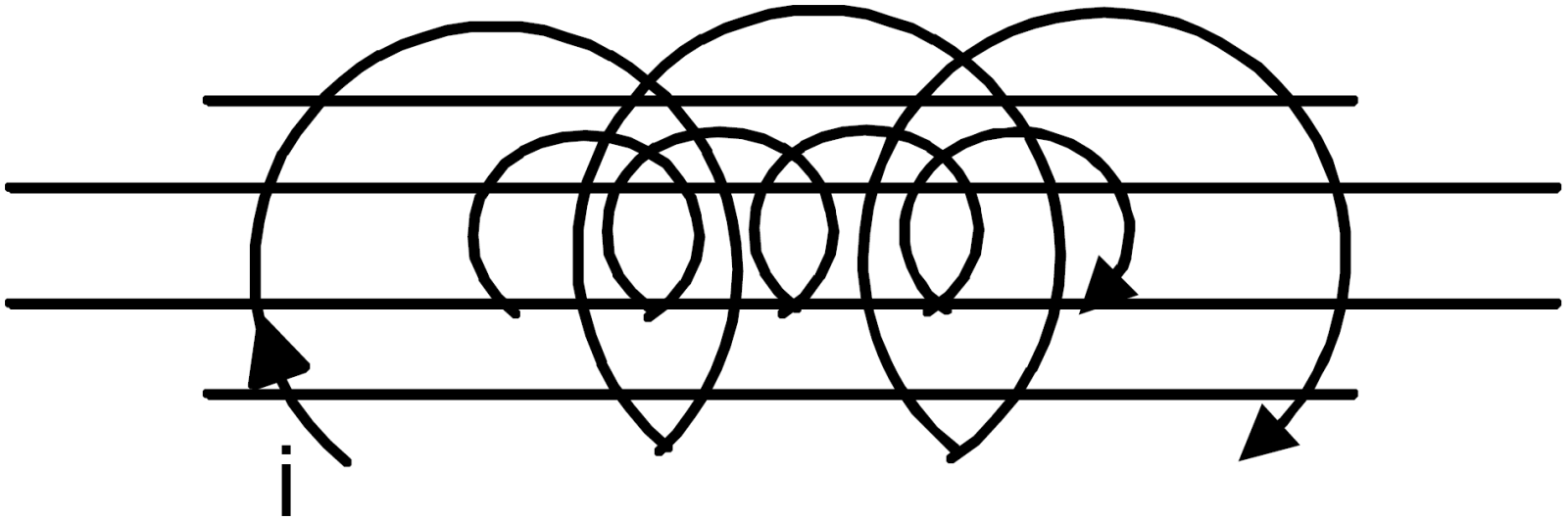
A current of 1.0A is established in a tightly wound solenoid of radius 2cm having 1000 turns/ metre. Find the magnetic energy stored in each metre of the solenoid.
Answer
i = 1.0A, r = 2cm, n = 1000 turn/m

Magnetic energy stored $=\frac{\text{B}^2\text{V}}{2\mu_0}$

Where B → Magnetic field, V → Volume of Solenoid.

$=\frac{\mu_0\text{n}^2\text{i}^2}{2\mu_0}\times\pi\text{r}^2\text{h}$

$=\frac{4\pi\times10^{-7}\times10^6\times1\times\pi\times4\times10^{-4}\times1}{2} \ [\text{h}=1\text{m}]$

$=8\pi\times10^{-5}$

$78.956\times10^{-5}=7.9\times10^{-4}\text{J}$.

View full question & answer
Question 555 Marks
A solenoid of length 20cm, area of cross-section 4.0cm2 and having 4000 turns is placed inside another solenoid of 2000 turns having a cross-sectional area 8.0cm2 and length 10cm. Find the mutual inductance between the solenoids.
Answer

Solenoid I:

$\text{a}_1=4\text{cm}^2; \ \text{n}_1=\frac{4000}{0.2}\text{m}; \ \text{l}_1=20\text{cm}=0.20\text{m}$

Solenoid II:

$\text{a}_1=8\text{cm}^2; \ \text{n}_2=\frac{2000}{0.1}\text{m}; \ \text{l}_2=10\text{cm}=0.10\text{m}$

$\text{B}=\mu_0\text{n}_2\text{i}$ let the current through outer solenoid be i.

$\phi=\text{n}_1\text{B.A}=\text{n}_1\text{n}_2\mu_0\text{i}\times\text{a}_1$

$=2000\times\frac{2000}{0.1}\times4\pi\times10^{-7}\times\text{i}\times4\times10^{-4}$

$\text{E}=\frac{\text{d}\phi}{\text{dt}}=64\pi\times10^{-4}\times\frac{\text{di}}{\text{dt}}$

$\Big[\text{As E}=\frac{\text{mdi}}{\text{dt}}\Big]$

Now $\text{M}=\frac{\text{E}}{\frac{\text{di}}{\text{dt}}}=64\pi\times10^{-4}\text{H}=2\times10^{-2}\text{H}.$

View full question & answer
Question 565 Marks
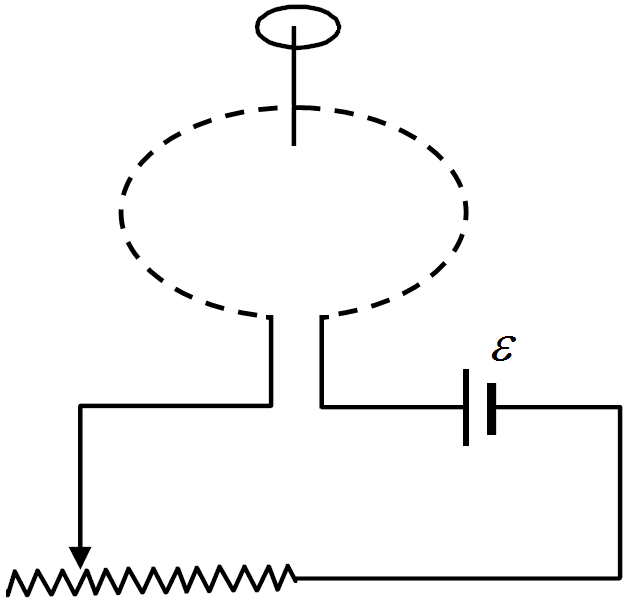
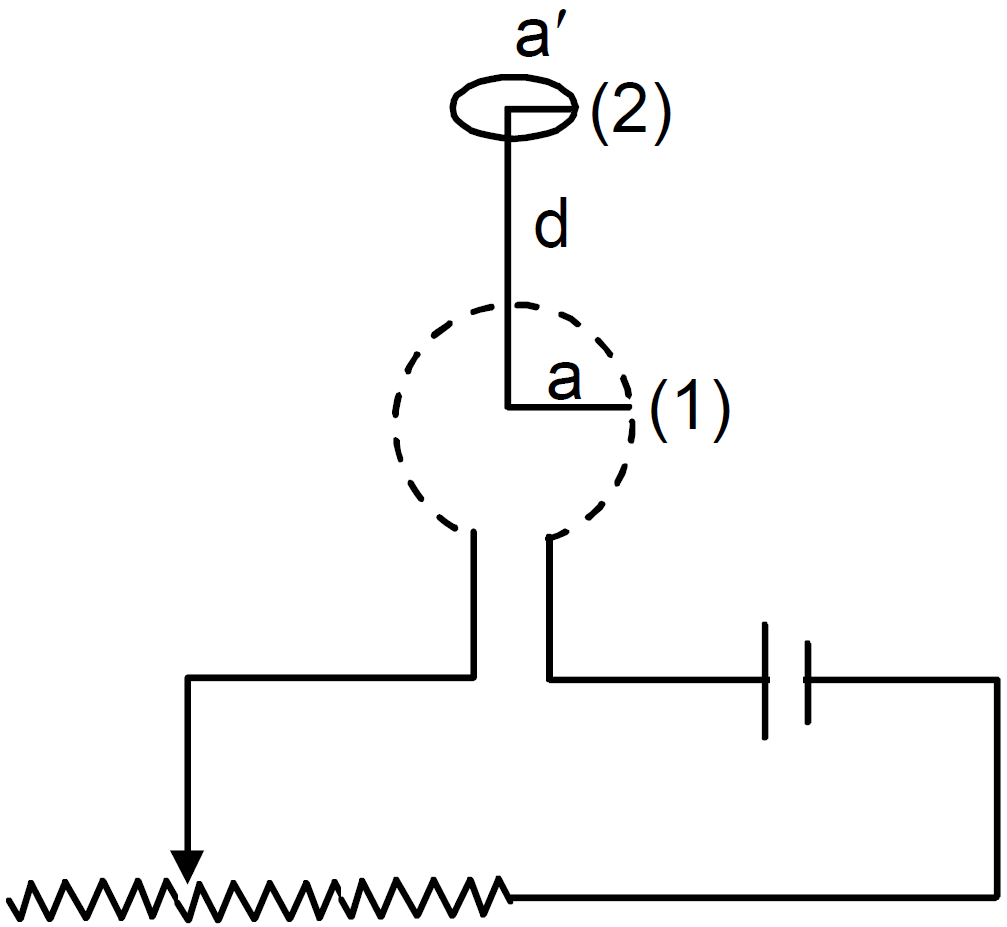
Figure shows a circular coil of N turns and radius a, connected to a battery of emf ϵ through a rheostat. The rheostat has a total length L and resistance R. The resistance of the coil is r. A small circular loop of radius a' and resistance r' is pl-aced coaxially with the coil. The centre of the loop is at a distance x from the centre of coil. the In the beginning, the sliding contact of the rheostat is at the left end and then onwards it is moved towards right at a constant speed u. Find the emf induced in the small circular loop at the instant:
  1. The contact begins to slide.
  2. It has slide through half the length of the rheostat.

Answer

Magnetic field due to the coil (1) at the center of (2) is $\text{B}=\frac{\mu_0\text{Nia}^2}{2(\text{a}^2+\text{x}^2)^{\frac{3}{2}}}$
Flux linked with the second,

$=\text{B}.\text{A}_{(2)}=\frac{\mu_0\text{Nia}^2}{2(\text{a}^2+\text{x}^2)^{\frac{3}{2}}}\pi\text{a}'^2$

E.m.f. induced $\frac{\text{d}\phi}{\text{dt}}=\frac{\mu_0\text{Na}^2\text{a}'^2\pi}{2(\text{a}^2+\text{x}^2)^{\frac{3}{2}}}\frac{\text{di}}{\text{dt}}$

$=\frac{\mu_0\text{N}\pi\text{a}^2\text{a}'^2}{2(\text{a}^2+\text{x}^2)^{\frac{3}{2}}}\frac{\text{d}}{\text{dt}}\frac{\text{E}}{\Big(\Big(\frac{\text{R}}{\text{L}}\Big)\text{x}+\text{r}\Big)}$

$=\frac{\mu_0\text{N}\pi\text{a}^2\text{a}'^2}{2(\text{a}^2+\text{x}^2)^{\frac{3}{2}}}\text{E}\frac{-1\frac{\text{R}}{\text{L}}\text{v}}{\Big(\Big(\frac{\text{R}}{\text{L}}\Big)\text{x}+\text{r}\Big)^2}$

  1. For $\text{x}=\text{L}$

$\text{E}=\frac{\mu_0\text{N}\pi\text{a}^2\text{a}'^2\text{RvE}}{2(\text{a}^2+\text{x}^2)^{\frac{3}{2}}\big(\text{R}+\text{r}\big)^2}$

  1. $=\frac{\mu_0\text{N}\pi\text{a}^2\text{a}'^2}{2(\text{a}^2+\text{x}^2)^{\frac{3}{2}}}\frac{\text{ERV}}{\text{L}\Big(\frac{\text{R}}{2}+\text{r}\Big)^2} \ \Big(\text{for} \ \text{x}=\frac{\text{L}}{2},\frac{\text{R}}{\text{L}}\text{x}=\frac{\text{R}}{2}\Big)$
View full question & answer
Question 575 Marks
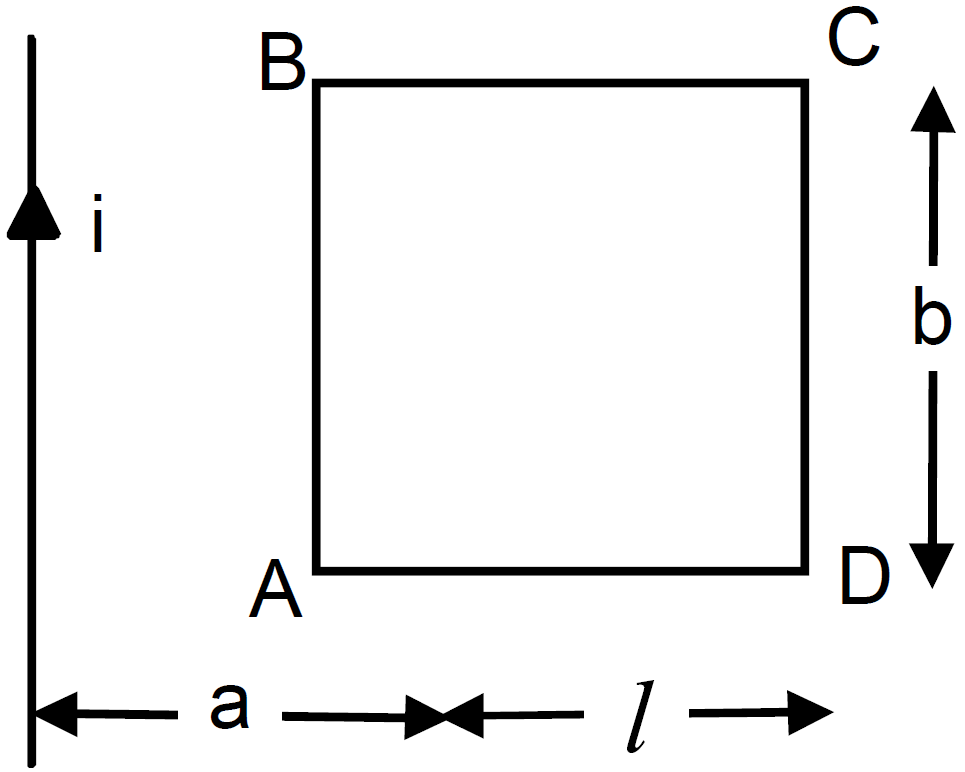
A rectangular metallic loop of length l and width b is placed coplanarly with a long wire carrying a current i. The loop is moved perpendicular to the wire with a speed v in the plane containing the wire and the loop. Calculate the emf induced in the loop when the rear end of the loop is at a distance a from the wire. Solve by using Faraday's law for the flux through the loop and also by replacing different segments with equivalent batteries.

Answer

Using Faraday’' law

Consider a unit length dx at a distance x
$\text{B}=\frac{\mu_0\text{i}}{2\pi\text{x}}$

Area of strip $=\text{b} \ \text{dx}$

$\text{d}\phi=\frac{\mu_0\text{i}}{2\pi\text{x}}\text{dx}$

$\Rightarrow\phi=\int\limits^{\text{a}+1}_\text{a}\frac{\mu_0\text{i}}{2\pi\text{x}}\text{bdx}$

$=\frac{\mu_o\text{i}}{2\pi}\text{b}\int\limits^{\text{a}+1}_\text{a}\Big(\frac{\text{dx}}{\text{x}}\Big)=\frac{\mu_0\text{ib}}{2\pi}\log\Big(\frac{\text{a}+\text{l}}{\text{a}}\Big)$

$\text{Emf}=\frac{\text{d}\phi}{\text{dt}}=\text{dt}\Big[\frac{\mu_0\text{ib}}{2\pi}\text{log}\Big(\frac{\text{a}+\text{l}}{\text{a}}\Big)\Big]$

$=\frac{\mu_0\text{ib}}{2\pi}\frac{\text{a}}{\text{a}+\text{l}}\Big(\frac{\text{va}-(\text{a}+\text{l})\text{v}}{\text{a}^2}\Big)$ $\Big($ Where $\frac{\text{da}}{\text{dt}}=\text{V}\Big)$

$=\frac{\mu_0\text{ib}}{2\pi}\frac{\text{a}}{\text{a}+\text{l}}\frac{\text{vl}}{\text{a}^2}=\frac{\mu_0\text{ibvl}}{2\pi(\text{a}+\text{l})\text{a}}$

The velocity of AB and CD creates the emf. since the emf due to AD and BC are equal and opposite to each other.

$\text{B}_{\text{AB}}=\frac{\mu_o\text{i}}{2\pi\text{a}} \ \Rightarrow \ \text{E.m.f.} \ \text{AB}=\frac{\mu_0\text{i}}{2\pi\text{a}}\text{bv}$

Length b, velocity v.

$\text{B}_{\text{CD}}=\frac{\mu_0\text{i}}{2\pi(\text{a}+\text{l})}$

$\Rightarrow \text{E.m.f.} \ \text{CD}=\frac{\mu_0\text{ibv}}{2\pi(\text{a}+\text{l})}$

Length b, velocity v.

Net emf $=\frac{\mu_0\text{i}}{2\pi\text{a}}\text{bv}-\frac{\mu_0\text{ibv}}{2\pi\text{a}(\text{a}+\text{l})}=\frac{\mu_0\text{ibvl}}{2\pi\text{a}(\text{a}+\text{l})}$

View full question & answer
Question 585 Marks
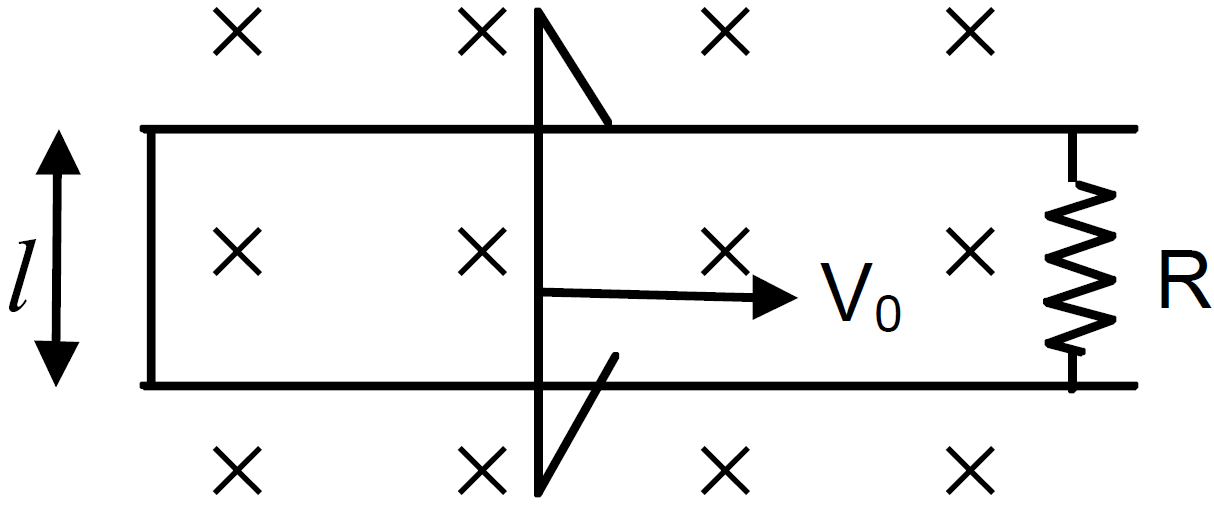
Consider the situation shown in figure. The wire PQ has mass m, resistance r and can slide on the smooth, horizontal parallel rails separated by a distance l. The resistance of the rails is negligible. A uniform magnetic field B exists in the rectangular region and a resistance R connects the rails outside the field region. At t = 0, the wire PQ is pushed towards right with a speed v0. Find

  1. The current in the loop at an instant when the speed of the wire PQ is v.
  2. The acceleration of the wire at this instant.
  3. The velocity vas a functions of x.
  4. The maximum distance the wire will move.

Answer

  1. When the speed is V

Emf = Blv

Resistance = r + r

Current $=\frac{\text{Blv}}{\text{r}+\text{R}}$

  1. Force acting on the wire =ilB

$=\frac{\text{BlvlB}}{\text{r}+\text{R}}=\frac{\text{B}^2\text{l}^2\text{v}}{\text{r}+\text{R}}$

Acceleration on the wire $=\frac{\text{B}^2\text{l}^2\text{v}}{\text{m}(\text{r}+\text{R})}$

  1. $\text{v}=\text{v}_0+\text{at}=\text{v}_0 -​​\frac{\text{B}^2\text{l}^2\text{v}}{\text{m}(\text{r}+\text{R})}\text{t}$ [force is opposite to velocity]

$=\text{v}_0 -​​\frac{\text{B}^2\text{l}^2\text{x}}{\text{m}(\text{r}+\text{R})}$

  1. $\text{a}=\text{v}\frac{\text{dv}}{\text{dx}}=​​\frac{\text{B}^2\text{l}^2\text{x}}{\text{m}(\text{r}+\text{R})}$

$\Rightarrow\text{dx}=\frac{\text{dvm}(\text{R}+\text{r})}{\text{B}^2\text{l}^2}$

$\Rightarrow\text{x}=\frac{\text{m}(\text{R}+\text{r})​​\text{v}_0}{\text{B}^2\text{l}^2}$

View full question & answer
Question 595 Marks
A 20cm long conducting rod is set into pure translation with a uniform velocity of 10cm/s-1 perpendicular to its length. A uniform magnetic field of magnitude 0.10T exists in a direction perpendicular to the plane of motion.
  1. Find the average magnetic force on the free electrons of the rod.
  2. For what electric field inside the rod, the electric force on a free elctron will balance the magnetic force? How is this electric field created?
  3. Find the motional emf between the ends of the rod.
Answer
l = 20cm = 0.2m

v = 10cm/s = 0.1m/s

B = 0.10T

  1. F = qvB = 1.6 × 10-19 × 1 × 10-1 × 1 × 10-1 = 1.6 × 10⁻²¹ N
  2. qE = qvB

⇒ E = 1 × 10-1 × 1 × 10-1 = 1 × 10⁻²V/m

This is created due to the induced emf.

  1. Motional emf = Bvl

= 0.1 × 0.1 × 0.2 = 2 × 10⁻³V

View full question & answer
Question 605 Marks
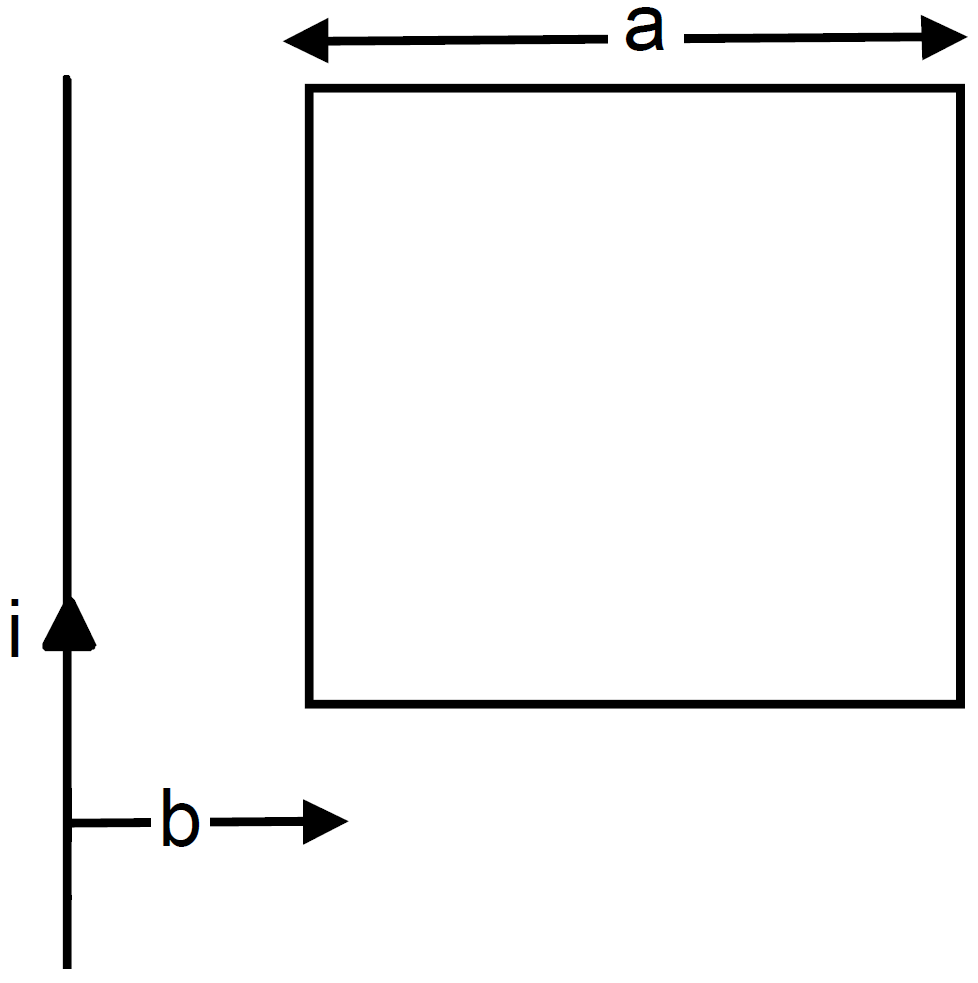
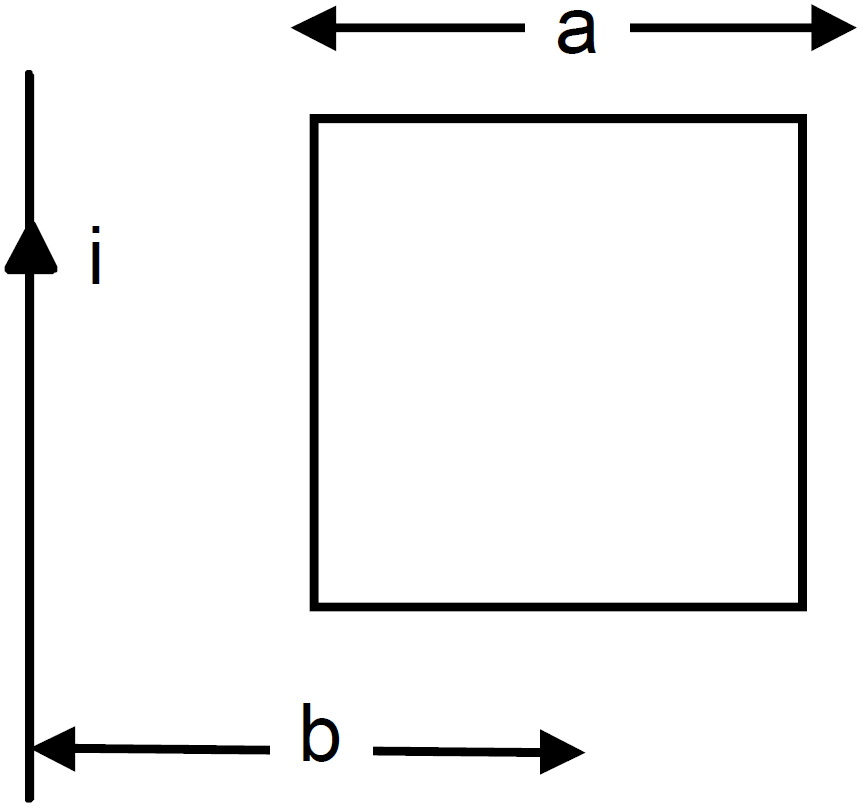
Find the mutual inductance between the straight wire and the square loop of figure.

Answer

We know,

$\frac{\text{d}\phi}{\text{dt}}=\text{E}=\text{M}\times\frac{\text{di}}{\text{dt}}$

From the question,

$\frac{\text{di}}{\text{dt}}=\frac{\text{d}}{\text{dt}}(\text{i}_0\sin\omega\text{t})=\text{i}_0\omega\cos\omega\text{t}$

$\frac{\text{d}\phi}{\text{dt}}=\text{E}\frac{\mu_0\text{ai}_0\omega\cos\omega\text{t}}{2\pi}\text{ln}\Big[1+\frac{\text{a}}{\text{b}}\Big]$

Now, $\text{E}=\text{M}\times\frac{\text{di}}{\text{dt}}$

$\frac{\mu_0\text{ai}_0\omega\cos\omega\text{t}}{2\pi}\text{ln}\Big[1+\frac{\text{a}}{\text{b}}\Big]=\text{M}\times\text{i}_0\omega\cos\omega\text{t}$

$\Rightarrow\text{M}=\frac{\mu_0\text{a}}{2\pi}\text{ln}\Big[1+\frac{\text{a}}{\text{b}}\Big]$

View full question & answer
5 Marks Questions - Page 2 - Physics STD 11 Science Questions - Vidyadip