Question
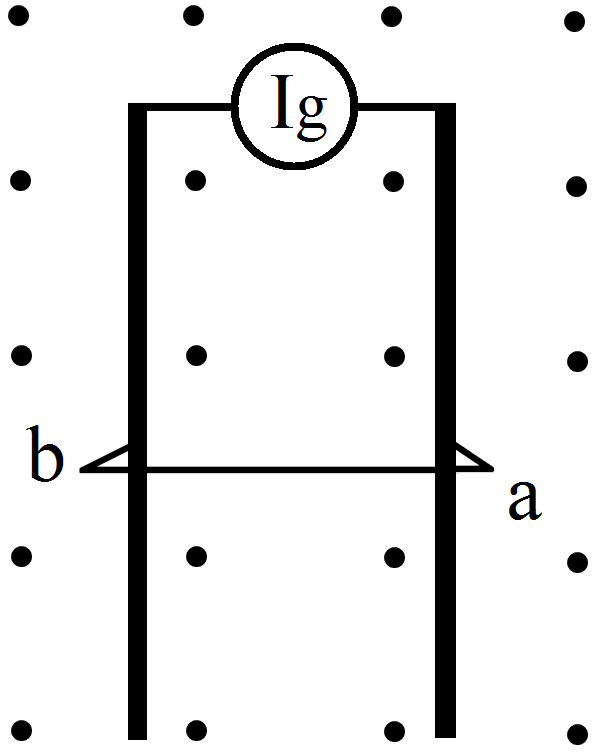
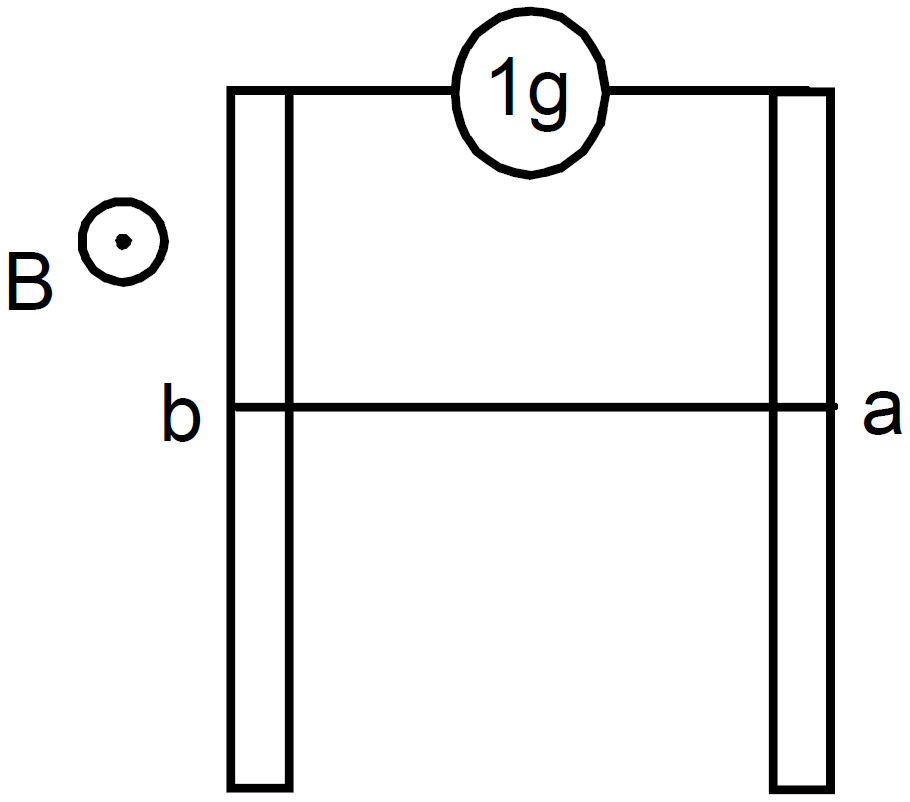
The system containing the rails and the wire of the previous problem is kept vertically in a uniform horizontal magnetic field B that is perpendicular to the plane of the rails (figure). It is found that the wire stays in equilibrium. If the wire ab is replaced by another wire of double its mass, how long will it take in falling through a distance equal to its length?
Answer

Given Blv = mg …(1)

When wire is replaced we have

2mg - Blv = 2ma [where a → acceleration]
$\Rightarrow\text{a}=\frac{2\text{mg}-\text{Blv}}{2\text{m}}$

Now, $\text{s}=\text{ut}+\frac{1}{2}\text{at}^2$

$\Rightarrow\text{l}=\frac{1}{2}\times\frac{2\text{mg}-\text{Blv}}{2\text{m}}\times\text{t}^2 \ \big[\therefore \ \text{s}=\text{l}\big]$

$\Rightarrow\text{t}=\sqrt{\frac{4\text{ml}}{2\text{mg}-\text{Blv}}}=\sqrt{\frac{4\text{ml}}{2\text{mg}-\text{mg}}}=\sqrt{\frac{2\text{l}}{\text{g}}}$ [from (1)]

Need a full question paper?

Generate a complete, print-ready paper with questions like this in minutes — across 16+ boards, with answer keys.

Start Generating Free

Similar questions

A gas in equilibrium has uniform density and pressure throughout its volume. This is strictly true only if there are no external influences. A gas column under gravity, for example, does not have uniform density (and pressure). As you might expect, its density decreases with height. The precise dependence is given by the so-called law of atmospheres:
$\text{n}_2=\text{n}_1\text{exp}\Big[\frac{-\text{mg}}{\text{k}_\text{B}\text{T}}(\text{h}_2-\text{h}_1)\Big]$
where n2, n1 refer to number density at heights h2 and h1 respectively. Use this relation to derive the equation for sedimentation equilibrium of a suspension in a liquid column:
$\text{n}_2=\text{n}_1\text{exp}\Big[\frac{-\text{mgN}_\text{A}(\rho-\rho')(\text{h}_2-\text{h}_1)}{(\rho\text{RT})}\Big]$
where $\rho$ is the density of the suspended particle, and $\rho'$ that of surrounding medium. [NA is Avogadro’s number, and R the universal gas constant]
[Hint: Use Archimedes principle to find the apparent weight of the suspended particle]
Two particles A and B, each carrying a charge Q, are held fixed with a separation d between them. A particle C having mass m and charge q is kept at the middle point of the line AB.
  1. If it is displaced through a distance x perpendicular to AB, what would be the electric force experienced by it.
  2. Assuming x << d, show that this force is proportional to x.
  3. Under what conditions will the particle C execute simple harmonic motion if it is released after such a small displacement?
Find the time period of the oscillations if these conditions are satisfied.
  1. Two particles of equal masses go around a circle of radius R under the action of their mutual gravitational force. Find the speed of each particle
  2. What is the binding energy of a satellite? Derive an expression for it.
An electron of kinetic energy 100eV circulates in a path of radius 10cm in a magnetic field. Find the magnetic field and the number of revolutions per second made by the electron.
A small particle travelling with a velocity u collides elastically with a spherical body of equal mass and of radius r initially kept at rest. The centre of this spherical body is located a distance (p < r) away from the direction of motion of the particle. Find the final velocities of the two particles.

[Hint: The force acts along the normal to the sphere through the contact. Treat the collision as onedimensional for this direction. In the tangential direction no force acts and the velocities do not change].
238U decays to 206Pb with a half-life of 4.47 × 10⁹y. This happens in a number of steps. Can you justify a single half for this chain of processes? A sample of rock is found to contain 2.00mg of 238U and 0.600mg of 206Pb. Assuming that all the lead has come from uranium, find the life of the rock.
(a) When a molecule (or an elastic ball) hits a ( massive) wall, it rebounds with the same speed. When a ball hits a massive bat held firmly, the same thing happens. However, when the bat is moving towards the ball, the ball rebounds with a different speed. Does the ball move faster or slower?
(b) When gas in a cylinder is compressed by pushing in a piston, its temperature rises. Guess at an explanation of this in terms of kinetic theory using (a) above.
(c) What happens when a compressed gas pushes a piston out and expands. What would you observe?
(d) Sachin Tendulkar used a heavy cricket bat while playing. Did it help him in anyway?
A uniform rod of mass m and length l is struck at an end by a force F perpendicular to the rod for a short time interval t. Calculate:
  1. The speed of the centre of mass.
  2. The angular speed of the rod about the centre of mass.
  3. The kinetic energy of the rod.
  4. The angular momentum of the rod about the centre of mass after the force has stopped to act. Assume that t is so small that the rod does not appreciably change its direction while the force acts.
Three blocks are connected as shown on a horizontal frictionless table, and pulled to the right with a force of T3 = 60N.

If m1 = 10kg, m2 = 20kg and m3 = 30kg. Prove that $\frac{\text{T}_1}{\text{T}_2}=\frac{1}{3}.$

A mass m is left free at a distance 3R from the surface of earth. On reaching the surface, what will be its velocity?
