Question 13 Marks
A person $(40\ kg)$ is managing to be at rest between two vertical walls by pressing one wall $A$ by his hands and feet and the other wall $B$ by his back. Assume that the friction coefficient between his body and the walls is $0.8$ and that limiting friction acts at all the contacts.
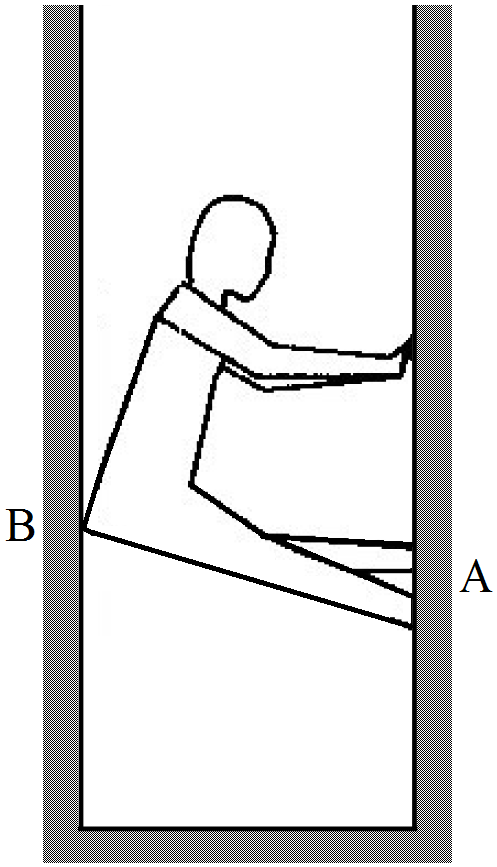
- Show that the person pushes the two walls with equal force.
- Find the normal force exerted by either wall on the person. Take $g = 10m/s^2$.
Answer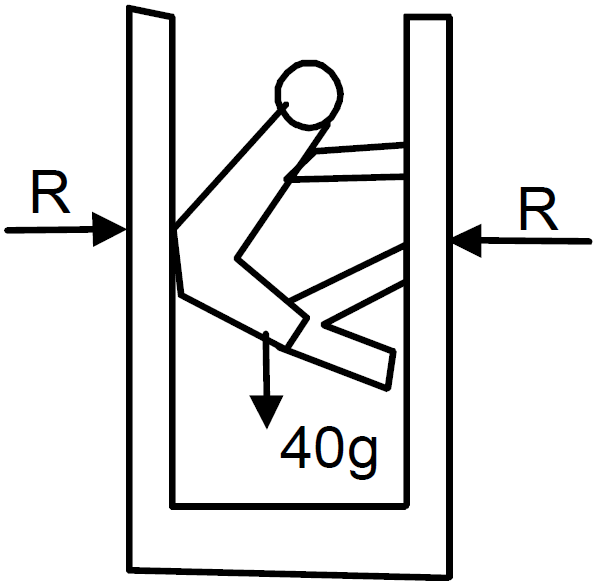
Frictional force developed between hands, legs $\&$ back side with the wall the wt of man. So he remains in equilibrium.
He gives equal force on both the walls so gets equal reaction $R$ from both the walls. If he applies unequal forces $R$ should be different he can’t rest between the walls.
Frictional force $2\mu\text{R}$ balance his wt.
From the free body diagram
$\mu\text{R}+\mu\text{R = 40g}$
$\Rightarrow2\mu\text{R}=40\times10$
$\Rightarrow\text{R}=\frac{40\times10}{2\times0.8}=250\text{N}$
View full question & answer→
- Mass of man $= 50\ kg.$
Frictional force developed between hands, legs $\&$ back side with the wall the wt of man. So he remains in equilibrium.
He gives equal force on both the walls so gets equal reaction $R$ from both the walls. If he applies unequal forces $R$ should be different he can’t rest between the walls.
Frictional force $2\mu\text{R}$ balance his wt.
From the free body diagram
$\mu\text{R}+\mu\text{R = 40g}$
$\Rightarrow2\mu\text{R}=40\times10$
$\Rightarrow\text{R}=\frac{40\times10}{2\times0.8}=250\text{N}$
- The normal force is $250N.$
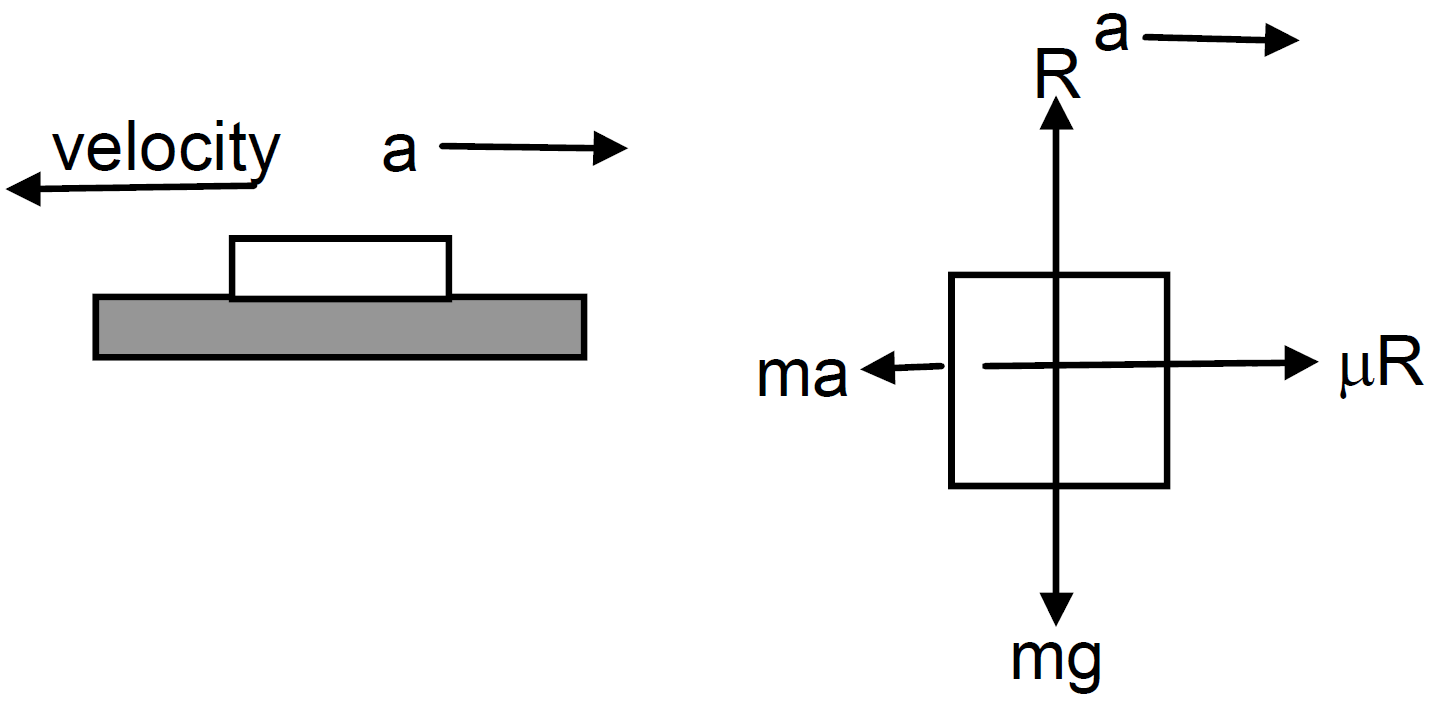 Due to friction the body will decelerate