11 questions · self-marked practice — reveal the answer and mark yourself.
$\frac{1}{\text{f}_2}=\Big(\frac{\mu_2}{\mu_\text{m}}-1\Big)\Big[\frac{1}{\text{R}_1}-\frac{1}{\text{R}_2}\Big]$
Is $\mu_{\text{medium}}$ is changed focal length gets changed.$\frac{1}{\text{v}}-\frac{1}{\text{u}}=\frac{1}{\text{f}}$
$\Rightarrow \frac{1}{\text{v}}=\frac{1}{(-12)}+\frac{1}{-\text{x}}$
$\Rightarrow \text{v}=-\Big(\frac{12\text{x}}{\text{x}+12}\Big)$
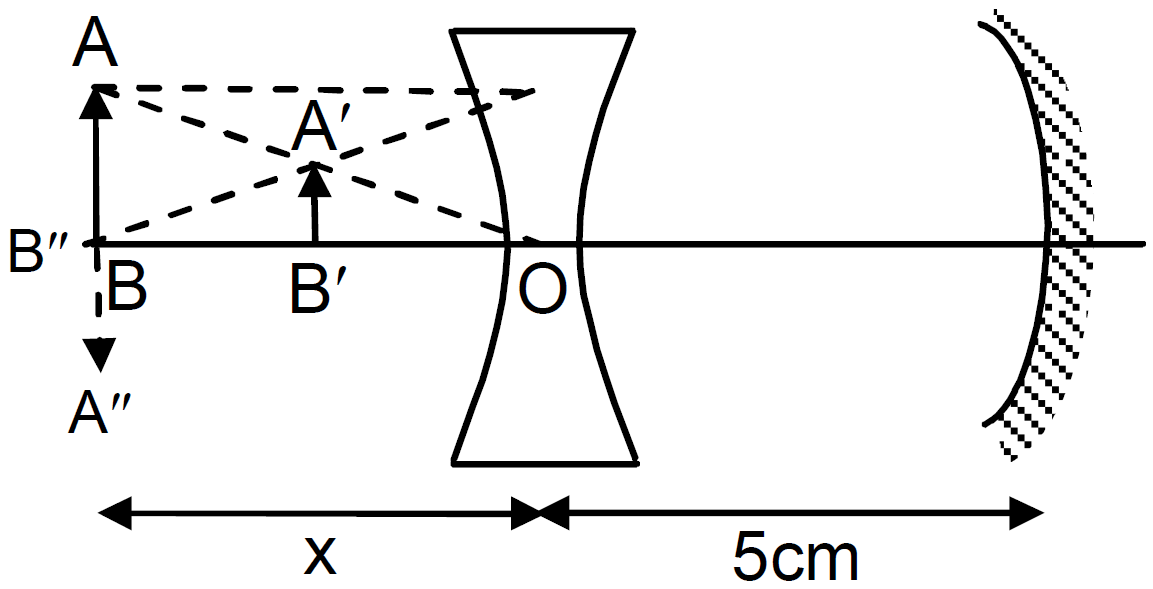
Thus, the virtual image due to the first refraction lies on the same side as that of object A'B'. This image becomes the object for the convex mirror, For the mirror,$\text{u}=-\Big(5+\frac{12\text{x}}{\text{x}+12}\Big)$
$=-\Big(\frac{17\text{x}+60}{\text{x}+12}\Big)$
$\text{f}=-7.5\text{cm}$
From mirror equation,$\frac{1}{\text{v}}+\frac{1}{\text{u}}=\frac{1}{\text{f}}$
$\Rightarrow \frac{1}{\text{v}}=\frac{1}{-7.5}+\frac{\text{x}+12}{17\text{x}+60}$
$\Rightarrow \frac{1}{\text{v}}=\frac{17\text{x}+60-7.5}{7.5(17\text{x}+60)}$
$\Rightarrow \text{v}=\frac{7.5(17\text{x}+60)}{52.5-127.5\text{x}}$
$\Rightarrow \text{v}=\frac{250(\text{x}+4)}{15\text{x}-100}$
$\Rightarrow \text{v}=\frac{50(\text{x}+4)}{(3\text{x}-20)}$
Thus, this image is formed towards the left of the mirror. Again for second refraction in concave lens,$\text{u}=-\Big[\frac{5-50(\text{x}+4)}{3\text{x}-20}\Big]$
(assuming that the image of mirror formed between the lens and mirror is 3x - 20),$\text{v}=\pm\text{x}$ (since, the final image is produced on the object A"B")
Using lens formula:$\frac{1}{\text{v}}-\frac{1}{\text{u}}=\frac{1}{\text{f}}$
$\Rightarrow \frac{1}{\text{x}}+\frac{1}{\frac{5-50(\text{x}\times4)}{3\text{x}-20}}=\frac{1}{-20}$
$\Rightarrow 25\text{x}^2-1400\text{x}-6000=0$
$\Rightarrow \text{x}^2-56\text{x}-240=0$
$\Rightarrow (\text{x}-60)(\text{x}+4)=0$
Thus, $\text{x}=60\text{m}$


Let the object to placed at a distance x from the lens further away from the mirror.
For the concave lens (1st refraction)
u = -x, f = -20cm
From lens formula,
$\frac{1}{\text{v}}-\frac{1}{\text{u}}=\frac{1}{\text{f}}\Rightarrow\frac{1}{\text{v}}=\frac{1}{-20}+\frac{1}{-\text{x}}$
$\Rightarrow\text{v}=-\Big(\frac{20\text{x}}{\text{x}+20}\Big)$
So, the virtual image due to fist refraction lies on the same side as that of object. (A'B')
This image becomes the object for the concave mirror.
For the mirror,
$\Rightarrow\text{u}=-\Big(5+\frac{20\text{x}}{\text{x}+20}\Big)=-\Big(\frac{25\text{x}+100}{\text{x}+20}\Big)$
$\text{f}=-10\text{cm}$
From mirror equation,
$\frac{1}{\text{v}}-\frac{1}{\text{u}}=\frac{1}{\text{f}}\Rightarrow\frac{1}{\text{v}}=\frac{1}{-10}+\frac{\text{x}+20}{25\text{x}+100}$
$\Rightarrow\text{v}=\frac{50(\text{x}+4)}{3\text{x}-20}$
So, this image is formed towards left of the mirror.
Again for second refraction in concave lens,
$\text{u}=-\Big[5-\frac{50(\text{x}+4)}{3\text{x}-20}\Big]$ (assuming that image of mirror is formed between the lens and mirro 3x -20)
$\text{v}=+\text{x}$ (Since, the final image is produced on the object A"B")
Using lens formula,
$\frac{1}{\text{v}}-\frac{1}{\text{u}}=\frac{1}{\text{f}}$
$\Rightarrow\frac{1}{\text{x}}+\frac{1}{\frac{5-50(\text{x}+4)}{3\text{x}-20}}=\frac{1}{-20}$
$\Rightarrow 25\text{x}^2-1400\text{x}-6000=0$
$\Rightarrow\text{x}^2-56\text{x} -240=0$
$\Rightarrow (\text{x}-60)(\text{x}+4)=0$
So, $\Rightarrow\text{x}=60\text{cm}$
The object should be placed at a distance 60cm from the lens further away from the mirror. So that the final image is formed on itself.
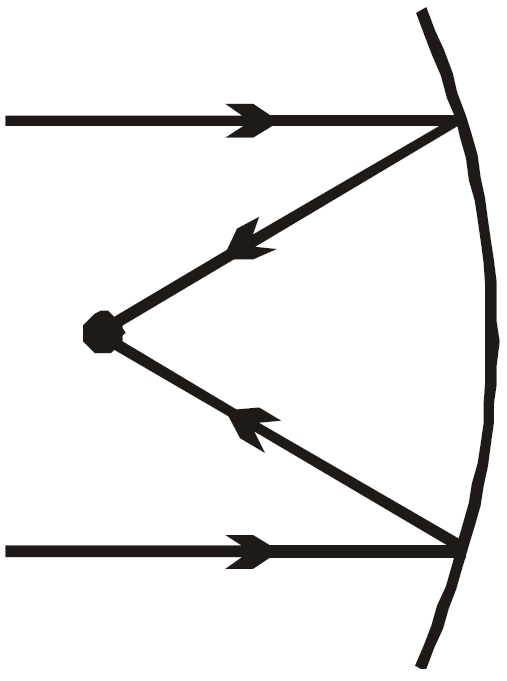
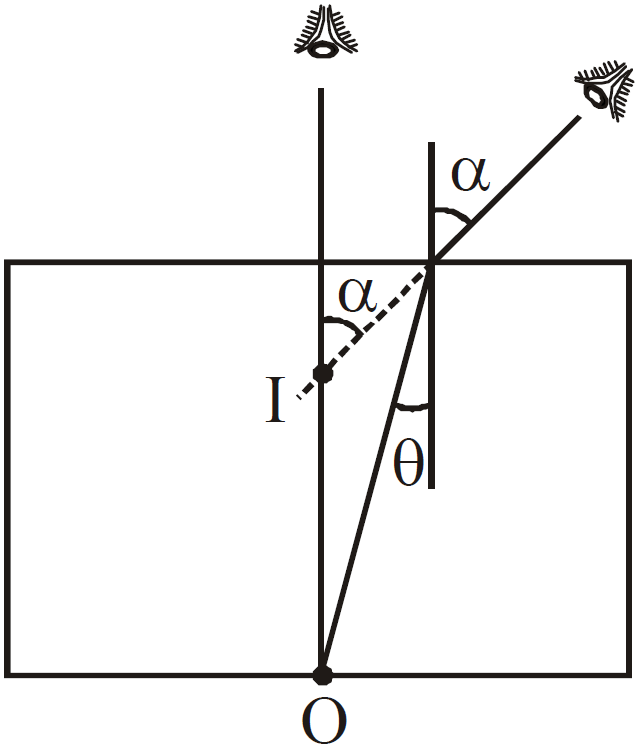
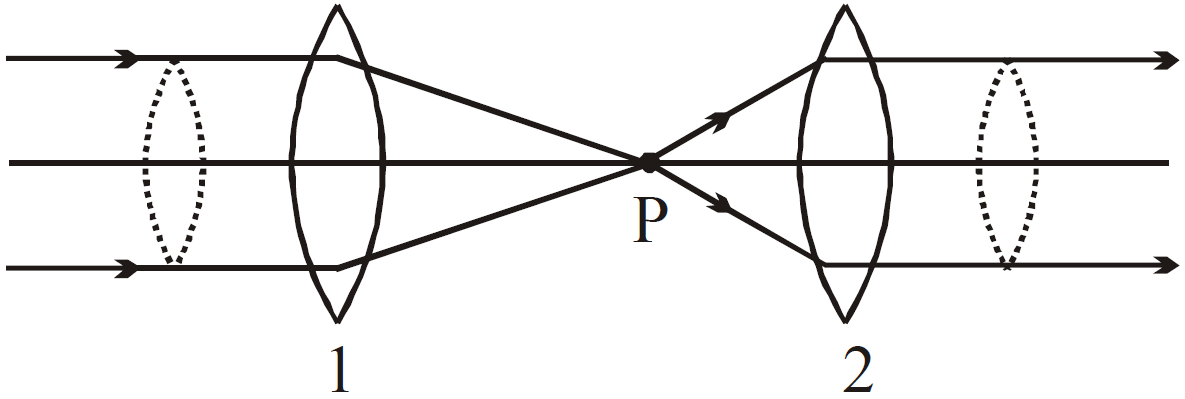
Point p is focal length of lens 1 as well as lens 2.