MCQ 11 Mark
The kinetic energy of the satellite in a circular orbit with speed vis given as:
- A
$\text{KE}=\frac{-\text{GmM}_\text{e}}{2(\text{R}_\text{e}+\text{h})}$
- B
$\text{KE}=\frac{\text{GmM}_\text{e}}{(\text{R}_\text{e}+\text{h})}$
- ✓
$\text{KE}=\frac{\text{GmM}_\text{e}}{2(\text{R}_\text{e}+\text{h})}$
- D
$\text{KE}=-\frac12\text{mv}^2$
AnswerCorrect option: C. $\text{KE}=\frac{\text{GmM}_\text{e}}{2(\text{R}_\text{e}+\text{h})}$
$KE$ of satellite $=\frac12\text{mv}^2{}$
$=\frac12\text{m}\bigg(\sqrt{\frac{\text{Gm}_\text{e}}{(\text{R}_\text{e}+\text{h})}}\bigg)^2$
$=\frac12\frac{\text{GmM}_\text{e}}{(\text{R}_\text{e}+\text{h})}$
View full question & answer→MCQ 21 Mark
A particle of mass $m$ is at the surface of the earth of radius $R.$ It is lifted to a heighth abov the surface of the earth. The gain in gravitational potential energy of the particle is:
- A
$\frac{\text{mgh}}{\big(1-\frac{\text{h}}{\text{R}}\big)}$
- B
$\frac{\text{mgh}}{\big(1+\frac{\text{h}}{\text{R}}\big)}$
- C
$\frac{\text{mghR}}{(\text{R}+\text{h})}$
- ✓
$\text{Both (b) and (c)}$
AnswerCorrect option: D. $\text{Both (b) and (c)}$
View full question & answer→MCQ 31 Mark
As observed from earth, the sun appears to move in an approximate circular orbit. For the motion of another planet like mercury as observed from earth, this would.
- A
- B
Not be true because the force between earth and mercury is not inverse square law.
- ✓
Not be true because the major gravitational force on mercury is due to sun.
- D
Not be true because mercury is influenced by forces other than gravitational forces.
AnswerCorrect option: C. Not be true because the major gravitational force on mercury is due to sun.
Force of attraction between any two objects obeys the inverse square law as its universal law. The relative motion between Earth, Mercury as observed from Earth will not be circular as the force on Mercury due to the sun is very large than due to Earth and due to the relative motion of Sun and Earth with Mercury.
View full question & answer→MCQ 41 Mark
If the gravitation force on body 1 due to 2 is given by $F_2$ and on body 2 due to 1 is given as $F_1$, then
AnswerCorrect option: B. $F_{12}=-F_{21}$
b. $F_{12}=-F_{21}$
Explanation:
Since, gravitational forces are attractive $F_{12}$ is directed opposite to $F_{21}$ and they are also equal in magnitude.
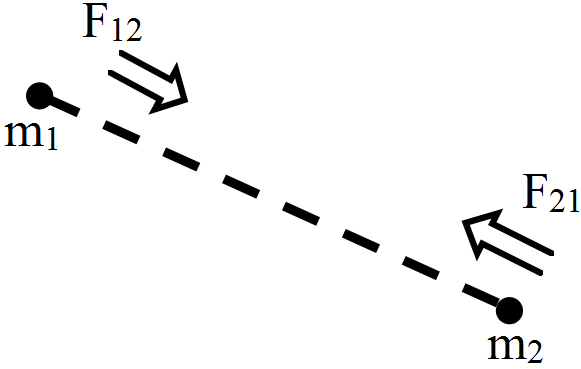
Hence, $F_{21}=-F_{12}$
Or $F_{12}=-F_{21}$ View full question & answer→MCQ 51 Mark
A point mass $m$ is placed outside a hollow spherical shell of mass $M$ and uniform density at a distanced from centre of the big sphere.Gravitational force on point mass mat $P$ is:
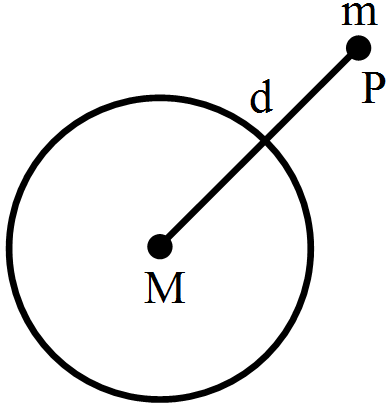
AnswerCorrect option: A. $\frac{\text{GmM}}{\text{d}^2}$
View full question & answer→MCQ 61 Mark
- A
Inertial mass is a measure of difficulty of accelerating a body by an external force whereas the gravitational mass is relevant in determining the gravitational force on it by an external mass.
- B
That the gravitational mass and inertial mass are equal is an experimental result.
- C
That the acceleration due to gravity on earth is the same for all bodies is due to the equality of gravitational mass and inertial mass.
- ✓
Gravitational mass of a particle like proton can depend on the presence of neighouring heavy objects but the inertial mass cannot.
AnswerCorrect option: D. Gravitational mass of a particle like proton can depend on the presence of neighouring heavy objects but the inertial mass cannot.
Key concept:
Inertial mass: It is the mass of the material body, which measures its inertia.
Gravitational Mass: It is the mass of the material body, which determines the gravitational pull acting upon it. According to the principle of equivalence, Gravitational mass of proton is equivalent to its inertial mass and is independent of presence of neighboring heavy objects.
Important point: Comparison between inertial and gravitational mass:
Both are measured in the same units.
Both are scalars.
Both do not depend on the shape and state of the body.
Inertial mass is measured by applying Newton’s second law of motion whereas gravitational mass is measured by applying Newton’s law of gravitation.
Spring balance measures gravitational mass and inertial balance measure inertial mass.
View full question & answer→MCQ 71 Mark
Mars has about $\frac{1}{10}^\text{th}$ as much mass as the earth and half as great a diameter. The acceleration of a falling body on Mars is about:
- A
$9.8\ ms^{-2}$
- B
$1.96\ ms^{-2}$
- ✓
$3.92\ ms^{-2}$
- D
$4.9\ ms^{-2}$
AnswerCorrect option: C. $3.92\ ms^{-2}$
View full question & answer→MCQ 81 Mark
What is the weight of a $700\ gm$ of body on a planet whose mass is $\frac{1}{7}^\text{th}$ of that of earth and radius is $\frac{1}{2}$ of earth:
- ✓
$400gm$
- B
$300gm$
- C
$700gm$
- D
$500gm$
AnswerCorrect option: A. $400gm$
On, earth, $\text{g}=\frac{\text{GM}}{\text{R}^2}$
On planet, $\text{g}'=\frac{\frac{\text{GM}}{7}}{\Big(\frac{\text{R}}{2}\Big)^2}=\frac{4}{7}\text{g}$
$\therefore$ Weight of body on planet,
$=\text{mg}'=700\times\frac{4}{7}\times\text{g}$
$=400\text{mg wt}.$
View full question & answer→MCQ 91 Mark
If $g$ is the acceleration due to gravity on the earth's surface, the gain in the potential energy of an object of mass $m$ raised from the earth's surface to a height equal to the radius $R$ of the earth, is:
AnswerCorrect option: A. $\frac{1}{2}\text{m g R}$
View full question & answer→MCQ 101 Mark
If $M$ is the mass of the earth and $R$ its radius, the ratio of the gravitational acceleration and the gravitational constant is:
- A
$\frac{\text{R}^2}{\text{M}}$
- ✓
$\frac{\text{M}}{\text{R}^2}$
- C
$\text{M}\text{R}^2$
- D
$\frac{\text{M}}{\text{R}}$
AnswerCorrect option: B. $\frac{\text{M}}{\text{R}^2}$
View full question & answer→MCQ 111 Mark
The distance of two planets $($neptune and saturn$)$ from sun are $10^{13}$ and $10^{12}$m respectively. The ratio of time period of the planets is:
- A
$100$
- B
$\frac{1}{\sqrt{10}}$
- C
$\sqrt{10}$
- ✓
$10\sqrt{10}$
AnswerCorrect option: D. $10\sqrt{10}$
$\frac{\text{T}^2_1}{\text{T}^2_2}=\frac{\text{r}^3_1}{\text{R}^3_2}$
$\text{or }\frac{\text{T}_1}{\text{T}_2}=\Big(\frac{\text{r}_1}{\text{r}_2}\big)^{\frac{3}{2}}=(10)^{\frac{3}{2}}$
View full question & answer→MCQ 121 Mark
The largest and shortest distance of earth from the sun are $r_1$ and $r_2$. Its distance from the sun when it is perpendicular to the major axis of the orbit drawn from the sun is:
- A
$\frac{\text{r}_1+\text{r}_2}{4}$
- B
$\frac{\text{r}_1+\text{r}_2}{\text{r}_1-\text{r}_2}$
- ✓
$\frac{2\text{r}_1\text{r}_2}{\text{r}_1+\text{r}_2}$
- D
$\frac{\text{r}_1+\text{r}_2}{2}$
AnswerCorrect option: C. $\frac{2\text{r}_1\text{r}_2}{\text{r}_1+\text{r}_2}$
View full question & answer→MCQ 131 Mark
Both earth and moon are subject to the gravitational force of the sun. As observed from the sun, the orbit of the moon.
- A
- ✓
Will not be strictly elliptical because the total gravitational force on it is not central.
- C
Is not elliptical but will necessarily be a closed curve.
- D
Deviates considerably from being elliptical due to influence of planets other than earth.
AnswerCorrect option: B. Will not be strictly elliptical because the total gravitational force on it is not central.
Moon revolves around the earth in a nearly circular orbit. When it is observed from the sun, two types of forces are acting on the moon one is due to gravitational attraction between the sun and the moon and the other is due to gravitational attraction between the earth and the moon. So moon is moving under the combined gravitational pull acting on it due to the earth and the sun. Hence, total force on the moon is not central.
View full question & answer→MCQ 141 Mark
An artificial earth satellite of mass $m$ is circling round the earth in an orbit of radius $R$. If the mass of the earth is $M,$ then the total energy of the satellite is:
- A
$\frac{3\text{GMm}}{2\text{R}}$
- ✓
$\frac{-\text{GMm}}{2\text{R}}$
- C
$\frac{\text{GMm}}{\text{R}}$
- D
$\frac{-\text{GMm}}{\text{R}}$
AnswerCorrect option: B. $\frac{-\text{GMm}}{2\text{R}}$
Total energy $= \text{P.E. + K.E.}$
$=\frac{\text{GMm}}{\text{R}}+\frac{1}{2}\text{mv}^2$
$=-\frac{\text{GMm}}{\text{R}}+\frac{1}{2}\text{m}\frac{\text{GM}}{\text{R}}$
View full question & answer→MCQ 151 Mark
A ring has a total mass $M$ but non$-$uniformly distributed over its circumference. The radius of the ring is $R.$ A point mass m is placed at the centre of the ring. Work done in taking away this point mass from centre to infinity is:
- A
$-\frac{\text{GMm}}{\text{R}}$
- ✓
$\frac{\text{GMm}}{\text{R}}$
- C
$-\frac{\text{GMm}}{2\text{R}}$
- D
$\frac{\text{GMm}}{\text{R}^2}$
AnswerCorrect option: B. $\frac{\text{GMm}}{\text{R}}$
View full question & answer→MCQ 161 Mark
If the gravitational potential energy at infinity is assumed to be zero, the potential energy at distance $(R_e + h)$ from the centre of the earth:
- A
$\text{PE}=\frac{\text{GmM}_\text{e}}{(\text{R}_\text{e}+\text{h})}$
- ✓
$\text{PE}=\frac{-\text{GmM}_\text{e}}{(\text{R}_\text{e}+\text{h})}$
- C
$\text{PE}=\text{mgh}$
- D
$\text{PE}=\frac{-\text{GmM}_\text{e}}{2(\text{R}_\text{e}+\text{h})}$
AnswerCorrect option: B. $\text{PE}=\frac{-\text{GmM}_\text{e}}{(\text{R}_\text{e}+\text{h})}$
View full question & answer→MCQ 171 Mark
The ratio of the magnitude of potential energy and kinetic energy of a satellite is:
- A
$1 : 2$
- ✓
$2 : 1$
- C
$3 : 1$
- D
$1 : 3$
AnswerCorrect option: B. $2 : 1$
View full question & answer→MCQ 181 Mark
The time period of a second's pendulum in a satellite is:
AnswerInside the satellite the effective value of $g = 0,$ so time period $\text{T}=2\pi\sqrt{\frac{\text{l}}{\text{g}}}$ is infinity.
View full question & answer→MCQ 191 Mark
A satellite orbits around the earth in a circular orbit with a speed $v$ and orbital radius $r.$ If it losses some energy, then $v$ and $r$ changes as:
- A
$V$ decreases and $r$ increases.
- B
Both $v$ and $r$ decreases.
- ✓
$V$ increases and $r$ decreases.
- D
Both $v$ and $r$ increases.
AnswerCorrect option: C. $V$ increases and $r$ decreases.
Orbital velocity, $\text{v}=\sqrt{\frac{\text{GM}}{\text{r}}}$
Total energy $= \text{K.E + P.E.}$
$=\frac{1}{2}\text{mv}^2+\Big(\frac{-\text{GMm}}{\text{r}}\Big)$
$=\frac{1}{2}\text{m}\frac{\text{GM}}{\text{r}}-\frac{\text{GMm}}{\text{r}}$
$=-\frac{\text{GMm}}{2\text{r}}$
If the satellite losses some energy, its total energy will decrease.
It will be so if $r$ decreases. Then from $(i)\ v$ increases.
View full question & answer→MCQ 201 Mark
Escape velocity of a planet is $v.$ If radius of the planet remains same and mass becomes $4$ times, the escape velocity becomes:
AnswerCorrect option: B. $2\text{v}_{\text{e}}$
Escape velocity,
$\text{v}_{\text{e}}=\sqrt{2\text{gR}}$
$=\sqrt{\frac{2\text{GM}}{\text{R}}},\text{v}_{\text{e}}\propto\sqrt{\text{M}}.$
View full question & answer→MCQ 211 Mark
A satellite of mass $m$ revolves around the earth of radius $R$ at a height $x$ from its surface. If $g$ is the acceleration due to gravity on the surface of the earth, the orbital speed of the satellite is:
- A
$\text{gx}$
- B
$\frac{\text{gR}}{\text{R}-\text{x}}$
- C
$\frac{\text{gR}^2}{\text{R}+\text{x}}$
- ✓
$\Big(\frac{\text{gR}^2}{\text{R}+\text{x}}\Big)^\frac{1}{2}$
AnswerCorrect option: D. $\Big(\frac{\text{gR}^2}{\text{R}+\text{x}}\Big)^\frac{1}{2}$
View full question & answer→MCQ 221 Mark
If the mass of the earth is doubled and its radius halved, then new acceleration due to the gravity $g’$ is:
- A
$g’ = 4g$
- ✓
$g’ = 8g$
- C
$g’ = g$
- D
$g’ = 16g$
AnswerCorrect option: B. $g’ = 8g$
View full question & answer→MCQ 231 Mark
Three particles each of mass $m$ are kept at vertices of an equilateral triangle of side $L.$ Th gravitational potential energy possessed by the system is:
- A
$\frac{-\text{Gm}^2}{\text{L}}$
- ✓
$\frac{-3\text{Gm}^2}{\text{L}}$
- C
$-\frac{2\text{Gm}^2}{\text{L}}$
- D
$\frac{+3\text{Gm}^2}{\text{L}}$
AnswerCorrect option: B. $\frac{-3\text{Gm}^2}{\text{L}}$
View full question & answer→MCQ 241 Mark
If two satellites of different masses are revolving in the same orbit, they have same:
AnswerCorrect option: D. $A$ and $C$ both
The speed and time period of revolution of a satellite is independent of mass of the satellite but energy and angular momentum of a satellite depend upon mass of the body.
View full question & answer→MCQ 251 Mark
The force of attraction due to a hollow spherical shell of mass $M,$ radius $R$ and uniform density, on a point mass $m$ situated inside it is:
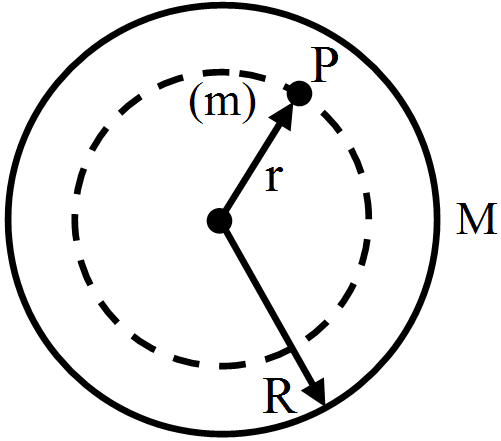
View full question & answer→MCQ 261 Mark
The change in potential energy, when a body of mass m is raised to a height $nR$ from earth's surface is $(R =$ radius of earth$):$
- A
$\text{mgR}\Big(\frac{\text{n}}{\text{n}-1}\Big)$
- B
$\text{nmgR}$
- C
$\text{mgR}\Big(\frac{\text{n}^2}{\text{n}^2+1}\Big)$
- ✓
$\text{mgR}\Big(\frac{\text{n}}{\text{n}+1}\Big)$
AnswerCorrect option: D. $\text{mgR}\Big(\frac{\text{n}}{\text{n}+1}\Big)$
Change in potential energy,
$\Delta\text{E}=\text{GMm}\Big(\frac{1}{\text{R}}-\frac{1}{\text{R}+\text{nR}}\Big)$
$=\frac{\text{GMm}}{\text{R}(\text{R}+\text{nR})}\times\text{nR}$
$=\frac{\text{GMm}}{\text{R}}\Big(\frac{\text{n}}{1+\text{n}}\Big)$
$=\text{gRm}\Big(\frac{\text{n}}{1+\text{n}}\Big)$
View full question & answer→MCQ 271 Mark
A satellite is moving in a circular orbit at a height $100\ km$ above the earth's surface. A person inside the satellite feels weightless because:
- A
Acceleration due to gravity is almost zero at such a height.
- B
The earth does not exert any force on the person.
- ✓
The centripetal force makes the satellite move in a circular orbit.
- D
The forces due to earth and moon are almost compensated at such a height.
AnswerCorrect option: C. The centripetal force makes the satellite move in a circular orbit.
When a satellite is moving in a circular orbit, then centripetal force makes the satellite to move in providing the centripetal force is balanced by centrifugal force. Due to which the person inside the satellite feels weightlessness.
View full question & answer→MCQ 281 Mark
Which of the following statements are true about acceleration due to gravity?
- A
'g' is zero at the centre of earth.
- B
'g' decreases if earth stops rotating on its axis.
- C
'g' decreases in moving away from the centre if r > R.
- ✓
AnswerExplanation:
Inside the earth, g' $=\text{g}\Big(1-\frac{\text{d}}{\text{R}}\Big)$
Where d = R, then g' $=\text{g}\Big(1-\frac{\text{R}}{\text{R}}\Big)=0$
Outside the earth g' $=\text{g}\Big(1-\frac{\text{2h}}{\text{R}}\Big),$ as h increases g' decrease.
View full question & answer→MCQ 291 Mark
If the law of gravitation, instead of being inversesquare law, becomes an inversecube law.
- A
Planets will not have elliptic orbits.
- B
Circular orbits of planets is not possible.
- C
Projectile motion of a stone thrown by hand on the surface of the earth will be approximately parabolic.
- ✓
AnswerExplanation:
If the law of gravitation becomes an inverse cube law instead of inverse square law, then for a planet of mass m revolving around the sun of mass M, we can write
$\text{F}=\frac{\text{GMm}}{\text{R}^3}=\frac{\text{mv}^2}{\text{R}}$ (where R is the radius of orbiting planet)
$\Rightarrow\ \text{Orbital speed}=\frac{\sqrt{\text{GM}}}{\text{R}}\Rightarrow\text{V}\propto\frac{1}{\text{ R}}$
Time period of revolution of a planet
$\text{T}=\frac{2\pi\text{R}}{\text{v}}=\frac{2\pi\text{R}}{\frac{\sqrt{\text{GM}}}{\text{R}}}=\frac{2\pi\text{R}^2}{\sqrt{\text{GM}}}$
$\Rightarrow\ \text{T}^2\propto\text{R}^4$
Hence, orbit will not be elliptical.
$[$For elliptical orbit $\text{T}^2\propto\text{R}^3]$
The circular orbits of the planets is not possible according to new law of gravitation.
As force $\text{F}=\Big(\frac{\text{GM}}{\text{R}^3}\Big)\text{m}$ = g'm
where, g' $=\frac{\text{GM}}{\text{R}^3}$
As g', acceleration due to gravity is constant, hence path followed by a projectile will be approximately parabolic, $(\text{as T}\propto\text{R}^2).$
Also, gravitational force inside a spherical shell of uniform density will have some value. So, only option (d) is incorrect.
View full question & answer→MCQ 301 Mark
- A
Potential is minimum at the centre.
- B
Potential is zero, both at centre and infinity.
- C
Field is zero both at centre and infinity.
- ✓
Potential is same, both at centre and infinity but no zero.
AnswerCorrect option: D. Potential is same, both at centre and infinity but no zero.
View full question & answer→MCQ 311 Mark
Two sphere of masses $m$ and $M$ are situated in air and the gravitational force between them is $F.$ The space around the masses is now filled with a liquid of specific gravity $3.$ The gravitational force will now be:
- ✓
$F.$
- B
$\frac{\text{F}}{3}$
- C
$\frac{\text{F}}{9}$
- D
$3F.$
AnswerGravitational force does not depend on the medium between the masses.
So, it will remain same i.e., $F.$
View full question & answer→MCQ 321 Mark
The escape velocity or earth is $V$. If the mass of a certain planet is $3$ times and radius $3$ times than that of the earth, then the escape velocity from the planet will be:
AnswerCorrect option: D. $\text{V}_{\text{e}}$
$\text{V}_{\text{e}}=\sqrt{\frac{2\text{GM}}{\text{R}}}$
or $\text{V}_{\text{e}}=\sqrt{\frac{2\text{GM}}{\frac{\text{R}}{4}}}$
$=11.2\text{km/s.}$
View full question & answer→MCQ 331 Mark
According to Kepler's law of planetary motion, if $T$ represents time period and $r$ is orbital radius, then for two planets these are related as:
- A
$\Big(\frac{\text{T}_1}{\text{T}_2}\Big)^3=\Big(\frac{\text{r}_1}{\text{r}_2}\Big)^2$
- B
$\Big(\frac{\text{T}_1}{\text{T}_2}\Big)^\frac32=\frac{\text{r}_1}{\text{r}_2}$
- ✓
$\Big(\frac{\text{T}_1}{\text{T}_2}\Big)^2=\Big(\frac{\text{r}_1}{\text{r}_2}\Big)^3$
- D
$\Big(\frac{\text{T}_1}{\text{T}_2}\Big)=\Big(\frac{\text{r}_1}{\text{r}_2}\Big)^\frac23$
AnswerCorrect option: C. $\Big(\frac{\text{T}_1}{\text{T}_2}\Big)^2=\Big(\frac{\text{r}_1}{\text{r}_2}\Big)^3$
View full question & answer→MCQ 341 Mark
The density of a newly discovered planet is twice that of earth. The acceleration due to gravity at the surface of the planet is equal to that at the surface of the earth. If the radius of the earth is surface of the earth. If the radius of the earth is $R,$ the radius of the planet would be:
- A
$2\text{R}$
- B
$4\text{R}$
- C
$\frac{\text{R}}{4}$
- ✓
$\frac{\text{R}}{2}$
AnswerCorrect option: D. $\frac{\text{R}}{2}$
$\text{g}_{\text{e}}=\frac{\text{GM}_{\text{e}}}{\text{R}^2_{\text{e}}}=\frac{\text{G}\times\frac{4}{3}\pi\text{R}^3_{\text{e}}\times\rho_{\text{e}}}{\text{R}^2_{\text{e}}}$
$=\frac{4}{3}\pi\text{GR}_{\text{e}}\rho$
and $g_{\text{p}}=\frac{\text{GM}_{\text{p}}}{\text{R}^2_{\text{p}}}$
$=\frac{\text{G}\times\frac{4}{3}\pi\text{R}^3_{\text{p}}\ \rho_{\text{p}}}{\text{R}^2_{\text{p}}}$
$=\frac{4}{3}\pi\text{GR}_{\text{p}}\ \rho_{\text{p}}$
View full question & answer→MCQ 351 Mark
A planet has twice the density of earth but the acceleration due to gravity on its surface is exactly the same as on the surface of earth. It radius in terms of radius of earth $R$ will be:
- A
$\frac{\text{R}}{4}$
- ✓
$\frac{\text{R}}{2}$
- C
$\frac{\text{R}}{3}$
- D
$\frac{\text{R}}{8}$
AnswerCorrect option: B. $\frac{\text{R}}{2}$
View full question & answer→MCQ 361 Mark
Law of areas is valid only when gravitational force is:
MCQ 371 Mark
A satellite $S$ is moving in an elliptical orbit around the earth. The mass of the satellite is very small compared to the mass of the earth.
- ✓
The acceleration of $S$ is always directed towards the centre of the earth.
- B
The angular momentum of $S$ about the centre of the earth changes in direction but its magnitude remains constant.
- C
The total energy of $S$ varies periodically with time.
- D
The linear momentum of $S$ remains constant in magnitude.
AnswerCorrect option: A. The acceleration of $S$ is always directed towards the centre of the earth.
View full question & answer→MCQ 381 Mark
Which of the following is true for a satellite in an orbit?
- A
It is a freely falling body.
- B
- C
It does not require energy for its motion in the orbit.
- ✓
AnswerExplanation:
A satellite in an orbit is a freely falling body. It does not require any energy for its motion in the orbit and its speed is constant.
View full question & answer→MCQ 391 Mark
The escape velocity of a body from the earth is $ve.$ If the radius of earth contracts to $\frac{1}{4}^\text{th}$ of its value, keeping the mass of the earth constant, escape velocity will be:
AnswerGive, escape speed $\text{v}_\text{e}=\sqrt{\frac{2\text{GM}_\text{e}}{\text{R}_\text{e}}}$
Where, $M_e$ = mass of the earth, $R_e$ = radius of the earth,
Now, radius of earth $=\text{R}'=\frac{\text{R}_\text{e}}{4}$
$\Rightarrow\text{v}'_\text{e}=\sqrt{\frac{\text{GM}}{\text{R}'}}=\sqrt{4\Big(\frac{2\text{GM}}{\text{R}_\text{e}}\Big)}=2\sqrt{\Big(\frac{\text{2GM}}{\text{R}_\text{e}}\Big)}$
$\text{v}'_\text{e}=2\text{v}_\text{e}$
View full question & answer→MCQ 401 Mark
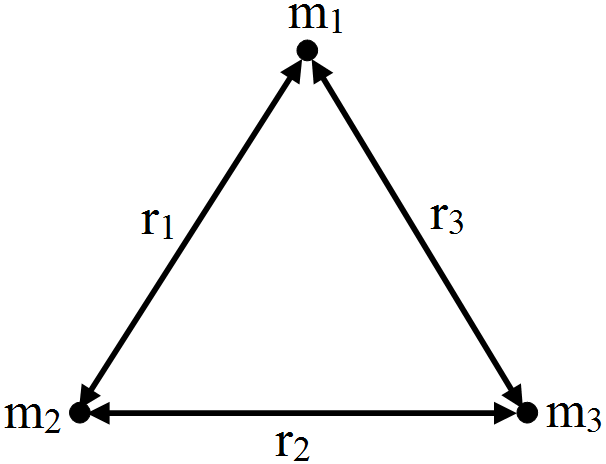
Gravitational potential energy of a system of particles as shown in the figure is:
- A
$\frac{\text{Gm}_1\text{m}_1}{\text{r}_1}+\frac{\text{Gm}_2\text{m}_3}{\text{r}_3}+\frac{\text{Gm}_1\text{m}_3}{\text{r}_3}$
- ✓
$\Big(\frac{-\text{Gm}_1\text{m}_2}{\text{r}_1}\Big)+\Big(\frac{-\text{Gm}_2\text{m}_3}{\text{r}_2}\Big)+\Big(\frac{-\text{Gm}_1\text{m}_3}{\text{r}_3}\Big)$
- C
$\frac{-\text{Gm}_1\text{m}_2}{\text{r}_1}-\frac{\text{Gm}_2\text{m}_3}{\text{r}_2}+\frac{\text{Gm}_1\text{m}_3}{\text{r}_3}$
- D
$\frac{\text{Gm}_1\text{m}_2}{\text{r}_1}+\frac{\text{Gm}_2\text{m}_3}{\text{r}_2}-\frac{\text{Gm}_1\text{m}}{\text{r}_3}$
AnswerCorrect option: B. $\Big(\frac{-\text{Gm}_1\text{m}_2}{\text{r}_1}\Big)+\Big(\frac{-\text{Gm}_2\text{m}_3}{\text{r}_2}\Big)+\Big(\frac{-\text{Gm}_1\text{m}_3}{\text{r}_3}\Big)$
For a system of particles, all possible pairs are taken and total gravitational potential energy is the algebraic sum of the potential energies due to each pair, applying the principle of superposition. Total gravitational potential energy.
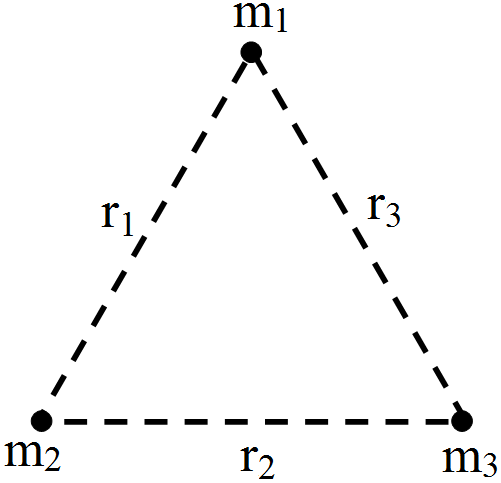
$=\frac{-\text{Gm}_1\text{m}_2}{\text{r}}-\frac{\text{Gm}_2\text{m}_3}{\text{r}_2}-\frac{\text{Gm}_1\text{m}_3}{\text{r}_3}$
$=\Big(\frac{-\text{Gm}_1\text{m}_2}{\text{r}_1}\Big)+\Big(\frac{-\text{Gm}_2\text{m}_3}{\text{r}_2}\Big)+\Big(\frac{-\text{Gm}_1\text{M}_3}{\text{r}_3}\Big)$ View full question & answer→MCQ 411 Mark
If both the mass and the radius of the earth decreases by $1\%$
- A
The escape velocity would increase.
- ✓
The acceleration due to gravity would increases.
- C
The escape velocity would decrease.
- D
The acceleration due to gravity would decrease.
AnswerCorrect option: B. The acceleration due to gravity would increases.
Escape velocity, $\text{v}_{\text{e}}=\sqrt{\frac{2\text{GM}}{\text{R}}}$
$\text{v}_{\text{e}}'=\sqrt{\frac{2\text{G}\big(\frac{99\text{M}}{100}\big)}{\big(\frac{99\text{R}}{100}\big)}}$
$=\sqrt{\frac{2\text{GM}}{\text{R}}}=\text{v}_{\text{e}}$
Also, $\text{g}=\frac{\text{GM}}{\text{R}^2}$
and $\text{g}'=\frac{\text{G}\big(\frac{99\text{M}}{100}\big)}{\big(\frac{99\text{R}}{100}\big)}=\frac{100}{99}\text{g}.$
View full question & answer→MCQ 421 Mark
If the acceleration due to gravity at earth is $'g\ '$ and mass of earth is $80$ times that of moon and radius of earth is $4$ times that of moon, the value of $'g\ '$ at the surface of moon will be:
- A
$\text{g}$
- B
$\frac{\text{g}}{20}$
- ✓
$\frac{\text{g}}{5}$
- D
$\frac{320}{\text{g}}$
AnswerCorrect option: C. $\frac{\text{g}}{5}$
Let $M$ and $R$ be the mass and radius of earth $M'$ and $R'$ are mass and radius of moon.
Then $\text{R}' = \frac{\text{R}}{{4}}$ and $M' = \frac{\text{M}}{80}$
Let $g$ and $g'$ the acceleration due to gravity on the surface of earth and moon respectively.
Then $\text{g}=\frac{\text{GM}}{\text{R}^2}$
and $g'=\frac{\text{GM}'}{\text{R}'^2}=\text{G}\frac{\frac{\text{M}}{80}}{\Big(\frac{\text{R}}{4}\Big)^2}$
$=\frac{1}{5}\frac{\text{GM}}{\text{R}^2}$
$=\frac{1}{5}\text{g}.$
View full question & answer→MCQ 431 Mark
A particle is kept at rest at a distance $R_e ($earth's radius$)$ above the earth's surface. The minimum speed with which it should be projected so that it does not return is $($mass of earth $= M_e)$
- A
$\sqrt{\frac{6\text{M}_\text{e}}{4\text{R}_\text{e}}}$
- B
$\sqrt{\frac{\text{GM}_\text{e}}{2\text{R}_\text{e}}}$
- ✓
$\sqrt{\frac{\text{GM}_\text{e}}{\text{R}_\text{e}}}$
- D
$\sqrt{\frac{2\text{GM}_\text{e}}{\text{R}_\text{e}}}$
AnswerCorrect option: C. $\sqrt{\frac{\text{GM}_\text{e}}{\text{R}_\text{e}}}$
View full question & answer→MCQ 441 Mark
The orbital velocity of a satellite orbiting near the surface of the earth is given by:
- ✓
$\text{v}\sqrt{\text{gR}_\text{e}},$ where $\text{g}=\frac{\text{GM}_\text{e}}{\text{R}^2_\text{e}}$
- B
$\text{v}=\sqrt{\text{gR}_\text{e}},$ where $\text{g}=\frac{\text{GM}_\text{e}}{\text{R}_\text{e}}$
- C
$\text{v}=\sqrt{\frac{\text{gh}}{\text{R}_\text{e}}},$ where $\text{g}=\frac{\text{GM}_\text{e}}{\text{R}^2_\text{e}}$
- D
$\text{v}=\sqrt{\text{gh}},$ where $\text{g}=\frac{\text{GM}_\text{e}}{\text{R}_\text{e}}$
AnswerCorrect option: A. $\text{v}\sqrt{\text{gR}_\text{e}},$ where $\text{g}=\frac{\text{GM}_\text{e}}{\text{R}^2_\text{e}}$
Orbital velocity of satellite, $\text{v}=\sqrt{\frac{\text{GM}_\text{e}}{(\text{R}_\text{e}+\text{h})}}$
If the satellite is close to the surface of the earth, $h = 0$
$\Rightarrow\text{v}=\sqrt{\frac{\text{GM}_\text{e}}{\text{R}_\text{e}}}$
$\Rightarrow\text{v}=\sqrt{\Big(\frac{\text{GM}_\text{e}}{\text{R}^2_\text{e}}\Big)\text{R}_\text{e}}$
$\sqrt{\text{gR}_\text{e}},$ $\Big[\because\text{g}=\frac{\text{GM}_\text{e}}{\text{R}^2_e}\Big]$
View full question & answer→MCQ 451 Mark
Two satellites of masses $m_1$ and $m_2$ $(m_1 > m_2)$ are revolving round the earth in circular orbits of radii $r_1$ and $r_2(r_1 > r_2)$ respectively. Which of the following statements is true regarding their speeds $v_1$ and $v_2$.
AnswerCorrect option: B. $\text{v}_1<\text{v}_2$
For satellite, orbital speed, $\text{v}\propto\frac{1}{\text{r}}$
Therefore, $\frac{\text{v}_1}{\text{v}_2}=\sqrt{\frac{\text{r}_2}{\text{r}_1}}<1$ or $\text{v}_1<\text{v}_2.$
View full question & answer→MCQ 461 Mark
The gravitational field due to a mass distribution is $\text{I}=\frac{\text{K}}{\text{r}^3}$ in the $X-$direction. $(K$ is a constant$)$.Taking the gravitational potential to be zero at infinity, its value at a distance $x$ is:
- A
$\frac{\text{K}}{\text{x}}$
- B
$\frac{\text{K}}{\text{2x}}$
- C
$\frac{\text{K}}{\text{x}^2}$
- ✓
$\frac{\text{K}}{\text{2x}^2}$
AnswerCorrect option: D. $\frac{\text{K}}{\text{2x}^2}$
Since, $\text{I}=\frac{-\text{dV}}{\text{dr}}\text{ or }\text{dV}=-\text{Idr}$
So $, \text{V}=\int^\limits{\text{x}}_\limits{0}-\text{Idr}$
$=\int^\limits{\text{x}}_{0}-\text{Kr}^{-3}\text{dr}$
$=-\text{K}\Big(\frac{\text{r}^{-3+1}}{-3+1}\Big)^{\text{x}}_0$
$=\frac{\text{K}}{2\text{x}^2}$
View full question & answer→MCQ 471 Mark
Which of the following options are correct?
AnswerCorrect option: C. $A$ and $B$
- The acceleration due to gravity at an altitude $($height$), gh =g(1-2).$
- As value of $\cos$ decrease from $0^\circ$ to $90^\circ ($from $1$ to $0).$ The acceleration due to gravity increases from equator $(\lambda=0^0)$ to pole $(\lambda=90^0).$ Option $(c)$ is correct.
- The acceleration due to gravity on surface of earth is $\text{g}=\frac{\text{GM}_\in}{\text{R}^2_\in}$ So $g$ on earth depends on mass of earth. Option $(d)$ is incorrect.
- Increasing depth $(d)$ decreases the value of ga . Option $(b)$ is incorrect.
- If $\lambda$ is latitude on earth then $\text{g}\lambda=\text{g}-\omega^2\text{R}\cos^2\lambda$
- Increasing height $(h)$ decreases the value of $gh$ option $(a)$ is correct.
- Assuming the earth to be a sphere of uniform density, the acceleration due to gravity at a particular depth $(d), \text{gd}=\text{g}\Big(1-\frac{\text{d}}{\text{R}}\Big).$
View full question & answer→MCQ 481 Mark
Particles of masses $2M, m$ and $M$ are respectively at points $A, B$ and $C$ with $AB = 1/2 (BC). m$ is muchmuch smaller than $M$ and at time $t = 0$, they are all at rest. At subsequent times before any collision takes place:

- A
$M$ will remain at rest.
- B
$M$ will move towards $M.$
- ✓
$M$ will move towards $2M.$
- D
$M$ will have oscillatory motion.
AnswerCorrect option: C. $M$ will move towards $2M.$
Let $\text{FBC}$ be the force experienced by mass $m$ at point $B$ due to mass $M$ at point $C$ and $\text{FBA}$ be the force experienced by mass $m$ at point $B$ due to mass $2M$ at point $A.$
$\text{F}_{\text{BC}}=\text{G}\frac{\text{mM}}{(\text{BC})^2}...(1)$
$\text{F}_\text{AB}=\text{G}\frac{\text{m2M}}{(\text{BA})^2}...(2)$
Suppose $AB = x$, then $\text{x}=\frac{1}{2}\text{ (BC)}$ or $\text{(BC)}=2\text{x}$
Substituting the values of $AB$ and $BC$ in the above equations $(1)$ and $(2)$
$\text{F}_{\text{BC}} =\text{G}\frac{\text{mM}}{(\text{2x})^2}$
$\text{F}_\text{BA}=\text{G}\frac{\text{m2M}}{(\text{x})^2}$
As $\text{F}_{\text{BA}}>\text{F}_{\text{BC}}, m$ will move towards point $A ($position of particle with mass $2M).$
View full question & answer→MCQ 491 Mark
The gravitational potential at a plane varies inversely proportional to $\text{x}^2\Big(\text{i.e., V }= \frac{\text{k}}{\text{x}_2}\Big)$ then gravitational field intensity at the place is:
- ✓
$\frac{-\text{k}}{\text{x}}$
- B
$\frac{\text{k}}{\text{x}}$
- C
$\frac{-2\text{k}}{\text{x}^3}$
- D
$\frac{2\text{k}}{\text{x}^3}$
AnswerCorrect option: A. $\frac{-\text{k}}{\text{x}}$
Gravitational intensity,
$\text{I}=-\frac{\text{dV}}{\text{dx}}$
$=-\frac{\text{d}}{\text{dx}}\Big(\frac{\text{k}}{\text{x}^2}\Big)$
$=\frac{-\text{k}}{\text{x}}$
View full question & answer→MCQ 501 Mark
If $g$ is the acceleration due to gravity at the surface of the earth. The force acting on the particle of mass $m$ placed at the surface is:
AnswerCorrect option: D. Both $(a)$ and $(b).$
Force on particle at surface is where,
$F = mg$
Where, $g =$ acceleration due to gravity at the earth's surface
Also,
$\text{g}=\frac{\text{gM}_\text{e}}{\text{R}^2_\text{e}}$
$\text{F}=\text{mg}=\frac{\text{GmM}_\text{e}}{\text{R}^2_\text{e}}$
View full question & answer→