55 questions · self-marked practice — reveal the answer and mark yourself.
$=\frac{2}{3\text{V}}.\frac{1}{2}\text{nmc}^2=\frac{2}{3\text{V}}\text{E},$
where V is volume and E is the total K.E. of the molecules.
$\text{C}_{\text{V}}=\frac{3}{2}\text{R}=\frac{3}{2}\times2=3\text{cal mol}^{-1}\text{K}^{-1}$
$\text{C}_{\text{V}}=\text{Mc}_{\text{V}}$
$\Rightarrow\text{M}=\frac{\text{C}_{\text{V}}}{\text{c}_{\text{V}}}=\frac{3}{0.075}=40$
$\text{U}=\frac{96}{4.2}=22.857\text{cal}\approx23\text{cal}$
$=18\times\frac{5}{18}=5\text{m/s}$
Kinetic energy of the man is given by,$\text{K}=\frac{1}{2}\text{mV}^2$
$\text{K}=\Big(\frac{1}{2}\Big)50\times5^2$
$\text{K}=25\times25=625\text{J}$
Specific heat of the water, s = 4200J/Kg-K Let the mass of the water heated be M. The amount of heat required to raise the temperature of water from 20°C to 30°C is given by,$\text{Q}=\text{ms}\triangle\text{T}=\text{M}\times4200\times(30-20)$
$\text{Q}=42000\text{M}$
According to the question,$\text{Q}=\text{K}$
$\Rightarrow42000\text{M}=625 $
$\Rightarrow\text{M}=\frac{625}{42}\times10^{-3}$
$\Rightarrow\text{M}=14.88\times10^{-3}$
$\Rightarrow\text{M}=15\text{g}$
$\text{W}=\frac{\text{mg}}{\sin\theta}$
$\text{W}=0.2\times10\times0.6\sin37^\circ$
$\text{W}=1.2\times\Big(\frac{3}{5}\Big)=0.72$
Let the change in temperature of the block be $\triangle\text{T.}$ Thermal energy gained by block $=\text{ms}\triangle\text{T}=0.2\times420\times\triangle\text{T}=84\triangle\text{T}$ But $84\triangle\text{T}=0.72$$\Rightarrow\triangle\text{T}=\frac{0.72}{84}=0.00857$
$\Rightarrow\triangle\text{T}=0.0086=8.6\times10^{-3}{^\circ}\text{C}$
$\Rightarrow\text{x}=\frac{(12-2)}{200}$
$\Rightarrow\text{x}=\frac{10}{200}=0.05\text{m}$
The mechanical energy of the block is transferred to both block and water. Let the rise in temperature of the block and the water be $\triangle\text{T}.$ Applying conservation of energy, we get$\frac{1}{2}\text{kx}^2+\text{mgh}-\text{V}\rho\text{gh}=\text{m}_1\text{s}_1\triangle\text{T}+\text{m}_2\text{s}_2\triangle\text{T}$
$\Rightarrow\frac{1}{2}\times200\times0.0025+1.2\times10\times\Big(\frac{40}{100}\Big)\\-2\times10^{-4}\times1000\times10\times\Big(\frac{40}{100}\Big)$
$\Rightarrow\Big(\frac{260}{1000}\Big)\times4200\times\triangle\text{T}+1.2\times250\times\triangle\text{T}$
$\Rightarrow0.25+4.8-0.8=1092\triangle\text{T}+300\triangle\text{T}$
$\Rightarrow1392\triangle\text{T}=4.25$
$\Rightarrow\triangle\text{T}=\frac{4.25}{1392}=0.0030531$
$\Rightarrow\triangle\text{T}=3\times10^{-3}{^\circ}\text{C}$
$\text{PV}=\text{nRT}$
$\Rightarrow\text{V}=\frac{\text{RT}}{\text{P}}=\frac{0.082\times273}{1}$
$\Rightarrow22.38\approx22.4\text{L}=22.4\times10^{-3}$
$\Rightarrow2.24\times10^{-2}\text{m}^3$
$=\frac{1}{2}\times0.02\times40\times40=16\text{J}$
Final kinetic energy of the bullet = 0 Change in energy of the bullet = 16J It is given that the bullet enters the block and stops inside it. The total change in its kinetic energy is responsible for the change in the internal energy of the block.$\therefore$ Change in internal energy of the block = Change in energy of the bullet = 16J.
$\frac{\text{C}_1}{\text{C}_2}=\sqrt{\frac{\text{M}_2}{\text{M}_1}}=\sqrt{\frac{\rho_2}{\rho_1}};$
$\frac{\text{C}_1}{\text{C}_2}=\sqrt{\frac{9}{6}}=\sqrt{3}:\sqrt{2}$
$=\sqrt{\frac{1}{16}}=\frac{1}{4}=1:4$
$\text{v}_1=\sqrt{2\text{gh}_1}=\sqrt{2\times10\times2}=\sqrt{40}\text{m/s}$
$\text{v}_2=\sqrt{2\text{gh}_2}=\sqrt{2\times10\times1.5}=\sqrt{30}\text{m/s}$
Change in kinetic energy is given by,$\triangle\text{K}=\frac{1}{2}\times\text{m}\times40-\Big(\frac{1}{2}\text{m}\Big)\times30=\Big(\frac{10}{2}\Big)\text{m}$
$\Rightarrow\triangle\text{K}=5\text{m}$
If the position of the ball is considered just before hitting the ground and after its first collision, then 40% of the change in its KE will give the change in thermal energy of the ball. At these positions, the PE of the ball is same. Thus, Loss in PE = 0 The change in kinetic energy is utilised in increasing the temperature of the ball. Let the change in temperature be $\triangle\text{T}.$ Then,$\Big(\frac{40}{100}\Big)\times\triangle\text{K}=\text{m}\times800\times\triangle\text{T}$
$\Big(\frac{40}{100}\Big)\times\frac{10}{2}\text{m}=\text{m}\times800\times\triangle\text{T}$
$\Rightarrow\triangle\text{T}=\frac{1}{400}=0.0025$
$\Rightarrow2.5\times10^{-3}{^\circ}\text{C}$
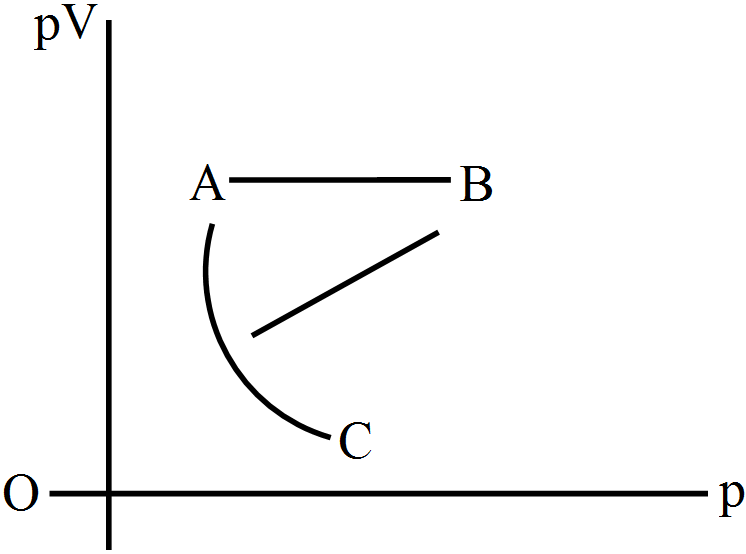
$\therefore\frac{\text{c}_{\text{O}_2}}{\text{c}_{\text{H}_2}}=\sqrt{\frac{2}{32}}=\sqrt{\frac{1}{16}}=\frac{1}{4}$
$\text{c}_{\text{O}_2}:\text{c}_{\text{H}_2}=1:4$

$\text{R}=\frac{\text{PV}}{\text{nT}}$
(n is a number of molecules)
$\text{R}=\frac{[\text{ML}^{-1}\text{T}^{-2}]\text{L}^3}{\text{K}}=[\text{ML}^2\text{T}^2\text{K}^{-1}]$
$\text{T}_2=\frac{\text{P}_2\text{T}_1}{\text{P}_1}$
$=\frac{2\times(273\times173)}{1}=200\text{k}=-73^{\circ}\text{C}$